

U0125 on 2011-2015 Chevrolet Cruze: StabiliTrak and Communication Faults Explained
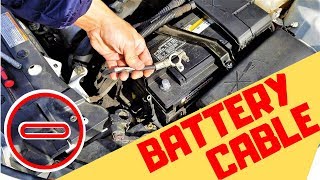
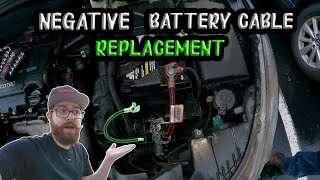
On a 2011-2015 Cruze, this code is most often caused by a faulty negative battery cable creating a bad ground, a known platform issue confirmed by GM Special Coverage bulletin 14311B. Before replacing any sensors, inspect the battery connections and replace the negative cable (GM P/N: 22754271), an inexpensive part that is the most common fix.
- U0125 on a 2011-2015 Cruze means the stability control system has lost communication with its main motion sensor.
- The most likely cause is NOT the sensor itself, but a faulty negative battery cable causing a bad ground. This is a well-known issue with this car.
- Always inspect and test (or simply replace) the negative battery cable before attempting the much more difficult and expensive yaw rate sensor replacement.
- Driving with this code is possible, but your primary safety systems (ABS and StabiliTrak) will not work.
- Fixing the issue may require a scan tool to clear codes and potentially recalibrate the new sensor if it is replaced.
What's Unique About the 2011-2015 Chevrolet CRUZE

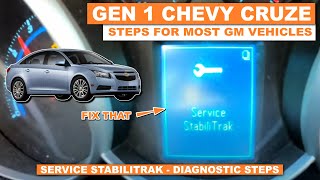
Unlike other GM vehicles where this code often points to under-body wiring corrosion, the first-generation Cruze is well-known for having electrical issues stemming from a poorly designed negative battery cable. This was so common that GM issued a Special Coverage bulletin (14311B) for it. The insufficient crimp on the factory cable causes intermittent high resistance, leading to a variety of seemingly unrelated electrical faults, including the U0125 code and 'Service StabiliTrak' messages. This makes checking the battery ground cable the number one diagnostic step for this specific vehicle. Another real-world failure pattern on the Cruze is the yaw rate sensor's vulnerability to liquid damage from the cupholders directly above its location under the center console.
Diagnostic Flowchart

Tap your situation to follow the diagnostic path that matches what you're seeing on this vehicle.
Symptoms You May Notice

- "Service StabiliTrak" message on the driver information center (DIC)
- "Service Traction Control" message on the DIC
- ABS warning light is on
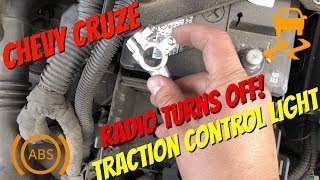
- Traction Control warning light is on
- Radio/HVAC display may turn off and on intermittently.
- Turn signal sound may not be heard.
- "Battery Saver Active" message may appear.
- In some cases, power steering assist may be lost, accompanied by a "Service Power Steering" message.
- Replacing the yaw rate sensor before checking the negative battery cable. The symptoms of a bad ground on this car perfectly mimic a failed sensor module, but the cable is a much cheaper, easier, and more probable fix, as documented in GM Special Coverage 14311B.
Most Likely Causes

- Faulty Negative Battery Cable / Bad Ground 🔴 High Probability → Shop Vehicle Battery This is a widely documented issue on the 2011-2015 Cruze, acknowledged by GM in Special Coverage bulletin 14311B. The crimp on the factory negative battery cable can fail internally, causing intermittent and poor ground connection, which disrupts module communication and triggers numerous electrical gremlins.
How to confirm: Perform a voltage drop test on the negative side of the battery circuit. Visually inspect the cable ends for corrosion or looseness. Many owners and shops replace it as a first step due to the high failure rate and low cost. The updated GM cable has a different chassis ground connection and may require a new bolt (M6x1.0) instead of reusing the original stud/nut.
Typical fix: Replace the negative battery cable assembly. Use OEM part 22754271 and bolt 11561025 if needed.
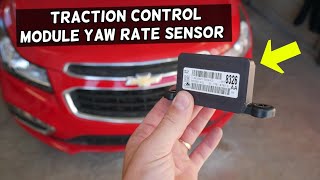
Est. part cost: $25-$50 - Faulty Multi-axis Acceleration (Yaw Rate) Sensor 🟡 Medium Probability → Shop Suspension Yaw Sensor The sensor is located directly under the center console cupholders, making it highly susceptible to damage from spilled liquids. Internal failure of the sensor's micro-electromechanical components or cracked solder joints can also occur.
How to confirm: If the battery cable and grounds are confirmed good, the next step is to test the sensor. This involves accessing the sensor under the center console and testing for power, ground, and communication signals. A high-end scan tool can be used to monitor the sensor's live data; intermittent dropouts while driving confirm a faulty sensor. If power and ground are present but the sensor does not communicate, it has likely failed.
Typical fix: Replace the yaw rate sensor. This is labor-intensive as it requires removing the center console and potentially the front seats to access. 🎬 Watch: How to locate and replace the yaw rate sensor. After replacement, the new sensor must be calibrated using a scan tool's 'Yaw Rate Sensor Learn' procedure.
Est. part cost: $100-$210 - Wiring or Connector Issue ⚪ Low Probability The yaw rate sensor is located under the center console, protecting its connector from external corrosion. However, wires can still chafe or break within the harness, or pins can become loose.
How to confirm: Visually inspect the wiring harness leading to the yaw rate sensor once the center console is removed. Check for continuity on the CAN bus wires between the sensor and the EBCM. Check connector pins for a secure fit. A key diagnostic step is to measure the resistance between the CAN High and CAN Low wires at the vehicle's DLC (pins 6 and 14); a healthy network should read approximately 60 Ohms with the battery disconnected.
Typical fix: Repair the damaged section of the wiring harness or replace the connector pigtail.
Est. part cost: $15-$40
Rare But Worth Checking
- Faulty Electronic Brake Control Module (EBCM): While rare, the EBCM is the module that communicates with the sensor. If the sensor and wiring are proven to be good, the EBCM itself could be the problem. A software reprogram should be attempted before replacing the module.
Diagnosis Steps

- Check for other stored DTCs in all modules (EBCM, BCM, etc.) to see if other communication codes are present.
- Inspect the negative battery cable and its connection points to the battery, chassis, and transmission. Ensure they are clean and tight.
- Perform a voltage drop test on the negative battery cable to check for internal resistance. Due to the high failure rate documented in TSB 14311B, replacing the cable is a common and effective first step.
- If replacing the cable, be aware the revised part may require a new M6x1.0 bolt for the chassis ground connection.
- With the battery disconnected, measure the resistance between Pin 6 (CAN High) and Pin 14 (CAN Low) of the Data Link Connector (DLC). A reading of approximately 60 Ohms indicates the main CAN bus terminating resistors are intact. A reading of 120 Ohms suggests an open in the bus, and a reading below 60 Ohms may indicate a short or an extra terminating resistor.
- If the battery cable and CAN bus resistance are confirmed good, the next step is to access the yaw rate sensor under the center console.
- With the key on, use a multimeter to check for power (typically 12V) and a solid ground at the sensor's electrical connector. Check for a 5V reference voltage if applicable to the specific sensor part number.
- If power and ground are good, inspect the CAN bus wiring between the sensor and the EBCM for any signs of chafing, breaks, or corrosion.
- If wiring is confirmed good, the yaw rate sensor is the most likely failed component.
- After replacing the sensor, a 'Yaw Rate Sensor Learn' procedure must be performed using a capable scan tool.
Parts You'll Likely Need
- Negative Battery Cable
(OEM #22754271 (supersedes 95281536, 95460238, 95995010))— This is the most common cause of intermittent electrical faults and StabiliTrak warnings on the 2011-2015 Cruze, as per GM Special Coverage 14311B.
Trusted brands: ACDelco (GM Genuine), Standard Motor Products
OEM price range: $35-$50
Aftermarket price range: $25-$40 - Ground Cable Bolt
(OEM #11561025)— The revised OEM negative battery cable often requires a new bolt for the chassis ground point, as the original design used a stud. An M6x1.0 bolt is a suitable alternative.
Trusted brands: GM
OEM price range: $5-$10
Aftermarket price range: $1-$3 - Multi-Axis Acceleration Sensor (Yaw Rate Sensor)
(OEM #13514502)— If the battery cable and wiring are good, the sensor itself is the next most likely part to have failed.
Trusted brands: ACDelco (GM Genuine)
OEM price range: $150-$210
Aftermarket price range: $90-$140
Related Codes That Often Appear With This One
- U0074 — This code for 'Control Module Communication Bus B Off' can be set along with U0125 due to the same chassis bus fault, as noted in TSB #PIT5076E.
- U0126 — Lost Communication With Steering Angle Sensor Module. This module is also on the same chassis network, and a general network failure caused by the faulty ground can cause multiple modules to lose communication.
Technical Service Bulletins (TSBs) & Recalls
- 14311B: Special Coverage for insufficient crimp on negative battery cable causing various electrical issues, including 'Service Stabilitrak' messages. Covers 2011-2015 Cruze.
- PIT5076E: Advises that if U0125 is set with other communication codes (U0074, U0126, etc.) and won't clear, the Chassis CAN bus itself should be diagnosed for a fault.
Platform-Specific Known Issues
- GM Special Coverage bulletin 14311B specifically addresses the faulty negative battery cable on 2011-2015 Cruzes, confirming it as the cause for StabiliTrak lights and other electrical issues.
- The yaw rate sensor is located under the center console, requiring significant interior disassembly for access, which increases labor time compared to vehicles with under-seat or under-dash locations.
- The sensor's location under the cupholders makes it vulnerable to damage from liquid spills, a common real-world failure scenario.
Mechanic-Grade Diagnostic Values
- CAN Bus Network Resistance — expected: Approximately 60 Ω (Ohms). Failure: A reading of 120 Ω indicates an open circuit or one missing terminating resistor. A reading significantly lower than 60 Ω (e.g., 40 Ω) can indicate a short or an extra resistor on the network.
- Yaw Rate Sensor Ground Pin to Chassis Ground — expected: Below 1 Ω (Ohm). Failure: High resistance indicates a poor ground connection for the sensor module.
- Yaw Rate Sensor Power Pin Voltage — expected: 11 to 14 V (or 5V reference, depending on sensor version). Failure: Low or no voltage indicates a problem with the power supply circuit to the sensor.
Scan Tool Commands That Help
- GDS2 (GM Global Diagnostic System 2) or equivalent high-end scanner: Yaw Rate Sensor Learn (or Reset/Calibration) — This procedure is required after replacing the Multi-Axis Acceleration Sensor or the Electronic Brake Control Module (EBCM). It resets the sensor's zero-point calibration. The procedure requires the vehicle to be on a flat, level surface with no occupants.
Wiring & Ground Locations
- G100 — Left front corner of the engine compartment.. A primary engine bay ground. While the negative battery cable is the most common fault, ensuring all major grounds like G100 are clean and tight is critical for stable module communication.
- G114 — Left rear of the engine.. Another critical engine ground point. A Reddit user identified this as one of two key grounds for starting issues, which often accompany the electrical problems that set U0125.
- Yaw Rate Sensor Connector — Under the center console, often beneath the cupholder assembly.. This is the direct connection point for the sensor. Technicians must test for power, ground, and CAN signals at this connector to determine if the fault is with the sensor or the wiring leading to it. Its location makes it vulnerable to liquid spills.
Real Owner Repair Stories
- YouTube video '2012 Chevy Cruze ground wire crank and cam sensors sloves stability track issues' (2012 Chevrolet Cruze 1.4L Turbo) — Stabilitrak/traction control problems, multiple random codes for already-replaced parts (boost sensors, misfires), engine stalling, high fan operation.
❌ Tried (didn't work) Replacing coil packs, spark plugs, and the negative battery cable did not solve the underlying issue for this owner.
✅ What actually fixed it The owner discovered a faulty ground wire that is part of the harness running to the ignition coil pack. The ground point is on the engine block. Repairing this specific ground connection by creating a new, clean connection to a nearby point on the harness resolved the stalling, random codes, and Stabilitrak warnings.
When the Usual Fixes Don't Work
- While the negative battery cable is the most frequent cause, it is not the only one. A documented case showed that even after replacing common parts, the root cause was a different, less obvious ground wire on the engine block related to the ignition coil harness. This highlights that if the battery cable replacement doesn't work, a systematic check of other major engine and chassis grounds (like G100 and G114) is necessary before condemning expensive modules.
OEM Part Supersession History
13578326→13514502— Standard part revision by the manufacturer, likely for improved reliability or component changes.
Heads up: The provided Pass 2 OEM part number (13514502) appears to be a supersession of the earlier 13578326. Both should be compatible, but using the latest revision is always recommended.
Helpful Videos
We Have This Part in Stock


The information in this article is provided for general reference and educational purposes only. Vehicle specifications, procedures, and part compatibility can vary by production date, trim level, and region. Always consult your vehicle's factory service manual and verify part numbers before purchasing or performing repairs. Safety-critical components such as airbags, seat belts, and braking systems should be installed by a qualified professional.
- Chevrolet CRUZE:
- 🧭 Diagnostic Flowchart
- 🎬 Helpful Videos
- 🛍️ Shop This Part
- What's Unique About the 2011-2015 Chevrolet CRUZE
- Symptoms You May Notice
- Most Likely Causes
- Rare But Worth Checking
- Diagnosis Steps
- Parts You'll Likely Need
- Related Codes That Often Appear With This One
- Technical Service Bulletins (TSBs) & Recalls
- Platform-Specific Known Issues
- Mechanic-Grade Diagnostic Values
- Scan Tool Commands That Help
- Wiring & Ground Locations
- Real Owner Repair Stories
- When the Usual Fixes Don't Work
- OEM Part Supersession History
- 🎟️ Get 5% Off