

U0126 on 2011-2015 Chevrolet Cruze: Lost Communication With Steering Angle Sensor Fixes
On a 2011-2015 Chevy Cruze, code U0126 means the safety systems have lost communication with the Steering Angle Sensor. This is most often caused by a faulty negative battery cable with a bad crimp, a problem so common GM issued a special warranty extension (Bulletin #14311B) to cover it. Check this cable before suspecting a bad sensor.
- Code U0126 on a 2011-2015 Cruze means a loss of communication with the Steering Angle Sensor, which will disable your ABS and StabiliTrak systems.
- The most likely cause is NOT the sensor itself, but a faulty negative battery cable, a known weak point on this car. Always check this first.
- Symptoms include 'Service StabiliTrak' and 'Service Traction Control' messages, along with ABS and traction control warning lights.
- Driving is possible but risky due to the deactivation of key safety features.
- If the sensor does need to be replaced, it must be calibrated with a professional scan tool for the repair to be complete.
What's Unique About the 2011-2015 Chevrolet CRUZE
On the first-generation Chevy Cruze and its platform cousins like the Sonic and Verano, electrical issues are a common source of multiple seemingly unrelated trouble codes. A widespread and well-documented problem is a faulty negative battery cable, which can cause high resistance and lead to numerous communication faults, including U0126. This issue was so prevalent that General Motors issued Special Coverage Bulletin #14311B, extending the warranty for this specific part to 10 years or 120,000 miles. The bulletin acknowledges that an insufficient crimp on the negative terminal clamp can lead to increased resistance, causing a host of electrical problems including StabiliTrak messages. Before suspecting an expensive module failure, owners should always inspect this ground cable first.
Diagnostic Flowchart
Tap your situation to follow the diagnostic path that matches what you're seeing on this vehicle.
Symptoms You May Notice
- "Service StabiliTrak" message on the instrument cluster.
- "Service Traction Control" message displayed.
- ABS warning light is on.
- Traction Control/StabiliTrak (ESC) warning light is on.
- Check Engine Light may be illuminated.
- Possible loss of or reduced power steering assist, making the wheel feel heavy.
- Radio/HVAC display may flicker, turn off and on, or go black.
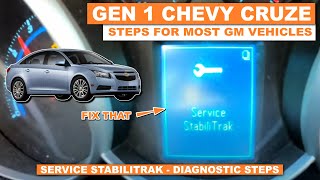
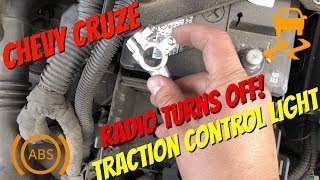
- Loss of audio for turn signal clicks or Bluetooth. 🎬 See how a bad cable causes these specific electrical glitches.
- Replacing the Steering Angle Sensor first. On the Cruze, wiring and ground faults are far more common causes for this communication code than the sensor itself. Always diagnose the electrical connections, especially the negative battery cable, before buying expensive parts.
Most Likely Causes
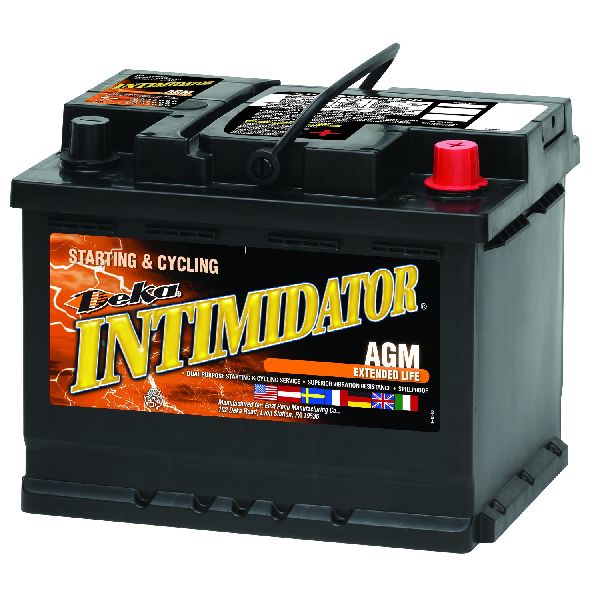
- Faulty Negative Battery Cable/Poor Ground Connection 🔴 High Probability → Shop Vehicle Battery The factory negative battery cable on this platform is known to fail internally at the terminal crimp, creating high resistance that disrupts module communication. GM acknowledged this with Special Coverage Bulletin #14311B. The internal resistance increases over time, starving electrical systems of adequate power.
How to confirm: With a multimeter set to DC volts, perform a voltage drop test. Place the red lead on the negative battery post and the black lead on a clean, unpainted chassis ground. With the engine running and accessories on, the reading should be less than 0.1 volts (100mV). A reading higher than this indicates excessive resistance in the cable. Wiggling the cable may cause the reading to fluctuate, confirming a bad connection.
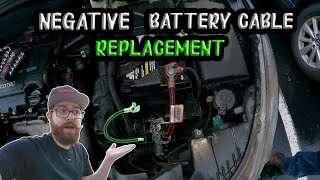
Typical fix: Replace the entire negative battery cable assembly. The updated GM part requires a new bolt for the chassis ground connection, as the original stud/nut design is changed. 🎬 Watch: How to replace the negative battery cable yourself.
Est. part cost: $25-$60 - Wiring Harness or Connector Issue 🟡 Medium Probability The TSB #PIT5076E points to potential issues on the 'Chassis bus', which is the wiring network connecting the steering and brake modules. Wires can chafe, or connectors can become corroded, interrupting the signal.
How to confirm: Visually inspect the wiring harnesses around the steering column, under the dash, and leading to the Electronic Brake Control Module (EBCM) for any signs of damage, chafing, or corrosion. A professional would use a multimeter to check for continuity and shorts on the CAN bus wires (typically pins 6 and 14 of the OBD-II port).
Typical fix: Repair the damaged section of wire or clean/replace the affected connector.
Est. part cost: $10-$50 - Low Battery Voltage ⚪ Low Probability → Shop Vehicle Battery
How to confirm: Test the battery voltage with the engine off. A healthy battery should read approximately 12.4-12.6 volts. With the engine running, the alternator should be charging at around 14 volts. If voltages are low, the battery or charging system is the problem. Note that a faulty negative cable can prevent the battery from charging properly, mimicking a bad battery.
Typical fix: Recharge or replace the battery.
Est. part cost: $150-$250 - Failed Steering Angle Sensor (SAS) ⚪ Low Probability → Shop Steering Angle Sensor
How to confirm: This should only be suspected after all wiring, ground, and power issues have been ruled out. A professional scan tool that can read live data is needed to see if the sensor is outputting any signal at all. If the wiring is good but the sensor is unresponsive, it has failed internally.
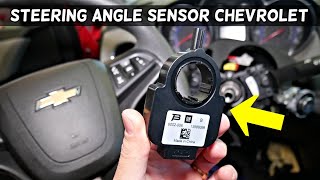
Typical fix: Replace the steering angle sensor. This requires removing the steering wheel and airbag, and the new sensor must be calibrated with a scan tool.
Est. part cost: $70-$200
Rare But Worth Checking
- Failed Electronic Brake Control Module (EBCM): → Shop ABS Control Module The EBCM is the main module that receives the SAS signal. While rare, an internal EBCM failure can cause it to stop communicating. This is usually accompanied by other communication codes, like U0121.
Diagnosis Steps
- Check and record all Diagnostic Trouble Codes (DTCs) from all vehicle modules using a capable OBD-II scanner. 🎬 Watch: A professional diagnostic walkthrough for Service StabiliTrak codes.
- Check for GM Special Coverage Bulletin #14311B. Contact a GM dealer with your VIN to see if your vehicle is still covered for a free negative battery cable replacement.
- Perform a voltage drop test on the negative battery cable. With the engine running, measure the voltage between the negative battery post and the chassis. A reading above 0.1V (100mV) confirms a bad cable.
- Visually inspect the negative battery cable for corrosion or damage at the terminal crimp and the chassis connection point.
- If the ground cable is good, inspect the wiring harness around the steering column and leading to the EBCM for any visible damage, corrosion, or loose connections.
- Using a scan tool, attempt to read live data from the Steering Angle Sensor. If data is present and changes as you turn the wheel, the sensor is likely communicating.
- If no data is available, test for power and ground at the Steering Angle Sensor connector using a multimeter.
- If the sensor is replaced, it must be calibrated using a compatible scan tool.
Parts You'll Likely Need
- Negative Battery Cable
(OEM #22754271)— This is the most frequent cause of communication codes like U0126 on the 2011-2015 Cruze due to a common internal failure at the terminal crimp. GM issued Special Coverage #14311B for this part.
Trusted brands: ACDelco (GM Genuine), Standard Motor Products, Dorman
OEM price range: $35-$50
Aftermarket price range: $25-$40 - Steering Angle Sensor
(OEM #13589398, 13515749 (check fitment by year))— If wiring and grounds are confirmed to be good, the sensor itself may have failed internally, preventing it from communicating.
Trusted brands: ACDelco (GM Genuine), Dorman, Autotecnica
OEM price range: $80-$160
Aftermarket price range: $70-$120
Related Codes That Often Appear With This One
- U0077 — Indicates a general communication bus fault, often appearing with U0126 when a wiring or ground issue is the root cause.
- U0125 — Lost Communication With Multi-axis Acceleration Sensor Module. This sensor also communicates on the chassis bus, and a fault on this network can take out both modules.
- C0710 — Steering Angle Sensor Signal Malfunction. This code may appear alongside U0126, indicating a problem with the sensor's data or calibration.
- P0300-P0304 — Random/Cylinder Misfire. Unstable voltage from a bad ground can cause misfires and trigger StabiliTrak warnings as the engine control module can't properly manage the engine.
Technical Service Bulletins (TSBs) & Recalls
- PIT5076E: Advises diagnosing the Chassis bus when U0126 is present with other specific communication DTCs.
- 14311B: Special Coverage for faulty negative battery cable. Acknowledges that an insufficient crimp can cause high internal resistance, leading to various electrical issues including 'Service Stabilitrac' messages. [⭐ MANUFACTURER TSB — highest authority]
Platform-Specific Known Issues
- A known issue on this platform is the failure of the negative battery cable, which causes high resistance and leads to various electrical and communication faults.
- GM Technical Service Bulletin #PIT5076E mentions that when U0126 is found with other communication codes, the 'Chassis bus' wiring should be diagnosed.
- GM Special Coverage Bulletin #14311B extends the warranty on the negative battery cable to 10 years/120,000 miles due to a high failure rate from an insufficient crimp.
Mechanic-Grade Diagnostic Values
- CAN Bus Resistance — expected: ~60 Ω (Ohms). Failure: A reading of ~120 Ω indicates an open in the circuit or a missing termination resistor. A reading significantly less than 60 Ω suggests a shorted module or an extra resistor on the network.
- CAN Bus Voltage (Key On, Engine Off) — expected: CAN High (Pin 6): ~2.6V to 3.5V. CAN Low (Pin 14): ~2.4V to 1.5V.. Failure: Voltages stuck high, low, or at battery/ground potential indicate a short on the bus. No voltage indicates an open circuit.
Scan Tool Commands That Help
- GM GDS2 / Professional Scan Tool: Steering Angle Sensor Calibration / Steering Wheel Angle Sensor Learn — This procedure is mandatory after replacing the Steering Angle Sensor. It is used to set the new sensor's zero position and re-establish communication with the EBCM. Failure to perform this will result in a persistent U0126 code and inoperative StabiliTrak system.
Wiring & Ground Locations
- Data Link Connector (DLC) — Under the driver's side dashboard, to the left of the steering column.. This is the primary access point for diagnostics. Pin 6 (CAN High) and Pin 14 (CAN Low) are used to test the resistance and voltage of the chassis CAN bus that the SAS module communicates on.
- Main Chassis Ground — A stud on the driver's side strut tower in the engine bay where the negative battery cable attaches.. This is the termination point for the notoriously faulty negative battery cable. A poor connection here due to the original nut/stud design is a primary cause of voltage instability leading to communication codes.
- Engine Harness Ground (near coil pack) — A small ground wire attached to the engine block/head near the ignition coil pack harness.. A loose or corroded ground at this location can cause erratic behavior, including multiple seemingly unrelated codes and stalling, as it provides the ground reference for critical engine sensors. This can destabilize the vehicle's electrical system and contribute to network communication faults.
Real Owner Repair Stories
- Reddit user Atrophyofc on r/cruze (2012 Chevrolet Cruze) — Service Stabilitrak/Traction Control lights.
❌ Tried (didn't work) Replacing the negative battery ground cable, which is the most common fix.
✅ What actually fixed it The ground strap connecting to the alternator was the actual issue. Replacing or cleaning this secondary ground resolved the problem. - Reddit user k4vglitcherr on r/cruze (2012 Chevrolet Cruze) — Car would not start after preventative maintenance.
❌ Tried (didn't work) Replacing the negative battery cable as preventative maintenance.
✅ What actually fixed it The user had installed the wrong negative battery cable (for an Equinox/Terrain) which did not fit correctly. Additionally, they may have forgotten to re-attach the small, secondary ground wire that connects to the main battery terminal clamp. Using the correct OEM part and ensuring all connections are made is critical.
OEM Part Supersession History
Unknown original part number→22754271 (Negative Battery Cable)— The original cable design had an insufficient crimp at the terminal, leading to high resistance and failure. The chassis connection was also changed.
Heads up: When replacing the original cable with the updated part 22754271, the original ground stud and nut on the chassis must be discarded. The new cable is designed to attach directly with a new bolt, GM part number 11561025.
Helpful Videos
We Have This Part in Stock


The information in this article is provided for general reference and educational purposes only. Vehicle specifications, procedures, and part compatibility can vary by production date, trim level, and region. Always consult your vehicle's factory service manual and verify part numbers before purchasing or performing repairs. Safety-critical components such as airbags, seat belts, and braking systems should be installed by a qualified professional.
- Chevrolet CRUZE:
- 🧭 Diagnostic Flowchart
- 🎬 Helpful Videos
- 🛍️ Shop This Part
- What's Unique About the 2011-2015 Chevrolet CRUZE
- Symptoms You May Notice
- Most Likely Causes
- Rare But Worth Checking
- Diagnosis Steps
- Parts You'll Likely Need
- Related Codes That Often Appear With This One
- Technical Service Bulletins (TSBs) & Recalls
- Platform-Specific Known Issues
- Mechanic-Grade Diagnostic Values
- Scan Tool Commands That Help
- Wiring & Ground Locations
- Real Owner Repair Stories
- OEM Part Supersession History
- 🎟️ Get 5% Off