

U0126 on 2020 Chevrolet Silverado 2500: Lost Communication With Steering Angle Sensor Fixes
On a 2020 Silverado 2500, code U0126 almost always indicates a wiring problem, not a failed sensor. The most common causes are pinched or chafed wire harnesses in the instrument panel or under the door sill plates, as documented in several GM Technical Service Bulletins. Specifically, TSB PIT5288H points to a pinch point behind the left I/P mounting bracket, and TSB PIT5457D identifies chafing on the Communication Enable circuit (5986) under the sill plates. Always inspect wiring before replacin
- U0126 on a 2020 Silverado 2500 disables the StabiliTrak and ABS safety systems and requires prompt attention.
- Before buying any parts, thoroughly inspect the wiring harnesses behind the left instrument panel and under the door sill plates, as these are known failure points documented in GM TSBs.
- A technician may see code U0131, but TSB #PIT5755 confirms this is often a mis-reported U0126 and should be diagnosed as such.
- If the Steering Angle Sensor is replaced, it must be calibrated with a professional scan tool for the repair to be complete.
What's Unique About the 2020-2020 Chevrolet SILVERADO 2500
For this generation of Silverado HD trucks (and their GMC Sierra counterparts), the U0126 code is very frequently caused by specific, well-documented wiring issues rather than a component failure. General Motors has issued multiple Technical Service Bulletins (TSBs) for the 2019-2020 model years that point to wire harnesses being pinched behind the instrument panel or chafed under the door sill plates. TSB PIT5288H specifically shows the dash harness getting crushed by the left I/P mounting bracket. TSB PIT5457D describes how the Communication Enable circuit (5986) gets damaged under the sill plates, preventing modules from 'waking up'. This makes a thorough wiring inspection the most critical first step in diagnosis, often leading to a simple wire repair instead of an expensive, unnecessary sensor replacement.
🎬 Watch: This $0 wiring fix might save you a trip to the mechanic.Diagnostic Flowchart
Tap your situation to follow the diagnostic path that matches what you're seeing on this vehicle.
Symptoms You May Notice
- "Service StabiliTrak" or "Service Stability System" message on the dashboard.
- ABS warning light is on.
- Traction control warning light is on.
- Loss of power steering assist, making the wheel feel heavy at low speeds.
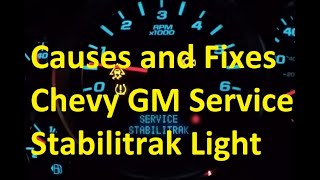
- Cruise control may be inoperative. 🎬 See common causes and fixes for the Service Stabilitrak light.
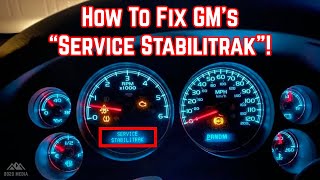
- Replacing the Steering Angle Sensor without first performing a thorough inspection of the related wiring harnesses. The problem is very often the wiring, and replacing the sensor will not fix the issue. 🎬 DIY: How to fix Stabilitrak and traction control lights yourself.
Most Likely Causes
- Pinched or Damaged Wiring Harness 🔴 High Probability Multiple TSBs (#PIT5288H, #PIT5457D) confirm that wire harnesses on these trucks are susceptible to damage in specific locations. The dash harness can be pinched by the left I/P mounting bracket near the parking brake, and the Communication Enable circuit (5986) is known to chafe or corrode under the driver and passenger door sill plates.
How to confirm: Visually inspect the wire harness on the left side of the instrument panel near the parking brake, looking for it to be crushed against the metal body by the I/P bracket. Remove the driver and passenger door sill plates to inspect the wiring channel for chafing, corrosion, or breaks, paying close attention to the Communication Enable circuit (often a tan wire with a specific circuit number 5986). TSB PIT5457D suggests using a 194 bulb to load-test circuit 5986 for high resistance.
Typical fix: Repair the damaged section of the wire harness using approved splicing techniques and protect it with anti-abrasion tape. Reroute the harness if necessary to prevent future damage.
Est. part cost: $5-$50 - Failed Steering Angle Sensor (SAS) 🟡 Medium Probability → Shop Steering Angle Sensor
How to confirm: If a thorough wiring inspection reveals no faults, use a professional scan tool to check for live data from the SAS. If there is no data signal from the sensor despite good power, ground, and network wiring integrity, the sensor has likely failed.
Typical fix: Replace the Steering Angle Sensor. This part is located in the steering column and requires calibration with a professional scan tool after installation.
Est. part cost: $80-$150 - Faulty Electronic Brake Control Module (EBCM) ⚪ Low Probability → Shop ABS Control Module
How to confirm: This is typically diagnosed by exclusion. If the SAS and all related wiring (including power, ground, and communication circuits) are confirmed to be good, but communication is still lost, the EBCM may be at fault. The EBCM may also set other communication codes.
Typical fix: Replace and program the Electronic Brake Control Module. This requires special software and procedures.
Est. part cost: $450-$650
Rare But Worth Checking
- Low Battery Voltage or Poor Grounds: → Shop Vehicle Battery Low system voltage can cause numerous, seemingly random communication codes to appear across various modules. Always ensure the battery is fully charged (above 12.5V engine off) and ground connections (like G218 on the left I/P support) are clean and tight before beginning complex diagnostics.
Diagnosis Steps
- Connect a professional scan tool capable of reading all vehicle modules, not just the engine computer. Check for U0126 and any other 'U' (network), 'C' (chassis), or 'B' (body) codes.
- Review TSBs. Specifically check for #PIT5755, #PIT5288H, and #PIT5457D, which are highly relevant to this code on this truck.
- If code U0131 is present, follow the diagnostic procedure for U0126 as instructed by TSB #PIT5755. The bulletin notes that engineering is aware of this incorrect mapping.
- Perform a detailed visual inspection of the wiring harness at the left instrument panel near the parking brake area for pinching or damage, as per TSB #PIT5288H. The harness may be crushed between the I/P mounting bracket and the body.
- Remove the driver and passenger door sill plates and inspect the wiring harness in the channel for chafing, corrosion, or breaks, paying close attention to the Communication Enable circuit 5986, as per TSB #PIT5457D.
- If wiring damage is found, perform a wire-to-wire repair using approved methods, then protect the harness with anti-abrasion tape, clear codes, and re-test.
- If wiring appears intact, use a multimeter to check for proper power, ground, and network continuity at the Steering Angle Sensor connector. TSB PIT5457D provides a procedure for testing circuit 5986 using a 194 light bulb as a load to check for high resistance.
- If power, ground, and wiring are confirmed good, suspect a faulty Steering Angle Sensor. Replace the sensor and perform the necessary calibration procedure with a scan tool.
- If the issue persists after all other steps, the Electronic Brake Control Module (EBCM) may be the cause.
Parts You'll Likely Need
- Steering Angle Sensor
(OEM #13589991)— If wiring is confirmed to be good, the sensor itself is the next most likely component to have failed. This part number supersedes previous versions like 13579709 and 13589257.
Trusted brands: ACDelco, Standard Motor Products
OEM price range: $80-$145
Aftermarket price range: $70-$120 - Electronic Brake Control Module (EBCM)
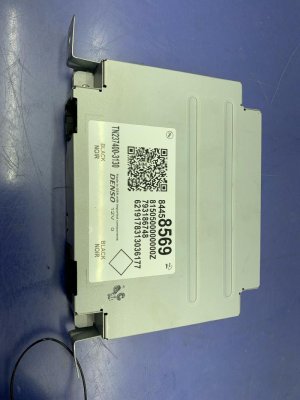
(OEM #84256781)— In rare cases where wiring and the sensor are good, the EBCM that receives the signal may be faulty. It is the least likely cause and most expensive part.
Trusted brands: ACDelco
OEM price range: $450-$570
Aftermarket price range: $350-$500
Related Codes That Often Appear With This One
- U0131 — TSB #PIT5755 specifically states that for 2020 models, the EBCM can incorrectly map a U0126 fault (Lost Communication With Steering Angle Sensor) and report it as a U0131 (Lost Communication With Power Steering Control Module). A technician should follow diagnostics for U0126 if this occurs, especially if the vehicle is not equipped with RPO NV8 (Variable Assist Power Steering).
- U0077 — This code, along with others like U0121 and U0415, often appears with U0126 because they are all related to communication on the same Chassis High Speed CAN bus. A single wiring issue, as described in TSB #PIT5457D, can disrupt communication for multiple modules simultaneously.
- U0121 — Indicates lost communication with the ABS module (EBCM). Since the EBCM is the primary module that listens for the SAS signal, a network fault often affects both, causing them to log codes against each other.
Technical Service Bulletins (TSBs) & Recalls
- PIT5755: Communicates an issue with the Electronic Brake Control Module incorrectly mapping DTC U0126 as a U0131 and directs following diagnostics for U0126.
- PIT5288H: Points to a pinched wire harness in the left instrument p
Platform-Specific Known Issues
- TSB #PIT5755 notes that the Electronic Brake Control Module (EBCM) on 2020 models can misreport a U0126 code as a U0131. Diagnosis for U0126 should be followed.
- TSB #PIT5288H points to a pinched wire harness at the left instrument panel mounting bracket as a cause for U0126 and a host of other electrical faults.
- TSB #PIT5457D identifies a wire harness under the driver and passenger sill plates that can become damaged, specifically on the Communication Enable circuit (5986), causing U0126 and other communication codes.
Mechanic-Grade Diagnostic Values
- High-Speed GMLAN Bus Resistance — expected: Approximately 60 Ω (measured between Pin 6 and Pin 14 of the DLC with the battery disconnected).. Failure: A reading of 120 Ω indicates an open circuit or one of the two terminating resistors is offline. A reading near 0 Ω indicates the CAN High and Low wires are shorted together.
- Communication Enable Circuit (5986) Load Test — expected: At least 11 volts measured across a 194 incandescent bulb connected between circuit 5986 at the module connector and a known good ground. The bulb should light brightly.. Failure: If the bulb does not light or the voltage across it is less than 11V, it indicates high resistance or an open in the circuit, a common issue under the sill plates.
- Steering Angle Sensor Power Supply — expected: 12.0 - 12.6 Volts at the SAS module power supply pin with Key On, Engine Off.. Failure: Low or no voltage points to a fault in the power supply circuit, fuse, or wiring.
- Steering Angle Sensor Ground Circuit Resistance — expected: Less than 0.5 Ω between the ground pin at the SAS connector and a clean chassis ground point.. Failure: Resistance higher than 0.5 Ω indicates a poor ground connection, which can cause the module to drop offline intermittently.
Hidden / Shadow Codes Worth Checking
- N/A (Symptom Byte): While not a hidden code, TSB 20-NA-113 notes a critical diagnostic trap: a Power Steering Control Module (PSCM) calibration error can cause DTCs like U0126 to remain as 'current' faults even after the root cause is fixed. They will not transition to 'history', misleading the technician. (see via This is observed with a professional scan tool like GDS2 when a seemingly resolved fault code cannot be cleared or immediately returns as current without a present fault.)
Scan Tool Commands That Help
- GDS2 (or equivalent professional scan tool): Steering Angle Sensor Calibration / Learn — This procedure is mandatory after replacing the Steering Angle Sensor or the Electronic Brake Control Module (EBCM), or after performing a wheel alignment. It is found in the EBCM or PSCM service functions and resets the sensor's zero-point calibration.
- GDS2 / TIS2WEB: PSCM (Power Steering Control Module) Programming — As per TSB 20-NA-113, if U0126 (and other codes) are stuck as 'current' DTCs and will not clear, the PSCM may need to be reprogrammed with the latest calibration to correct a software error.
Wiring & Ground Locations
- G218 — Located on the left-hand (driver's side) I/P support structure, under the dash and often behind the dash insulator mat.. This is a primary ground for the Body Control Module (BCM). TSB PIT5405C notes that the dash insulator mat can get trapped between the ground eyelet and the body stud, causing a poor connection. A bad BCM ground can cause widespread communication faults on the network, including U0126.
- Circuit 5986 (Communication Enable) — This wire runs in the harness located under the driver and passenger side door sill plates.. This circuit, activated by the BCM, 'wakes up' various modules, including the SAS. TSB PIT5457D specifically identifies this wire as being prone to chafing, corrosion, or breaking in the sill plate area, which prevents the SAS from communicating.
- Splice J365 — Located in the wiring harness under the passenger front sill plate.. This is a splice point for Circuit 5986. Corrosion or a poor connection at this splice can cause the same symptoms as a chafed wire, leading to a loss of communication with modules downstream.
- I/P Harness at Parking Brake — The main instrument panel harness runs near the parking brake pedal assembly and the left I/P mounting bracket.. TSB PIT5288H identifies a specific issue where this harness gets pinched between the I/P mounting bracket and the body, crushing wires and causing opens or shorts that result in code U0126 and other communication DTCs.
"I Checked Everything" — The Actual Cause
- A scenario described in TSB 20-NA-113 presents a situation where all wiring and parts may test good, yet the U0126 code remains current. The root cause is a software calibration error in the Power Steering Control Module (PSCM) that prevents the DTC from transitioning to history after an intermittent fault has passed. The actual fix is not a component replacement, but reprogramming the PSCM with updated software via TIS2WEB.
OEM Part Supersession History
13513905, 13579709, 13584209, 13589257, 20959922→13589991— Standard part evolution, integrating design updates and new materials.
Heads up: The new part (13589991) requires a calibration procedure using a professional scan tool after installation to function correctly.
Model Year Variations Within This Range
- 2020: TSB #PIT5755 highlights a software issue specific to 2020 models where the Electronic Brake Control Module (EBCM) can incorrectly log a U0131 code when the actual fault is a U0126. Technicians are directed to follow the U0126 diagnostic path if this occurs.
Helpful Videos

We Have This Part in Stock

The information in this article is provided for general reference and educational purposes only. Vehicle specifications, procedures, and part compatibility can vary by production date, trim level, and region. Always consult your vehicle's factory service manual and verify part numbers before purchasing or performing repairs. Safety-critical components such as airbags, seat belts, and braking systems should be installed by a qualified professional.
- Chevrolet SILVERADO 2500:
- 🧭 Diagnostic Flowchart
- 🎬 Helpful Videos
- 🛍️ Shop This Part
- What's Unique About the 2020-2020 Chevrolet SILVERADO 2500
- Symptoms You May Notice
- Most Likely Causes
- Rare But Worth Checking
- Diagnosis Steps
- Parts You'll Likely Need
- Related Codes That Often Appear With This One
- Technical Service Bulletins (TSBs) & Recalls
- Platform-Specific Known Issues
- Mechanic-Grade Diagnostic Values
- Hidden / Shadow Codes Worth Checking
- Scan Tool Commands That Help
- Wiring & Ground Locations
- "I Checked Everything" — The Actual Cause
- OEM Part Supersession History
- Model Year Variations Within This Range
- 🎟️ Get 5% Off