

U0131 on 2015-2019 Chevrolet Tahoe: Lost Communication With Power Steering Control Module
This code means the Power Steering Control Module (PSCM) has lost communication. On 2015-2019 Tahoes, this is frequently caused by wiring or ground issues, as noted in GM Technical Service Bulletins. Always check grounds (specifically G218) and wiring harnesses under the door sill plates before replacing the expensive PSCM.
- U0131 on a 2015-2019 Tahoe means the Power Steering Control Module is offline.
- Before suspecting a bad module, **always** inspect the wiring under the door sill plates (TSB #PIT5457D) and the BCM ground G218 (TSB #PIT5405C).
- Loss of power steering is a critical safety issue; the vehicle should not be driven until repaired.
- Check for Safety Recall 14743 if you have a 2015 model.
- If the PSCM or steering rack is replaced, it will require programming by a dealer or a properly equipped independent shop.
What's Unique About the 2015-2019 Chevrolet TAHOE

For this generation of Chevrolet Tahoe and its K2XX platform mates (like the Suburban, Yukon, and Silverado), code U0131 is strongly linked to specific, documented wiring and grounding problems. GM has issued multiple Technical Service Bulletins (TSBs) pointing technicians toward common failure points. These include damaged wiring under the door sill plates (TSB #PIT5457D, which specifically mentions circuit 5986) and a poor ground connection for the Body Control Module at location G218 (TSB #PIT5405C). These known issues make a wiring or ground fault a much more likely cause than a failed Power Steering Control Module itself, a common misdiagnosis.
Diagnostic Flowchart

Tap your situation to follow the diagnostic path that matches what you're seeing on this vehicle.
Symptoms You May Notice

- Complete loss of power steering, making the wheel very heavy to turn.
- "Service Power Steering" message on the driver information center.
- Illuminated warning lights for ABS, StabiliTrak, or traction control.
- Intermittent return and loss of power steering assist.
- Steering wheel jerks or kicks back when turning.
- Other electrical issues may occur at the same time, such as the radio/HVAC display going blank or the engine stalling at low speeds, especially when turning the wheel.
- Replacing the Power Steering Control Module (PSCM) or the entire steering rack before thoroughly checking all related wiring and grounds. The TSBs for this vehicle strongly suggest that wiring and ground issues are the most frequent culprits.
Most Likely Causes

- Poor Body Control Module (BCM) Ground (G218) 🔴 High Probability TSB #PIT5405C and its revisions specifically call out a poor ground at location G218. The front dash insulator mat can get trapped between the ground ring terminal and the body stud, causing a weak or intermittent connection. This single ground issue can cause dozens of communication codes, including U0131.
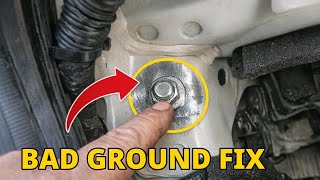
How to confirm: Locate ground G218, which is on the driver's side, behind the lower kick panel to the left of the brake pedal. Visually inspect it to see if the black dash insulation is caught under the ground's ring terminal. Even if it looks okay, remove the 10mm nut, pull the terminal off, and ensure the contact surfaces are clean and free of insulation, paint, or corrosion.
Typical fix: Remove the 10mm ground nut. If insulation is trapped, carefully trim it away from the stud with a utility knife. Clean the ring terminal and the body surface with a wire brush or emery paper to ensure a bright, metal-to-metal contact. Re-secure the connection tightly.
Est. part cost: $0-$5 - Damaged Wiring Harness Under Sill Plates 🔴 High Probability As documented in TSB #PIT5457D, the wiring harness routed under the driver and passenger door sill plates is susceptible to damage. Water intrusion, corrosion, or simply wires getting pinched or broken can cause an open in the communication enable circuit (specifically circuit 5986), leading to a loss of communication with the PSCM and other modules.
How to confirm: Remove the plastic driver and passenger sill plates. This may require removing other trim pieces first. Carefully peel back the carpet and inspect the wiring harness channel. Look for any signs of chafing, breaks, corrosion (especially green crust), or previous poor repairs. Pay close attention to splice points, like splice J365 under the passenger front sill plate.
Typical fix: Repair the damaged section of the wire. This involves cutting out the corroded or broken section, splicing in a new piece of wire of the same gauge using solder and heat shrink (or high-quality butt connectors), and re-wrapping the harness with automotive-grade tape.
Est. part cost: $10-$50 - Poor Power Steering Module Power/Ground Connection 🟡 Medium Probability → Shop Power Steering Control Module The main power and ground connections for the electric power steering rack are exposed to the elements under the vehicle. Road salt, moisture, and vibration can cause these large-gauge wire connections to become loose or corroded. TSB #PIT5405C mentions inspecting the 2-way connector (X183 or X133) at the rack for loose terminals.
How to confirm: Safely raise and support the vehicle. Locate the electric power steering rack. Visually inspect the large gauge red and black wires and their connectors. Check for tightness and any signs of corrosion or damage. Use a multimeter to test for battery voltage and a good ground directly at the PSCM connector.
Typical fix: Disconnect the battery. Disassemble the connections, clean the ground studs and eyelets with a wire brush, tighten any loose connections, and apply dielectric grease to the connectors to prevent future moisture intrusion.
Est. part cost: $5-$15 - Failed Power Steering Control Module (PSCM) / Steering Rack ⚪ Low Probability → Shop Power Steering Control Module While the module itself can fail, it is far less common than wiring or ground issues. An internal fault can prevent it from communicating on the CAN bus. It's often replaced unnecessarily when a simple wiring or ground fix was the real solution.
How to confirm: This is a diagnosis of exclusion. If all wiring (power, ground, and CAN bus), fuses, and ground points have been meticulously tested and confirmed to be good, the module itself is the likely culprit. This requires a scan tool that can show network topology to confirm the PSCM is offline.
Typical fix: Replace the Power Steering Control Module, which is integrated into the steering rack assembly. This is a significant mechanical job. The new module must be programmed to the vehicle's VIN using GM-specific software (SPS2).
Est. part cost: $800-$1500
Rare But Worth Checking
- Blown EPS Fuse: The electric power steering (EPS) system is protected by a large fuse, often a 100A fuse located in the underhood fuse block. A short circuit in the main power wire to the rack can cause this fuse to blow, cutting all power to the module.
- CAN Bus Network Fault: A short or open in the CAN bus wiring (often a twisted pair of wires) anywhere between modules can disrupt communication and set a U0131 code. Diagnosing this requires measuring resistance (should be ~60 ohms between CAN High and CAN Low with the battery disconnected) and potentially using an oscilloscope.
- Poor Battery or Main Cable Connections: → Shop Vehicle Battery TSB 18-NA-161 (for slightly later models but relevant) points to high resistance in main battery cables causing voltage drops that shut down the EPS module. Always ensure battery terminals and fuse block connections are clean and tight.
Diagnosis Steps
- Scan all vehicle modules for DTCs and document them. Note which other modules are reporting a loss of communication with the PSCM. A topology view is very helpful here.
- Check for GM Safety Recall 14743, which affected some 2015 models for sudden loss of power steering assist due to an internal EPS module fault.
- PRIORITY 1: Inspect Body Control Module ground G218. Per TSB #PIT5405C, locate the ground stud behind the driver's kick panel, remove the 10mm nut, and ensure the dash insulator is not trapped under the ground terminal. Clean and tighten the connection.
- PRIORITY 2: Remove the driver and passenger sill plates and inspect the wiring harness for damage, as described in TSB #PIT5457D. Look for corrosion, breaks, or pinched wires, especially in the communication enable circuit (Circuit 5986).
- Inspect the main power and ground connections at the electric power steering rack for tightness and corrosion. Check the large 2-pin connector (X183/X133).
- Check the large fuse for the EPS system (often 100A) in the underhood fuse block.
- If all wiring and grounds are confirmed good, test the CAN bus network. With the battery disconnected, measure the resistance between Pin 6 and Pin 14 at the DLC. A healthy network should read approximately 60 Ohms. A reading of 120 Ohms indicates an open circuit or a missing termination resistor, while a reading significantly less than 60 Ohms could indicate a shorted wire or a faulty module.
- If all the above steps fail to identify the issue, the Power Steering Control Module (PSCM) itself may have failed. Replacement requires programming with GM's Service Programming System (SPS).
Parts You'll Likely Need
- Wiring Harness Repair Supplies — Often, the fix is repairing a damaged wire in the harness under the sill plates or cleaning the G218 ground, which is a very common issue on these vehicles.
Trusted brands: N/A (wire, solder, Tesa tape)
OEM price range: $10-$50
Aftermarket price range: $10-$50 - Power Steering Gear Assembly (Rack and Pinion)
(OEM #19417064, 86553005)— This is the part to replace if all wiring and ground faults have been ruled out. The PSCM is integrated into this assembly. Replacement requires VIN programming.
Trusted brands: ACDelco (GM Genuine)
OEM price range: $1200-$1900
Aftermarket price range: $400-$1200
Related Codes That Often Appear With This One
- U0121 — Lost Communication with Anti-Lock Brake System (ABS) Control Module. Often set alongside U0131 due to shared wiring harnesses (under sill plates) and ground points, as noted in TSB #PIT5457D.
- U0140 — Lost Communication With Body Control Module. This can be a primary cause or a related symptom, especially if the G218 ground is at fault, as per TSB #PIT5405C.
- U0077 — Lost Communication With Chassis Control Module 'A'. This code is also listed in TSB #PIT5457D and points to a general network problem affecting multiple chassis-related modules, often stemming from the same wiring harness issue.
- U0428 — Invalid Data Received From Steering Angle Sensor Module. This can occur when communication with the power steering system is unstable, as mentioned in TSB #PIT5457D and #PIT5405C.
Technical Service Bulletins (TSBs) & Recalls
- PIT5457D: Loss of communication with various modules, including PSCM, due to wiring harness damage under sill plates.
- PIT5405C: Multiple communication codes set due to a poor BCM ground at G218.
Platform-Specific Known Issues
- TSB #PIT5457D: Points to loss of communication with multiple modules (including the PSCM) due to an open or damaged wire (Circuit 5986) in the harness located under the driver and passenger sill plates.
- TSB #PIT5405C: Identifies a poor ground connection at G218 (for the BCM) as a cause for numerous communication DTCs, including U0131. The dash insulator mat can get caught under the ground terminal, causing an intermittent connection. This TSB also notes that symptoms are worse at low speeds while turning the wheel.
- Safety Recall 14743: Issued for some 2015 models for a potential sudden loss of power steering assist, which can be related to code U0131. The remedy was to replace the power steering assist motor kit.
Mechanic-Grade Diagnostic Values
- CAN Bus Network Resistance — expected: 54 to 69 Ω (approximately 60 Ω). Failure: A reading of ~120 Ω indicates an open circuit or a missing terminating resistor. A reading significantly below 60 Ω suggests a short or an extra resistor on the network.
- Communication Enable Circuit (5986) Voltage — expected: Approximately 12 Volts when the BCM is awake (e.g., ignition in ACC or ON).. Failure: Low or no voltage indicates an open, short, or high resistance in Circuit 5986 between the BCM and the PSCM. The circuit should be able to light a small bulb (like a 194) and maintain at least 11 volts under that load.
- CAN Bus Voltage (Key-On) — expected: Both CAN High and CAN Low lines should be at approximately 2.5V relative to ground when idle. During communication, CAN High should pulse towards 3.5V and CAN Low should pulse towards 1.5V.. Failure: Voltages stuck high or low, or not centered around 2.5V, indicate a short to power, a short to ground, or a faulty module pulling the bus down.
Scan Tool Commands That Help
- GM GDS2/SPS (Service Programming System): Electronic Power Steering - Prepare Control Module for Removal — This function must be used BEFORE removing the old Power Steering Control Module. It saves critical data (like the worm gear wear counter) from the old module to the scan tool, which is then transferred to the new module.
- GM GDS2/SPS (Service Programming System): Electronic Power Steering - Programming — This is used to flash the new Power Steering Control Module with the correct software for the vehicle's VIN after it has been physically installed.
- GM GDS2/SPS (Service Programming System): Electronic Power Steering - Setup — After programming, this function performs necessary calibrations and configurations for the new module.
- GM GDS2: Power Steering Control Module Calibration — This final step, which includes Steering Angle Sensor Centering and Software Endstop Learning, must be performed after programming and setup to ensure proper operation of the steering system.
Wiring & Ground Locations
- G218 — Driver's side, behind the lower kick panel, to the left of the brake pedal. It is a ground stud on the body.. This is the primary ground for the Body Control Module (BCM). TSB #PIT5405C identifies that the dash insulator mat can get trapped under the ground terminal, causing high resistance and leading to dozens of communication codes, including U0131.
- Circuit 5986 — Runs in the wiring harness under both the driver and passenger side door sill plates.. This is the 'Communication Enable' circuit. The BCM sends a 12V signal on this wire to 'wake up' modules like the PSCM. TSB #PIT5457D notes this wire is prone to breaking or corroding in the sill plate area, preventing the PSCM from turning on and communicating.
- Splice J365 — Located in the wiring harness under the passenger front sill plate.. TSB #PIT5457D identifies this as a potential failure point within Circuit 5986. A corroded or failed splice here can cut off the wake-up signal to the PSCM.
- X133 / X183 — The 2-way main power and ground connector at the power steering rack itself.. TSB #PIT5405C points to loose connections at this connector as a possible cause. Being under the vehicle, it is exposed to moisture and corrosion, which can interrupt the main power or ground supply to the PSCM.
OEM Part Supersession History
84722752→86553014— Part number update or revision by the manufacturer.
Heads up: Part numbers are often specific to model year ranges. For example, part number 19417064 is listed for 2015-2016 models, while 84722752 (and its successor) are for 2017-2020 models. Using the wrong part may lead to programming or operational issues.
Model Year Variations Within This Range
- 2015: Certain 2015 models were subject to GM Safety Recall 14743. This recall addressed a condition where the electric power steering (EPS) could fail suddenly due to a fault within the EPS module. The remedy was to replace the power steering assist motor kit.
- 2015: Some 2015 models were also part of recall 18289, which involved updating the EPS module software to prevent a momentary loss and sudden return of power assist, which could make the vehicle difficult to control.
Helpful Videos

The information in this article is provided for general reference and educational purposes only. Vehicle specifications, procedures, and part compatibility can vary by production date, trim level, and region. Always consult your vehicle's factory service manual and verify part numbers before purchasing or performing repairs. Safety-critical components such as airbags, seat belts, and braking systems should be installed by a qualified professional.
- Chevrolet TAHOE:
- 🧭 Diagnostic Flowchart
- 🎬 Helpful Videos
- What's Unique About the 2015-2019 Chevrolet TAHOE
- Symptoms You May Notice
- Most Likely Causes
- Rare But Worth Checking
- Diagnosis Steps
- Parts You'll Likely Need
- Related Codes That Often Appear With This One
- Technical Service Bulletins (TSBs) & Recalls
- Platform-Specific Known Issues
- Mechanic-Grade Diagnostic Values
- Scan Tool Commands That Help
- Wiring & Ground Locations
- OEM Part Supersession History
- Model Year Variations Within This Range
- 🎟️ Get 5% Off