

U0140 on 2008-2017 Buick Enclave: Lost Communication with BCM Fixes
This code on a Buick Enclave often points to an intermittent short in the communication wiring or water intrusion, not a failed Body Control Module (BCM). A key symptom is multiple electrical issues appearing after hitting a bump or during rain. Do not replace the BCM without first thoroughly checking for water damage and testing the wiring harness for damage, especially under the driver's seat and near the sunroof drains.
- U0140 on a 2008-2017 Enclave is very frequently caused by either a water leak from a clogged sunroof drain shorting the BCM, or an intermittent wiring short, as detailed in TSB PIT4730B.
- Do not immediately assume the BCM has failed; it is often misdiagnosed. Thoroughly investigate water intrusion and wiring harness integrity first.
- Symptoms are often intermittent and may be triggered by bumps or rain, which is a strong clue pointing towards a physical wiring or water issue rather than internal module failure.
- This is a known issue across all GM Lambda platform vehicles, including the GMC Acadia, Chevrolet Traverse, and Saturn Outlook.
What's Unique About the 2008-2017 Buick Enclave
On this specific generation of Buick Enclave and its platform mates (GMC Acadia, Chevy Traverse, Saturn Outlook), GM issued a Technical Service Bulletin (PIT4730B) that provides critical insight. It states that an intermittent short-circuit on the high-speed communication network (GMLAN), even for a fraction of a second, can knock the BCM offline for the entire ignition cycle. This makes it appear as if the BCM has failed when the root cause is actually a wiring issue, often triggered by driving over bumps or rough roads. Technicians are specifically warned not to replace the BCM until all diagnostic steps for an intermittent electrical fault have been completed. Furthermore, this platform is highly susceptible to water leaks from clogged sunroof drains, which drip directly onto the BCM and fuse block, causing corrosion and communication failures.
Symptoms You May Notice
- "Service StabiliTrak" message on the driver information center.
- Door locks cycling on their own, especially while driving.
- Intermittent no-start or crank-no-start condition.
- Speedometer and tachometer needles freeze or drop to zero while driving.
- Power windows, mirrors, or seat controls stop working.
- Headlights, taillights, or interior lights acting erratically or failing to turn off.
- Key fob and remote start become inoperative.
- Wet carpets on the driver or passenger side, especially after rain. 🎬 See how wet carpets lead to these major electrical issues
- Vehicle continues to run after the key is removed from the ignition.
- Replacing the Body Control Module (BCM) without first diagnosing the wiring harness and checking for water leaks. The TSB for this platform explicitly warns that an intermittent wiring fault is a common cause that can mimic a failed BCM.
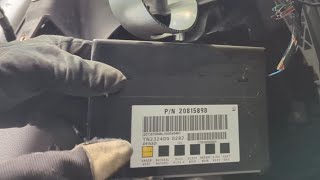
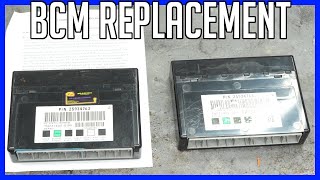
- Replacing other modules (like the ECM or TCM) when the U0140 code is present, as the BCM communication fault is the primary issue to be addressed. 🎬 Watch: Professional case study on diagnosing and programming the BCM
Most Likely Causes
- Water Intrusion Damaging BCM/Connectors 🔴 High Probability The GM Lambda platform is notorious for clogged sunroof drain tubes. The tubes exit via a grommet behind the kick panel 🎬 Watch: How to find and clear clogged sunroof drain tubes that gets clogged with debris, causing water to back up and overflow from the A-pillar, dripping directly onto the BCM and the main fuse block located under the driver's side dashboard.
How to confirm: Peel back the carpet on the driver's side footwell and feel for moisture. Visually inspect the BCM and its connectors for blue or green corrosion. Pour water into the sunroof drain channel and see if it leaks into the cabin instead of draining under the car.
Typical fix: First, clear the clogged sunroof drain tubes using compressed air or a flexible wire. Disconnect the battery. Remove the BCM and its connectors, then clean all corrosion from the pins and terminals using an electrical contact cleaner. If damage is severe, the BCM or connector pigtail may need replacement. Apply dielectric grease to the connectors before reassembly to prevent future corrosion.
Est. part cost: $20-$450 - Intermittent Short in GMLAN Wiring Harness 🟡 Medium Probability As noted in TSB PIT4730B, the communication network is sensitive to brief shorts. Wires can chafe against chassis components over time. Common chafe points reported by owners include the harness under the driver's seat (from seat movement), near the parking brake pedal mechanism, and in the driver's side door jamb.
How to confirm: With the vehicle running, wiggle and manipulate sections of the wiring harness in known problem areas while a helper observes for symptoms or while monitoring module status on a professional scan tool. A visual inspection for chafed, pinched, or corroded wires is also necessary.
Typical fix: Isolate the damaged section of the wiring harness, repair the broken or shorted wire(s), and protect the harness from future damage using loom or tape.
Est. part cost: $5-$50 - Poor Power or Ground Connection to BCM 🟡 Medium Probability Ground connections on any vehicle can loosen or corrode over time. A weak ground or intermittent power supply can cause a module to drop off the communication network unexpectedly.
How to confirm: Check that the battery voltage is above 12.4V. Locate the BCM's dedicated ground points; a primary one is G301, located behind the left kick panel. Inspect for corrosion and ensure the connections are clean and tight.
Typical fix: Clean the ground connection points to bare metal and tighten the fasteners. Replace any corroded connectors or terminals.
Est. part cost: $1-$20 - Failed Body Control Module (BCM) ⚪ Low Probability → Shop Body Control Module While the BCM can fail internally, it is often misdiagnosed. The primary reason for true failure on this platform is unaddressed water intrusion causing irreversible damage to the circuit board.
How to confirm: This is a last resort after all wiring, power, ground, and water intrusion issues have been definitively ruled out by a professional. The BCM's connector should be inspected for any signs of water damage or corrosion.
Typical fix: Replace the Body Control Module. The new module will require programming to the vehicle's specific VIN and options, which must be done by a dealer or a properly equipped independent shop.
Est. part cost: $250-$500
Diagnosis Steps
- Verify the complaint and check for other stored DTCs. Note if U0073 or other 'U' codes are present.
- Check the battery. Ensure it is fully charged (above 12.4V) and the terminals are clean and tight. Low voltage can cause numerous communication errors.
- Inspect for water intrusion. Pull back the driver's side carpet and A-pillar trim. Check for dampness and look for signs of corrosion on the BCM and fuse block connectors.
- Test sunroof drains. Pour a small amount of water into the front sunroof drain holes and confirm it exits behind the front wheels, not into the cabin.
- Visually inspect known problem areas for wiring harnesses, such as under the driver's seat, around the steering column, near the parking brake pedal, and in the driver's side footwell/kick panel where the BCM is located.
- Following the guidance in TSB PIT4730B, attempt to recreate the issue. Driving over a bumpy road or manually wiggling the harness may trigger the symptoms.
- If the problem is active, use a professional scan tool to see which modules are communicating. If the BCM is the only module offline, focus on its power, ground, and communication wires.
- With the ignition off, check the resistance between Pin 6 (CAN High) and Pin 14 (CAN Low) on the Data Link Connector (DLC). A healthy network should read approximately 60 ohms.
- Inspect the BCM ground connection G301 behind the left kick panel for tightness and corrosion.
- If all wiring, power, grounds, and water intrusion paths are confirmed to be good, the BCM itself may be at fault. However, this step should only be taken after exhausting all other possibilities.
Parts You'll Likely Need
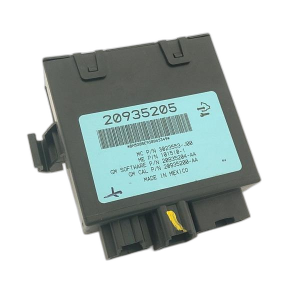
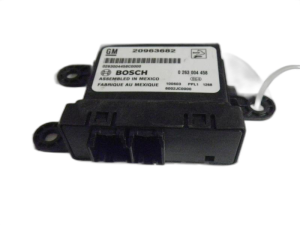
- Body Control Module (BCM)
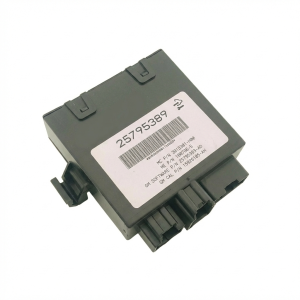
(OEM #ACDelco 22860591 (fits 2008-2012 models), 25847589)— This is the part that needs to be replaced if it has failed internally, most often due to water damage. A replacement requires professional programming to the vehicle's VIN.
Trusted brands: ACDelco (GM Genuine)
OEM price range: $300-$500
Aftermarket price range: $200-$400 - Electrical Contact Cleaner and Dielectric Grease — Necessary for cleaning corroded terminals on the BCM and its connectors after water intrusion and for protecting the connection after repair.
Trusted brands: CRC, Permatex
OEM price range: $15-$30
Aftermarket price range: $10-$20
Related Codes That Often Appear With This One
- U0073 — U0073 (Control Module Communication Bus 'A' Off) is a related network code. TSB PIT4730B mentions that U0140 and U0073 often appear together as they can both be triggered by the same intermittent short on the GMLAN bus.
- U0100 — Lost Communication With ECM. If the GMLAN bus wiring is shorted or damaged by water intrusion near the BCM, it can disrupt the entire network, causing other modules to also lose communication with the Engine Control Module.
Technical Service Bulletins (TSBs) & Recalls
- PIT4730B: Diagnostic Tip- Information for U0140 or U0073 (BCM Appears Off Line On The High Speed Buss). This TSB is critical for correctly diagnosing this code on a 2008-2017 Enclave, warning that intermittent wiring faults are a common cause and that the BCM can appear offline for a full ignition cycle after a momentary fault.
- Bulletin #PIC6607B: This manufacturer bulletin advises technicians not to replace the Image Processing Module if U0140 is found as a history code, suggesting that the communication loss may be transient.
Platform-Specific Known Issues
- The platform is susceptible to intermittent GMLAN shorts causing the BCM to go offline for an entire ignition cycle, as documented in TSB PIT4730B.
- Water leaks from clogged sunroof drains or faulty windshield seals are known to cause electrical issues, including direct damage to the BCM and its connectors, which are located directly in the water path.
Mechanic-Grade Diagnostic Values
- GMLAN Bus Resistance at DLC — expected: Approximately 60 Ω (Ohms) between Pin 6 and Pin 14 with the battery disconnected.. Failure: A reading of ~120 Ω indicates an open circuit or a missing termination resistor. A reading near 0 Ω indicates the CAN High and CAN Low wires are shorted together.
- GMLAN Bus Voltage (Key On, Engine Off) — expected: Both CAN High (Pin 6) and CAN Low (Pin 14) should be at approximately 2.5V at rest. During data transmission, CAN High toggles towards 3.5V and CAN Low toggles towards 1.5V.. Failure: A line shorted to ground will read 0V. A line shorted to power will read battery voltage (12V). If both lines are stuck at 2.5V, there is no communication.
- BCM Power Supply — expected: 12.2V - 12.8V at the BCM power input pins with the key on.. Failure: Voltage below 12V can cause modules to drop off the network.
- BCM Ground Connection — expected: Less than 0.1 Ω resistance between the BCM ground pins and a clean chassis ground point.. Failure: High resistance indicates a corroded or loose ground connection, which can cause intermittent module resets.
Scan Tool Commands That Help
- GDS2 / Tech2 (or equivalent professional scanner): Setup SDM Primary Key in BCM — Required after replacing the BCM if the airbag (SIR) warning light remains illuminated. This procedure syncs the new BCM with the Sensing and Diagnostic Module (SDM).
- GDS2 / Tech2 (or key-on/off procedure): Vehicle Anti-Theft System Relearn — Required after BCM replacement to allow the vehicle to start. The BCM is part of the immobilizer system. This often involves a 30-minute procedure of cycling the key.
- GDS2 / Tech2: Module Status / Network Topology View — Used during initial diagnosis to see which modules are actively communicating on the network and which are offline. This helps confirm if the BCM is the only module not responding.
Wiring & Ground Locations
- BCM — Under the driver's side of the instrument panel, to the left of the steering column.. This is the module that has lost communication. Its location makes it highly vulnerable to water intrusion from clogged sunroof drains or leaking windshield seals.
- G301 — Behind the left (driver's side) kick panel.. This is a primary ground point for the Body Control Module. Corrosion or looseness at this point can cause the BCM to lose power intermittently and drop off the network.
- G303 — Near the base of the left (driver's side) 'B' pillar.. An important ground distribution point for various interior electronics. A fault here can cause widespread electrical issues that may be confused with a BCM failure.
- BCM Connector X3 — One of the main connectors on the Body Control Module.. This specific connector contains the primary High-Speed GMLAN communication wires. Pin 8 (TN/BK) is CAN+ and Pin 9 (TN) is CAN-. A secondary pair is at Pins 16 and 17. These are the critical pins to test for voltage and continuity when diagnosing U0140.
- Splice Packs (e.g., JX305/JX201) — Located in various places, often behind kick panels or under the dash, where multiple GMLAN wires join together.. These junctions are common points for corrosion and failure. A technician can disconnect the comb from a splice pack to isolate entire sections of the network, helping to pinpoint where a short or open circuit exists.
"I Checked Everything" — The Actual Cause
- A static continuity or resistance test on the GMLAN wiring may show that the circuit is fine (60 ohms, no shorts). However, the actual cause can be poor terminal pin fitment (pin drag) inside a connector. The connection is just good enough to pass a static test but separates and loses contact when subjected to road vibration, triggering the intermittent U0140 code. This is why wiggle-testing harnesses is a critical diagnostic step.
OEM Part Supersession History
22860591→84922494— Standard part revision and update by the manufacturer.
Heads up: Part number 22860591 is specified for 2008-2012 models. While the superseding part may be backward compatible, it is critical to verify the correct part number for the vehicle's specific model year and VIN before ordering.
Model Year Variations Within This Range
- 2008-2012: These earlier models commonly use BCM part number 22860591.
- 2013-2017: Post-facelift models may use a different BCM (such as 25847589, as noted in Pass 2). The physical location remains under the driver's side dash, but the internal hardware and software may differ, making part number verification essential.
Diagnostic Flowchart
Other Known Issues on This Vehicle
Issues unrelated to this code that are worth knowing about as an owner of this generation:
- Premature Timing Chain Stretch (3.6L V6) 🔴 High — Very common, especially on 2008-2012 models. Can occur as early as 40,000 miles but is frequently seen between 70,000-120,000 miles. Often leads to codes P0008, P0017, P0018, P0019. (Ref: Special Coverage Adjustment #11340C (now expired) extended warranty to 10 years/120,000 miles for 2009 models. TSBs 12-06-01-009F and PIP3423M provide diagnostic and repair info.)
- Broken 3-5-R Transmission Wave Plate (6T70/6T75) 🔴 High → Shop Transmission Assembly — Most prevalent in 2008-2010 models. Failure results in sudden loss of 3rd, 5th, and Reverse gears, requiring a transmission rebuild. (Ref: Special Coverage Adjustment #14404B (now expired) covered repairs for 10 years/120,000 miles.)
- Power Steering Pump/Gear Failure 🟠 Medium — Common on 2008-2011 models, causing loss of power assist at low speeds. (Ref: Special Coverage Adjustment #14329 covered replacement of the power steering pump and related components for 10 years/150,000 miles.)
- Water Leaks into Cabin 🔴 High — Widespread issue across all years. Clogged or detached sunroof drain tubes are the primary culprit, allowing water to soak carpets and drip onto the BCM and fuse block under the dash, causing a variety of electrical failures.
- Failed Ignition Coils 🟡 Low — A common maintenance item that can cause misfires and poor engine performance.
Used vs. New Parts: Buying Guide for This Vehicle
When a used part is the smart pick: A used OEM BCM from a reputable salvage yard or refurbisher is a cost-effective and viable option, provided it can be programmed to your vehicle's VIN. Since the primary failure mode is often external (water damage), a module from a dry, collision-damaged vehicle can be a good candidate.
Donor-vehicle mileage cap: roughly under 120000 miles for the part to have meaningful remaining life.
What to inspect on the donor part:
- Inspect the casing for any signs of water stains or pry marks.
- Check all connector sockets for any hint of blue or green corrosion.
- Ensure all pins are straight and not bent or pushed in.
- If possible, obtain the VIN of the donor vehicle to assist with programming compatibility checks.
OEM-only on this vehicle (don't cheap out):
- Body Control Module (BCM)
Aftermarket brands forum-validated for this vehicle:
- ACDelco (GM Genuine - New or Remanufactured)
- Dorman (Remanufactured - generally considered a secondary option to OEM)
Brands owners have reported issues with on this vehicle:
- Unbranded, no-name modules from online marketplaces should be avoided due to high failure rates and potential programming issues.
Real Owner Stories
Aggregated from forums and TSBs cited above. Mileages and costs reflect what owners reported in those sources.
2009 Buick Enclave
Symptoms: Wet carpet and bizarre electrical problems including the engine not shutting off after the key was removed.
What fixed it: Cleaned the clogged sunroof drain grommets and addressed water damage to the BCM.
Source hint: YouTube - 'BUICK ENCLAVE WET CARPET AND ELECTRICAL ISSUES FIXED!' by Rodriguez Repairs
2008 Buick Enclave
Symptoms: Sunroof drain failures led to water leaks that shorted out the amplifier and other electrical components.
What fixed it: Dealers often struggled to permanently fix the leak, but the root cause was identified as sunroof drain failure.
Source hint: Edmunds.com Forums thread titled 'Buick Enclave Leaks When It Rains'
Documented NHTSA Reports
NHTSA ODI #11242729
Symptoms: An owner reported that during a test drive, all gauges dropped to zero. Diagnostic scans revealed multiple communication codes including U0140, U0100, and U2099 stored in the BCM, transmission, and engine control modules.
NHTSA ODI #10918054
Symptoms: A report describes a vehicle failing with active codes for U0140 (Lost Communication with Body Control Module), U0100 (Lost Communication with ECM), and U0073 (Communication Bus Off).
Related OBD-II Codes
Frequently Asked Questions
Does TSB PIT4730B apply to my 2008-2017 Buick Enclave regarding the U0140 code?
Why does my Enclave continue to run even after I remove the key from the ignition?
I have wet carpets and a 'Service StabiliTrak' message; are these related to U0140?
Where is the BCM ground located on a 2008-2017 Enclave?
Can I just replace the BCM myself to fix the U0140 code?
How can I check if my sunroof drains are causing the electrical issues?
Helpful Videos



We Have This Part in Stock

The information in this article is provided for general reference and educational purposes only. Vehicle specifications, procedures, and part compatibility can vary by production date, trim level, and region. Always consult your vehicle's factory service manual and verify part numbers before purchasing or performing repairs. Safety-critical components such as airbags, seat belts, and braking systems should be installed by a qualified professional.
- Buick Enclave:
- 🧭 Diagnostic Flowchart
- 🎬 Helpful Videos
- 🛍️ Shop This Part
- What's Unique About the 2008-2017 Buick Enclave
- Symptoms You May Notice
- Most Likely Causes
- Diagnosis Steps
- Parts You'll Likely Need
- Related Codes That Often Appear With This One
- Technical Service Bulletins (TSBs) & Recalls
- Platform-Specific Known Issues
- Mechanic-Grade Diagnostic Values
- Scan Tool Commands That Help
- Wiring & Ground Locations
- "I Checked Everything" — The Actual Cause
- OEM Part Supersession History
- Model Year Variations Within This Range
- Other Known Issues on This Vehicle
- Used vs. New Parts: Buying Guide for This Vehicle
- Real Owner Stories
- 2009 Buick Enclave
- 2008 Buick Enclave
- Documented NHTSA Reports
- NHTSA ODI #11242729
- NHTSA ODI #10918054
- Related OBD-II Codes
- Frequently Asked Questions
- 🎟️ Get 5% Off