

OBD-II Code U0208: Lost Communication With Seat Control Module 'A'
What U0208 means, why it triggers, and how to fix it
- Code U0208 indicates a total communication failure with the Seat Control Module, immediately disabling power adjustments, memory presets, and seat climate functions.
- You can safely drive the vehicle, but if the airbag warning light is also illuminated, the system lacks seat position data and will not deploy airbags correctly in a collision.
- Over 80% of U0208 codes stem from damaged wiring or corroded connectors under the seat; Ram 1500 owners must inspect the passenger seat, while 2500/3500 owners must check the driver's seat.
- Never replace the $150-$400 module without first verifying 12V power and <1.0 ohm ground resistance at the connector, or performing a 30-second battery disconnect to clear a software lock-up.
What Does U0208 Mean?
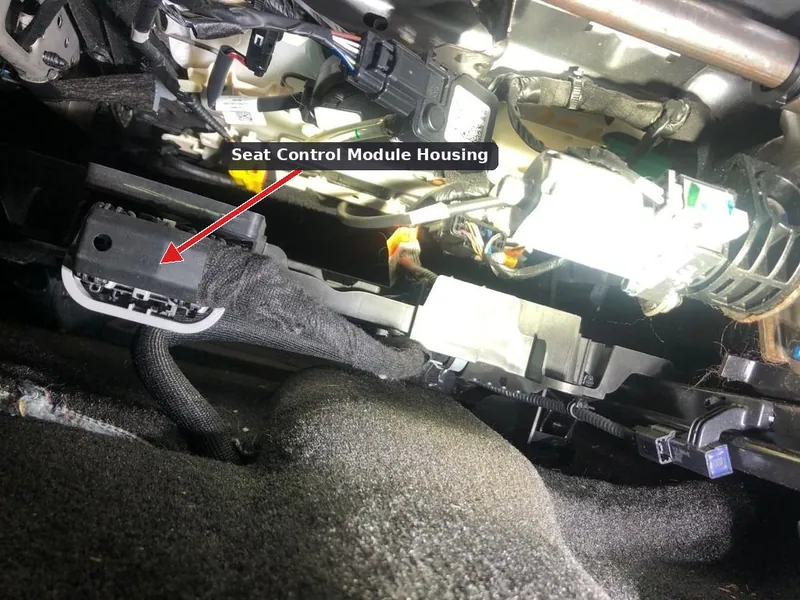
Code U0208 means your car's main computer lost its connection with the Seat Control Module 'A' (the driver's side power seat module). This module manages seat position, memory presets, and climate functions. When the main computer fails to receive a signal from this module for a few seconds, it logs this trouble code and disables the seat.
Technical definition: Lost Communication With Seat Control Module 'A'. This indicates the periodic state-of-health signal expected from the Seat Control Module 'A' was not received by other modules on the Controller Area Network (CAN) bus for a predetermined time, typically 2 to 5 seconds.
Can I Drive With U0208?
Yes, But With Caution. You can safely drive the vehicle, as this code does not affect driving dynamics. However, the Seat Control Module provides seat position data to the Occupant Restraint Controller (airbag module). If the airbag warning light is illuminated alongside U0208, the system lacks this data and will not deploy airbags correctly in a collision. Address this promptly if the airbag light is on.
Common Causes

- Damaged Wiring or Corroded Under-Seat Connector (Very Common) — The wiring harness under the seat is highly exposed. Items pushed under the seat, moisture from spills, or moving the seat back and forth causes wires to break or chafe. Corrosion on the connector pins is a frequent culprit in humid or 'salt belt' climates.
- Blown Fuse or Missing Power/Ground (Common) — The seat control module requires a steady 12-volt power supply and a solid ground. A blown fuse, a corroded fuse box terminal, or a loose ground wire cuts power and takes the module offline.
- Failed Seat Control Module (Common) — The module itself fails due to internal voltage spikes, water damage, or age, preventing it from powering on and communicating with the vehicle network.
- Module Software Lock-Up (Less Common) — On some vehicles, particularly General Motors trucks, the module's software freezes. This does not require replacement; a hard reset (pulling the fuse for 30 seconds) or a dealer software reflash restores communication.
- Weak Vehicle Battery (Less Common) — Modern vehicles are highly sensitive to low battery voltage. A weak battery causes random communication codes, including U0208, as modules shut down to conserve power.
- CAN Bus Network Failure (Rare) — If multiple 'U' codes appear for different modules, the problem is a wider network failure rather than the seat module itself.
- Internal Module Short (Rare) — The seat control module develops an internal short that stops communication and keeps the module 'awake' when the car is off, resulting in a severe parasitic battery drain.
- Incompatible Aftermarket Seat Installation (Rare) — Installing aftermarket seats or a seat from a different vehicle with incompatible electronics causes a communication failure and triggers U0208.
Symptoms

- Power Seat Adjustments Disabled — The seat will not move forward, backward, or recline using the physical switches.
- Seat Memory and Climate Functions Inoperative — Memory preset buttons fail to recall positions, and heated or ventilated seats will not activate.
- Airbag Warning Light Illuminated — The airbag system loses seat track position data, triggering a dashboard warning light.
- Intermittent Seat Operation — Seat functions work sporadically, indicating a loose connection or frayed wire making temporary contact.
- Parasitic Battery Drain — An internally shorted seat module fails to sleep when the ignition is off, draining the battery overnight.
Diagnostic Flowchart

Tap your situation to follow the diagnostic path that matches what you're seeing on this code.
Common Fixes & Costs
- Repair Damaged Wiring or Clean Connector
— Parts: $5-$60, Labor: $150-$450, ~2 hr book time
(Intermediate)
: OEM 68156993AB (Alt: N/A) - Replace Blown Fuse / Circuit Breaker — Parts: $1-$25, Labor: $0-$75, ~0.3 hr book time (DIY)
- Reprogram or Hard Reset Module — Parts: $0, Labor: $0-$180, ~0.5 hr book time (DIY)
- Replace Seat Control Module
— Parts: $140-$450, Labor: $75-$250, ~1.5 hr book time
(Professional)
: OEM 68592282AA (Alt: N/A)
: OEM JU5Z-14C708-Y (Alt: N/A)
: OEM 23338340 (Alt: Dorman) - Replace Weak or Dead Battery — Parts: $150-$350, Labor: $50-$100, ~0.5 hr book time (DIY)
Used vs. New Parts: Buying Guide
When a used part is worth it: Buy used for older vehicles if the module is plug-and-play. Buy new if the module requires VIN-specific programming.
Donor-vehicle mileage cap: roughly under 100000 miles for the part to have meaningful remaining life.
Donor quality checklist:
- Match the part number exactly. Superseded numbers may not be compatible.
- Purchase from a reputable salvage yard offering a 30-day warranty.
- Avoid parts from vehicles with flood or fire damage.
- Confirm if the module requires programming before purchasing used.
Decision logic:
- If The module requires VIN-specific programming to function → Buy new. The cost and hassle of trying to make a used module work outweigh the initial savings.
- If Vehicle is less than 10 years old and the new part is under $250 → Buy new for the longer warranty and guaranteed compatibility.
- If Vehicle is over 10 years old, budget is a primary concern, and the module is plug-and-play → A used part with a warranty is a reasonable choice. Verify the part number is an exact match.
Warranty tradeoff: Used parts typically come with a 30-90 day functional warranty. New OEM parts offer a warranty of 1 year or longer.
Worst-case if a used part fails: $200-$400 if a used part is Dead on Arrival (DOA), representing wasted labor costs for installation and re-diagnosis.
What Happens If You Wait — Timeline
- Immediate: Code U0208 is set. All functions controlled by the module (power seat adjustment, memory, climate) stop working. (MPG impact: 0%% · Added cost: $0)
- Ongoing: If the fault triggers the airbag warning light, the Supplemental Restraint System (SRS) is compromised and will not deploy airbags correctly in a collision. (MPG impact: 0%% · Added cost: N/A (Significant Safety Risk))
- 1 week - 2 months: If the root cause is an internal module short causing a parasitic draw, the vehicle's battery dies repeatedly, requiring frequent jump starts. (MPG impact: 0%% · Added cost: $20-$50 (for jump start service))
- 2-6 months: Constant draining destroys the battery, requiring replacement. The vehicle fails emissions inspections due to readiness monitor resets. (MPG impact: 0%% · Added cost: $250-$600 (for a new battery and diagnostic time))
Cost of Not Fixing It
- Immediate: Loss of all power seat functions: adjustment, memory, and climate controls. (Added cost: $0)
- Ongoing: If the airbag warning light is on, the Occupant Restraint Controller lacks seat position data, leading to failed airbag deployment in a collision. (Added cost: N/A (Safety Risk))
- 1-3 Months: If the cause is an internal module short causing a parasitic draw, you experience repeated dead batteries, causing premature battery failure. (Added cost: $150-$450 (for diagnostic time and a new battery))
Diagnosis Steps
- Read All Trouble Codes
Use an OBD-II scanner capable of reading network codes to confirm U0208 is present. Look for other 'U' codes, as multiple communication codes point to a larger network issue rather than a single module problem.
Tools: OBD-II Scanner (with network capability) (Beginner) - Visually Inspect Under the Seat
Slide the affected seat forward and up. Look underneath for loose connectors, pinched wires, or debris. Pay close attention to where the harness flexes or rubs against metal brackets.
Tools: Flashlight (Beginner) - Check Fuses and Circuit Breakers
Locate the fuse box and find the fuse for the Seat Control Module. Pull the fuse and inspect it for breaks or terminal corrosion. Some vehicles, like Ram trucks, use a 25A circuit breaker instead of a fuse.
Tools: Owner's Manual, Fuse Puller or Pliers (Beginner) - Inspect the Main Connector
Disconnect the main electrical connector at the seat control module. Look closely at the pins for green or white corrosion, or bent pins. Apply dielectric grease upon reassembly.
Tools: Small pick tool, Dielectric Grease (Intermediate) - Verify Power and Ground at the Module
With the ignition on, use a multimeter to test the module's connector. Locate the power pin and verify 11.0V-14.0V. Locate the ground pin and verify under 1.0 ohm of resistance to a clean chassis ground. Lack of either indicates a wiring problem.
Tools: Multimeter, Wiring Diagram (Intermediate) - Check CAN Bus Resistance
With the battery disconnected, measure the resistance between the two CAN bus wires (CAN High and CAN Low) at the module's connector. A healthy network reads approximately 60 ohms. A reading of 120 ohms indicates an open wire.
Tools: Multimeter, Wiring Diagram (Advanced) - Perform a Parasitic Draw Test
If experiencing a dead battery, perform a parasitic draw test. With the vehicle off and asleep, connect a multimeter in series with the negative battery terminal. If the draw exceeds 50mA and drops when the seat module is unplugged, the module has an internal short.
Tools: Multimeter (with 10A setting) (Advanced) - Analyze CAN Bus Signal with an Oscilloscope
Use an oscilloscope to view the CAN bus signals directly at the module connector. A healthy CAN High signal toggles between 2.5V and 3.5V. If the signal is flat or shorted to ground, it indicates a critical wiring fault.
Tools: Oscilloscope, Wiring Diagram (Professional)
When This Code Triggers (Freeze-Frame Conditions)
- Battery Voltage: 11.5-14.5V (During normal operation when the timeout is detected.)
- Engine Coolant Temp: 185-205°F (85-96°C) (Vehicle at normal operating temperature.)
- Vehicle Speed: 30-60 mph (48-97 km/h) (Steady state cruise when the communication loss is logged.)
- Engine RPM: 1500-2500 RPM (Steady cruise or light acceleration.)
Related Codes
- U0151 — Lost Communication with Occupant Restraint Controller (Airbag Module). This appears with U0208 if the main under-seat wiring harness is damaged, as it contains circuits for both systems.
- U0141 — Lost Communication with Body Control Module. If present with U0208, it points to a broader network problem. Diagnose the BCM and network first.
- B1EB1 — Seat Heater Sensor Circuit Fault. If both codes are present, B1EB1 is the root cause, and U0208 is the result of the module shutting down due to the internal fault.
- B226D — Seat Switch Assembly Fault. A Ford-specific code indicating the seat switch has an internal failure, making the switch assembly the most likely culprit.
Climate & Environmental Factors
- Water Intrusion: Moisture from spills or high ambient humidity seeps into the under-seat area, accelerating corrosion on the electrical connector pins and causing communication failure.
- Road Salt Exposure: In regions using road salt, salt-laden moisture tracked into the vehicle severely damages under-seat wiring and connectors, leading to a high incidence of code U0208.
How to Talk to a Mechanic About This Code
Say this: "I have a U0208 code and my power seat isn't working. Based on my research, this is usually a wiring problem under the seat rather than a failed module. Please start by inspecting the under-seat harness and connector for power, ground, and visible damage before quoting a module replacement."
This signals you are an informed customer. It directs the technician to the most common and cheapest failure point first, preventing them from immediately quoting an expensive module replacement.
Avoid saying:
- 'My power seat is broken, fix it.'
- 'My car has a U0208 code, just replace the seat module.'
- 'The internet said it's a broken wire under the seat.' (Guide their starting point, but let them perform the diagnosis.)
Questions to ask before authorizing the repair:
- Did you verify 12V power and a clean ground at the module's electrical connector?
- Did you inspect the CAN bus wires in the harness for damage or corrosion?
- If the module requires replacement, does the new unit require VIN programming, and is that included in the quote?
- What is the warranty on the proposed repair for both parts and labor?
Where to Take It: Dealer vs Independent vs Chain
- Dealer:
Recommended only if an independent shop confirms the module requires replacement and dealer-level programming, or if a specific TSB applies.
Best for: Vehicles under warranty., Complex cases where a module replacement is confirmed and requires VIN-specific programming., Diagnosing manufacturer-specific software glitches or TSBs.
Downsides: Highest labor rates., Technicians often default to module replacement without thoroughly checking for a simpler wiring fix. (Typical cost: +50% vs. baseline) - Independent Shop:
Best first choice. A competent independent auto electric specialist easily handles the common wiring and connector issues that cause U0208.
Best for: Out-of-warranty vehicles., Diagnosing and repairing the most common causes like broken wires or corroded connectors., Cost-effective initial diagnosis.
Downsides: Diagnostic capabilities vary greatly by shop., May lack the OEM tools required to program a new module. (Typical cost: +0% vs. baseline) - Chain Shop:
Not recommended. This code requires specific electrical diagnostic skills beyond the scope of a typical chain shop.
Best for: Simple tasks like battery replacement or reading a code for free.
Downsides: Technicians lack experience with complex electrical network diagnostics., High pressure to sell parts leads to unnecessary module replacement quotes. (Typical cost: -10% vs. baseline)
When to Walk Away From the Repair
If the estimated repair cost for the U0208 fault exceeds 50% of your car's private-party value, seriously consider selling or trading in the vehicle instead of repairing it.
- Car worth $4000, fix is $700: Fix it. The repair cost is well below the 50% threshold and restores a key comfort feature.
- Car worth $3000, fix is $1600: Walk away. A repair cost exceeding 50% of the car's value for a non-essential system is a poor investment on an older vehicle.
- Car worth $15000, fix is $800: Fix it. This is a minor cost compared to the vehicle's overall value.
What Scan Tool You Need for This Code
Minimum: A scanner capable of reading manufacturer-specific codes from the Body Control Module (BCM) and Supplemental Restraint System (SRS/Airbag).
A basic $20 code reader only checks engine codes (P-codes) and cannot communicate with body, seat, or airbag modules. Diagnosing U0208 requires visibility into the entire vehicle network to see if other modules are offline.
Budget: BlueDriver Pro Scan Tool (~$100) — Connects to your smartphone and reads codes from all modules, including the BCM and SRS. It reveals if U0208 is an isolated code or part of a larger network failure.
Mid-range: Foxwell NT630 Plus / Innova 5610 (~$150) — Offers full system diagnostics and limited bidirectional controls to test components. The Innova 5610 provides strong diagnostic capabilities for body and network codes.
Professional: Autel MaxiCOM MK808 / Launch CRP919XBT (~$450-700) — Provides full bidirectional control to command the module and test functions directly. These tools perform advanced functions like module programming, necessary if the Seat Control Module requires replacement.
Rent vs buy: Auto parts stores offer free code reading, but their tools rarely read body or network codes. Buying a capable scanner like the BlueDriver is a mandatory investment for DIY electrical diagnosis.
How to Clear the Code After You Fix It
- Fix the root cause of the fault (e.g., repair wiring, replace module).
- Use an OBD-II scan tool to clear the Diagnostic Trouble Codes (DTCs).
- Perform a complete drive cycle to allow the vehicle's readiness monitors to run and confirm the fix.
Drive cycle (~30 minutes): A full drive cycle requires a cold start, followed by 2-3 minutes of idling. Perform a mix of city driving and steady highway driving at 55-60 mph for at least 10 minutes until the vehicle reaches normal operating temperature.
Readiness monitors affected: All monitors are reset when codes are cleared., Catalyst Monitor, EVAP Monitor, O2 Sensor Monitor
Before emissions retest: drive at least 100 miles to fully set monitors.
Watch out for:
- Clearing the code without fixing the underlying hardware issue causes the code to return immediately.
- Taking the vehicle for an emissions test too soon after clearing codes results in a 'Not Ready' failure.
Will This Fail Emissions / State Inspection?
Yes — this code typically fails an OBD-II emissions inspection.
- California: A vehicle with an illuminated Malfunction Indicator Lamp (MIL) fails the smog check. You must drive over 100 miles to set all readiness monitors before a re-test.
- New York: An illuminated 'Check Engine' light is an automatic failure. The system also checks readiness monitor status.
- Texas: In counties requiring emissions testing, an illuminated MIL causes the vehicle to fail the OBD-II test.
Most Commonly Affected Vehicles
- Ram 1500 (2014-2018) — Extremely common issue. The fault is almost always under the PASSENGER seat. Check the CAN bus wires (White for CAN+ and Brown for CAN-) at the main connector for damage.
- Ram 2500 / 3500 (2014-2018) — The fault is typically under the DRIVER'S seat. Check the large yellow connector (C1) for broken wires. The circuit is protected by a 25A circuit breaker (CB2) in the under-hood fuse box.
- Jeep Grand Cherokee (2014-2015) — Issues stem from complex wiring under the power seats suffering from damage or corrosion at the connectors. There is no known software fix for this code on the Grand Cherokee.
- Jeep Cherokee (KL) (2015) — TSB 08-028-15 REV. A addresses a U0208 code accompanied by radio screen lock-ups, fixed via a radio software update. This applies ONLY to the Cherokee (KL).
- Chevrolet / GMC Silverado, Sierra, Tahoe, Suburban, Yukon (2013-2015) — GM bulletin PI1103C advises AGAINST immediate module replacement. Technicians must first perform a hard reset by removing the logic fuse for 30 seconds.
- Ford F-150 / Super Duty (2015-2018) — On models with Multi-Contour seats, codes U024B and U024C appear alongside U0208. The Driver Seat Module (DSM) part number JU5Z-14C708-Y is a common replacement.
- Toyota Various Models with Power/Memory Seats (2008-2022) — Toyota integrates the seat control module directly into the main power seat switch assembly on the side of the seat. A failure of this switch assembly triggers a U0208 code.
- Dodge / Chrysler Various (Magnum, Charger, 300) (2006-2010) — These vehicles are known for CAN bus communication issues. Diagnosis involves checking if the Heated Seat Module (HSM) is active on the network using a scan tool.
Manufacturer-Specific Notes
- Chrysler/Dodge/Jeep/Ram: TSB 08-028-15 REV. A addresses a U0208 code on the 2015 Jeep Cherokee (KL) with a radio software update. For Ram trucks, the cause is physical wiring damage under the passenger (1500) or driver (2500/3500) seat.
- General Motors (Chevrolet/GMC/Cadillac): GM Preliminary Information bulletin PI1103C warns technicians NOT to immediately replace the Memory Seat Module (MSM) for a U0208 code, but to perform a hard reset by pulling the logic fuse for 30 seconds.
- Ford: On trucks with advanced multi-contour massaging seats, you see additional codes like U024B and U024C for seat modules 'G' and 'H'. The massage function has an automatic 20-minute timeout mistaken for a fault.
- Toyota/Lexus: Toyota integrates the seat control module directly into the power seat switch assembly on the side of the seat. If you hear no clicks from the motors, the entire switch assembly is the point of failure.
Real Owner Stories
2015 Ram 1500 with 85,000 miles
Heated and cooled passenger seat stopped working, along with all power adjustments. Code U0208 was present.
Outcome: The owner inspected the wiring harness under the passenger seat and found two broken CAN bus wires right at the main connector. They repaired the wires with butt connectors for $10. All seat functions were restored.
Lesson: On Ram 1500 trucks, always inspect the wiring under the passenger seat before replacing the module. This is the most common failure point.
2014 Chevrolet Silverado with 110,000 miles
The driver's power seat became completely inoperative. A scan showed code U0208.
Outcome: The owner found GM bulletin PI1103C, which warns against immediate module replacement. The owner pulled the fuse for the module for 30 seconds. Upon reinsertion, all seat functions returned. The software had locked up.
Lesson: For GM vehicles, always try a hard reset by pulling the relevant fuse for 30 seconds before agreeing to a costly module replacement.
2015 Ram 3500 with 150,000 miles
Driver's heated seat would turn on for a second then shut off, and memory functions were dead. The truck required a jump start recently.
Outcome: The owner had both batteries load-tested, and both failed. After replacing the batteries, all seat functions returned to normal. Low voltage caused the communication failure.
Lesson: A weak battery causes numerous random electronic codes. Always test the battery system before diving into complex wiring diagnostics.
How to Prevent This Code From Triggering
- Keep the under-seat area clear of debris (Daily habit) — Objects like umbrellas or bottles shift and break the delicate wiring and connectors located under the seat, which is the #1 cause of code U0208.
- Periodically inspect under-seat connectors (Once per year) — Visually checking that connectors are fully seated and wiring harnesses are not pinched catches problems before a wire breaks.
- Apply dielectric grease to under-seat connectors (When a connector is disconnected) — Applying dielectric grease to the connector seal blocks moisture and prevents pin corrosion, which causes high resistance and communication loss.
- Use a battery tender for long-term storage (When the vehicle sits for more than 2 weeks) — Maintains battery voltage and prevents it from dropping to a level where control modules glitch and lose communication.
Frequently Asked Questions
Can I fix a U0208 code myself?
Yes, in many cases. The most common causes are simple issues like a blown fuse or a loose connector under the seat, which a DIYer can fix with basic tools. However, if the module itself fails, it requires professional replacement and VIN programming.
How much does it cost to fix U0208?
Costs vary based on the root cause. A simple fuse replacement is under $25, while a professional wiring repair ranges from $150 to $450. Replacing the Seat Control Module costs between $225 and $700 including parts, labor, and programming.
I replaced the Seat Control Module but the U0208 code came back. What now?
This proves the module was not the problem. The fault lies in the wiring, connectors, or power supply to the module. You must verify 12V power and a clean ground at the connector with a multimeter, and check the CAN bus network for 60 ohms of resistance.
What are the most common mistakes when diagnosing U0208?
The biggest mistake is replacing the seat control module without confirming it failed. Always inspect under-seat wiring, test the battery, and verify power and ground first. On GM vehicles, a simple hard reset by pulling the module's fuse often fixes software lock-ups.
What is 'Seat Control Module A' vs 'Seat Control Module B'?
'Seat Control Module A' is the standard industry designation for the driver's side power seat module. In vehicles with power passenger seats, the corresponding module is called 'Seat Control Module B' and triggers a U0209 code upon failure.
My airbag light is on with the U0208 code. Are they related?
Yes, they are directly related. The airbag system relies on data from the seat control module to determine the seat's track position for smart deployment. A damaged under-seat harness severs communication for both systems simultaneously.
Will clearing the code make it go away?
No. If the underlying broken wire or failed module is not fixed, the code returns the moment the vehicle's computer attempts to communicate with the seat.
My seat works sometimes but not others. Is it still a U0208 issue?
Yes, intermittent operation is a classic symptom of a loose connection or a frayed wire making temporary contact. Wiggling the harness under the seat while operating the controls confirms this physical wiring fault.
Key Takeaways
- Code U0208 indicates a total communication failure with the Seat Control Module, immediately disabling power adjustments, memory presets, and seat climate functions.
- You can safely drive the vehicle, but if the airbag warning light is also illuminated, the system lacks seat position data and will not deploy airbags correctly in a collision.
- Over 80% of U0208 codes stem from damaged wiring or corroded connectors under the seat; Ram 1500 owners must inspect the passenger seat, while 2500/3500 owners must check the driver's seat.
- Never replace the $150-$400 module without first verifying 12V power and <1.0 ohm ground resistance at the connector, or performing a 30-second battery disconnect to clear a software lock-up.
Shop the Parts Behind U0208
Below are the parts most often responsible for code U0208, ranked by how frequently each one is the actual culprit (per the diagnosis above). Tap any to see what we have for your vehicle.





The information in this article is provided for general reference and educational purposes only. Vehicle specifications, procedures, and part compatibility can vary by production date, trim level, and region. Always consult your vehicle's factory service manual and verify part numbers before purchasing or performing repairs. Safety-critical components such as airbags, seat belts, and braking systems should be installed by a qualified professional.
- 🧭 Diagnostic Flowchart
- 🛍️ Shop This Part
- What Does U0208 Mean?
- Can I Drive With U0208?
- Common Causes
- Symptoms
- Common Fixes & Costs
- Used vs. New Parts: Buying Guide
- What Happens If You Wait — Timeline
- Cost of Not Fixing It
- Diagnosis Steps
- When This Code Triggers (Freeze-Frame Conditions)
- Related Codes
- Climate & Environmental Factors
- How to Talk to a Mechanic About This Code
- Where to Take It: Dealer vs Independent vs Chain
- When to Walk Away From the Repair
- What Scan Tool You Need for This Code
- How to Clear the Code After You Fix It
- Will This Fail Emissions / State Inspection?
- Most Commonly Affected Vehicles
- Manufacturer-Specific Notes
- Real Owner Stories
- 2015 Ram 1500 with 85,000 miles
- 2014 Chevrolet Silverado with 110,000 miles
- 2015 Ram 3500 with 150,000 miles
- How to Prevent This Code From Triggering
- Frequently Asked Questions
- Can I fix a U0208 code myself?
- How much does it cost to fix U0208?
- I replaced the Seat Control Module but the U0208 code came back. What now?
- What are the most common mistakes when diagnosing U0208?
- What is 'Seat Control Module A' vs 'Seat Control Module B'?
- My airbag light is on with the U0208 code. Are they related?
- Will clearing the code make it go away?
- My seat works sometimes but not others. Is it still a U0208 issue?
- Key Takeaways
- 🎟️ Get 5% Off