

OBD-II Code U0230: Lost Communication With Rear Gate Module
What U0230 means, why it triggers, and how to fix it
- Broken wires inside the flexible rubber boot between the liftgate and the body cause over 50% of U0230 codes.
- Check the glovebox deactivation switch and perform a 15-second manual liftgate reset before spending money on diagnostics.
- Toyota Highlanders (2008-2013) and Chevy Tahoes (2021) have specific Technical Service Bulletins for U0230 requiring a latch replacement or software update.
- The vehicle remains 100% safe to drive with a U0230 code, though you must operate the tailgate manually.
- Clogged sunroof drains in BMW X5s channel water directly into the trunk floor, destroying the rear gate module and triggering this code.
What Does U0230 Mean?
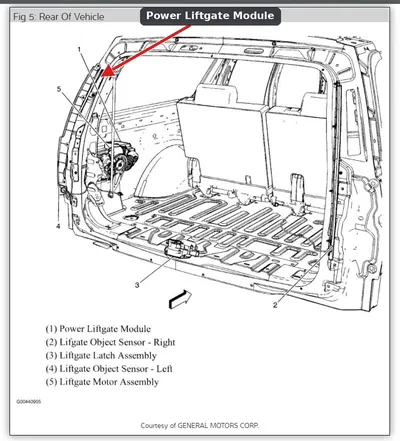
Code U0230 means the vehicle's main computer lost communication with the electronic module controlling the power liftgate. This module handles all automatic opening, closing, and latching functions. When communication drops, the power liftgate stops working and a warning light illuminates on the dashboard.
Technical definition: The SAE/OBD-II definition is "Lost Communication With Rear Gate Module." This indicates the Rear Gate Module (RGM) is not sending or receiving signals over the Controller Area Network (CAN bus). The master control unit triggers this code when it fails to receive a signal from the liftgate module for approximately 2,500 milliseconds.
Can I Drive With U0230?
Yes, But With Caution. Yes, the vehicle is safe to drive. This code disables the power liftgate but does not impact the engine, braking, or primary safety systems. You must operate the tailgate manually, and related features like the cargo light or anti-theft sensors might stop functioning.
Common Causes

- Damaged Wiring Harness (Very Common) — Wires running from the body to the liftgate pass through a flexible rubber boot. Repeated opening and closing causes these wires to fatigue, bend, and break. This is the most common failure point.
- Blown Fuse (Common) — The rear gate module requires power to communicate. A blown fuse cuts power, taking the module offline. This usually indicates an underlying short circuit.
- Low Battery Voltage / Improper Initialization (Common) — A weak battery provides insufficient voltage during engine cranking, causing the module to drop off the network. Disconnecting the battery also erases the module's memory, requiring a manual initialization procedure.
- Faulty Liftgate Latch Assembly (Common) — The latch assembly contains internal sensors and motors. Mechanical or electrical failure inside the latch disrupts the module's position tracking, triggering a communication fault. This is highly prevalent on Toyota Highlanders.
- Corroded or Loose Connectors (Common) — The module's electrical connector is exposed to moisture and road salt. Corrosion on the pins creates high resistance, blocking communication signals.
- Failed Rear Gate Module (Less Common) — The control module fails due to water intrusion, vibration, or age. When the internal processor dies, it stops talking to the vehicle network.
- Poor Ground Connection (Less Common) — The module requires a solid connection to the metal chassis. A loose or corroded ground strap prevents operation and causes intermittent faults.
- Software/Calibration Anomaly (Less Common) — The module's software can enter a fault state. GM issued TSB PIT5776B for 2021 SUVs, requiring a power cycle and software reprogramming to fix this exact issue.
- Cracked Power Liftgate Strut Housing (Rare) — On models like the Hyundai Palisade, the motorized liftgate strut's plastic housing cracks. This mechanical failure sets a communication code.
Symptoms

- Power liftgate will not open or close — The tailgate ignores the key fob, dashboard switch, and hatch button.
- Rear gate/tailgate warning light is on — A "Liftgate Ajar" message or tailgate icon stays illuminated on the instrument cluster.
- Liftgate operates erratically — The hatch starts to open, stops, reverses direction, or moves only a few inches before failing.
- Beeping sound from the rear of the vehicle — The vehicle emits a series of warning beeps when attempting to use the power liftgate.
- Interior lights or alarm system malfunction — The cargo area light fails to turn on, or the anti-theft system behaves erratically due to unknown tailgate position.
Diagnostic Flowchart

Tap your situation to follow the diagnostic path that matches what you're seeing on this code.
Common Fixes & Costs
- Repairing Broken Wires in Harness — Parts: $5-$20, Labor: $150-$450, ~2.5 hr book time (Intermediate)
- Replacing Blown Fuse — Parts: $1-$5, Labor: $0-$50, ~0.1 hr book time (DIY)
- Performing System Reset/Initialization — Parts: $0, Labor: $0-$100, ~0.1 hr book time (DIY)
- Replacing Liftgate Latch Assembly
— Parts: $350-$550, Labor: $100-$250, ~1.2 hr book time
(Intermediate)
Toyota Highlander (2008-2013): OEM 69350-0E100 (Alt: Dorman 931-861, Aisin DLT-108) - Replacing Rear Gate Module
— Parts: $100-$900, Labor: $150-$250, ~1.5 hr book time
(Professional)
Honda Pilot (2016-2018): OEM 74970-TG7-A11 (Alt: Cardone (Remanufactured), Dorman)
Toyota Highlander (2008-2013): OEM 89222-48060 - Replacing Power Liftgate Strut
— Parts: $200-$400, Labor: $100-$200, ~0.8 hr book time
(Intermediate)
Hyundai Palisade (2020-2022): OEM 81831-S8100 (Left), 81841-S8100 (Right)
DIY vs Professional
- Replacing Blown Fuse — Beginner: True
- Performing System Reset/Initialization — Beginner: True
- Repairing Broken Wires in Harness — Beginner: False
- Replacing Liftgate Latch Assembly — Beginner: False
- Replacing Rear Gate Module — Beginner: False
Used vs. New Parts: Buying Guide
When a used part is worth it: Buying a used module from a salvage yard makes sense for vehicles over 10 years old where a new OEM part is cost-prohibitive. It is a high-risk option for budget-conscious owners.
Donor-vehicle mileage cap: roughly under 100000 miles for the part to have meaningful remaining life.
Donor quality checklist:
- Verify the exact part number match.
- Inspect connector pins for corrosion.
- Buy from a seller with a return policy, as used electronics are often sold 'as-is'.
Decision logic:
- If Vehicle is under 8 years old or requires programming → Buy new OEM. The risk of a used part being incompatible or failing after programming is too high.
- If Vehicle is over 12 years old and budget is tight → A used part is a viable gamble, but understand it may have a limited lifespan.
- If The failure is due to a known wear item → Favor a remanufactured unit, as these have weak points corrected and are fully tested.
Warranty tradeoff: Used parts from salvage yards typically offer a 30-day warranty. Remanufactured parts offer a 1-year to lifetime warranty. New OEM parts carry a 1-year warranty.
Worst-case if a used part fails: $300-$600 if a used module fails, including the sunk cost of the part plus diagnostic and programming labor.
What Happens If You Wait — Timeline
- 0-1 month: Code U0230 sets. The power liftgate becomes inoperative or intermittent, requiring manual operation. (MPG impact: 0%% · Added cost: $0)
- 1-3 months: A shorted wire or faulty module creates a parasitic drain, killing the battery after a few days of sitting. (MPG impact: 0%% · Added cost: $150-$250)
- 3-12 months: Corrosion spreads from the connector to the module pins, destroying the module and requiring a wiring pigtail replacement. (MPG impact: 0%% · Added cost: $500-$1200)
- 12+ months: Severe corrosion damages the main body wiring harness or shorts the Body Control Module (BCM), requiring extensive network repair. (MPG impact: 0%% · Added cost: $1500-$3000+)
Cost of Not Fixing It
- 0-1 month: Loss of power liftgate functionality requires manual operation. This is an inconvenience but poses no safety risk. (Added cost: Negligible)
- 1-6 months: A shorted wire or failing module creates a parasitic battery drain. This kills the battery if the vehicle sits for several days. (Added cost: $150-$250 for a new battery.)
- 6+ months: Continued moisture ingress at a failed connector causes extensive corrosion. This damages the main wiring harness, drastically increasing repair costs. (Added cost: $500+ for harness connector replacement.)
Diagnosis Steps
- Check for a Deactivation Switch
Many vehicles feature a power liftgate disable button in the glove box or overhead console. Ensure this switch wasn't accidentally pressed before starting repairs.
Tools: None (Beginner) - Inspect the Fuses
Locate the Rear Gate Module fuses in the passenger and under-hood fuse boxes. Replace any blown fuses. If the new fuse blows immediately, trace the circuit for a short.
Tools: Fuse puller or needle-nose pliers (Beginner) - Attempt a System Reset/Initialization
Manually open the liftgate fully, then press and hold the close button on the hatch for 10-15 seconds until it beeps. This soft reset resolves temporary glitches caused by low voltage.
Tools: None (Beginner) - Inspect the Wiring Harness
Peel back the rubber boot between the vehicle body and the liftgate. Inspect every wire for breakage, chafing, or damaged insulation. Wiggle the harness while an assistant operates the gate to check for intermittent connections.
Tools: Panel trim tool, flashlight (Intermediate) - Check the Module Connector and Ground
Locate the Rear Gate Module (usually behind a cargo area trim panel). Disconnect it and clean any green or white corrosion with electrical contact cleaner. Ensure the black ground wire is bolted tightly to the chassis.
Tools: Trim panel removal tools, multimeter, electrical contact cleaner (Intermediate) - Test for Power and Ground at the Module
With the module unplugged and ignition on, use a multimeter to verify 12.0V-12.6V at the power supply pin. Verify the ground pin has less than 0.1 ohm of resistance to the chassis.
Tools: Multimeter, vehicle-specific wiring diagram (Advanced) - Check CAN Bus Communication Signals
Check the CAN bus wires at the module connector with the ignition on. CAN High must measure 2.5V-3.5V, and CAN Low must measure 1.5V-2.5V. With the battery disconnected, resistance between CAN High and Low should be 60 or 120 ohms.
Tools: Multimeter, vehicle-specific wiring diagram (Advanced) - Analyze Live Data with a Scan Tool
Connect a scan tool and view the Body Control Module live data. Monitor 'Liftgate Switch Status'. If the status changes when you press the button but the gate doesn't move, suspect a mechanical or internal module fault.
Tools: OBD-II Scan Tool with Live Data capability (Advanced) - Use a Bi-Directional Scan Tool
Use a professional scan tool's 'Actuator Test' to command the liftgate open. If the module ignores the command despite having verified power, ground, and CAN signals, replace the module.
Tools: Bi-directional OBD-II scan tool (Professional)
When This Code Triggers (Freeze-Frame Conditions)
- Vehicle Speed: 0 mph (The fault is logged when the vehicle is stationary, either at key-on or when a liftgate command is issued.)
- RPM: 0 or 750 RPM (Typically set during a key-on, engine-off network check, or immediately after starting the engine.)
- Battery Voltage: 11.8V - 14.5V (Normal battery voltage. The code triggers during a normal voltage state if communication drops.)
- System Time: 2,500 ms (The fault sets after the master module fails to hear from the liftgate module for this specific timeout duration.)
Related Codes
- B2222 — Toyota-specific code for an internal power back door ECU fault. When paired with U0230, it confirms a failed latch assembly.
- B1495 — Ford code for a hands-free liftgate sensor circuit failure. A short in this bumper sensor disrupts the liftgate module's communication.
- U0002 / U1002 — General CAN bus performance codes. If present with U0230, the issue is a broader network short, not an isolated liftgate module failure.
- U-codes in other modules — If U0230 is stored in multiple modules (instrument cluster, radio, BCM), it confirms multiple systems cannot hear from the rear gate module.
Climate & Environmental Factors
- Road Salt (Rust Belt Regions): Road salt spray accelerates corrosion on wiring, connectors, and ground points, creating high resistance that blocks communication.
- High Humidity / Water Ingress: Clogged sunroof drains or failed seals allow water to pool on module circuit boards. This is the leading cause of failure for trunk-floor mounted modules.
- Extreme Cold: Cold weather drops battery voltage below the module's minimum operating threshold during startup. Plastic wiring insulation also becomes brittle and prone to snapping.
How to Talk to a Mechanic About This Code
Say this: "I have a U0230 code and an inoperative power liftgate. Please check for TSBs, inspect the hinge wiring harness, and verify module power/ground before recommending a replacement."
Directs the technician to follow a logical diagnostic path instead of jumping to an expensive module replacement.
Avoid saying:
- 'My trunk won't open.'
- 'The liftgate is broken, just fix it.'
- 'I think I need a new liftgate computer.'
Questions to ask before authorizing the repair:
- Did you find broken wires in the hinge harness?
- Did you confirm the module has good power, ground, and CAN signals?
- Does the new module require programming?
- What is the warranty on this specific repair, including both parts and labor?
Where to Take It: Dealer vs Independent vs Chain
- Dealer:
Recommended for vehicles under warranty, newer models requiring proprietary programming, or complex German electrical issues.
Best for: Vehicles under warranty or covered by a specific TSB/service campaign., Newer vehicles requiring proprietary programming., Complex electrical issues on German brands.
Downsides: Highest labor rates., More likely to replace an entire assembly rather than repair a single wire. (Typical cost: +50% vs. baseline) - Independent Shop:
Best for out-of-warranty vehicles needing wiring repairs or latch replacements at a lower labor rate.
Best for: Out-of-warranty vehicles where the most common cause is a wiring or mechanical issue., Diagnosing and repairing broken wires in the hinge harness., Vehicles over 5 years old where cost is a primary concern.
Downsides: May not have the latest OEM software to program a new module., Quality varies; look for shops specializing in electrical diagnostics. (Typical cost: +0% vs. baseline) - Chain Shop:
Avoid for U0230. This code requires specific electrical diagnostic skills beyond the scope of a typical chain shop.
Best for: Simple fuse replacement if you are unable to do it yourself.
Downsides: Technicians lack experience for complex electrical or CAN bus diagnosis., High pressure to upsell., Not equipped for module programming or in-depth wiring repairs. (Typical cost: -10% vs. baseline)
When to Walk Away From the Repair
If the repair cost exceeds 15-20% of the car's value, consider living with a manual tailgate. If it exceeds 50%, sell the vehicle as-is.
- Car worth $4000, fix is $1200: Walk away. The repair is 30% of the car's value for a non-essential feature. Sell as-is with disclosure or use manually.
- Car worth $15000, fix is $800: Fix it. The cost is low relative to the car's value and restores a key feature.
- Car worth $2500, fix is $1500: Definitely walk away. The repair cost is 60% of the car's value. This money is better put toward a replacement vehicle.
What Scan Tool You Need for This Code
Minimum: A scanner that can read Body Control Module (BCM) codes and view live data PIDs for body systems.
A basic engine code reader cannot communicate with the Body Control Module to see U0230. You need a full-system scanner.
Budget: BlueDriver Pro (~$99) — Reads and clears BCM codes and views live data PIDs like liftgate switch status.
Mid-range: Foxwell NT809 / Autel MaxiCOM MK808S (~$350-450) — Provides bi-directional control to command the liftgate open or close, directly testing the module's output.
Professional: Autel MaxiIM IM608 / Launch X431 Series (~$600-1500+) — Performs VIN programming and initialization required when replacing the Rear Gate Module.
Rent vs buy: Buying a budget pick like BlueDriver is a good investment. If bi-directional control is needed for a one-time fix, a mid-range tool is a justifiable purchase as it's still cheaper than one diagnostic hour at a dealer.
How to Clear the Code After You Fix It
- Reconnect the battery if disconnected.
- Use an OBD-II scan tool to erase the U0230 code.
- Operate the power liftgate multiple times using the key fob, interior switch, and hatch button to confirm functionality.
Drive cycle (~20 minutes): Start the vehicle cold and idle for 2-3 minutes. Drive in mixed city/highway conditions for 15-20 minutes, including steady-state cruising. Perform several key cycles over the next day to allow the main computer to verify communication with the rear gate module.
Readiness monitors affected: All monitors, Catalyst monitor, EVAP system monitor, O2 sensor monitor
Before emissions retest: drive at least 50 miles to fully set monitors.
Watch out for:
- Clearing the code resets all emissions readiness monitors to 'not ready', causing an immediate emissions test failure.
- For 2010+ vehicles, a 'Permanent DTC' remains until the computer verifies the repair over multiple drive cycles.
- If the root cause is not fully repaired, the code returns intermittently.
Will This Fail Emissions / State Inspection?
Yes — this code typically fails an OBD-II emissions inspection.
- California: A U0230 code does not fail a smog check, but clearing it resets all OBD-II readiness monitors to 'incomplete'. California requires all monitors to pass before testing. You must complete a 50-100 mile drive cycle after the repair.
- New York: NYS inspections include an OBD-II scan. Clearing the code right before the test causes an automatic failure due to 'incomplete' monitors.
- Texas: Texas allows only one non-continuous monitor to be 'not ready' for 2001+ vehicles. Clearing U0230 resets all monitors, guaranteeing a failure until driven.
Most Commonly Affected Vehicles
- Toyota Highlander / Highlander Hybrid (2008-2013) — Covered by Warranty Enhancement Program ZG4 and TSB T-SB-0038-15 for power back door latch assembly failures (Part 69350-0E100). Often accompanied by code B2222.
- Hyundai Palisade (2020-2022) — Failures stem from cracked motorized liftgate struts or internal wiring issues covered under service campaign T4X (TSB 20-01-022H-1).
- Honda Pilot (2012-2018) — 2016+ models require dealer programming for new modules (74970-TG7-A11). Diagnosis requires checking under-hood fuse No. 23 and under-dash fuse No. 10.
- Ford Expedition / Edge (2015-2019) — Often caused by a shorted hands-free liftgate sensor harness in the rear bumper, which blows the module's fuse.
- Dodge Durango / Grand Caravan (2017-2021) — Issues arise from blown fuses or problems with the liftgate control module located in the left rear quarter panel area.
- BMW X5 (E70) (2007-2013) — The tailgate control module sits in a trunk floor recess, making it highly vulnerable to flooding from clogged sunroof drains.
- Subaru Outback / Forester (2020-2023) — Prone to erratic behavior and communication faults. The issue is often the liftgate drive unit (motor) or the latch assembly.
- Chevrolet Tahoe / Suburban (2021) — TSB PIT5776B addresses a software anomaly causing module failure. The fix requires a power cycle and dealership reprogramming.
Manufacturer-Specific Notes
- Toyota: A loud 'pop' or 'clunk' from the latch on 2008-2013 Highlanders indicates a mechanical latch failure (TSB T-SB-0038-15).
- General Motors (Chevy/GMC/Cadillac): TSB PIT5776B for 2021 SUVs advises pulling the liftgate fuse for 1 minute to reset the module, followed by a software update.
- Ford / Lincoln: Restoring function often requires a 'Power Liftgate Initialization' by disconnecting the negative battery terminal for 20 seconds.
- BMW: Always check the spare tire well for standing water from clogged sunroof drains before replacing the module on E70 X5 models.
- Mitsubishi: The A/C control unit or radio receives signals from the liftgate module. A U0230 code sets in these seemingly unrelated modules if communication drops.
Real Owner Stories
2009 Toyota Highlander with 155K miles - The Easy Fix
Owner reported the power liftgate beeped twice and ignored all buttons. No other symptoms were present.
What they tried:
- Verified the rear glass was fully latched.
- Checked fuses related to the power back door.
Outcome: The owner discovered the 'Pwr Door' deactivation switch in the glove box was accidentally pressed. Pushing the button immediately restored full function.
Lesson: Always check for a deactivation switch before beginning diagnosis. It is the most common oversight.
2012 Honda Pilot with 120K miles - Misdiagnosis Story
The power tailgate stopped working completely. The owner assumed the control module failed due to the U0230 code.
What they tried:
- Owner purchased a used power tailgate control unit online for $150.
- After replacing the module, the liftgate still did not work.
Outcome: Professional diagnosis revealed two broken wires inside the flexible rubber boot near the liftgate hinge. The shop repaired the wires for $250. The original module was fine.
Lesson: Never assume the module is the problem. Perform wiring, power, and ground checks before replacing expensive electronics.
2008 BMW X5 with 130K miles - Unusual Root Cause
The power tailgate became intermittent, eventually failing completely. The owner noticed a musty smell in the cargo area after heavy rain.
What they tried:
- Checked fuses and attempted a system reset.
- Inspected the wiring harness at the hinge.
Outcome: The owner found over an inch of standing water in the spare tire well, submerging the tailgate module due to clogged sunroof drains. The corroded module required a $400 replacement.
Lesson: Always check for water intrusion on vehicles with trunk-mounted modules. Cleaning sunroof drains prevents expensive repairs.
How to Prevent This Code From Triggering
- Periodically lubricate liftgate hinges and pivot points (Once per year) — Apply white lithium grease to mechanical hinges to reduce strain on the liftgate motor and prevent electrical faults.
- Clean and protect the wiring harness boot (Every 2-3 years) — Clean the rubber boot and apply a vinyl protectant to maintain flexibility, reducing stress on internal wires.
- Apply dielectric grease to the module connector (Once, or when exposed for other service) — Apply a thin layer of dielectric grease to the connector seal to prevent moisture and road salt corrosion.
- Clean sunroof and rear window drains (Once per year, especially in leafy areas) — Clear sunroof drains with compressed air to prevent water from flooding trunk-mounted modules.
Frequently Asked Questions
Can I drive my car with a U0230 code?
Yes, it is safe to drive. The code disables the power liftgate but does not impact the engine, braking, or safety systems. You must operate the tailgate manually.
Why did my liftgate stop working after my car battery died or was replaced?
A weak or disconnected battery erases the rear gate module's memory. When power is restored, the module requires re-initialization. Manually open and close the liftgate, or hold the close button until it beeps to reset it.
What are the most common mistakes when diagnosing U0230?
The biggest mistake is immediately replacing the expensive rear gate module. Technicians must first rule out a blown fuse, a pressed deactivation switch, or broken hinge wires. Always check for Technical Service Bulletins (TSBs) before buying parts.
How do I reset the rear gate module?
A reset often fixes temporary glitches. Disconnect the negative battery terminal for 5 minutes, or pull the liftgate module fuse for 30 seconds. Alternatively, manually cycle the liftgate and hold the close button until it beeps.
Will the U0230 code clear itself?
Intermittent problems like a loose wire may allow the code to become a 'history' code, restoring function temporarily. However, persistent faults require a physical repair, and the code will not permanently clear until the root cause is fixed.
Can I replace the rear gate module myself?
Physical replacement is straightforward for DIYers since the module sits behind a cargo trim panel. However, most new modules require VIN programming with a dealer-level scan tool. Skipping programming leaves the new module completely inoperative.
Is it expensive to fix a U0230 code?
Costs range from $0 for a system reset to $150-$450 for a common wiring repair. Replacing the control module or latch assembly at a dealership costs between $800 and $1,600. Always rule out blown fuses and broken wires before replacing expensive parts.
Key Takeaways
- Broken wires inside the flexible rubber boot between the liftgate and the body cause over 50% of U0230 codes.
- Check the glovebox deactivation switch and perform a 15-second manual liftgate reset before spending money on diagnostics.
- Toyota Highlanders (2008-2013) and Chevy Tahoes (2021) have specific Technical Service Bulletins for U0230 requiring a latch replacement or software update.
- The vehicle remains 100% safe to drive with a U0230 code, though you must operate the tailgate manually.
- Clogged sunroof drains in BMW X5s channel water directly into the trunk floor, destroying the rear gate module and triggering this code.
Shop the Parts Behind U0230
Below are the parts most often responsible for code U0230, ranked by how frequently each one is the actual culprit (per the diagnosis above). Tap any to see what we have for your vehicle.



The information in this article is provided for general reference and educational purposes only. Vehicle specifications, procedures, and part compatibility can vary by production date, trim level, and region. Always consult your vehicle's factory service manual and verify part numbers before purchasing or performing repairs. Safety-critical components such as airbags, seat belts, and braking systems should be installed by a qualified professional.
- 🧭 Diagnostic Flowchart
- 🛍️ Shop This Part
- What Does U0230 Mean?
- Can I Drive With U0230?
- Common Causes
- Symptoms
- Common Fixes & Costs
- DIY vs Professional
- Used vs. New Parts: Buying Guide
- What Happens If You Wait — Timeline
- Cost of Not Fixing It
- Diagnosis Steps
- When This Code Triggers (Freeze-Frame Conditions)
- Related Codes
- Climate & Environmental Factors
- How to Talk to a Mechanic About This Code
- Where to Take It: Dealer vs Independent vs Chain
- When to Walk Away From the Repair
- What Scan Tool You Need for This Code
- How to Clear the Code After You Fix It
- Will This Fail Emissions / State Inspection?
- Most Commonly Affected Vehicles
- Manufacturer-Specific Notes
- Real Owner Stories
- 2009 Toyota Highlander with 155K miles - The Easy Fix
- 2012 Honda Pilot with 120K miles - Misdiagnosis Story
- 2008 BMW X5 with 130K miles - Unusual Root Cause
- How to Prevent This Code From Triggering
- Frequently Asked Questions
- Can I drive my car with a U0230 code?
- Why did my liftgate stop working after my car battery died or was replaced?
- What are the most common mistakes when diagnosing U0230?
- How do I reset the rear gate module?
- Will the U0230 code clear itself?
- Can I replace the rear gate module myself?
- Is it expensive to fix a U0230 code?
- Key Takeaways
- 🎟️ Get 5% Off