

U0293 on 2018-2021 Jeep Wrangler: Lost Communication With Hybrid Module Fixes
This code means a communication link to the hybrid system has failed. On your Wrangler (eTorque or 4xe), the most common cause is a software glitch requiring a multi-module dealer update per manufacturer bulletins. Less common causes are wiring issues, a weak 12V battery causing network instability, or a failed control module (BPCM on eTorque, PIM on 4xe).
- U0293 means the hybrid system has stopped communicating with the main computer; it is not a specific part failure but a loss of data.
- For the 2018-2021 Wrangler, the most probable cause is a software bug. Check with a dealer for available TSBs before attempting any expensive repairs.
- This is not a DIY-friendly repair. Diagnosing network issues and working on hybrid systems requires specialized tools and expertise.
- Symptoms can be severe, including stalling and limp mode, so it is important to have the vehicle diagnosed promptly.
- Do not immediately assume a major component like the battery or motor has failed; the problem is often in the software or wiring that connects them.
What's Unique About the 2018-2021 Jeep WRANGLER

The 2018-2021 Wrangler JL platform includes two different 'hybrid' systems, and this code can appear on both. Wranglers with the 2.0L or 3.6L engine can have the eTorque mild-hybrid system, which uses a Battery Pack Control Module (BPCM) that communicates on a private CAN-ePT bus with the MGU and PCM. Starting in 2021, the Wrangler 4xe introduced a full plug-in hybrid (PHEV) system with a more complex network of modules, including the Power Inverter Module (PIM), Integrated Dual Charging Module (IDCM), and BPCM. For both systems, Jeep has issued several Technical Service Bulletins (TSBs) indicating that software updates are a common fix for this communication loss, often requiring flashes for multiple modules (PCM, TCM, BPCM, PIM) to resolve the issue.
Diagnostic Flowchart

Tap your situation to follow the diagnostic path that matches what you're seeing on this vehicle.
Symptoms You May Notice

- Check Engine Light (MIL) illuminated
- Hybrid/EV system warning light on
- Dashboard messages like 'Hybrid System Disabled', 'Service Hybrid System', or 'Reduced Power'.
- Vehicle enters 'limp mode' with limited speed and acceleration.
- Auto stop-start function is disabled or works incorrectly (eTorque models).
- Loss of electric-only driving mode (4xe models).
- Vehicle may stall unexpectedly, sometimes displaying 'Shift to P to Start' while in motion, as reported by owners.
- 12-volt battery not charging properly, leading to a dead battery, because the DC-to-DC converter (managed by the hybrid module) is offline.
- Regenerative braking is disabled, resulting in a different brake pedal feel.
- Replacing the 12V battery without diagnosing the charging system. A failing hybrid system (due to U0293) will stop the DC-to-DC converter from charging the 12V battery, making the dead battery a symptom, not the root cause.
- Replacing the main PCM. While possible, it is much more likely that the communication issue originates with the hybrid module, its software, or its dedicated wiring, as these are the components specifically called out in TSBs.
- Replacing the Motor Generator Unit (MGU) on eTorque models. One owner on the forums replaced the MGU hoping to fix the U0293 code, but the problem persisted, indicating the fault was elsewhere in the system (wiring, BPCM, or software).
Most Likely Causes

- Control Module Software Needs Updating 🔴 High Probability Multiple manufacturer TSBs (#21-015-22, #08-166-23, #21-028-21) confirm that outdated software in the hybrid system's control modules is a primary cause for this communication loss. These updates correct logic errors that lead to the U0293 code. TSBs often require updating several modules in tandem (e.g., PCM, BPCM, TCM, PIM) for the fix to be effective.
How to confirm: A dealer or a shop with a subscription to Jeep's technical information (DealerCONNECT) can check your vehicle's VIN against known TSBs and Rapid Service Updates (RSUs).
Typical fix: The relevant control modules must be reprogrammed with the latest software version using a wiTECH scan tool. This is not a DIY task.
Est. part cost: $0 - Damaged Wiring or Loose Connectors 🟡 Medium Probability The CAN bus network relies on a pair of twisted wires for communication. These wires run throughout the vehicle and can be susceptible to chafing, corrosion, or damage from road debris, water intrusion, or previous repairs, especially in a vehicle designed for off-road use. A single loose pin or corroded connector at the BPCM or PIM can take the module offline. Forum users have reported wiring harnesses melting from proximity to exhaust components.
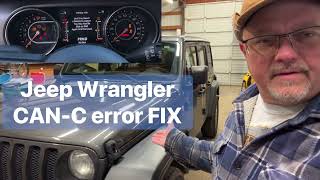
How to confirm: Visually inspect the wiring harness between the PCM and the relevant Hybrid Control Module. A technician will use a multimeter to check for proper resistance (typically 54-69 ohms) on the CAN bus and an oscilloscope to verify signal integrity. 🎬 Watch: Professional diagnostic steps for Jeep CAN bus communication faults.
Typical fix: Repair the damaged section of the wiring harness or clean and re-secure the affected connectors. Dielectric grease should be applied to prevent future corrosion.
Est. part cost: $10-$50 - Failing Hybrid Control Module (BPCM or PIM) ⚪ Low Probability While less common, the module itself can fail due to internal electronic faults. On eTorque models, this is the Battery Pack Control Module (BPCM), which is integrated with the 48V battery pack (Power Pack Unit). On 4xe models, this is the Power Inverter Module (PIM). This is a last-resort diagnosis after software and wiring have been completely ruled out.
How to confirm: After confirming the wiring, power, and ground to the module are good and the software is up to date, the module is diagnosed as the point of failure. This requires advanced diagnostic tools to confirm the module is unresponsive on the network.
Typical fix: Replace the failed module. The new module will need to be programmed and configured for the specific vehicle's VIN. On some models, the BPCM is considered internal to the high-voltage battery and the entire battery assembly must be replaced.
Est. part cost: $800-$2000
Rare But Worth Checking
- Low 12V Battery Voltage: → Shop Vehicle Battery
- Faulty CAN Bus Star Connector:
Diagnosis Steps
- Verify the complaint and check for any warning messages on the instrument cluster.
- Connect a professional-grade scan tool (like wiTECH) and check for TSBs related to U0293 for the vehicle's VIN.
- Read codes from ALL available modules, not just the PCM. Note any other communication (U-prefix) or performance codes.
- If a software update TSB is available, perform the update(s) as the first step. Note that multiple modules may require flashing.
- If no TSB applies or the code returns, perform a full CAN network diagnostic test to check the status of all modules.
- Test the health of the 12V battery system (both main and auxiliary, if equipped). A weak battery can cause network-wide communication faults.
- Visually inspect the wiring harness and connectors between the PCM and the Hybrid Control Module (BPCM on eTorque, PIM on 4xe). Look for signs of chafing, corrosion, or loose pins. Pay attention to areas exposed to elements or near hot exhaust components.
- Using a multimeter with the battery disconnected, check for proper resistance on the CAN bus wires at the Hybrid Control Module connector. Resistance between CAN-H and CAN-L should be around 60 ohms. Some service data suggests a range of 54-69 Ω.
- If wiring, power, and software are confirmed to be good, the Hybrid Control Module itself is the likely point of failure and requires replacement and programming.
Parts You'll Likely Need
- Control Module Software Update — This is not a physical part, but a dealer service. It is the most common fix documented in manufacturer TSBs for U0293.
- Star Connector
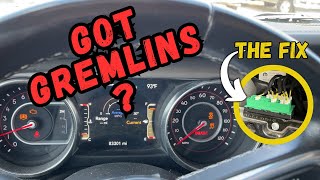
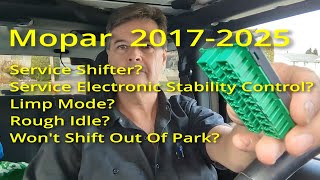
(OEM #68321746AA)— A known failure point on the JL/JT platform that can cause widespread communication issues, including U0293. It acts as a central hub for the CAN bus network. 🎬 Watch: How to locate and fix star connector gremlins.
- Power Inverter Module (PIM)
(OEM #05185282AB)— For 4xe models, this is the primary hybrid control module. It is replaced only after software and wiring issues are ruled out. - Battery Pack Control Module (BPCM) / Power Pack Unit (PPU) — For eTorque models, the BPCM is the hybrid control module. It is often serviced as part of the entire 48V battery assembly (PPU).
Related Codes That Often Appear With This One
- U1886-00 — This code for 'Lost Communication With ECM/PCM' from the Battery Energy Control Module often appears with U0293, as they both indicate a breakdown in communication between the main engine and hybrid controllers. It is specifically mentioned in TSB #08-166-23.
- P0A94-00 — This code relates to the performance of the DC/DC converter, which is managed by the hybrid control system. A communication loss (U0293) can lead to performance faults in the components the module controls. It is also cited in TSB #08-166-23.
- P0732-00 — This code for 'Gear 2 Shift Incorrect Ratio' can be set alongside U0293 because the hybrid module provides critical torque information to the transmission control module for smooth shifting. A loss of this data can confuse the transmission's logic, as noted in TSBs #21-015-22 and #21-028-21.
- P061B-00 — This code for 'Internal Control Module Torque Calculation Performance' is directly related to U0293. The hybrid module is a key part of the overall powertrain torque calculation. If its data is missing, the PCM flags a performance error. This is also cited in TSBs #21-015-22 and #21-028-21.
Technical Service Bulletins (TSBs) & Recalls
- 21-015-22
- 08-166-23
- 21-028-21
- 08-178-23
- 08-050-23
Platform-Specific Known Issues
- TSB #21-015-22 and #21-028-21 address MIL illumination with U0293 on 2021 4xe models, pointing to a software update for the TCM, PCM, PIM, and BPCM.
- TSB #08-166-23 specifically calls out U0293 on 2018 Wranglers with the 2.0L eTorque engine, noting the cause as 'BPCM software' and providing a software update as the correction.
- An owner of a 2021 model reported U0293 appeared alongside other communication codes after a suspected improper wake-up of a control module. [ODI #11485491]
- Owners on jlwranglerforums.com have documented experiencing U0293 in conjunction with a dead 12V battery, as the hybrid system's failure prevents the DC-DC converter from keeping the 12V system charged.
Mechanic-Grade Diagnostic Values
- CAN Bus Network Resistance — expected: Approximately 60 Ohms (Ω). Failure: A reading of ~120 Ohms indicates an open circuit or a missing terminating resistor. A reading near 0 Ohms indicates a short between the CAN High and CAN Low wires.
- CAN High Voltage (Key On, Engine Off) — expected: 2.5 – 3.5 Volts. Failure: Voltage outside this range indicates a potential short to power or ground, or a faulty module pulling the voltage down.
- CAN Low Voltage (Key On, Engine Off) — expected: 1.5 – 2.5 Volts. Failure: Voltage outside this range indicates a potential short to power or ground, or a faulty module pulling the voltage down.
Scan Tool Commands That Help
- wiTECH: Loss of Comm Test — This function continuously 'pings' all modules on the network to check for responses. It is extremely useful for diagnosing intermittent connection problems. A technician can wiggle harnesses while watching the screen to see if any module's 'no response' count increases, pinpointing the location of a physical fault.
- wiTECH: Restore Configuration and Align Proxi — This procedure is required after replacing a major control module like the BPCM or PIM. It ensures the new module is correctly integrated into the vehicle's network and security systems.
Wiring & Ground Locations
- Star Connectors (CSCB, CSCIP) — Located behind the glove box, mounted to a bracket near the HVAC housing.. These are central hubs for the CAN C bus. A failure in the connector itself due to heat or vibration can sever communication to multiple modules, including the hybrid controller, causing U0293 and other U-codes. Wiggling the harnesses connected to it can be a quick diagnostic check.
- Power Inverter Module (PIM) - 4xe Models — Mounted high on the driver's side of the engine bay.. This is the Hybrid Control Module for the 4xe. Its connectors and nearby harness are primary inspection points for damage or corrosion when diagnosing U0293.
- Battery Pack Control Module (BPCM) - eTorque Models — Integral to the Power Pack Unit (PPU), which is the 48V battery pack mounted on the back wall of the cabin, behind the rear seats.. This is the Hybrid Control Module for eTorque models. Accessing its connectors requires removing interior trim and accessing the 48V battery assembly.
- G905A / G908A — These are ground points for the Dash and Instrument Panel (IP) harnesses, located in the driver and passenger footwells, typically behind the kick panels.. A poor ground connection at these points can cause instability for any module grounded through them, potentially including network gateway modules, leading to communication codes.
- Common Chafe/Melt Point — Wiring harness routed over the transmission and near exhaust components, particularly behind the passenger-side fender liner.. Multiple owner reports indicate that harnesses in this area can rest on hot exhaust pipes, melting the insulation and causing shorts in the CAN bus wires, which directly leads to communication codes like U0293.
Real Owner Repair Stories
- jlwranglerforums.com user 'msandhu413' (2019 Jeep Wrangler (eTorque)) — Hybrid system not working, 12V battery not charging, vehicle stalled and would not restart until the 12V battery was charged externally. Displayed 'Shift to P to Start' even when in Park.
❌ Tried (didn't work) Replaced the Motor Generator Unit (MGU).
✅ What actually fixed it The user was still diagnosing at the end of the thread, but had confirmed the code was U0293 and that replacing the MGU (which includes a control module) did not solve the issue. This points strongly toward a wiring, BPCM, or software issue, rather than the MGU itself.
Model Year Variations Within This Range
- 2018-2021 eTorque vs 2021 4xe: The location and identity of the 'Hybrid Control Module' is completely different. On eTorque models, it's the BPCM integrated with the 48V battery pack in the cabin. On 4xe models, it's the Power Inverter Module (PIM) located under the hood. Diagnostic procedures must correctly identify which system is being worked on.
- 2021-2023 4xe: On 4xe models, the Integrated Dual Charging Module (IDCM) is responsible for charging the 12V battery from the high-voltage system. A special procedure, pulling fuse F09 in the engine bay fuse box, is required to disable the IDCM before safely disconnecting the 12V battery for service.
Helpful Videos

Used OEM Parts in Stock
New Aftermarket Parts Available


The information in this article is provided for general reference and educational purposes only. Vehicle specifications, procedures, and part compatibility can vary by production date, trim level, and region. Always consult your vehicle's factory service manual and verify part numbers before purchasing or performing repairs. Safety-critical components such as airbags, seat belts, and braking systems should be installed by a qualified professional.
- Jeep WRANGLER:
- 🧭 Diagnostic Flowchart
- 🎬 Helpful Videos
- 🛍️ Shop This Part
- What's Unique About the 2018-2021 Jeep WRANGLER
- Symptoms You May Notice
- Most Likely Causes
- Rare But Worth Checking
- Diagnosis Steps
- Parts You'll Likely Need
- Related Codes That Often Appear With This One
- Technical Service Bulletins (TSBs) & Recalls
- Platform-Specific Known Issues
- Mechanic-Grade Diagnostic Values
- Scan Tool Commands That Help
- Wiring & Ground Locations
- Real Owner Repair Stories
- Model Year Variations Within This Range
- 🎟️ Get 5% Off