

U0402 on 2021 Dodge Challenger: Causes for Implausible Data from TCM
On a 2021 Dodge Challenger, code U0402 most often indicates a software issue in the Powertrain Control Module (PCM) that needs an update from a dealer. TSB 18-001-23 confirms a reflash is the fix for a limp mode caused by this code. Before replacing any parts, check for software updates and verify battery voltage, as these are the most common and least expensive fixes.
- U0402 is a communication error, not a mechanical transmission failure.
- The most likely cause on a 2021 Challenger is a software bug in the Powertrain Control Module (PCM).
- Always check for software updates (TSBs) with a dealer before replacing expensive hardware like the TCM.
- Verify your battery and charging system are healthy, as low voltage can trigger this code.
- Driving with this code is not recommended due to the risk of unpredictable shifting and entering limp mode.
What's Unique About the 2021-2021 Dodge CHALLENGER
For this specific generation of Dodge Challenger and its platform-mates (Charger, 300, Ram 1500), the U0402 code is frequently linked to software glitches. The manufacturer has issued Technical Service Bulletins (TSBs), like 18-001-23 Rev. A, which state the PCM software may misinterpret data, deny torque requests from the TCM, and force the transmission into a fixed-gear limp mode. This makes a software reflash a critical first diagnostic step, distinguishing it from older vehicles where hardware failure might be the immediate suspect.
🎬 Watch: Common causes and fixes for the U0402 codeDiagnostic Flowchart
Tap your situation to follow the diagnostic path that matches what you're seeing on this vehicle.
Symptoms You May Notice
- Check Engine Light (Malfunction Indicator Lamp) is on.
- Vehicle enters a "limp mode," often getting stuck in a single gear.
- Erratic, harsh, or delayed shifting.
- Transmission or other warning lights (e.g., Traction Control) may illuminate on the dashboard.
- Inability to shift out of Park after the event occurs.
- Loss of traction control or stability control.
- Replacing the Transmission Control Module (TCM) when the actual fault is outdated PCM software.
- Replacing the entire transmission when the issue is purely electronic (software, module, or wiring).
Most Likely Causes
- Outdated Powertrain Control Module (PCM) Software 🔴 High Probability → Shop Engine Control Module (ECM) Manufacturer TSBs (specifically 18-001-23 Rev. A) confirm that faulty software logic can cause the PCM to incorrectly flag TCM data, deny torque requests, and trigger a fixed-gear limp mode as a direct result.
How to confirm: A dealership or qualified shop with a wiTECH scan tool can check the current software calibration ID against the latest version available from the manufacturer for your VIN.
Typical fix: Reprogramming (flashing) the PCM with the latest software version. This procedure requires a stable battery voltage between 13.2 and 13.5 volts to be maintained throughout the process.
Est. part cost: $0 - Low Battery Voltage or Charging System Fault 🟡 Medium Probability → Shop Vehicle Battery Modern control modules are highly sensitive to voltage. A weak battery or failing alternator can cause communication dropouts and data corruption between modules, especially during startup.
How to confirm: Test the battery's state of charge and health. With the engine running, use a multimeter to check the alternator output at the battery terminals; it should typically be between 13.5 and 14.5 volts.
Typical fix: Recharge or replace the battery. Replace the alternator if its output is out of range.
Est. part cost: $150-$400 - Faulty Transmission Control Module (TCM) ⚪ Low Probability → Shop Transmission Assembly While less common than software issues, internal failure of the TCM can cause it to send corrupted data. This can be due to hardware failure or firmware corruption.
How to confirm: This is typically diagnosed by exclusion. If the PCM software is up-to-date, and all wiring, power, and grounds are confirmed good, the TCM becomes the primary suspect. An advanced scan tool may show erratic data coming from the module.
Typical fix: Replace the Transmission Control Module and program it to the vehicle.
Est. part cost: $500-$1200 - Wiring Harness or Connector Issue ⚪ Low Probability Connections to the TCM can become corroded or damaged, disrupting the CAN bus communication signals. The central CAN bus hub, known as the Star Connector, is a key point to inspect for loose connections or internal failure.
How to confirm: Visually inspect the wiring harness and connectors between the PCM and TCM for any signs of damage, corrosion, or loose pins. Check for continuity on the CAN bus wires (typically twisted pairs) and verify resistance is approximately 60 ohms across the high and low lines with the battery disconnected.
Typical fix: Repair the damaged section of the wiring harness or clean/replace the affected connectors. Ensure the Star Connector pins are fully seated.
Est. part cost: $50-$300
Rare But Worth Checking
- Failing Powertrain Control Module (PCM): → Shop Engine Control Module (ECM) Although rare, the PCM itself can fail, causing it to misinterpret otherwise valid data from the TCM. This should only be considered after all other possibilities have been exhausted.
- Internal Transmission Valve Body Issue: → Shop Transmission Valve Body A TSB for a related platform (21-016-25 REV. C) notes that corrosion on CAN terminals *inside* the transmission valve body can lead to U0402. While not common for the Challenger, it is a possibility if all external checks pass.
- Faulty Star Connector (CAN Bus Junction): In rare cases, the Star Connector itself can fail. A technician on a related platform found an internal capacitor in the connector was failing intermittently after a long drive, causing the entire network to crash. The connector required replacement to fix the issue.
Diagnosis Steps
- Scan for all DTCs in all modules to see if other codes are present, which can provide more context.
- Check and verify battery voltage and the health of the charging system. Ensure voltage is stable and within the 13.5-14.5V range while running.
- Check for available Technical Service Bulletins (TSBs) related to U0402 for your vehicle's VIN. TSB 18-001-23 Rev. A is a primary candidate.
- If a TSB applies, have a dealer or qualified shop reprogram the PCM with the latest software. Ensure they maintain stable voltage between 13.2 and 13.5 volts during the flash.
- Inspect the wiring harness and connectors for the TCM and PCM for any visible damage, corrosion, or loose connections. Pay special attention to the main CAN bus junction (Star Connector) located behind the glove box.
- With the battery disconnected, use a multimeter to measure the resistance between the CAN-C High and CAN-C Low pins at the OBD-II port (Pins 6 and 14). A healthy network should read approximately 60 ohms.
- Using an advanced scan tool like wiTECH, monitor live data from the TCM to identify what data might be considered 'implausible' and perform bidirectional tests to command shifts.
- If all previous steps fail to resolve the issue, diagnosis then points toward a faulty TCM or, more rarely, a faulty PCM.
Parts You'll Likely Need
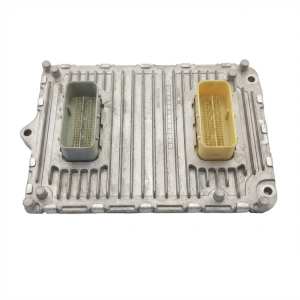
- Powertrain Control Module (PCM)
(OEM #68434935AC (one of several possibilities, VIN-dependent))— While a reflash is the most common fix, if the module itself has failed, it will need replacement. This part is listed for 2021 Challengers but must be verified with a VIN.
Trusted brands: Mopar
OEM price range: $550-$1100
Aftermarket price range: $300-$800 - Transmission Control Module (TCM) — If software updates and wiring checks do not resolve the code, the TCM itself may have an internal fault causing it to send corrupt data.
Trusted brands: Mopar
OEM price range: $800-$1200
Aftermarket price range: $500-$800
Related Codes That Often Appear With This One
- U0101 — This code for 'Lost Communication With TCM' often appears alongside U0402, indicating a broader communication problem with the transmission module. TSB 1801122 lists both codes as part of a potential widespread communication fault.
- P0700 — This is a general 'Transmission Control System Malfunction' code. The TCM requests the PCM to turn on the check engine light, and U0402 can be one of the underlying specific faults.
- U-series codes — TSB #1801122 lists numerous other U-codes (U0102, U0140, U0403, etc.) that can be set along with U0402, pointing to a widespread communication or module issue that can be resolved with a PCM software update.
Technical Service Bulletins (TSBs) & Recalls
- 18-001-23 Rev. A: Explicitly identifies a PCM software bug as the cause for U0402 and the resulting limp mode. The fix is a PCM reflash.
- 1801122: Lists U0402 as part of a large group of communication DTCs that can be resolved by a PCM software update.
Platform-Specific Known Issues
- PCM Software Requires Update: TSB #18-001-23 Rev. A specifically addresses DTC U0402-00. It states that when this code sets, the PCM will deny torque requests from the TCM, causing the transmission to enter a fixed-gear limp mode. The official repair is to reprogram the PCM with the latest software.
- Widespread Communication DTCs: A broader Technical Service Bulletin (#1801122) for the 2021 Dodge Challenger lists U0402 as one of many potential communication codes that can be fixed with a single PCM software update, indicating a known systemic software issue.
Mechanic-Grade Diagnostic Values
- CAN Bus Network Resistance — expected: ~60 Ohms. Failure: A reading of ~120 Ohms indicates an open circuit or missing terminating resistor. A reading near 0 Ohms indicates a short between the CAN High and Low wires.
- CAN Bus Voltage (Active) — expected: CAN High (Pin 6) should be ~2.6V and CAN Low (Pin 14) should be ~2.4V.. Failure: Voltages shorted to ground will be near 0V. Voltages shorted to power could be 5V or as high as battery voltage (12V). A reading above 6.0V is a definitive sign of a short to voltage.
- Transmission Solenoid Resistance (NAG1 5-Speed) — expected: Line Pressure Solenoid: ~5.5 Ohms. Shift Solenoids: ~4.5 Ohms. Lock-up Clutch Solenoid: ~2.7 Ohms.. Failure: Readings significantly outside these ranges indicate a faulty solenoid or internal wiring.
Hidden / Shadow Codes Worth Checking
- U0402-00: This is the full code with a symptom byte. TSB 18-001-23 Rev. A specifies that when this exact code is set, the PCM's software will deny torque requests from the TCM, directly causing the transmission to enter a fixed-gear limp mode. (see via A dealer-level scan tool like wiTECH will display the full code with its symptom byte.)
Scan Tool Commands That Help
- wiTECH: Reprogram PCM/TCM — This is the primary repair step identified in TSBs for U0402, used to load updated manufacturer software that corrects logic flaws.
- wiTECH: Quick Learn — This procedure must be performed after reprogramming the TCM. The software flash clears the transmission's adaptive memory, and the Quick Learn routine re-establishes the baseline shift parameters.
- wiTECH: VIN Verification — This is a necessary security and configuration step after flashing or replacing a TCM to ensure it is correctly paired with the vehicle.
- Advanced Scan Tool: Bidirectional Shift Command — To test the integrity of the communication path. If the scan tool can command a gear change and the transmission responds, it helps confirm the wiring and basic module function are intact, pointing more toward a data plausibility issue rather than a total communication loss.
Wiring & Ground Locations
- Star Connector (CAN Bus Junction) — Located on the passenger side, behind the glove box. The glove box must be unlatched and lowered completely to access a small panel which houses the connector block.. This is the central hub where wiring from multiple modules on the CAN-C bus meets. It is a critical diagnostic point. A technician can disconnect modules one by one from this point to isolate which branch of the network is causing a fault. A failure of the connector itself is also a rare but possible cause.
Real Owner Repair Stories
- Rob The Mechanic, YouTube (Ram Truck (related Chrysler platform)) — Intermittent loss of communication with multiple modules on the CAN-C network, causing numerous U-codes. The failure would only occur after driving for exactly 33 miles.
❌ Tried (didn't work) Initial checks of modules and wiring showed no faults.
✅ What actually fixed it The Star Connector itself was faulty. An internal capacitor designed to reduce network noise was failing under load and heat. The mechanic diagnosed it by measuring the capacitance of the connector and watching the value drift over time, which did not happen on a known-good part. Replacing the Star Connector resolved the issue.
"I Checked Everything" — The Actual Cause
- In a documented case on a related Ram truck, all standard wiring and module checks passed, but the vehicle would lose network communication after a long drive. The root cause was a failing capacitor inside the CAN bus Star Connector, a component that is typically used for diagnostics but not often suspected as the failure point itself.
OEM Part Supersession History
68434935AA, 68434935AB→68434935AC— Standard revision and update by the manufacturer for the Powertrain Control Module (PCM).
Helpful Videos
![How To Test CAN BUS With A Multimeter [CAN Bus Resistance Check] Mechanic Mindset](https://img.youtube.com/vi/JPE42HSJxAk/mqdefault.jpg)
Used OEM Parts in Stock
New Aftermarket Parts Available



The information in this article is provided for general reference and educational purposes only. Vehicle specifications, procedures, and part compatibility can vary by production date, trim level, and region. Always consult your vehicle's factory service manual and verify part numbers before purchasing or performing repairs. Safety-critical components such as airbags, seat belts, and braking systems should be installed by a qualified professional.
- Dodge CHALLENGER:
- 🧭 Diagnostic Flowchart
- 🎬 Helpful Videos
- 🛍️ Shop This Part
- What's Unique About the 2021-2021 Dodge CHALLENGER
- Symptoms You May Notice
- Most Likely Causes
- Rare But Worth Checking
- Diagnosis Steps
- Parts You'll Likely Need
- Related Codes That Often Appear With This One
- Technical Service Bulletins (TSBs) & Recalls
- Platform-Specific Known Issues
- Mechanic-Grade Diagnostic Values
- Hidden / Shadow Codes Worth Checking
- Scan Tool Commands That Help
- Wiring & Ground Locations
- Real Owner Repair Stories
- "I Checked Everything" — The Actual Cause
- OEM Part Supersession History
- 🎟️ Get 5% Off