

U0415 on 2006-2013 Buick LaCrosse: ABS Communication Fault Causes and Fixes
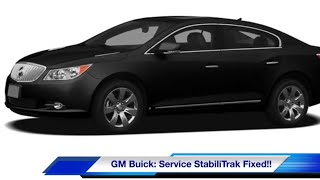
Code U0415 on a 2006-2013 Buick LaCrosse means a critical safety module, like power steering or stability control, has received invalid data from the Anti-Lock Brake System (ABS). This commonly results from a faulty wheel speed sensor or its wiring, a bad ABS module (EBCM), or a software issue requiring a dealer reprogram as noted in TSB PI0800A. The issue is often accompanied by "Service StabiliTrak" and "Steering Assist is Reduced" messages.
- U0415 is a serious safety code that disables ABS and stability control; do not ignore it.
- The most common cause is a faulty wheel speed sensor. Diagnosis should start by checking live data from all four sensors.
- Before replacing expensive modules, check for damaged wiring and see if your vehicle is eligible for a software update as described in TSB PI0800A.
- Do not replace the power steering module or rack based on this code alone; it's almost always a symptom, not the cause.
What's Unique About the 2006-2013 Buick LACROSSE
The Buick LaCrosse across these two generations integrates electronic power steering and the StabiliTrak stability control system, both of which heavily depend on accurate wheel speed data from the ABS module. A data interruption can trigger an alarming cascade of warnings, including the "Steering Assist Is Reduced" message, which is a known issue cited in manufacturer bulletins. GM has specifically issued Technical Service Bulletins, such as PI0800A for the first-generation models, that address this code by reprogramming the power steering control module, indicating a known sensitivity in the system's software. The second generation (2010-2013) is built on the Epsilon II platform, sharing its architecture with vehicles like the Chevrolet Malibu and Cadillac XTS, which can experience similar electronic faults.
Diagnostic Flowchart
Tap your situation to follow the diagnostic path that matches what you're seeing on this vehicle.
Generation note: This range covers the first-generation (2006-2009) on the GM W platform and second-generation (2010-2013) on the Epsilon II platform. While the root causes are similar, specific part numbers and component locations differ. TSB PI0800A is particularly relevant to the first generation, addressing a software fix in the power steering module. The EBCM on first-gen models is located in the engine compartment on the driver's side, part of the brake pressure modulator valve. On second-gen models, it's in a similar location near the brake booster. Second-generation models also experience these faults, often with similar symptoms like StabiliTrak warnings, and may have wheel speed sensors that can be replaced independently of the hub assembly.
Symptoms You May Notice
- ABS warning light illuminated
- Traction Control or "StabiliTrak" warning light on
- "Service StabiliTrak" message on the driver information c 🎬 Watch: How to fix common StabiliTrak and traction control issues.enter
- "Steering Assist Is Reduced" message
- Increased or heavy steering effort
- Cruise control may be inoperative
- Audible chimes and blinker sounds may stop working
- Replacing the Power Steering Control Module or the entire steering rack when the actual fault is invalid data originating from the ABS system (e.g., a bad wheel speed sensor).
- Replacing the EBCM (ABS Module) when the root cause is a simple wiring break, corroded ground, or a faulty wheel speed sensor.
Most Likely Causes
- Faulty Wheel Speed Sensor or Hub Bearing Assembly 🔴 High Probability → Shop ABS Wheel Speed Sensor Wheel speed sensors and their wiring are exposed to the elements, making them susceptible to damage from road debris, moisture, and corrosion. A failing wheel bearing can also cause an erratic signal. On some LaCrosse models, the sensor is integrated into the wheel hub assembly, while on others (typically 2nd gen), it can be replaced separately. 🎬 See this walkthrough on replacing a standalone wheel speed sensor.
How to confirm: Use a scan tool capable of reading live ABS data to monitor all four wheel speed sensors while driving. A faulty sensor will read 0 MPH or show an erratic signal compared to the others. A resistance test on the sensor should read between 850-1350 Ohms for first-gen models, and 1000-2000 Ohms for second-gen. Also, inspect the wiring harness for breaks or corrosion, especially where it flexes with steering and suspension movement.
Typical fix: Replace the faulty wheel speed sensor or the entire wheel hub bearing assembly if the sensor is integrated or the bearing is failing. 🎬 Watch: How to replace the full wheel hub and sensor assembly. Sometimes the sensor is just dirty and can be cleaned. A grinding noise when turning can indicate a bad wheel bearing, which contains the sensor reluctor ring.
Est. part cost: $30-$150 - Failing ABS Control Module (EBCM) 🟡 Medium Probability → Shop ABS Control Module The electronic brake control module (EBCM) can suffer from internal solder joint failures or other electronic faults over time, causing it to send corrupted data or fail to communicate. This is a known issue on many GM vehicles of this era.
How to confirm: After confirming all wheel speed sensors and wiring are good, the ABS module becomes the primary suspect. Diagnosis requires a high-end scan tool to check for internal module faults and communication status. This is often a process of elimination.
Typical fix: The module can be replaced with a new or remanufactured unit, which will require programming to the vehicle. Alternatively, the original module can be sent to a specialist for repair, which is often more cost-effective and doesn't require programming.
Est. part cost: $150-$500 for repair/remanufactured, $800-$1200+ for new - Power Steering Control Module (PSCM) Software Issue ⚪ Low Probability → Shop Power Steering Control Module TSB PI0800A specifically identifies an issue on some first-generation models where the PSCM incorrectly sets U0415 and requires a software update to correct its sensitivity to ABS data. This indicates a known calibration issue from the factory.
How to confirm: A GM dealer or a shop with a subscription to GM's TIS2WEB service can check if your vehicle's VIN has a pending software update for the PSCM related to TSB PI0800A.
Typical fix: Reprogram the Power Steering Control Module with the updated software calibration provided by GM. This is a dealer or specialty shop-level repair.
Est. part cost: $0 (if under warranty/campaign), $100-$250 for dealer labor - Damaged Wiring or Corroded Connectors ⚪ Low Probability Wiring harnesses, especially for wheel speed sensors or the main EBCM connector, can become damaged from road debris, improper repairs, or corrosion from water intrusion. The harness can also get stretched or break internally from suspension travel and steering.
How to confirm: Visually inspect the wiring harness leading to each wheel speed sensor and the main connector at the ABS module. Check for chafing, breaks, and green or white corrosion on the connector pins. A multimeter can be used to check for continuity and shorts in the harness.
Typical fix: Repair the damaged section of wire or clean the connector pins with electrical contact cleaner. If corrosion is severe, the connector pigtail may need to be replaced.
Est. part cost: $10-$50
Rare But Worth Checking
- Low Battery Voltage or Poor Grounds: → Shop Vehicle Battery A weak battery or failing alternator can cause low system voltage, leading to unpredictable communication errors between various modules. Always ensure the battery is above 12.4V and the charging system is healthy before diagnosing network codes. Check the main EBCM ground, often located on the frame rail under the driver's door or on a transmission stud.
- Low Brake Fluid Level: → Shop Brake Fluid While more common on later GM truck platforms, a brake fluid level near the 'MIN' mark can cause the fluid to slosh during turns or braking. This can momentarily trigger the level sensor, causing the EBCM to send what other modules interpret as invalid data, setting a U0415 code. Always check and top off the brake fluid as a first step.
Diagnosis Steps
- Perform a full vehicle scan to check for codes in ALL modules. Pay special attention to any 'C' codes in the EBCM (ABS module), as they will often pinpoint the root cause.
- Check the brake fluid level and top it off to the MAX line if it is low.
- Verify the vehicle's battery is fully charged (above 12.4V) and the charging system is operating correctly. Check main body and module grounds for corrosion.
- If any wheel speed sensor codes (C0035-C0051) are present, diagnose that specific sensor and its circuit first.
- Using a scan tool with live data capability, graph the output of all four wheel speed sensors while driving. Look for a sensor that drops out, reads erratically, or doesn't match the others.
- Inspect the wiring and connectors for the wheel speed sensors and the main ABS module for any signs of physical damage, corrosion, or looseness. Pay close attention to areas where the harness flexes.
- Check for applicable TSBs for your vehicle's VIN. A software update for the Power Steering Control Module may be the required fix, as per TSB PI0800A.
- If all sensors, wiring, and software are confirmed to be good, the ABS control module (EBCM) itself is the most likely failed component. Consider sending it for repair as a cost-effective option.
Parts You'll Likely Need
- Wheel Speed Sensor
(OEM #ACDelco 13503749 (Example, varies by year/position))— This is the most common failure point that causes the invalid data broadcast from the ABS module. - Wheel Hub and Bearing Assembly
(OEM #GM 513288 (Example for 2nd Gen))— On many LaCrosse models, the wheel speed sensor is integrated into the hub assembly, requiring the replacement of the entire unit. - Electronic Brake Control Module (EBCM)
(OEM #GM 84102577 (Example, varies significantly by year))— If sensors and wiring are good, the module itself may have failed internally, requiring repair or replacement.
Related Codes That Often Appear With This One
- C0544 — This code for the Steering Wheel Angle Sensor is mentioned alongside U0415 in TSB PI0800A, indicating they are often related to the same power steering system fault logic.
- C056D — This code indicates the Electronic Stability Control (ESC) system is disabled. It's a direct result of the system not trusting the data it's receiving, which is the root cause of U0415.
- C0035 - C0051 — These are specific codes for wheel speed sensor circuits (e.g., C0040 for Right Front, C0045 for Left Rear). If one of these is present, it is a strong indicator of the root cause of the U0415 code, pointing directly to the problematic corner of the car.
- U0121 — This code means "Lost Communication With Anti-Lock Brake System (ABS) Control Module". If this code is present with U0415, it suggests a more severe problem, like a complete EBCM failure, power/ground loss to the module, or a CAN bus wiring failure, rather than just corrupted data.
Technical Service Bulletins (TSBs) & Recalls
- PI0800A: Addresses reprogramming the power steering control module on 2006 models for DTCs C0544 and U0415, which cause a 'Steering Assist is Reduced' message.
- 19NA182: A later TSB for a different model year that also links the 'Steering Assist is Reduced' message to codes C056D and U0415, showing a persistent pattern in GM's system logic.
- PIT5490B: While for trucks, this TSB is highly relevant as it details how a low brake fluid level can cause the EBCM to send intermittent signals that other modules flag as invalid, setting code U0415.
Platform-Specific Known Issues
- Real-World Repair Journey on a 2011 LaCrosse: A YouTuber documented their extensive troubleshooting for the 'Service StabiliTrak' light. They replaced both front wheel speed sensors, the brake light switch, and spark plugs with no success. The light had initially appeared after a tie rod was replaced. The ultimate fix, which resolved the light for over 1,000 miles, was getting a proper four-wheel alignment. This suggests the steering angle sensor data, post-repair, may have been conflicting with wheel speed data, causing the system to fault.
- Grinding Noise on Turns as a Precursor: An owner on a forum noted that prior to the ABS/Traction lights appearing, they would hear a grinding noise when making hard turns. This was correctly identified by another poster as a classic symptom of a failing wheel bearing. The failing bearing can damage the integrated magnetic reluctor ring that the wheel speed sensor reads, causing an erratic signal and triggering the U0415 fault chain.
Mechanic-Grade Diagnostic Values
- Wheel Speed Sensor Resistance (1st Gen, W-Body) — expected: 850 - 1350 Ohms. Failure: An open circuit (infinite resistance) or a reading far outside the expected range.
- Wheel Speed Sensor Resistance (2nd Gen, Epsilon II) — expected: 1000 - 2000 Ohms. Failure: An open circuit (infinite resistance) or a short circuit (near-zero resistance).
- Wheel Speed Sensor AC Voltage Output — expected: Greater than 100-250 mV AC (0.1-0.25 VAC) when spinning the wheel by hand.. Failure: Voltage below the minimum threshold indicates a weak or failed sensor/hub assembly.
- CAN Bus High (at DLC Pin 6 to Ground) — expected: ~2.6V - 2.7V (average, key on). Failure: 0V, 5V, or a voltage matching CAN Low indicates a short or open.
- CAN Bus Low (at DLC Pin 14 to Ground) — expected: ~2.3V - 2.4V (average, key on). Failure: 0V, 5V, or a voltage matching CAN High indicates a short or open.
- CAN Bus Terminating Resistance (at DLC Pins 6 & 14) — expected: ~60 Ohms (key off). Failure: 120 Ohms indicates one terminating resistor is offline; an open or shorted reading indicates a network wiring fault.
Scan Tool Commands That Help
- GM GDS2 / High-End Bidirectional Scanner: Automated Bleed / ABS Bleed — After replacing the EBCM or any hydraulic component of the ABS system, this function is required to cycle the internal solenoids and pump to purge trapped air from the hydraulic control unit (HCU). Failure to do so can leave a spongy pedal and set new fault codes.
- GM GDS2 / High-End Bidirectional Scanner: Actuator Tests — Allows a technician to command individual components like the ABS pump motor or specific solenoid valves on and off. This can help verify the EBCM's ability to control outputs and confirm the functionality of the hydraulic unit before condemning the module.
Wiring & Ground Locations
- EBCM (1st Gen, W-Body) — Located in the left (driver's) side of the engine compartment, attached to the brake pressure modulator valve assembly.. This is the source of the invalid data. Checking its main connector and ground is a primary diagnostic step.
- EBCM (2nd Gen, Epsilon II) — Located in the engine compartment on the driver's side, near the brake booster and master cylinder.. This is the source of the invalid data. Its location makes it susceptible to heat and moisture, and its main connector should be inspected for corrosion.
- G200 / G202 — Behind the left side of the dash knee bolster, at the base of the steering column.. These are major interior ground points for multiple modules, including the Body Control Module (BCM). A poor connection here can cause a wide range of communication issues across the vehicle network.
- EBCM Connector (1st Gen, W-Body) — On the EBCM module. The Right Front Wheel Speed Sensor circuit is on Pins 4 and 5. The Left Front is on Pins 20 and 21.. Allows for testing wheel speed sensor circuits directly at the module, which isolates the problem to the sensor/wiring or the module itself.
Real Owner Repair Stories
- YouTube user 'YouCanDoIt!' (2011 Buick LaCrosse CXL) — "Service StabiliTrak" light and traction control light were on.
❌ Tried (didn't work) Replacing the front left wheel speed sensor., Replacing the front right wheel speed sensor., Resetting codes with a professional scanner.
✅ What actually fixed it The problem was ultimately resolved by replacing the brake pedal position sensor (also known as the brake light switch). The faulty switch was sending incorrect data, which the EBCM then broadcast, causing other modules to flag the U0415 code and disable StabiliTrak.
Model Year Variations Within This Range
- 2006-2009 (W-Platform): The PCM is located under the air filter box. The EBCM is part of the larger brake pressure modulator valve assembly. The front wheel speed sensor is integrated into the hub assembly. TSB PI0800A regarding a PSCM reprogram is most relevant to this generation.
- 2010-2013 (Epsilon II Platform): Shares architecture with Chevy Malibu and Cadillac XTS. On some models/years, the front wheel speed sensor is a separate component that can be replaced without changing the entire wheel hub assembly. The EBCM is a more compact unit located near the brake booster.
Helpful Videos



We Have This Part in Stock

The information in this article is provided for general reference and educational purposes only. Vehicle specifications, procedures, and part compatibility can vary by production date, trim level, and region. Always consult your vehicle's factory service manual and verify part numbers before purchasing or performing repairs. Safety-critical components such as airbags, seat belts, and braking systems should be installed by a qualified professional.
- Buick LACROSSE:
- 🧭 Diagnostic Flowchart
- 🎬 Helpful Videos
- 🛍️ Shop This Part
- What's Unique About the 2006-2013 Buick LACROSSE
- Symptoms You May Notice
- Most Likely Causes
- Rare But Worth Checking
- Diagnosis Steps
- Parts You'll Likely Need
- Related Codes That Often Appear With This One
- Technical Service Bulletins (TSBs) & Recalls
- Platform-Specific Known Issues
- Mechanic-Grade Diagnostic Values
- Scan Tool Commands That Help
- Wiring & Ground Locations
- Real Owner Repair Stories
- Model Year Variations Within This Range
- 🎟️ Get 5% Off