

U0594 on 2021-2023 Dodge Charger: Causes for Implausible HCP Data
On a 2021-2023 Dodge Charger, code U0594 is most often caused by a software glitch in the Powertrain Control Module (PCM). The fix is typically a software update performed by a dealer, as outlined in Technical Service Bulletins (TSBs). Less common causes include wiring faults or a failing control module.
- U0594 on a 2021-2023 Charger is a network communication error, not a hybrid system problem.
- The most likely cause is a software issue in the Powertrain Control Module (PCM).
- Before any parts are replaced, check if the vehicle needs a PCM software update as specified in TSBs like #18-066-21.
- This is not a DIY-friendly repair; it requires a dealership's diagnostic and programming tools.
- Do not ignore this code, as it can affect transmission operation and disable critical safety systems like ABS and traction control.
What's Unique About the 2021-2023 Dodge CHARGER
This code is a potential trap for technicians because on many other Stellantis (Dodge, Chrysler, Jeep) vehicles, 'HCP' stands for Hybrid Control Processor. However, the 2021-2023 Charger is not a hybrid. For this specific vehicle, U0594 is a pure network communication fault. Authoritative Technical Service Bulletins from Dodge confirm the code's existence on standard gasoline models and point directly to a software update for the main Powertrain Control Module (PCM) as the primary solution, rather than a hybrid component failure.
Diagnostic Flowchart
Tap your situation to follow the diagnostic path that matches what you're seeing on this vehicle.
Symptoms You May Notice
- Check Engine Light (Malfunction Indicator Lamp) is on
- Loss of shifting capability or transmission fixed in one gear (e.g., third gear)
- Vehicle enters 'Limp Mode', with severely reduced power and speed 🎬 Watch: Understanding limp mode causes and fixes for your Charger
- Anti-lock Brake System (ABS) warning light on
- Traction Control System (TCS) or Electronic Stability Control (ESC) warning light on
- Cruise control may not function
- Loss of Engine Start/Stop (ESS) functionality
- Multiple warning lights on the instrument cluster may appear simultaneously
- Replacing the ABS module or other chassis components. Because U0594 often appears with codes for the brake system or steering control module, those modules might be blamed. However, the root cause is often the PCM software misinterpreting data, not a failure of the other components.
- Replacing the transmission or shifter assembly. Symptoms like being stuck in gear can lead a technician to suspect a mechanical transmission fault, but in this case, it is often a symptom of the PCM entering a fail-safe 'limp mode' due to the communication error.
Most Likely Causes
- Powertrain Control Module (PCM) Software Requires Update 🔴 High Probability → Shop Engine Control Module (ECM) Manufacturer TSBs (#1801222 and #18-066-21) explicitly call out a PCM software update to resolve this and other related communication codes for certain 2021 models. This indicates a known logic flaw that was corrected with new software, which is the most common resolution path.
How to confirm: A technician uses a wiTECH scan tool to compare the vehicle's current PCM software calibration ID against the latest version available from the manufacturer's service library.
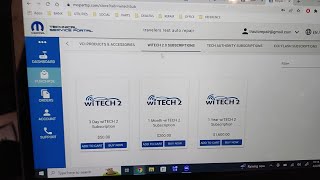
Typical fix: Reprogramming (flashing) the PCM with the latest software version. 🎬 Watch: How a technician performs a PCM reflash using wiTech This is a labor-only procedure done at a dealership and typically takes about an hour.
Est. part cost: $0 - CAN Bus Wiring or Connector Fault 🟡 Medium Probability Complex vehicle networks are susceptible to issues from corrosion, loose pins, or physical damage to the wiring harness, which can corrupt communication signals. A weak battery can also cause a flood of communication codes.
How to confirm: Visually inspect wiring harnesses and connectors between major modules like the PCM, ABS module, and BCM. A technician can also test the CAN bus network for proper voltage (approx. 2.5V) and resistance (approx. 60 ohms). 🎬 See how to diagnose CAN bus electrical issues at the connector A common failure point can be the main harness connectors or grounds.
Typical fix: Repairing the damaged wire, cleaning corrosion from a connector, or re-seating a loose connection. In some cases, a weak or failing 12V battery is the root cause, and replacing it resolves the communication faults after a system reset.
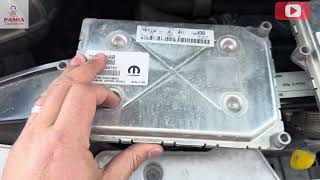
Est. part cost: $5-$250 - Failing Control Module (PCM) ⚪ Low Probability While less common than software or wiring issues, the module processing the data (PCM) can fail internally due to hardware defects.
How to confirm: This is a process of elimination. If the PCM software is up-to-date and all network wiring is confirmed to be good, the module itself becomes the primary suspect. This requires advanced diagnostics with a dealer-level tool to rule out all other possibilities.
Typical fix: Replacing the faulty Powertrain Control Module and programming the new unit to the vehicle's VIN.
Est. part cost: $400-$1200
Rare But Worth Checking
- Failing 12V Battery: → Shop Vehicle Battery
Diagnosis Steps
- Connect a professional scan tool (like wiTECH) and perform a full vehicle scan. Record all active and stored DTCs from all modules.
- Check the health of the 12V battery with a load tester. A weak battery is a common cause of multiple communication faults.
- Using the vehicle's VIN, check for applicable Technical Service Bulletins (TSBs). Specifically, look for TSB #18-066-21 or similar PCM updates related to communication codes.
- If a relevant TSB exists, follow its procedure precisely. This typically involves connecting a stable battery charger (maintaining 13.2-13.5 volts) and reprogramming the PCM with the latest software.
- After the update, clear all DTCs from all modules and perform a vehicle re-scan to confirm the fault is gone. A test drive is necessary to verify the fix.
- If no TSB applies, or if the code returns after the update, begin network diagnostics. Inspect the wiring and connectors for the PCM, ABS module, and Body Control Module for any signs of damage, corrosion, or loose pins.
- Test the CAN bus network resistance (should be ~60 ohms with battery disconnected) and voltage to ensure it is within specification. Isolate and test individual modules if a network abnormality is found.
- If the network wiring and software are confirmed to be good, the fault may lie with a control module itself. This is a diagnosis of exclusion and typically points to the PCM, which may require replacement.
Parts You'll Likely Need
- Powertrain Control Module (PCM) Software Update — This is not a physical part, but a software re-flash that corrects logic errors within the PCM, which is the most common fix documented in manufacturer TSBs.
OEM price range: $150-$300 (Labor)
Aftermarket price range: N/A - Powertrain Control Module (PCM)
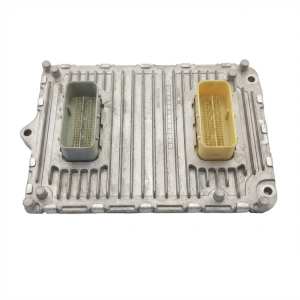
(OEM #68434924AC)— In the rare case that a software update does not fix the issue and the wiring is good, the PCM itself may have a hardware failure. Part number 68434924AC is a common replacement for 2020-2023 3.6L models and supersedes older versions. The new module requires VIN programming to function.
Trusted brands: Mopar
OEM price range: $800-$1200
Aftermarket price range: $350-$800 (Remanufactured)
Related Codes That Often Appear With This One
- U0418 — Implausible Data Received From Brake System Control Module. Both codes are listed in the same TSB and point to a central communication/software issue.
- U0429 — Implausible Data Received From SCM (Steering Control Module). This is another network code often triggered alongside U0594 by the same PCM software fault. [Bulletin #1801222]
- U1110 — Lost Vehicle Speed Message. This indicates a breakdown in network communication, which is the core of the U0594 fault. [Bulletin #1801222]
- U1120 — Lost Wheel Distance Message. Like U1110, this points to a general network data loss that is often fixed with the PCM software update. [Bulletin #1801222]
Technical Service Bulletins (TSBs) & Recalls
- Bulletin #1801222: Lists U0594 - Implausible Data Received From HCP as a known issue on 2021 models.
- TSB #18-066-21: Involves reprogramming the PCM on 2021 3.6L models to fix a list of communication DTCs, including U0594, and addresses symptoms like loss of shifting and disabled ABS/TCS.
Platform-Specific Known Issues
- For 2021 Dodge Chargers with the 3.6L engine built on or before October 14, 2021, TSB #18-066-21 was released to address U0594 and a host of other communication codes via a PCM software update.
Mechanic-Grade Diagnostic Values
- CAN C Bus Resistance — expected: ~60 Ω (measured between pins 6 and 14 of the OBD-II port with the battery disconnected). Failure: A reading of ~120 Ω indicates an open circuit or a missing terminating resistor. A reading significantly lower than 60 Ω (e.g., ~40-45 Ω) could indicate a shorted module or an extra terminating resistor on the network.
- CAN C High Voltage (Key On, Engine Off) — expected: Fluctuates between 2.5V and 3.5V. A multimeter will show an average of ~2.6V.. Failure: Stuck at 0V, 2.5V, or a reading above 6.0V indicates a short to ground, open circuit, or short to power, respectively.
- CAN C Low Voltage (Key On, Engine Off) — expected: Fluctuates between 2.5V and 1.5V. A multimeter will show an average of ~2.4V.. Failure: Stuck at 0V, 2.5V, or a reading above 6.0V indicates a short to ground, open circuit, or short to power, respectively.
Scan Tool Commands That Help
- wiTECH 2.0 or AlfaOBD: Proxy Alignment — This procedure is required after replacing any major control module on the CAN bus. It configures the network and ensures all modules (nodes) are recognized. Failure to perform a proxy alignment often results in a flashing odometer and multiple communication DTCs.
- wiTECH 2.0: Network Topology View — This is a primary diagnostic screen that provides a visual map of all control modules on the vehicle's networks. It color-codes modules to show which are active, non-responsive, or have stored DTCs, allowing a technician to quickly assess the overall health of the communication network.
- wiTECH 2.0: Reprogram PCM — This function is used to flash the Powertrain Control Module with updated software from FCA's servers. It is the specific fix called for in TSBs related to code U0594 on 2021 models.
Wiring & Ground Locations
- Body Control Module (BCM) — Located above the passenger kick panel area.. The BCM is a central hub for multiple vehicle networks. A wiring issue at or near the BCM can cause widespread communication faults.
- CAN C Bus Wires — Twisted pair of 22-gauge wires. At one connector near the BCM, CAN High is White/Green and CAN Low is White/Blue.. These are the primary communication lines between the PCM and other critical modules. Damage or corrosion to this twisted pair is a direct cause of 'U' series codes.
- Vehicle System Interface Module (VSIM) — Located under the left-hand (driver's) side of the instrument panel assembly.. The VSIM is another key integration module that communicates on the CAN C bus. It's a potential point of failure or wiring issues, especially on former police (Pursuit) models.
Real Owner Repair Stories
- Mopar technician video on YouTube (2024 Dodge Charger Daytona EV (demonstrates a parallel issue)) — Bricking events, 'Not Drive Ready' messages, limp mode, multiple battery performance codes.
❌ Tried (didn't work) Allowing the vehicle to sit through a sleep cycle (works sometimes, but not a permanent fix)., Disconnecting the 12V battery (temporary fix).
✅ What actually fixed it A new software update for the Battery Pack Control Module (BPCM) was released (TSB 08-022-25 REV. B) to resolve false DTCs and limp mode activation. However, the technician stresses that this software update will NOT fix the problem if the underlying cause is a failing 12V AGM battery, which he found on one vehicle with an internal short. The battery must be properly load-tested before assuming the software is the only issue.
OEM Part Supersession History
68434924AA, 68434924AB→68434924AC— Standard part revision and update by the manufacturer.
Heads up: Part is specified for the 3.6L V6 engine. Must be programmed to the vehicle's VIN after installation.
Model Year Variations Within This Range
- 2021 models built on or before October 14, 2021: These vehicles are specifically called out in TSB #18-011-22 as potentially having a PCM software bug that causes U0594 and a host of other communication codes. For these specific vehicles, a PCM reflash is the most likely solution.
- 2022-2023 and 2021 models built after October 14, 2021: These vehicles should have the updated PCM software from the factory. If U0594 appears on one of these models, it is less likely to be the known software bug and more likely to be a wiring fault, a failing 12V battery, or a hardware failure in a control module.
Helpful Videos
We Have This Part in Stock

The information in this article is provided for general reference and educational purposes only. Vehicle specifications, procedures, and part compatibility can vary by production date, trim level, and region. Always consult your vehicle's factory service manual and verify part numbers before purchasing or performing repairs. Safety-critical components such as airbags, seat belts, and braking systems should be installed by a qualified professional.
- Dodge CHARGER:
- 🧭 Diagnostic Flowchart
- 🎬 Helpful Videos
- 🛍️ Shop This Part
- What's Unique About the 2021-2023 Dodge CHARGER
- Symptoms You May Notice
- Most Likely Causes
- Rare But Worth Checking
- Diagnosis Steps
- Parts You'll Likely Need
- Related Codes That Often Appear With This One
- Technical Service Bulletins (TSBs) & Recalls
- Platform-Specific Known Issues
- Mechanic-Grade Diagnostic Values
- Scan Tool Commands That Help
- Wiring & Ground Locations
- Real Owner Repair Stories
- OEM Part Supersession History
- Model Year Variations Within This Range
- 🎟️ Get 5% Off