

OBD-II Code U0623: Lost Communication With Seat Control Module 'H' / Coolant Pump 'A'
What U0623 means, why it triggers, and how to fix it on your specific vehicle
- Code U0623 means a faulty seat control module on Ford/Lincoln vehicles, but indicates a critical auxiliary coolant pump failure on GM and BMW models.
- Ford and Lincoln models frequently trigger this code due to melted connector pins under the driver's seat, requiring a $50 pigtail repair kit (Ford P/N WPT-928).
- GM 3.0L Duramax diesels log U0623 when the engine wiring harness chafes against the alternator bracket, a known defect covered under TSB 23-NA-115.
- Stop driving immediately if your engine cooling fan runs constantly alongside this code; continuing to drive with a failed coolant pump causes $3,000+ in engine damage.
- Basic $20 code readers misdiagnose U0623; you must use a full-system scanner like FORScan or BlueDriver to identify the specific offline module.
What Does U0623 Mean?
U0623 is a network communication code indicating a primary control module lost connection with a subordinate module. The identity of this module depends entirely on the vehicle manufacturer. On Ford and Lincoln vehicles, it points to the Seat Control Module 'H' (managing power adjustments and massage). On General Motors and BMW vehicles, U0623 means 'Lost Communication With Coolant Pump A', a critical fault affecting engine temperature. On select Hyundai models, it refers to the Instrument Panel Cluster.
Technical definition: Lost Communication With Seat Control Module 'H'. While this is the standard SAE definition, manufacturers frequently redefine it. The code sets when a supervisory module (like the Body Control Module) fails to receive expected signals over the CAN or LIN Bus from a specific node. Manufacturer-specific definitions include 'Lost Communication with Coolant Pump A' (GM/BMW) or 'Lost Communication With Instrument Panel Cluster' (Hyundai).
Can I Drive With U0623?
Yes, But With Caution. If the code relates to seat functions (Ford/Lincoln), it is safe to drive as it only affects comfort features. If the code signifies lost communication with an auxiliary coolant pump (GM/BMW), stop driving immediately. The vehicle enters a 'reduced acceleration mode' and runs the cooling fans at maximum speed. Driving more than a few miles without proper coolant circulation causes severe engine or turbocharger overheating, resulting in $3,000+ in engine damage.
Common Causes
- Harness Chafing or Pinched Wiring (Very Common) — Wiring harnesses easily sustain physical damage. On GM trucks, the engine harness rubs against the alternator bracket or A/C lines, wearing through the insulation and shorting the LIN bus wire (TSB 23-NA-115). On Fords, seat movement pinches and severs wires underneath the driver's seat.
- Failed Electric Coolant Pump or Driver Module (Very Common) — Modern electric coolant pumps feature integrated electronics. These internal circuit boards fail from thermal stress, preventing the pump from communicating with the Engine Control Module. This is a guaranteed failure point on BMW N52, N54, and N55 engines. 🎬 See how to test and bleed your BMW electric pump
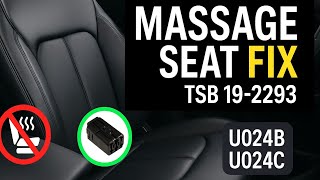
- Failed Seat Control Module (Common) — The electronic seat module fails due to internal circuit board damage or voltage spikes. This completely disables advanced multi-contour and massage seat systems 🎬 Watch: Understanding the Ford massage seat TSB and repair on Ford and Lincoln vehicles.
- Water Intrusion and Corroded Connectors (Common) — External module connectors lack perfect weather sealing. Water and road salt penetrate the coolant pump connector, corroding the pins and blocking the communication signal (noted in GM TSB 23-NA-102). Ford seat modules also suffer from terminal fretting (micro-corrosion) at the main connector.
- Blown Fuse or Power Supply Issue (Less Common) — Modules require a stable 12V power source. A blown fuse, faulty relay, or severed ground wire forces the module to shut down and drop off the network. A weak battery also causes modules to fail initialization during startup.
- CAN/LIN Bus Network Fault (Rare) — A short circuit on the main communication bus or a software glitch in the Body Control Module takes down the entire network. If multiple unrelated modules display 'U' codes simultaneously, the main network wiring is compromised.
Symptoms
- Engine Cooling Fan Runs Continuously — On GM or BMW vehicles, the engine's main cooling fan runs constantly at maximum speed as a fail-safe measure to prevent overheating.
- Check Engine Light and Overheating Warning — A warning light illuminates on the dash. GM vehicles display a 'Reduced Acceleration' warning, while BMWs show a red engine overheat icon.
- Power Seat and Massage Functions Inoperative — On Ford/Lincoln vehicles, the seat refuses to move, and massage/memory functions fail to respond to button presses or infotainment screen commands.
- Gauges and Instrument Panel Inoperative — On Hyundai models, the Instrument Panel Cluster fails, causing gauges, warning lights, and the driver information display to go blank.
Diagnostic Flowchart
Tap your situation to follow the diagnostic path that matches what you're seeing on this code.
Common Fixes & Costs
- Repairing Damaged Wiring or Connector Pigtail — Parts: $20-$50, Labor: $200-$400, ~2.5 hr book time (Intermediate)
- Replacing an Electric Coolant Pump (GM/BMW) — Parts: $150-$600, Labor: $250-$500, ~3.5 hr book time (Professional)
- Replacing the Seat Control Module (Ford) — Parts: $400-$800, Labor: $100-$200, ~1.0 hr book time (Professional)
- Replacing a Blown Fuse — Parts: $1-$5, Labor: $0, ~0.1 hr book time (DIY)
- Updating Control Module Software — Parts: $0, Labor: $100-$250, ~1.0 hr book time (Professional)
Used vs. New Parts: Buying Guide
When a used part is worth it: Buy a used Seat Control Module from a low-mileage donor vehicle to save money, provided the part numbers match exactly. Never buy a used electric coolant pump due to its 100% failure rate over time.
Donor-vehicle mileage cap: roughly under 60000 miles for the part to have meaningful remaining life.
Donor quality checklist:
- Verify the part number on the used module is identical to the original.
- Ensure the donor vehicle has no flood or fire damage history.
- Inspect the used seat module connector pins for green corrosion or melting.
Decision logic:
- If The part is a BMW or GM electric water pump → Buy a new OEM or Pierburg part. The labor is too intensive to risk a used part failing.
- If The part is a Ford seat control module → A used part from a reputable salvage yard is a smart, cost-effective choice.
Warranty tradeoff: Used parts offer a 30-day warranty. New aftermarket parts include a 1-year warranty. New OEM parts carry a 2-year warranty.
Worst-case if a used part fails: $3000. A failed used coolant pump destroys the engine, costing thousands in collateral damage.
What Happens If You Wait — Timeline
- 0-4 weeks: Seat massage and lumbar features become intermittent. Code U0623 is stored but triggers no warning lights. (MPG impact: 0%% · Added cost: $0)
- 1-3 months: The seat module fails completely. All multi-contour and power adjustment functions cease to operate. (MPG impact: 0%% · Added cost: $0)
- Immediate: Check Engine Light illuminates. The main cooling fan runs at 100% speed. The vehicle enters limp mode with reduced power. (MPG impact: 10%% · Added cost: $0)
- 5-50 miles of continued driving: The engine overheats. The temperature gauge spikes, and red overheat warnings appear on the dash. (MPG impact: N/A% · Added cost: $1,500 - $3,000)
- 50+ miles or one severe overheat: Catastrophic engine damage occurs. The cylinder head or engine block cracks, requiring a complete engine replacement. (MPG impact: N/A% · Added cost: $7,000 - $15,000)
Cost of Not Fixing It
- Immediate: Loss of power seat adjustments and massage functions (Ford). On GM/BMW, the check engine light illuminates and cooling fans run at maximum speed. (Added cost: $0)
- 1-3 months: Continued driving with a failed coolant pump causes severe engine overheating, warping the cylinder head or blowing the head gasket. (Added cost: $1,500-$3,000)
- 6+ months: Ignoring a critical coolant pump failure inevitably cracks the engine block, requiring a complete engine replacement. (Added cost: $5,000-$15,000)
Diagnosis Steps
- Confirm Code Definition with an Advanced Scan Tool
Use a full-system OBD-II scanner (like FORScan or BlueDriver) to read manufacturer-specific codes from all modules. Verify whether U0623 refers to the seat module, coolant pump, or instrument cluster for your specific VIN.
Tools: Advanced OBD-II Scan Tool (Beginner) - Visually Inspect Wiring and Connectors
Inspect the relevant harness. For Ford seats, move the seat fully forward and up to check for melted pins on the main module connector. For GM trucks, inspect the engine harness near the alternator bracket for chafing (TSB 23-NA-115).
Tools: Flashlight, inspection mirror (Intermediate) - Inspect Fuses and Relays
Locate the fuse box and pull the specific fuse for the 'seat module' or 'coolant pump'. A blown fuse confirms a dead short in the wiring that you must locate before replacing the fuse.
Tools: Fuse puller, multimeter (Beginner) - Perform a Bidirectional Control Test
Use a high-end scan tool to command the suspect module directly. Command the coolant pump to turn on. If it runs, the module has power and ground, isolating the fault to the communication wire.
Tools: High-end bi-directional scan tool (Professional) - Check Power and Ground at the Module Connector
Unplug the module. Test for battery voltage (12.0V-12.6V) at the power pin with the key on. Measure resistance between the ground pin and the chassis; it must read less than 0.5 ohms.
Tools: Multimeter, vehicle-specific wiring diagram (Advanced) - Check LIN Bus Voltage
For single-wire LIN bus modules (coolant pumps), back-probe the LIN terminal with the key on. A healthy, inactive LIN bus shows steady battery voltage (11-12V). An active bus toggles rapidly, averaging 7-8V. A constant 0V indicates a short to ground.
Tools: Multimeter, back-probe pins (Advanced) - Test the CAN/LIN Bus Wires for Resistance
With the battery disconnected, measure resistance between CAN_H and CAN_L pins. A healthy bus reads 60 ohms. 120 ohms indicates an open circuit to one terminating resistor. Near 0 ohms indicates a shorted bus.
Tools: Multimeter, vehicle-specific wiring diagram (Advanced) - Isolate the Module
If the entire network is down, unplug the suspect module. If unplugging the seat module or coolant pump restores communication to the rest of the vehicle, that specific module is internally shorted and requires replacement.
Tools: Basic hand tools (Advanced) - Analyze the Communication Signal with an Oscilloscope
Back-probe the communication wire. A healthy LIN bus shows a clean square wave dropping from 12V to 1V. A flatlined or heavily distorted signal confirms a corrupted network requiring wire repair or module replacement.
Tools: Automotive oscilloscope, back-probe pins (Professional)
When This Code Triggers (Freeze-Frame Conditions)
- Engine Coolant Temp: 170-230°F (Triggers most frequently after the engine reaches full operating temperature and thermal expansion stresses wiring or internal pump electronics.)
- Vehicle Speed: 0-65 mph (Communication loss happens at any speed, but limp-mode symptoms become immediately apparent during highway cruising.)
- System Voltage: 11.5-14.4V (Voltage drops below 12V during cranking cause sensitive modules to fail initialization and log the code.)
Related Codes
- U024C — The specific SAE designation for 'Lost Communication with Seat Control Module H'. Seeing this alongside U0623 confirms the fault lies entirely with the driver's seat module.
- U024B — Indicates 'Lost Communication with Seat Control Module G' (passenger seat). When both appear, it proves a shared power supply or ground wire has failed.
- U1345 — GM code for 'Engine Control Module LIN Bus 1'. Appearing with U0623, it confirms a wiring short on the coolant pump network rather than a failed pump.
- 2E81 / 2E82 — BMW codes for 'Coolant pump speed deviation' and 'cutoff'. These guarantee the electric water pump's internal motor has failed and requires replacement.
Climate & Environmental Factors
- High Humidity and Road Salt: Moisture and salt penetrate unsealed coolant pump connectors, corroding pins and blocking the LIN bus signal. Apply dielectric grease to connector seals during repair.
- Extreme Cold: Wiring insulation becomes brittle and cracks. Cold weather also exposes weak batteries, dropping voltage during startup and causing modules to fail initialization.
How to Talk to a Mechanic About This Code
Say this: "I have a [Year/Make/Model] with code U0623. My symptom is [e.g., 'my driver's massage seat is dead' or 'my engine fan runs constantly']. Based on my research, I suspect it's the [e.g., 'seat module wiring' or 'auxiliary coolant pump harness']."
Specifying the vehicle and symptom prevents the shop from misdiagnosing the code. It focuses the technician directly on the known failure points (like the GM harness chafe or Ford seat connector), saving diagnostic labor hours.
Avoid saying:
- 'My check engine light is on, can you look at it?'
- 'Just fix whatever's wrong.'
- 'My friend said it's probably the computer.'
Questions to ask before authorizing the repair:
- What specific failure did you find? Was it the module, the connector, or a chafed wire?
- For GM trucks: Did you inspect the harness near the alternator per TSB 23-NA-115?
- For Ford seats: Did you find melted pins? Does the repair include a new pigtail (WPT-928)?
- For BMWs: Are you replacing the thermostat and using new aluminum bolts?
Where to Take It: Dealer vs Independent vs Chain
- Dealer:
Recommended only for warranty claims or mandatory software flashes.
Best for: Vehicles under powertrain warranty (GM coolant pump issues are covered)., Complex software updates or module programming required after replacement.
Downsides: Highest labor rates, often $180-$250 per hour., Dealers default to replacing entire $800 assemblies instead of splicing a $50 wire. (Typical cost: +50% vs. baseline) - Independent Shop:
Best choice for out-of-warranty repairs, provided they use manufacturer-level diagnostic software.
Best for: Out-of-warranty vehicles where cost is a major factor., Well-known issues like the BMW water pump or Ford seat module.
Downsides: The shop MUST possess advanced, manufacturer-specific scan tools to diagnose network codes. (Typical cost: +0% vs. baseline) - Chain Shop:
AVOID. This code requires diagnostic expertise beyond the scope of chain shops.
Best for: Simple jobs like oil changes, tires, and brakes.
Downsides: Technicians lack the training and oscilloscope tools for complex network diagnostics., High risk of misdiagnosis and replacing expensive parts without confirming the root cause. (Typical cost: -10% vs. baseline)
When to Walk Away From the Repair
If the estimated repair cost exceeds 50% of the car's private-party value, sell the car as-is or trade it in.
- Car worth $25000, fix is $1200: Fix it. A BMW water pump replacement for $1200 on a $25,000 car is a mandatory repair.
- Car worth $5000, fix is $2800: Walk away. If a coolant pump failure blew the head gasket, spending $2800 on a $5000 car is a poor investment.
- Car worth $15000, fix is $800: Fix it. Replacing a Ford seat module for $800 restores key features and maintains resale value.
What Scan Tool You Need for This Code
Minimum: A scanner that reads manufacturer-specific codes from ALL vehicle modules (BCM, SCM, ECM).
A basic $20 code reader only checks the engine computer and gives a generic definition. It cannot tell you that on a GM truck, U0623 comes from the Body Control Module and refers to a coolant pump.
Budget: BlueDriver Pro / FORScan with ELM327 Adapter (~$100) — BlueDriver accesses codes from multiple modules. For Ford owners, an ELM327 adapter with free FORScan software provides dealer-level diagnostic access to the seat module.
Mid-range: Foxwell NT510 / Autel MaxiCheck MX808 (~$180-350) — Offers full-system scans and bidirectional control. You can command the coolant pump to turn on, instantly determining if the fault is in the wiring or the module itself.
Professional: Autel MaxiCOM MK808 / Launch X431 Series (~$500-1200) — Provides full bidirectional control and network topology mapping. This allows a technician to visually see the entire communication network and pinpoint the offline module.
Rent vs buy: Auto parts stores read codes for free, but their tools misidentify the module for U0623. Buying a midrange scanner is a mandatory investment for diagnosing network codes.
How to Clear the Code After You Fix It
- Reconnect the battery if disconnected during repair.
- Use an OBD-II scan tool to clear all network 'U' codes from every module.
- Perform a complete drive cycle to reset readiness monitors.
Drive cycle (~20 minutes): Start a cold engine and idle for 3 minutes. Drive at a steady 55 mph for 10 minutes on the highway. Follow with 10 minutes of stop-and-go city driving. Idle for 2 minutes before shutting the engine off.
Readiness monitors affected: Comprehensive Component Monitor
Before emissions retest: drive at least 50 miles to fully set monitors.
Watch out for:
- Disconnecting the battery does not clear permanent network codes or set readiness monitors.
- The code returns instantly upon startup if the underlying short circuit or chafed wire remains unfixed.
Will This Fail Emissions / State Inspection?
Yes — this code typically fails an OBD-II emissions inspection.
- California: An illuminated Check Engine Light is an automatic failure. You must complete a full drive cycle after repair to set readiness monitors.
- New York: Vehicles fail if the Check Engine Light is on or if more than one readiness monitor reads 'Not Ready'.
- Texas: Requires driving 50-100 miles after clearing codes to reset monitors before passing the OBD-II plug-in test.
Most Commonly Affected Vehicles
- Ford F-150 (2015-2020) — Extremely common on Platinum and Limited trims. The driver's side multi-contour seat module (SCMH) fails due to melted connector pins.
- Ford Explorer (2016-2019) — Affects Platinum models where under-seat wiring chafes and severs due to repeated seat movement.
- Lincoln Navigator / Continental (2018-2020) — TSB 19-2390 addresses terminal fretting at the seat module, requiring a pigtail replacement.
- GMC Sierra (2022-2024) — On 3.0L Duramax diesels, U0623 means 'Lost Communication with Heater Coolant Pump'. TSB 23-NA-115 points to engine harness chafing.
- Chevrolet Silverado (2022-2024) — Shares the 3.0L diesel engine and identical coolant pump wiring harness chafing defects as the GMC Sierra.
- Chevrolet Tahoe / Suburban (2022-2023) — Subject to the same auxiliary coolant pump communication failures and TSBs as the Silverado.
- BMW 3-Series, 5-Series, X3, X5 (2007-2018) — On N52, N54, and N55 engines, this code indicates a failed electric water pump. Always replace the thermostat simultaneously.
- Hyundai Tucson (2022-2023) — U0623 specifically means 'Lost Communication With Instrument Panel Cluster', requiring dashboard wiring diagnostics.
Manufacturer-Specific Notes
- Ford: This fault almost exclusively targets the multi-contour massage seat module. TSB 19-2390 dictates replacing the melted pigtail connector rather than the expensive module itself.
- General Motors: GM redefines U0623 as 'Lost Communication with Heater Coolant Pump'. TSB 23-NA-115 reveals the engine harness rubs through on the alternator bracket, shorting the network wire.
- BMW: BMW uses this code to flag a dying electric water pump. Professionals always replace the electronically controlled thermostat alongside the pump to prevent duplicate labor costs.
- Hyundai: Hyundai redefines U0623 as 'Lost Communication With Instrument Panel Cluster', shifting the entire diagnostic focus to the dashboard wiring and Body Control Module.
Real Owner Stories
2018 Ford F-150 Platinum at 70k miles
Driver's multi-contour massage seat and power adjustments stopped working. Memory seat function also failed.
What they tried:
- Swapped the control switch with the passenger side; the switch was good.
- Checked fuse #5 in the passenger kick panel; it was intact.
- Visually inspected wiring under the driver's seat and found a melted pin on the main connector to the Seat Control Module.
Outcome: Replaced the module and spliced in a new connector pigtail (Ford P/N WPT-928) for $450. All seat functions were restored.
Lesson: Always inspect the main connector under a Ford driver's seat for melted pins before replacing the expensive module.
2011 BMW 335i (N55 engine) at 81k miles
The engine cooling fan suddenly started running at maximum speed. A red engine temperature warning appeared, and the car entered limp mode.
What they tried:
- Pulled over immediately and scanned for codes, finding U0623 and 2E81.
- Attempted the coolant system bleed procedure; the pump ran intermittently.
- Checked for power and ground at the pump connector; voltage was stable.
Outcome: Replaced the failing electric water pump and the thermostat for $1,100. The repair resolved the overheating and cleared the codes.
Lesson: A BMW water pump fails intermittently before dying completely. Fan running at full blast is a classic sign of imminent failure.
2023 GMC Sierra 3.0L Duramax
Check Engine Light illuminated, the truck entered reduced acceleration mode, and the engine fan ran constantly. The seats worked perfectly.
What they tried:
- Took the vehicle to the dealer for warranty diagnosis.
- The dealer found the engine wiring harness rubbing against the alternator bracket, wearing through the LIN bus wire.
Outcome: The dealer repaired the damaged wire and rerouted the harness per TSB 23-NA-115. Covered under powertrain warranty.
Lesson: U0623 on a modern GM truck points to the auxiliary coolant pump, not the seats. Always check for harness chafing TSBs.
How to Prevent This Code From Triggering
- Proactively replace BMW electric water pump and thermostat. (Every 60,000-80,000 miles.) — These pumps have a 100% failure rate within this mileage window. Proactive replacement prevents catastrophic engine overheating.
- Apply dielectric grease to vulnerable connectors. (During any repair or inspection.) — Blocks moisture and road salt from entering external coolant pump connectors, preventing pin corrosion and communication loss.
- Inspect and secure wiring harnesses. (During every oil change.) — Securing the GM engine harness with zip ties prevents it from rubbing against the alternator bracket and severing the LIN bus wire.
Frequently Asked Questions
Can I fix a U0623 code myself?
If the cause is a blown fuse or visibly damaged under-seat wiring, you can fix it yourself with basic electrical tools. Diagnosing a faulty module, a network issue, or a chafed engine harness requires professional scan tools and wiring diagrams. Stop DIYing and go to a shop if visual inspections reveal no obvious damage.
What are common misdiagnosis mistakes for a U0623 code?
The biggest mistake is using a generic code reader and misidentifying the faulty module. A technician wastes hours diagnosing a seat module on a GM truck when the code actually refers to a coolant pump. Always verify the manufacturer-specific definition before replacing parts.
My GM truck has a U0623 code but the seats work fine. What's wrong?
On GM trucks, U0623 indicates a communication failure with an auxiliary coolant pump, not the seats. You will see a check engine light and hear the cooling fans running constantly. The issue stems from the pump's wiring or internal electronics.
What is the difference between U0623 and P0623?
A 'U' code like U0623 indicates a Network Communication fault between computer modules. A 'P' code like P0623 indicates a Powertrain fault, specifically for the alternator's warning light circuit. They require completely different diagnostic procedures.
Can a bad battery cause a U0623 code?
Yes, low system voltage during cranking causes sensitive electronic modules to temporarily shut down and drop off the network. This triggers communication 'U' codes across multiple systems. Test your battery and alternator first if the code appears alongside slow engine cranking.
What is a LIN bus and how does it relate to U0623?
A LIN bus is a single-wire communication network used for components that do not require high-speed data transfer. Coolant pumps and seat modules rely on this wire to talk to the main computer. A break or short in this single wire immediately triggers code U0623.
Will my heated and cooled seats still work?
It depends on your vehicle's specific module architecture. If the multi-contour massage module is separate from the heating/cooling module, your climate seats will still work. If they are integrated into a single unit, you lose all advanced seat functions.
Why does the code sometimes disappear and then come back?
Intermittent codes point directly to a loose connection or failing wire. Common culprits include a loose connector pin or a wire that chafes against the chassis only when hitting bumps. It also indicates a module beginning to fail under specific thermal conditions.
My massage seat turned off by itself, is that the U0623 code?
Not necessarily, as many vehicles automatically shut off massage features after 15-20 minutes to prevent motor overheating. This is normal operation and does not trigger a check engine code. Code U0623 indicates a persistent electrical fault where the feature refuses to turn on at all.
The dealer wants a lot of money just to diagnose the problem. What should I do?
Diagnosing network issues requires specialized tools and time. Perform initial visual checks and fuse inspections yourself to rule out obvious damage. If you find nothing, pay for a professional diagnosis to avoid replacing the wrong $500 module.
Key Takeaways
- Code U0623 means a faulty seat control module on Ford/Lincoln vehicles, but indicates a critical auxiliary coolant pump failure on GM and BMW models.
- Ford and Lincoln models frequently trigger this code due to melted connector pins under the driver's seat, requiring a $50 pigtail repair kit (Ford P/N WPT-928).
- GM 3.0L Duramax diesels log U0623 when the engine wiring harness chafes against the alternator bracket, a known defect covered under TSB 23-NA-115.
- Stop driving immediately if your engine cooling fan runs constantly alongside this code; continuing to drive with a failed coolant pump causes $3,000+ in engine damage.
- Basic $20 code readers misdiagnose U0623; you must use a full-system scanner like FORScan or BlueDriver to identify the specific offline module.
Helpful Videos
Shop the Parts Behind U0623
Below are the parts most often responsible for code U0623, ranked by how frequently each one is the actual culprit (per the diagnosis above). Tap any to see what we have for your vehicle.



The information in this article is provided for general reference and educational purposes only. Vehicle specifications, procedures, and part compatibility can vary by production date, trim level, and region. Always consult your vehicle's factory service manual and verify part numbers before purchasing or performing repairs. Safety-critical components such as airbags, seat belts, and braking systems should be installed by a qualified professional.
- 🧭 Diagnostic Flowchart
- 🎬 Helpful Videos
- 🛍️ Shop This Part
- What Does U0623 Mean?
- Can I Drive With U0623?
- Common Causes
- Symptoms
- Common Fixes & Costs
- Used vs. New Parts: Buying Guide
- What Happens If You Wait — Timeline
- Cost of Not Fixing It
- Diagnosis Steps
- When This Code Triggers (Freeze-Frame Conditions)
- Related Codes
- Climate & Environmental Factors
- How to Talk to a Mechanic About This Code
- Where to Take It: Dealer vs Independent vs Chain
- When to Walk Away From the Repair
- What Scan Tool You Need for This Code
- How to Clear the Code After You Fix It
- Will This Fail Emissions / State Inspection?
- Most Commonly Affected Vehicles
- Manufacturer-Specific Notes
- Real Owner Stories
- 2018 Ford F-150 Platinum at 70k miles
- 2011 BMW 335i (N55 engine) at 81k miles
- 2023 GMC Sierra 3.0L Duramax
- How to Prevent This Code From Triggering
- Frequently Asked Questions
- Can I fix a U0623 code myself?
- What are common misdiagnosis mistakes for a U0623 code?
- My GM truck has a U0623 code but the seats work fine. What's wrong?
- What is the difference between U0623 and P0623?
- Can a bad battery cause a U0623 code?
- What is a LIN bus and how does it relate to U0623?
- Will my heated and cooled seats still work?
- Why does the code sometimes disappear and then come back?
- My massage seat turned off by itself, is that the U0623 code?
- The dealer wants a lot of money just to diagnose the problem. What should I do?
- Key Takeaways
- 🎟️ Get 5% Off