

U1000 on 2005-2008 Infiniti G35: CAN Communication Failure Causes and Fixes
U1000 on a G35 indicates a CAN communication network failure. The most common causes are a weak battery, corroded ground wires, or a faulty control module. Start by checking the battery and cleaning all major engine and chassis ground connections, especially the battery negative cable and points near the coolant reservoir and brake fluid reservoir, before attempting more complex diagnostics.
- Do not immediately assume a major computer has failed. The U1000 code on a G35 is most often caused by a simple electrical issue.
- Your first steps should always be to test the battery and thoroughly clean the main engine and chassis ground connections.
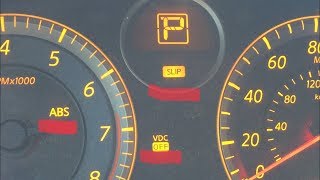
- The appearance of the 'VDC OFF' and 'SLIP' lights alongside a U1000 code is a classic symptom combination for this car.
- If basic checks don't solve the problem, professional diagnosis with a CAN-capable scan tool is necessary to avoid needlessly replacing expensive modules.
What's Unique About the 2005-2008 Infiniti G35
The Infiniti G35, and other vehicles on the Nissan FM platform like the Nissan 350Z, are particularly sensitive to voltage and grounding issues. A weak battery or a corroded ground strap is a very common trigger for a U1000 code, often causing more dramatic symptoms like a no-start condition or the dash lighting up with 'VDC OFF' and 'SLIP' warnings. Forum discussions on G35driver.com frequently cite owners successfully resolving the U1000 code by meticulously cleaning all engine bay ground points. Unlike some other makes where U1000 is a rare or vague code, on the G35 it's a frequent complaint that almost always points back to an electrical foundation issue before indicating a truly failed (and expensive) control module.
Diagnostic Flowchart
Tap your situation to follow the diagnostic path that matches what you're seeing on this vehicle.
Generation note: The 2005-2008 range covers two G35 generations. The V35 chassis (2005-2006 sedan, 2005-2007 coupe) and the V36 chassis (2007-2008 sedan). While the U1000 code's meaning is the same, specific ground point locations and module designs may differ slightly. For example, early V35 models had unique CAN wiring at the OBD-II port compared to later years. However, the primary causes (grounds, battery) are common to both generations and shared with platform mates like the Nissan 350Z.
Symptoms You May Notice
- Check Engine Light is on
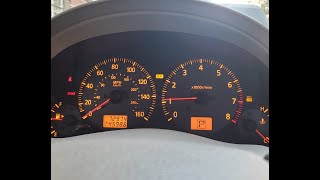
- "VDC OFF" and "SLIP" lights are illuminated on the dashboard
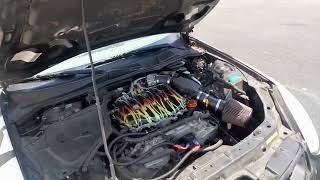
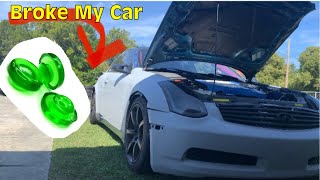
- Vehicle cranks but will not start, or will not crank at all 🎬 Watch this guide to starting a G35 with a U1000 code.
- Engine may stall intermittently
- Transmission may be stuck in a single gear (limp mode)
- Erratic behavior from gauges or other electronics like the A/C controls
- Gear selection indicator on the dash may disappear
- Inability to control A/C or radio functions
- Replacing the ECM (Engine Control Module) first. The TSB ITB10029A explicitly states the module reporting the U1000 is usually NOT the one that has failed. The ECM is often blamed when the real issue is a bad ground or a different module like the ABS or BCM.
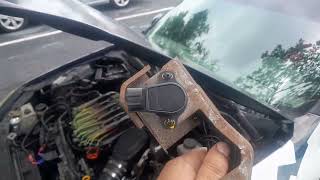
- Replacing the throttle body or accelerator pedal. While these can cause limp mode or other drivability issues, they don't typically cause a U1000 code directly. However, one owner did report fixing their U1000 issue after replacing a faulty accelerator pedal and reprogramming the throttle body, suggesting a wider electrical fault was at play.
Most Likely Causes
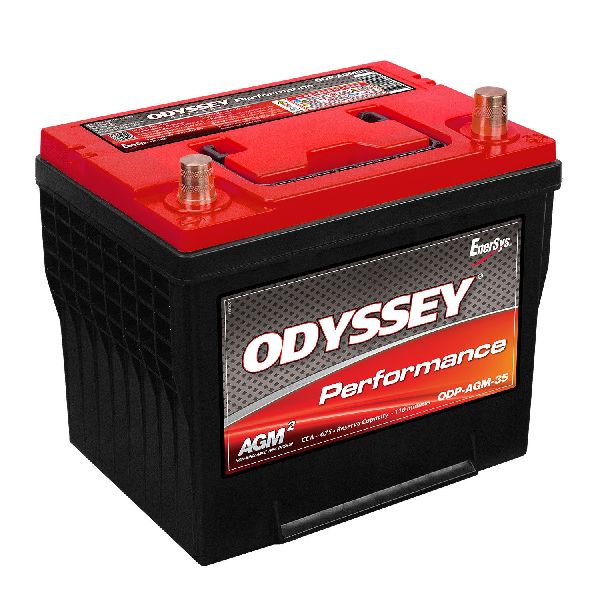
- Weak or Failing Battery 🔴 High Probability → Shop Vehicle Battery Control modules require stable voltage (above 10V) to communicate. A drop in voltage during startup is a very common cause for CAN communication errors on this platform. Even a battery that tests as 'good' but is slightly weak can trigger the code intermittently.
How to confirm: Test the battery with a multimeter or a digital battery tester. A healthy, resting battery should be at or above 12.5 volts. Have it load tested at an auto parts store to confirm its health under cranking conditions.
Typical fix: Replace the vehicle's battery.
Est. part cost: $150-$250 - Corroded or Loose Ground Wires 🔴 High Probability Infiniti/Nissan vehicles of this era are known for having ground points that are susceptible to corrosion, leading to poor electrical connections that disrupt the CAN network. Forum members on G35driver and InfinitiScene consistently point to this as the top fix.
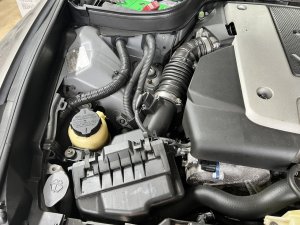
How to confirm: Visually inspect and physically check the main battery ground cable (chassis connection point), and other key grounding points. Specific, problematic locations include: two points in the battery compartment, grounds on the engine timing cover, a point under the coolant reservoir, and one near the brake fluid reservoir. Look for rust, green/white powder, fraying, or looseness. Clean the contact points with a wire brush until they are shiny metal.
Typical fix: Disconnect the battery. Remove, sand/wire brush, and securely retighten all main engine and chassis ground connections. If a cable (especially the main battery ground) is heavily corroded, replace it.
Est. part cost: $1-$50 for cleaning supplies or a new ground strap. - Faulty Control Module (e.g., ABS, BCM, TCM) 🟡 Medium Probability Water intrusion is a known issue, particularly in the battery compartment area where the IPDM (Intelligent Power Distribution Module) is located, which can lead to module failure. The ABS module is also a common failure point that can bring down the network.
How to confirm: This requires an advanced scan tool (like Infiniti's CONSULT) that can perform a network test or 'roll-call' to see which specific module is not responding. Once the offline module is identified, a technician will test for power and ground at that module's connector. In one documented case, a technician unplugged modules one by one while monitoring CAN bus resistance to find shorted modules.
Typical fix: Replace the failed control module and potentially reprogram it to the vehicle.
Est. part cost: $200-$1500+ depending on the module. - Damaged CAN Wiring Harness ⚪ Low Probability
How to confirm: Visually inspect the wiring harnesses for any signs of physical damage, rodent chewing, or corrosion, particularly around the ECM, TCM, and under the dashboard. A multimeter is used to check for continuity and resistance between the CAN High and CAN Low wires at the OBD-II port (should be ~60 ohms with the battery disconnected).
Typical fix: Repair the specific section of damaged wire or replace the affected harness.
Est. part cost: $10-$500+ depending on the extent of the damage and labor.
Rare But Worth Checking
- Blown Fuse: A fuse related to a specific control module (like the ABS, 'AT CONT', or AWD unit) can blow, taking that module offline and triggering a U1000 code. Always check fuses in the IPDM (under hood) and in-cabin fuse boxes before replacing expensive parts.
- Low Brake Fluid: On the G35, very low brake fluid can cause the brake fluid level sensor to trigger the VDC and SLIP lights, which are often seen with communication codes. This is more of a related symptom but is a simple and crucial check that has resolved the warning lights for many owners. 🎬 See how low brake fluid triggers VDC and SLIP lights.
- Aftermarket Electronics: Improperly installed aftermarket stereos, alarms, or remote starters can interfere with the CAN bus and cause communication errors. One owner on a forum traced their U1000 issue to a recently installed remote starter and aftermarket radio.
- Missing Exhaust Ground Strap: → Shop Engine Ground Strap Some owners, particularly after installing an aftermarket exhaust, have resolved a U1000 code by installing a proper ground strap for the exhaust system, suggesting it's a necessary part of the vehicle's overall grounding scheme.
Diagnosis Steps
- Check Battery Health: Ensure the battery voltage is above 12.5V with the car off and that it holds a charge under load. A weak battery is the #1 cause.
- Scan for All Codes: Use a quality OBD-II scanner that can access all modules (Engine, Transmission, ABS, BCM). Note which modules are storing the U1000 and which, if any, are not communicating at all. This is a critical first step.
- Inspect and Clean Grounds: Disconnect the battery. Locate, remove, and thoroughly clean the main battery-to-chassis ground, and other key grounding points. Key spots are on the timing cover, under the coolant reservoir, and near the brake fluid reservoir. Use a wire brush to clean terminals and mounting surfaces to bare metal. 🎬 Watch: How to properly clean and repair your ground connections.
- Check Fuses: Inspect all fuses related to the ECM, TCM, BCM, and ABS systems in both the under-hood (IPDM) and in-cabin fuse boxes.
- Check Brake Fluid: Ensure the brake fluid reservoir is filled to the 'MAX' line. Low fluid is a well-documented cause of the VDC/SLIP lights that are often seen with U1000.
- Perform CAN Resistance Check (DIY): With the battery disconnected, measure the resistance between Pin 6 (CAN-H) and Pin 14 (CAN-L) on the OBD-II port. A healthy network should read approximately 60 ohms. A reading of 120 ohms suggests an open circuit in one of the terminating modules, while other readings (like a documented 50 ohms) indicate a problem on the bus.
Parts You'll Likely Need
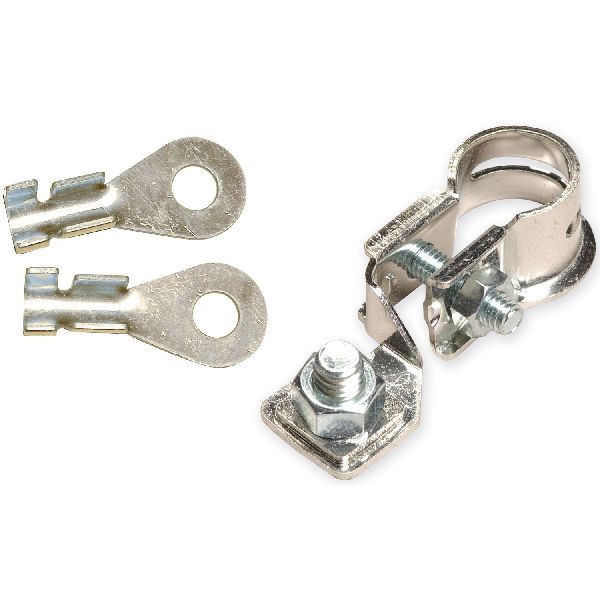
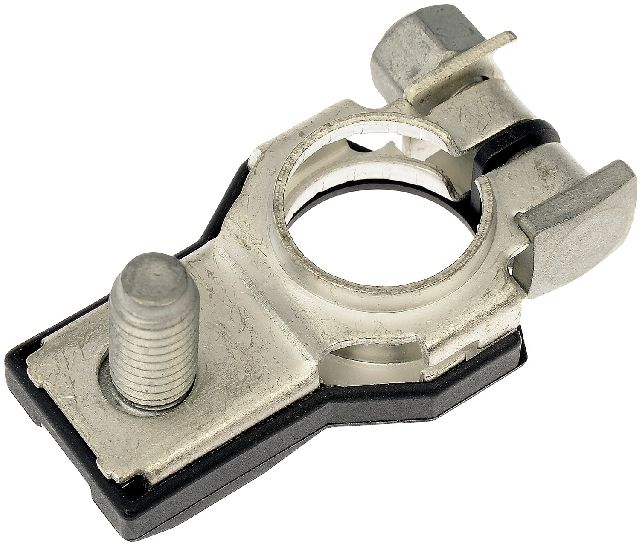
- Battery Ground Cable
(OEM #24080-AM600)— The factory ground cable's terminal is crimped on and known to corrode internally and at the chassis connection point, creating a poor connection that is a primary cause of the U1000 code. Replacement is often a more permanent fix than cleaning. Note: Part number B4080-AM600 may be an older or alternative number that is replaced by 24080-AM600. - ABS Control Module / Actuator
(OEM #47660-JK50B (AWD specific, example))— If diagnostics point to the ABS/VDC system as the source of the CAN failure, the entire module assembly often needs to be replaced. It is a common point of failure leading to U1000.
Related Codes That Often Appear With This One
- U1001 — This code specifically indicates a loss of communication with the ECM. It is often stored alongside U1000 in other modules when the ECM is the source of the problem or is affected by the network failure.
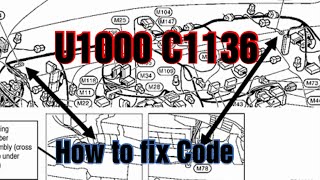
- C1136 — This is an ABS code for the 'Brake Fluid Pressure Sensor Circuit'. If the ABS module is the source of the communication failure, it may log this code, and the U1000 will be stored in other modules that can no longer hear from it.
- P1815 — This code relates to the Manual Mode Switch in the transmission. When the TCM (Transmission Control Module) loses communication, it may store this code alongside the U1000.
Technical Service Bulletins (TSBs) & Recalls
- ITB10-029a — CAN COMMUNICATION CODES – DIAGNOSTIC TIPS & GUIDELINES — Provides official diagnostic procedure for U1000/U1001. States that the module storing the code is usually not the faulty part. Emphasizes checking for power, ground, and CAN resistance (~60 ohms) at the suspected offline module before replacement. (2014-06-24)
- ITB13-029 — CAN COMMUNICATION – NETWORK DIAGNOSTIC FLOW CHART — Offers a detailed flowchart for diagnosing CAN issues. Defines codes U1000, U1001, U1002, and U1010. Notes that low voltage (<10V) will cause modules to drop off the network. Recommends diagnosing CAN codes first before any other DTCs. (2013-08-22)
Platform-Specific Known Issues
- Corrosion on ground points near the battery and on the engine timing cover are very common.
- Water leaking into the cabin can sometimes damage the Body Control Module (BCM) or its wiring, causing network issues.
- The ABS actuator assembly is a known failure point that can cause a U1000 code and is an expensive repair.
Mechanic-Grade Diagnostic Values
- CAN Bus Resistance — expected: ~60 Ω between Pin 6 (CAN-H) and Pin 14 (CAN-L) at the DLC with the battery disconnected.. Failure: A reading of ~120 Ω indicates an open circuit to one of the two terminating resistors. A reading significantly different from 60 Ω (e.g., 50 Ω) points to a circuit issue like a shorted module.
- CAN Bus Voltage (Key On, Engine Off) — expected: CAN-H: ~2.6-2.7V; CAN-L: ~2.3-2.4V. The two voltages should be mirror images of each other and total approximately 5V.. Failure: Voltages that are stuck high, low, or do not mirror each other. One documented failure showed CAN-H at 1.5V and CAN-L at 0.9V.
- System Voltage Threshold — expected: Modules require stable voltage, generally above 10V, to maintain communication.. Failure: A battery dropping below 10V during cranking can cause various modules to stop communicating, triggering a U1000 code.
Scan Tool Commands That Help
- Infiniti CONSULT-II / CONSULT-III: CAN Diag Support Monitor — This is the primary professional diagnostic function. It performs a 'roll call' of all control units on the CAN bus and reports which specific modules are not responding, which is essential for pinpointing the source of the U1000 code.
- Manual Procedure: BCM 'Auto Active Test' (Self-Diagnostic Mode) — To quickly verify the BCM is powered and functional. With the ignition ON, pressing the driver's door jamb switch 10 times activates a test mode that cycles wipers, lights, and other BCM-controlled accessories. This can confirm the BCM is alive even if other modules are offline.
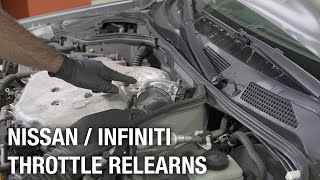
- Manual Procedure: Idle Air Volume / Throttle / Pedal Position Learning — This multi-step pedal dance procedure is required after replacing, cleaning, or disconnecting the throttle body or accelerator pedal. Failure to perform this relearn can cause drivability issues and, in at least one documented case, a persistent U1000 code.
- Infiniti CONSULT or compatible scan tool: Steering Angle Sensor (SAS) Reset — A reset is mandatory after a wheel alignment or if any steering or suspension components have been replaced. An uncalibrated SAS can cause the VDC/ABS module to fault and drop off the network, triggering a U1000 code in other modules.
Wiring & Ground Locations
- E17 — On the right side of the engine compartment, near the front.. This is a primary engine bay ground point for multiple components, including the IPDM E/R, cooling fans, and lighting. Corrosion here can disrupt power distribution and module communication.
- E43 — On the left front side of the engine compartment.. This ground serves components on the driver's side of the engine bay. Ensuring a clean connection here is part of a thorough grounding service.
- M30 & M66 — Located behind the dashboard; M30 is behind the instrument cluster and M66 is behind the right side of the dash (glove box area).. These are major interior ground points for the BCM, data link connector, A/C amplifier, and navigation/audio units. A loose or corroded connection here can cause widespread interior electronic failures and CAN codes.
- LH Head-to-Chassis Strap — A braided ground strap from the driver's side (LH) cylinder head connects to a blade-style connector bolted to the frame, located directly under the intake tube near the MAF sensor.. This is a critical engine-to-chassis ground. If it's disconnected or corroded, modules on the engine may lose their ground reference, causing communication failures.
Real Owner Repair Stories
- G35Driver Forum (2005 G35x) — U1000 code, car feels like it's being held back, RPMs increase but speed does not.
❌ Tried (didn't work) Cleaning multiple factory ground points.
✅ What actually fixed it The owner had an aftermarket grounding kit installed. Removing the grounding wire that connected to the transmission made the U1000 code disappear permanently. This indicates an improperly installed or faulty aftermarket ground can induce network errors. - Reddit r/G35 (2004 G35 Sedan) — U1000 code stored in ABS module, 'SLIP' and 'VDC OFF' lights on, cooling fan running constantly.
❌ Tried (didn't work) Owner spent nearly a year and 'several $100' on various attempted fixes.
✅ What actually fixed it The final solution was replacing a faulty ABS wheel speed sensor, which cost only $15. A bad sensor can cause the entire ABS module to fault and stop communicating on the CAN bus. - YouTube channel 'Less Expensive Fix' (Infiniti G35 (2003-2007)) — Persistent U1000/U1001 codes after installing aftermarket parts.
❌ Tried (didn't work) Cleaning grounds, checking battery, checking brake fluid.
✅ What actually fixed it The owner had replaced the accelerator pedal and disconnected the throttle body. The U1000 code was finally resolved after performing the specific, multi-step 'Accelerator Pedal Released Position Learning,' 'Throttle Valve Closed Position Learning,' and 'Idle Air Volume Learning' procedures. This reprogrammed the components to the ECU. - Pico Technology Forums (2008 Infiniti G35X) — No speedometer, VDC/SLIP lights on, no A/C control, U1000 in multiple modules. No communication with ABS, AV, and SIR modules.
❌ Tried (didn't work) Dealer had already replaced the ECM, ABS module, IPDM, A/C amp, and three wiring harnesses.
✅ What actually fixed it A technician diagnosed the CAN lines and found incorrect resistance (50 ohms). By disconnecting modules one by one while measuring resistance from the CAN lines to ground, he identified four separate shorted modules: the seat module, steering module, IPDM, and A/V module.
When the Usual Fixes Don't Work
- While cleaning grounds and replacing the battery are the most common fixes, there are numerous documented cases where these steps did not solve the problem. In one instance, a persistent U1000 code was only resolved by replacing a faulty accelerator pedal and performing a full throttle/idle relearn procedure, suggesting a data mismatch from a component was the root cause, not a core network failure. In another case that stumped even a dealership, a technician found the true cause to be multiple control modules (seat, steering, IPDM, A/V) that were internally shorted, which could not have been fixed by cleaning grounds alone. A third owner chased the issue for a year before discovering a single faulty ABS wheel speed sensor was taking the entire ABS module offline, triggering the U1000 code in other modules.
OEM Part Supersession History
284B7-AQ001B, 284B7-AQ016→284B7-AQ006, 284B7-AQ066— Revision for IPDM (Intelligent Power Distribution Module) for V35 models (approx. 2003-2006).
Heads up: Part numbers can be specific to Coupe vs. Sedan models even within the same year. A 2004 Coupe IPDM (284B7-Q006) was found to be incompatible with a 2004 Sedan IPDM (284B7-Q067).47930-AL700→47930-AL70A— Revision for the Gravity/Yaw Rate Sensor.
Model Year Variations Within This Range
- 2005-2006 (V35 Sedan) / 2005-2007 (V35 Coupe): These models use an IPDM with part numbers like 284B7-AQ006/AQ016. The CAN protocol is based on Nissan's proprietary CONSULT-II system, which may require specific scanners or adapters compared to later models.
- 2007-2008 (V36 Sedan): The V36 generation uses a different IPDM and a more standardized ISO CAN protocol. The Yaw Rate sensor is also specific to the V36 sedan platform. Wiring pinouts at the BCM for aftermarket integrations also differ from the V35.
Helpful Videos



Used OEM Parts in Stock
New Aftermarket Parts Available


The information in this article is provided for general reference and educational purposes only. Vehicle specifications, procedures, and part compatibility can vary by production date, trim level, and region. Always consult your vehicle's factory service manual and verify part numbers before purchasing or performing repairs. Safety-critical components such as airbags, seat belts, and braking systems should be installed by a qualified professional.
- Infiniti G35:
- 🧭 Diagnostic Flowchart
- 🎬 Helpful Videos
- 🛍️ Shop This Part
- What's Unique About the 2005-2008 Infiniti G35
- Symptoms You May Notice
- Most Likely Causes
- Rare But Worth Checking
- Diagnosis Steps
- Parts You'll Likely Need
- Related Codes That Often Appear With This One
- Technical Service Bulletins (TSBs) & Recalls
- Platform-Specific Known Issues
- Mechanic-Grade Diagnostic Values
- Scan Tool Commands That Help
- Wiring & Ground Locations
- Real Owner Repair Stories
- When the Usual Fixes Don't Work
- OEM Part Supersession History
- Model Year Variations Within This Range
- 🎟️ Get 5% Off