

U1000 on 2005-2012 Nissan Altima: CAN Communication Failure Causes and Fixes
The U1000 code on a 2005-2012 Nissan Altima indicates a CAN communication network failure, not a specific part failure. The most common causes are poor ground connections, especially the main ground from the battery to the transmission and chassis, or a weak battery. Checking and cleaning grounds is often a no-cost fix that resolves the issue.
- U1000 is a network communication code, not a specific component failure code.
- Always check the easiest and most common causes first: battery health and ground connections, especially the one on the transmission.
- The module that stores the U1000 code is rarely the one that needs to be replaced.
- Do not replace expensive modules like the ECM or TCM without performing a proper diagnosis to confirm they are the source of the communication failure.
- This code often requires professional-level diagnostic tools to solve if the issue isn't a simple ground or battery problem.
What's Unique About the 2005-2012 Nissan ALTIMA

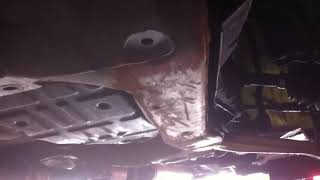
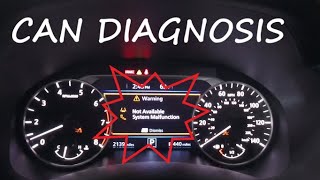
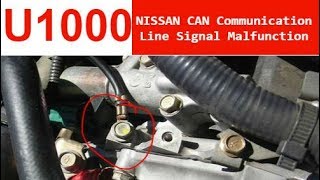
The 3rd and 4th generation Altima is known for having electrical grounding issues that can trigger a U1000 code. 🎬 Watch: Common reasons for the U1000 code in Nissans. Specifically, the main ground strap from the battery to the transmission case is a frequent point of corrosion and failure, leading to a host of communication problems. Unlike some vehicles where this code points to a specific module, on the Altima, it's almost always a sign to check the basics first: battery voltage and all major ground points in the engine bay 🎬 See how a bad ground causes issues on an Altima. before suspecting any expensive control units.
Diagnostic Flowchart

Tap your situation to follow the diagnostic path that matches what you're seeing on this vehicle.
Generation note: This guide covers the end of the third generation (2005-2006) and the entire fourth generation (2007-2012) Nissan Altima. The underlying cause of poor ground connections is common to both generations, particularly the ground point on the transmission case. TSB NTB06-009a specifically calls out the 2002-2006 Altima for this issue. A critical model-year specific issue is the failure of the Electronic Steering Column Lock (ESCL) on 2009-2010 models, which can cause a no-start and log communication codes.
Symptoms You May Notice

- Check Engine Light is on
- Vehicle may not start or cranks but won't start
- Erratic or non-functional instrument cluster gauges
- Transmission may not shift correctly, feel sluggish, or get stuck in one gear
- Loss of power or engine stalling, sometimes while driving
- ABS, Traction Control (TCS), or Vehicle Dynamic Control (VDC) / SLIP warning lights are on
- Electrical glitches with windows, locks, or HVAC system
- Scan tool cannot read the VIN automatically because the ECM is not communicating
- Yellow 'KEY' warning light illuminated on the dash (specifically for 2009-2010 models with ESCL failure)
- Replacing the control module that stored the U1000 code. As per Nissan TSB NTB10-066A/B, the module storing the code is usually not the one that has failed; it is reporting a problem it sees on the network.
- Replacing the ECM or TCM without first verifying all power and ground connections are clean, tight, and have low voltage drop.
Most Likely Causes

- Poor or Corroded Ground Connections 🔴 High Probability The ground strap from the negative battery terminal to the transmission case and chassis is a well-documented failure point on this platform, prone to corrosion and breaking. Nissan TSBs NTB06-009a and NTB10-066A directly address this as a primary cause.
How to confirm: Visually inspect the main ground straps from the battery. Check for green/white corrosion, looseness, or frayed/broken wires where they bolt to the transmission and chassis. Use a multimeter to perform a voltage drop test on the ground circuit (from the negative battery post to the engine block and chassis); a reading above 0.2-0.3 volts with the engine running indicates a bad connection.
Typical fix: Disconnect the battery (negative terminal first). Remove the ground cable bolts (often 10mm or 13mm). Clean the contact points on the cable eyelets and the mounting surfaces on the transmission and chassis with a wire brush until they are shiny bare metal. Reinstall securely. If the cable is frayed or broken, it must be replaced.
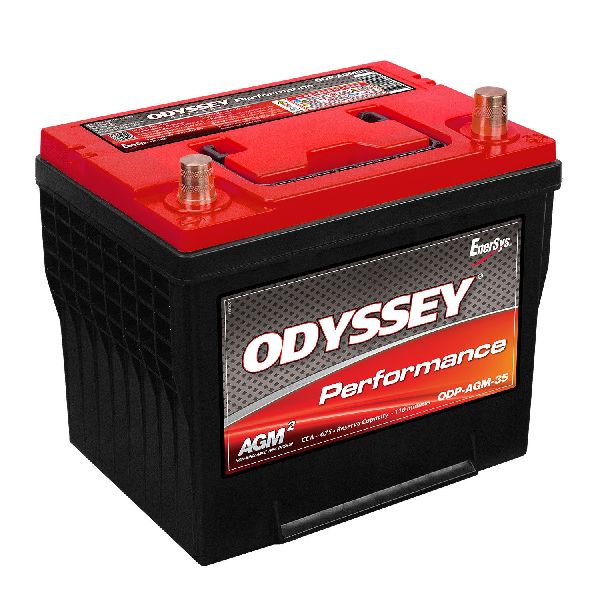
Est. part cost: $15-$70 - Weak or Failing Battery 🟡 Medium Probability → Shop Vehicle Battery Low system voltage (below 12.4V) during startup can prevent modules from initializing correctly, causing them to drop off the CAN network and trigger communication codes. Modern electronics are highly sensitive to voltage stability. A Nissan TSB notes that in a low voltage situation (below 10V), different modules will stop communicating at different voltage thresholds.
How to confirm: Test the battery with a digital multimeter or a load tester. A healthy, fully charged battery should read approximately 12.6 volts with the engine off. With the engine running, the alternator should be charging it at 13.7 to 14.7 volts.
Typical fix: Recharge or replace the battery. If the battery is over 4-5 years old, replacement is recommended.
Est. part cost: $150-$250 - Damaged CAN Bus Wiring ⚪ Low Probability Wiring harnesses can be damaged by abrasion against engine components, moisture intrusion leading to corrosion in connectors, or rodents chewing wires.
How to confirm: This requires advanced diagnostics. A technician will check for the correct resistance between CAN High (Pin 6) and CAN Low (Pin 14) at the DLC connector with the key off and battery disconnected. The reading should be approximately 60 ohms. A reading of 120 ohms indicates an open circuit or a faulty/unplugged terminating resistor (often in the ECM or BCM), while a low reading suggests a short circuit.
Typical fix: Identify and repair the damaged section of the wiring harness. This may involve soldering, heat-shrinking, or replacing a connector pin.
Est. part cost: $5-$100 for wiring repair supplies - Failed Control Module ⚪ Low Probability While less common, any module on the network (ECM, TCM, BCM, ABS, Instrument Cluster) can fail. The instrument cluster is a known failure point, as documented in NHTSA complaint #10970695, where a failed cluster caused a U1000 code and required replacement and programming.
How to confirm: A professional scan tool is used to perform a network test or 'roll call' to see which specific module is not responding. The technician will then verify power and ground to that module before condemning it, as per Nissan TSB guidelines.
Typical fix: Replace the failed module. This often requires programming the new module to the vehicle using a tool like Nissan's CONSULT.
Est. part cost: $200-$1500+ depending on the module
Rare But Worth Checking
- Blown Fuse: A fuse that powers a critical module (like the TCM, AWD, or a 10A 'ENG CONT' fuse) can blow, taking the module offline and causing a U1000 code elsewhere. Always check fuses in the interior and engine bay fuse boxes (IPDM).
- Faulty Alternator: → Shop Alternator An alternator that is failing can produce excessive AC ripple voltage or unstable DC voltage, disrupting module communication. This can be checked with a multimeter set to AC volts while the engine is running; anything over 0.5V AC is a concern.
Diagnosis Steps
- Check and record any other stored DTCs. Codes other than U1000 are critical clues to finding the root cause.
- Check the battery. Ensure it has a full charge (12.6V+) and that the terminals are clean and tight.
- Start the engine and check the alternator output (13.7V-14.7V).
- Perform a thorough visual inspection of the main negative battery cable (OEM P/N: 24080-JA00A or 24080-JA10A). Pay close attention to where it bolts to the transmission case and the chassis. Look for any signs of corrosion, looseness, or physical damage.
- Inspect other major ground points in the engine bay and under the dash for integrity.
- If grounds and battery are good, clear the codes and see if they return. A U1000 can sometimes be an intermittent glitch.
- If the code returns, perform a CAN bus resistance check. With the battery disconnected, use a multimeter to measure resistance between Pin 6 (CAN-H) and Pin 14 (CAN-L) on the OBD-II port. A healthy network will read ~60 Ohms.
- If resistance is incorrect, or if the code persists, a more advanced scan tool is needed to see which module(s) are not communicating on the network.
- Based on the non-communicating module, inspect its specific power, ground, and CAN wiring connections.
- If wiring and connections to the module are confirmed good, the module itself is the likely culprit.
Parts You'll Likely Need
- Battery Ground Cable
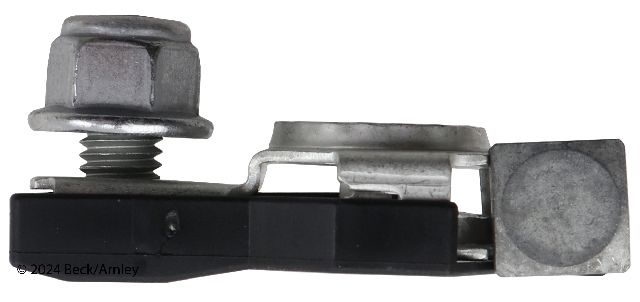
(OEM #24080-JA00A (Sedan), 24080-JA10A (Coupe, 3.5L CVT))— This is the most frequent failure point for this code on this vehicle due to corrosion and breakage at the transmission mounting point. Replacing the entire cable assembly ensures a solid connection.
Trusted brands: Nissan OE, Standard Motor Products
OEM price range: $40-$70
Aftermarket price range: $15-$40 - Car Battery — A weak battery causes low voltage, a common trigger for communication codes on startup.
Trusted brands: Interstate, DieHard, Duralast
OEM price range: $200-$300
Aftermarket price range: $150-$250 - Instrument Cluster — A documented failure point that can take down the CAN network. NHTSA complaint #10970695 describes a 2012 Altima where the cluster failed, had good power and ground, but would not communicate, causing a U1000 code.
Related Codes That Often Appear With This One
- U0100 — Lost Communication With ECM/PCM
- U0101 — Lost Communication with TCM. This may be a permanent code that requires a drive cycle to clear after repair.
- U0121 — Lost Communication With Anti-Lock Brake System (ABS) Control Module
- P1700 / P1715 — These are CVT/TCM related codes that may appear alongside U1000 if the Transmission Control Module is the source of the communication loss, as seen in NHTSA complaint #10946177.
Technical Service Bulletins (TSBs) & Recalls
- NTB10-066A / NTB10-066B: Titled 'CAN COMMUNICATION CODES – DIAGNOSTIC TIPS AND GUIDELINES', this is the primary TSB for this issue. It advises technicians to diagnose communication codes first and states that the module reporting U1000 is typically operating normally. It was updated in 2014 (A) and 2022 (B).
- NTB06-009a: Titled 'MIL “ON” WITH DTC U1000 OR U1010 STORED IN ENGINE CONTROL UNIT', this TSB specifically instructs technicians to clean and re-tighten ECM and battery ground connections to resolve the code on 2002-2006 Altimas and other models.
Platform-Specific Known Issues
- NHTSA owner complaint #10970695 for a 2012 Altima documents a case where a failed instrument cluster caused a U1000 code and required replacement.
- NHTSA owner complaint #10946177 for a 2011 Altima shows U1000 appearing with multiple CVT codes, pointing to a potential TCM or related wiring issue.
- A broken ground wire on the transmission is a very common cause for random misfires (P0300) and can also cause communication codes like U1000.
Mechanic-Grade Diagnostic Values
- CAN Bus Resistance — expected: ~60 Ω between Pin 6 (CAN-H) and Pin 14 (CAN-L) at the DLC with battery disconnected.. Failure: 120 Ω indicates an open circuit or one of the two terminating modules is disconnected/faulty. A reading near 0 Ω indicates a short between the CAN lines.
- CAN Bus Voltage — expected: CAN High and CAN Low lines carry differential signals at a nominal 2.5 volts.. Failure: Significant deviation from 2.5V on either line, or lines that are stuck high or low, indicates a short to power or ground.
- System Voltage Under Load — expected: Should remain above 10.0V during engine cranking.. Failure: Voltage dropping below 10.0V can cause various modules to randomly drop off the CAN network.
Scan Tool Commands That Help
- Nissan CONSULT-II / CONSULT-III plus: CAN Diag Support Monitor — This function performs a network-wide 'roll call' to show the communication status of every module. It helps pinpoint which specific module is not transmitting or receiving, which is essential for isolating the fault.
- Nissan CONSULT-II / CONSULT-III plus: Self-Diagnostic Results — To pull DTCs from all vehicle modules simultaneously. This is crucial because the module that has failed is often not the one logging the U1000 code.
Wiring & Ground Locations

- TCM (Transmission Control Module) — On a 2010 Altima, the TCM is located in the engine bay, right in front of the battery.. If the TCM loses communication (often accompanied by code U0101), checking its dedicated power, ground, and harness connections is a primary diagnostic step. Its exposed location makes it susceptible to damage or corrosion.
- IPDM (Intelligent Power Distribution Module) — Located in the engine bay, it is the main 'smart' fuse and relay box.. The IPDM supplies power to many other control modules. A fault within the IPDM can cut power to a module, causing it to drop off the network and trigger a U1000 code elsewhere. It can also cause intermittent electrical issues that damage other modules over time.
- Main Negative Ground Cable — Connects from the negative battery terminal to a bolt on the transmission case and also to the chassis.. This is the most common failure point. Corrosion at the transmission case bolt creates high resistance, leading to voltage drops that disrupt CAN communication across the entire vehicle.
Real Owner Repair Stories
- Reddit user 'Brutl' in r/Nissan (2009 Nissan Altima Coupe) — Recurring no-start condition with a 'KEY' light on the dash. The car would need to be towed.
❌ Tried (didn't work) Replacing the Electronic Steering Column Lock (ESCL) multiple times at the dealership under warranty. The problem kept returning.
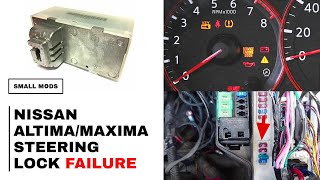
✅ What actually fixed it The root cause was identified as a faulty Intelligent Power Distribution Module (IPDM). The IPDM was damaging the new ESCL units, causing the repeated failures. Replacing the IPDM resolved the issue permanently. - YouTube video by 'Small Mods' (2009-2010 Nissan Altima/Maxima) — No-start, key fob not recognized, 'KEY' light on dash, cascade of communication codes.
❌ Tried (didn't work) Replacing key fob battery.
✅ What actually fixed it The final fix was replacing the faulty Electronic Steering Column Lock (ESCL) as part of Nissan's service campaign (PC516). The video also notes temporary fixes to get the car started, such as hammering on the ESCL unit under the steering column or pulling the 10-amp 'Steering Lock' fuse from the engine bay fuse box.
"I Checked Everything" — The Actual Cause
- A common scenario is when a 2009-2010 Altima repeatedly has its Electronic Steering Column Lock (ESCL) fail, even after replacement. The standard diagnosis correctly identifies the failed ESCL, but the actual root cause is a faulty Intelligent Power Distribution Module (IPDM) that is electrically damaging the new ESCL units. Technicians may miss this because the IPDM itself doesn't log a code, it just creates the problem downstream.
When the Usual Fixes Don't Work
- While cleaning grounds and checking the battery fixes a majority of U1000 issues, there are documented cases where the problem persists. For 2009-2010 models, the most common counter-narrative is a failed Electronic Steering Column Lock (ESCL), which requires replacement, not just a ground cleaning. In an even more complex case, a user found that even replacing the ESCL didn't fix the problem permanently; the true culprit was a faulty IPDM (smart fuse box) that was repeatedly destroying the new ESCL module. This demonstrates that if the simple fixes don't work, the diagnostic path must expand to consider module-on-module interference.
OEM Part Supersession History
Electronic Steering Column Lock (ESCL) Assembly→Electronic Steering Column Box (ESCB) Assembly— The original ESCL unit had a high failure rate, causing a no-start condition. The replacement ESCB part eliminates the physical steering lock function entirely to prevent this failure.
Heads up: After the campaign is performed, the steering wheel will no longer lock when the vehicle is parked and turned off. This is by design.
Model Year Variations Within This Range
- 2009-2010: These model years are uniquely affected by a widespread failure of the Electronic Steering Column Lock (ESCL) module. This specific part failure is a primary cause of no-start and U1000 codes on these vehicles, a problem not present on earlier or later models in the generation. Nissan issued a voluntary service campaign (PC516) to replace the faulty part.
- 2005-2007: While the CAN bus system was present, the mandate for its use for all OBD-II diagnostics in the USA was not until 2008. These earlier models may have a mix of communication protocols alongside the CAN bus, which can slightly alter diagnostic procedures compared to 2008-2012 models.
Helpful Videos



We Have This Part in Stock


The information in this article is provided for general reference and educational purposes only. Vehicle specifications, procedures, and part compatibility can vary by production date, trim level, and region. Always consult your vehicle's factory service manual and verify part numbers before purchasing or performing repairs. Safety-critical components such as airbags, seat belts, and braking systems should be installed by a qualified professional.
- Nissan ALTIMA:
- 🧭 Diagnostic Flowchart
- 🎬 Helpful Videos
- 🛍️ Shop This Part
- What's Unique About the 2005-2012 Nissan ALTIMA
- Symptoms You May Notice
- Most Likely Causes
- Rare But Worth Checking
- Diagnosis Steps
- Parts You'll Likely Need
- Related Codes That Often Appear With This One
- Technical Service Bulletins (TSBs) & Recalls
- Platform-Specific Known Issues
- Mechanic-Grade Diagnostic Values
- Scan Tool Commands That Help
- Wiring & Ground Locations
- Real Owner Repair Stories
- "I Checked Everything" — The Actual Cause
- When the Usual Fixes Don't Work
- OEM Part Supersession History
- Model Year Variations Within This Range
- 🎟️ Get 5% Off