

U1002 on 2008-2013 Infiniti G37: Causes and Fixes for CAN Communication Failure
The U1002 code on a 2008-2013 Infiniti G37 indicates a loss of communication on the vehicle's CAN network. This is most commonly caused by water damage to the Body Control Module (BCM) from clogged sunroof drains, but can also stem from a poor ground connection or low battery voltage. Diagnosis is complex and usually requires professional tools to pinpoint the fault.
- U1002 means there is a serious communication breakdown between the electronic modules in your G37.
- Before complex diagnostics, always check the easiest things first: battery health and major ground connections.
- A common and specific failure point on the G37 is water leaking from clogged sunroof drains onto the Body Control Module (BCM). Check the passenger footwell for moisture.
- This is not a DIY-friendly code. Accurate diagnosis requires professional tools and knowledge of CAN bus systems.
- Do not replace modules based solely on them reporting a U1002 code; they are often just the messenger, not the cause of the problem.
What's Unique About the 2008-2013 Infiniti G37

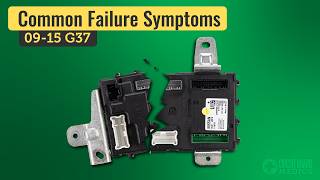
On the Infiniti G37, CAN communication codes like U1002 are frequently traced back to water intrusion affecting the Body Control Module (BCM). The BCM is located in the passenger-side kick panel area, which is directly in the path of water when the front sunroof drains become clogged or their firewall grommets fail. This water drips onto the BCM and its connectors, causing corrosion and electrical shorts that disrupt the entire CAN network. This makes checking for water damage a critical first step when diagnosing this code on a G37.
Diagnostic Flowchart

Tap your situation to follow the diagnostic path that matches what you're seeing on this vehicle.
Symptoms You May Notice

- Check Engine Light is on
- VDC (Vehicle Dynamic Control) and SLIP warning lights are on
- Car will not start or only cranks but won't turn over.
- Transmission may shift harshly or get stuck in one gear
- Instrument cluster gauges may behave erratically or reset; trip computer resets with every start.
- Loss of power to accessories like the radio or interior lights.
- Key fob not working to lock/unlock doors.
- Brake warning light may be illuminated
- Replacing a module that is simply reporting the U1002 code. The module setting the code is often working correctly; it's just reporting that it can't hear from another module on the network.
- Replacing wheel speed sensors when ABS/VDC/SLIP lights are on with a U1002 code. The root cause is more likely the network failure, not the sensors themselves.
Most Likely Causes

- Water Damage to BCM or Connectors 🔴 High Probability The front sunroof drain tubes are notorious for clogging or the firewall grommet failing, causing water to leak into the passenger-side A-pillar and footwell. The BCM is located directly in this leak path, making it highly susceptible to water damage and corrosion.
How to confirm: Remove the passenger-side kick panel and A-pillar trim. Feel the carpet for dampness and inspect the BCM and its wiring harness connectors for any signs of blue or green corrosion, water stains, or a mildew smell. A common symptom progression is the key fob failing after rain, followed by a no-start condition. 🎬 Watch: See how water under the carpet causes no-start issues.
Typical fix: If corrosion is minor, connectors can be cleaned with an electronics cleaner after disconnecting the battery. If the BCM itself is damaged, it must be replaced and programmed to the vehicle. 🎬 Watch: How to replace and program a BCM using OEM scanners. A preventative and permanent fix is to reroute the sunroof drain tube to splice into the A/C condensation drain hose, bypassing the faulty firewall exit point entirely. 🎬 See this walkthrough on installing a sunroof drain repair kit.
Est. part cost: $500-$800 for a new BCM, or $150-$250 for a used one from a junkyard. - Poor Ground Connection 🟡 Medium Probability Multiple electronic systems rely on shared grounding points. Corrosion or looseness at a key ground can disrupt communication for several modules. A specific ground strap connecting the body to the exhaust manifold heat shield has been noted by owners to rust off, causing electrical issues. General chassis and engine block grounds can also degrade over time.
How to confirm: Inspect and clean all major ground points, particularly the main battery ground, engine block grounds, and any grounds near the BCM and ECM. One main grounding point is on the passenger side strut tower in the engine bay. Check for less than 1 ohm of resistance between the ground point and the battery negative terminal.
Typical fix: Clean the contact surfaces of the ground wire and chassis with a wire brush until shiny, then re-secure the connection. Apply dielectric grease to prevent future corrosion. Some owners install aftermarket grounding kits to improve electrical stability.
Est. part cost: $0-$20 - Low Battery Voltage or Failing Alternator 🟡 Medium Probability → Shop Vehicle Battery Infiniti's electronic modules are sensitive to voltage. When system voltage drops below a certain threshold (e.g., 10V-12V), modules can stop communicating properly, triggering U-codes. This is explicitly mentioned in Infiniti's diagnostic guidelines for CAN codes.
How to confirm: Test the battery voltage with the engine off (should be >12.4V). Then, start the engine and test the alternator output (should be 13.5V-14.8V). A load test on the battery is the most definitive test. Low voltage can also be a symptom of a parasitic drain, possibly from a faulty module.
Typical fix: Replace the weak battery or failing alternator.
Est. part cost: $150-$400 - Damaged CAN Bus Wiring Harness ⚪ Low Probability Wiring can be damaged from previous repairs, improper installation of aftermarket electronics, or chafing against sharp metal edges. Tapping into the mirror wiring for a radar detector is a known cause for shorting the CAN bus if done incorrectly.
How to confirm: With the battery disconnected, measure the resistance between Pin 6 (CAN-H) and Pin 14 (CAN-L) at the OBD-II port. A healthy network should read approximately 60 ohms. A reading of 120 ohms indicates an open circuit (likely a disconnected module or broken wire), while 0 ohms indicates a short circuit between the CAN lines.
Typical fix: Locate the break or short in the wiring and repair it. This often requires tracing the harness and is very labor-intensive.
Est. part cost: $5-$50 for wiring supplies
Rare But Worth Checking
- Faulty ABS Module: → Shop ABS Control Module A failing ABS control module can internally short or fail, disrupting the CAN network and causing a U1002 code to be logged by other modules. This is often accompanied by ABS, VDC, and SLIP lights, and may set codes like C1109 or C1110. In some cases, the ABS pump motor may run continuously, draining the battery.
- Faulty Control Module: A single faulty module (e.g., TCM or ECM) can fail in a way that it floods the network with bad data or shorts the CAN bus, bringing down the entire system. This is hard to diagnose without isolating each module one by one using a process of elimination.
- Improperly Installed Aftermarket Electronics: Tapping into CAN bus wires for aftermarket alarms, remote starters, or audio equipment is a common source of these errors. A user on MyG37.com reported triggering U1000/U1001 codes after incorrectly hardwiring a radar detector to the auto-dimming mirror, which is on the CAN network.
Diagnosis Steps
- Check and record all stored DTCs from all available modules. Pay attention to which module is reporting the U1002 code, but remember it may not be the faulty part.
- Verify battery voltage is above 12.4V with the engine off and that the charging system is putting out 13.5V-14.8V when running. Low voltage is a primary cause of CAN faults.
- If the vehicle has a sunroof, perform a thorough inspection of the passenger footwell and kick panel area for any signs of moisture or corrosion near the BCM. Pull back the carpet to be sure.
- Inspect all visible major ground connections for tightness and corrosion, especially near the battery, on the engine block, and the exhaust manifold heat shield ground strap.
- Disconnect the battery. Measure the resistance between pins 6 (CAN-H) and 14 (CAN-L) of the DLC (OBD-II port). The reading should be approximately 60 ohms.
- If resistance is 120 ohms, there is an open in the circuit or a terminating resistor (often in the ECM or BCM) is disconnected/faulty. If resistance is near 0 ohms, there is a short between the CAN High and CAN Low wires.
- If resistance is correct but the problem persists, the issue may be intermittent. Check for aftermarket devices spliced into the vehicle's wiring.
- If a specific module is suspected (e.g., ABS module), a technician may disconnect it to see if the 60-ohm resistance is restored and communication returns to the rest of the network.
Parts You'll Likely Need
- Body Control Module (BCM)
(OEM #284B1-JK62A)— Often the victim of water damage from clogged sunroof drains, leading to corrosion and network failure. This part requires programming upon replacement.
Trusted brands: Infiniti (OEM)
OEM price range: $500-$800
Aftermarket price range: $150-$400 (Used/Remanufactured)
Related Codes That Often Appear With This One
- U1000 — U1000 is a general CAN communication failure code. U1002 is a more specific version of the same fault with stricter timing criteria, and they frequently appear together.
- U1001 — This code specifically points to a communication loss with the ECM. It often accompanies other CAN codes when the network is unstable.
- C1109 — This code indicates a power supply issue (low voltage) to the ABS actuator. It can be triggered by a failing ABS module, which in turn can cause network codes like U1002.
Technical Service Bulletins (TSBs) & Recalls
- ITB10-029A / NTB10-066B: Provides general diagnostic guidelines for Infiniti/Nissan CAN communication codes U1000, U1001, U1002, and U1010. It emphasizes checking for low battery voltage first and using the CONSULT scan tool for proper diagnosis. It also clarifies that the module reporting the code is often not the one that has failed.
- NTB13-027C: A general CAN diagnostic flowchart that provides step-by-step electrical checks for resistance and voltage on the network when communication is lost.
Platform-Specific Known Issues
- Clogged Sunroof Drains Causing BCM Failure: This is the most well-documented and G37-specific cause for code U1002. The front drain grommets at the firewall shrink and fail, allowing water into the passenger footwell. Owners have documented this extensively, with many recommending a permanent fix of rerouting the drain hose to the A/C drain line inside the cabin, completely bypassing the firewall. Ignoring a damp passenger floorboard will almost inevitably lead to BCM failure and a no-start condition.
Mechanic-Grade Diagnostic Values
- CAN Bus Resistance — expected: Approximately 60 Ω. Failure: A reading of 120 Ω indicates an open circuit or a disconnected terminating module. A reading near 0 Ω indicates a short between the CAN-H and CAN-L lines.
- CAN Bus Voltage (CAN-H to Ground) — expected: Approximately 2.6V (Key ON, Engine OFF). Failure: Significant deviation from 2.6V can indicate a short or open on the CAN High line.
- CAN Bus Voltage (CAN-L to Ground) — expected: Approximately 2.4V (Key ON, Engine OFF). Failure: Significant deviation from 2.4V can indicate a short or open on the CAN Low line.
Scan Tool Commands That Help
- Infiniti CONSULT-II / CONSULT-III Plus: CAN Diagnosis Support Monitor — This is the primary function used to automatically poll all modules on the CAN network and display which ones are communicating and which are not. It is the starting point for any U-code diagnosis.
- Infiniti CONSULT-II / CONSULT-III Plus: Self-Diagnostic Results — After running the CAN support monitor, this function is used to check the DTCs stored in each individual module. This helps determine which module is logging the U1002 code and which other codes are present that might point to the root cause.
- Infiniti CONSULT-II / CONSULT-III Plus: ECU Programming / Configuration — This function is required after replacing a control module, such as the BCM or ECM. The new module must be programmed to the vehicle's VIN and configuration to restore communication and functionality.
Wiring & Ground Locations
- BCM Connectors M121, M122, M123, M124 — Located on the Body Control Module (BCM) in the passenger-side kick panel area.. These are the main connectors for the BCM. Water intrusion from the sunroof drain often corrodes the pins on these connectors, especially the 40-pin connectors M121 and M122, disrupting CAN signals.
- Ground Points M57, M61 — These are primary body ground points located in the driver and passenger kick panel areas.. The BCM and other nearby modules rely on these grounds. Corrosion or looseness at these points can cause intermittent communication failures and trigger U-codes.
- CAN_H and CAN_L wires — Pink (CAN_H) and Blue (CAN_L) twisted pair wires running throughout the vehicle's wiring harness, accessible at the OBD-II port (Pins 6 & 14) and at each control module connector.. These two wires form the backbone of the CAN network. All diagnostic resistance and voltage measurements are performed on this pair to check the health of the network.
Real Owner Repair Stories
- Reddit user New_Weight9419 on r/G37 (Infiniti G37 (year not specified)) — Sunroof leaked onto BCM. Initially, the car seemed fine after the BCM was dried out. A year later, a cascade of electrical issues began: computer module failed, BCM failed, connector port showed water corrosion, parasitic battery drain, and fan speed control module failure.
❌ Tried (didn't work) Drying out the original BCM without replacing it. This provided a temporary fix but did not prevent long-term failure from the initial water damage.
✅ What actually fixed it The user's post is a cautionary tale implying a full replacement of the BCM and affected connectors was ultimately necessary. The key takeaway is that once a BCM gets wet, even if it dries and works temporarily, it should be considered compromised and prone to future failure. - Reddit user on r/G37 (Infiniti G37 (year not specified)) — After rain, the key fob would not lock/unlock the doors, a yellow key light appeared on the dash, and the car would not start. Water sounds were heard from the passenger side.
❌ Tried (didn't work) The post focuses on the successful repair, so no failed attempts were listed.
✅ What actually fixed it The user identified a wet BCM. The fix involved: 1. Replacing the damaged BCM with a used unit from eBay. 2. Having a mobile locksmith/reprogrammer sync the new BCM and keys to the car. 3. Permanently fixing the leak by rerouting the sunroof drain hose to the A/C drain hose in the passenger footwell.
OEM Part Supersession History
284B1-JK600, 284B1-JK61A→284B1-JK62A— Revision and update by the manufacturer. Newer part numbers typically include reliability improvements.
Heads up: Part number 284B1-JK62A is specified for 2007-2008 G35 and 2008-2009 G37 models. While physically similar, using a BCM from a different year range or model (e.g., coupe vs. sedan) may cause functionality issues even after programming. Always match the part number exactly or use the latest superseded number.
Model Year Variations Within This Range
- 2008-2013: While the sunroof drain design flaw persists across the entire 2008-2013 G37 model range, there are minor variations in BCM wiring and connector pinouts between sedan, coupe, and convertible models, and between early (2008-2009) and later (2010+) years. For example, the lock/unlock wire colors can differ. It is crucial to consult the correct Factory Service Manual (FSM) for the specific year and model before attempting any wiring repairs.
Helpful Videos
We Have This Part in Stock

The information in this article is provided for general reference and educational purposes only. Vehicle specifications, procedures, and part compatibility can vary by production date, trim level, and region. Always consult your vehicle's factory service manual and verify part numbers before purchasing or performing repairs. Safety-critical components such as airbags, seat belts, and braking systems should be installed by a qualified professional.
- Infiniti G37:
- 🧭 Diagnostic Flowchart
- 🎬 Helpful Videos
- 🛍️ Shop This Part
- What's Unique About the 2008-2013 Infiniti G37
- Symptoms You May Notice
- Most Likely Causes
- Rare But Worth Checking
- Diagnosis Steps
- Parts You'll Likely Need
- Related Codes That Often Appear With This One
- Technical Service Bulletins (TSBs) & Recalls
- Platform-Specific Known Issues
- Mechanic-Grade Diagnostic Values
- Scan Tool Commands That Help
- Wiring & Ground Locations
- Real Owner Repair Stories
- OEM Part Supersession History
- Model Year Variations Within This Range
- 🎟️ Get 5% Off