

U1002 on 2005-2012 Nissan Armada: CAN Communication Fault Causes and Fixes
Code U1002 on a 2005-2012 Nissan Armada indicates a CAN communication network failure. The most common causes are a faulty Intelligent Power Distribution Module (IPDM), poor electrical grounds, or corroded wiring. Diagnosis is complex, but checking CAN bus resistance (target 60 ohms) and performing an IPDM self-test are key steps.
- U1002 is a network communication code, not a specific part failure code. Do not replace parts without a proper diagnosis.
- Start your diagnosis with the basics: check the battery and clean all major ground connections.
- A multimeter check of the CAN bus resistance at the OBD-II port is a quick way to identify the type of network fault (open or short).
- This fault often triggers ABS and VDC/SLIP lights, as these safety systems are highly dependent on network communication.
- Due to the complexity, professional diagnosis with advanced tools is strongly recommended to avoid costly misdiagnosis.
What's Unique About the 2005-2012 Nissan ARMADA
On this generation of Nissan trucks and SUVs built on the F-Alpha platform, the CAN communication system is extensive, linking dozens of modules. The U1002 code often appears alongside various warning lights like 'VDC OFF' and 'SLIP' because the Vehicle Dynamic Control system relies on constant communication between the engine, brake, and steering angle sensors. These vehicles are particularly prone to failures in the Intelligent Power Distribution Module (IPDM), as well as wiring corrosion and ground point failures over time, which are primary triggers for intermittent and hard-to-diagnose network faults like U1002.
Diagnostic Flowchart
Tap your situation to follow the diagnostic path that matches what you're seeing on this vehicle.
Symptoms You May Notice
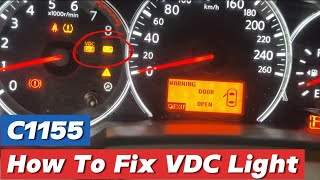
- VDC OFF and SLIP warning lights illuminated on the dashboard. 🎬 Watch: Troubleshooting VDC and SLIP light causes
- ABS warning light on.
- Brake warning light on (sometimes related to low fluid, which can trigger VDC faults).
- Check Engine Light may be on.
- Vehicle may not start or crank (no-start condition).
- Vehicle may crank but not start.
- Engine may stall while driving, especially at low speeds.
- Erratic or jittery vehicle behavior while driving.
- Loss of function in systems like power steering, 4WD, or HVAC.
- Steering wheel appears off-center while driving straight (can be a cause or result of VDC system confusion).
- Replacing a single control module without performing a full network diagnosis. The U1002 code indicates a communication problem, which is often external to the module reporting the code.
- Assuming the starter is bad during a no-crank condition without first checking for a signal from the IPDM.
Most Likely Causes
- Faulty Intelligent Power Distribution Module (IPDM) 🔴 High Probability → Shop Fuse Box The IPDM is a known weak point. It's a complex unit containing integrated relays and a circuit board that acts as a network gateway. Internal failures, particularly of the non-serviceable ECM relay, are common and can cause stalling, no-start conditions, and network collapse.
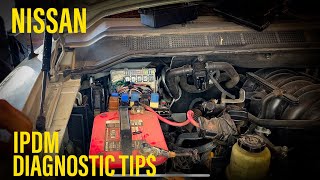
How to confirm: Perform the IPDM's built-in self-test (auto active test). This test cycles various outputs (wipers, lights, A/C clutch) to confirm the IPDM's basic functions. A failure of this test points to a bad IPDM. If the test passes but symptoms persist, the IPDM can still be the cause of the CAN fault.
Typical fix: Replace the entire IPDM E/R assembly. For a specific issue on 2004-2006 models with a white IPDM, Nissan authorized the replacement of just the ECM relay.
Est. part cost: $250-$700 - Poor Ground Connections 🔴 High Probability Over time, main ground points on the engine block, chassis, and behind the dashboard can corrode, creating high resistance and disrupting sensitive module communications. This is a well-documented issue on Nissan vehicles of this era.
How to confirm: Visually inspect and clean all major ground straps and connection points, especially the main battery-to-chassis/engine ground. Use a multimeter to test for voltage drops between the battery negative terminal and various ground points on the chassis and engine.
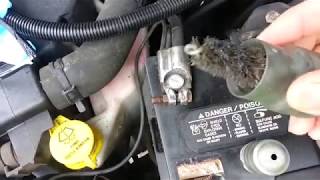
Typical fix: Remove, clean all contact surfaces to bare metal, 🎬 See this guide on cleaning battery terminals and grounds and securely re-fasten all corroded ground connections. It may be necessary to replace corroded ground straps or the entire battery ground cable.
Est. part cost: $5-$75 - Corroded or Damaged Wiring Harness 🟡 Medium Probability Wiring harnesses, especially those in the engine bay or under the vehicle, are exposed to heat, moisture, and physical stress, which can lead to broken wires or corroded connectors, disrupting the CAN network.
How to confirm: Visually inspect harnesses for damage. With the battery disconnected, use a multimeter to check for continuity on the CAN High and CAN Low wires between modules and check for shorts to power or ground. The total resistance across the CAN H and CAN L pins at the OBD-II port should be approximately 60 ohms.
Typical fix: Repair the damaged section of the wiring harness or replace the affected connector.
Est. part cost: $20-$300 - Low Battery Voltage ⚪ Low Probability → Shop Vehicle Battery A weak or failing battery can cause modules to drop off the network as voltage levels become unstable during startup or operation. Nissan TSBs note that modules will stop communicating at different voltages when system voltage drops below 10V.
How to confirm: Test the battery's state of charge and health. Ensure voltage is above 12.4V at rest and that it doesn't drop below 10V while cranking.
Typical fix: Charge or replace the vehicle's battery.
Est. part cost: $150-$300 - Faulty Control Module (ECM, BCM, ABS) ⚪ Low Probability While less common than IPDM or wiring issues, a module itself can fail internally, causing it to either stop communicating or flood the network with bad data. The ECM and BCM are terminating modules, so their failure can take down the whole network.
How to confirm: This is a process of elimination. If wiring, grounds, and the IPDM are confirmed to be good, a technician can use a scope to analyze network data or disconnect modules one by one to see if communication is restored.
Typical fix: Replace the faulty module. This often requires programming the new module to the vehicle.
Est. part cost: $200-$1500
Rare But Worth Checking
- Aftermarket Electronics: Poorly installed aftermarket accessories like remote starters, alarms, or audio equipment can interfere with the CAN network and cause communication codes. Some devices may even have their own 120-ohm terminating resistor, which can disrupt the network's 60-ohm balance.
Diagnosis Steps
- Check and charge the battery. Ensure battery voltage is stable and above 12.4V, and does not drop below 10V during cranking.
- Use a CAN-capable scan tool to see which modules are reporting the U1002 code and which modules are not communicating.
- Always diagnose communication codes (U-codes) first, before any other DTCs.
- Perform the IPDM Self-Test (Auto Active Test). This is a quick way to check the basic functionality of the IPDM's internal relays and circuits.
- Inspect all major power and ground connections for the engine and chassis. Pay special attention to the main battery ground cable and any straps from the engine to the firewall. Clean any corrosion found.
- With the battery disconnected, measure the resistance between Pin 6 (CAN-H) and Pin 14 (CAN-L) at the OBD-II port. A healthy network should read approximately 60 ohms.
- If resistance is ~120 ohms, it indicates an open circuit or a missing terminating resistor (often in the ECM or BCM).
- If resistance is near 0 ohms, there is a short between the CAN High and CAN Low wires.
- With the key on (engine off), check CAN line voltages. Measure Pin 6 (CAN-H) to chassis ground (should be ~2.5-3.0V). Measure Pin 14 (CAN-L) to chassis ground (should be ~2.0-2.5V).
- Visually inspect wiring harnesses for physical damage, chafing, or corrosion, paying close attention to connectors for the ECM, BCM, IPDM, and ABS modules.
- If wiring and grounds are good, the issue may be a faulty module. This requires advanced diagnostics, often by disconnecting modules one by one to isolate the source of the network failure.
Parts You'll Likely Need
- Intelligent Power Distribution Module (IPDM)
(OEM #Varies by year/model. (e.g., 284B7-ZE03A for some models, verify with VIN))— The IPDM is a very common failure point, causing a wide range of electrical and communication issues, including U1002.
Trusted brands: Nissan OE
OEM price range: $400-$700
Aftermarket price range: $250-$500 - ECM Relay (for IPDM)
Related Codes That Often Appear With This One
- U1000 — Both are CAN communication failure codes. U1002 has a stricter timing requirement for setting the fault, but they point to the same underlying network issue.
- U1001 — This is a specific CAN communication code related to the ECM. It often appears with other U-codes when a network-wide issue is present.
- C1103-C1108 — These are codes for wheel speed sensor circuits. A fault in the ABS module or its wiring can trigger both a C-code for the sensor and a U-code for the loss of communication from the ABS module.
- C1142 — This code relates to the steering angle sensor. If the VDC module loses communication with the steering angle sensor, it will set this code along with U-codes and illuminate the SLIP light.
Technical Service Bulletins (TSBs) & Recalls
- NTB10-066A / NTB10-066B: Provides service information for communication codes U1000, U1001, U1002, and U1010, advising that they be diagnosed first and defining U1002 as a communication error with a tighter specification than U1000.
- NTB13-027C: An amended bulletin that provides a detailed diagnostic flowchart for CAN communication issues, including helpful tips on low voltage effects and checking high-level fuses.
- NTB10-145B (BR10-011B): Specifically addresses diagnosis when the ABS/VDC warning light is on with DTC U1000, providing a repair flowchart.
Platform-Specific Known Issues
- 2004-2006 White IPDM ECM Relay Failure: Early models in this generation (including 2005-2006 Armadas) equipped with a white-colored IPDM were prone to failure of the internal, non-serviceable ECM relay. Symptoms included stalling at low speeds, intermittent no-start, or a crank-no-start condition. Nissan issued a service bulletin and a specific replacement relay (Part No. 284B7-CW29E) to address this one-time exception to their 'do not replace relays' rule.
Mechanic-Grade Diagnostic Values
- CAN Bus Resistance (at OBD-II Port) — expected: ~60 Ohms. Failure: 120 Ohms indicates a missing terminating resistor or an open in the circuit. ~0 Ohms indicates a short between CAN-H and CAN-L wires.
- CAN High Voltage (Pin 6 at OBD-II to Ground, Key On) — expected: ~2.6V to 3.5V. Failure: Significant deviation from this range indicates a bus problem. A static 2.5V may indicate the bus is idle.
- CAN Low Voltage (Pin 14 at OBD-II to Ground, Key On) — expected: ~1.5V to 2.4V. Failure: Significant deviation from this range indicates a bus problem. A static 2.5V may indicate the bus is idle.
- Resistance of a terminating module (e.g., ECM, BCM) — expected: ~120 Ohms. Failure: A reading significantly different from 120 Ohms at a known terminating module suggests the module's internal resistor has failed.
Scan Tool Commands That Help
- Nissan CONSULT-II / CONSULT-III: Self Diagnostic Result — To retrieve DTCs from individual control units like the ABS, which may be the source of the U1002 code stored in other modules.
- Nissan CONSULT-III: CAN Diagnosis Support Monitor — This function provides a detailed matrix of which control units are successfully communicating and which have current or past errors, helping to pinpoint the source of the network failure. A pink highlight on a module indicates an internal error.
- Nissan CONSULT-III: IPDM E/R Active Test — To command the IPDM to cycle its various outputs (lights, wipers, relays). This confirms the IPDM's basic command functions are working, even if it has an intermittent CAN fault.
Wiring & Ground Locations
- Engine Room Harness Grounds — Key ground points are located on the fenders near the battery, on the engine block itself, and sometimes a braided strap from the rear of the engine to the firewall.. Corrosion at these primary ground points introduces resistance and electrical noise, which is a primary cause of CAN communication failures like U1002.
- Trailer Brake Controller Harness Connector — Tucked up under the dashboard, often zip-tied to the left of the steering column near the E-brake pedal assembly.. This factory-provided connector can be a source of issues if an aftermarket brake controller is installed incorrectly, or if the unused connector's pins become shorted or corroded.
- IPDM E/R (Intelligent Power Distribution Module Engine Room) — Located in the engine bay, typically near the battery.. This module is a central hub for both power distribution and CAN communication. Its connectors and internal board are critical points of failure for U1002.
Real Owner Repair Stories
- TitanTalk Forum Member (Nissan Titan (sister platform to Armada)) — Random glitching, loss of power, crank but no start, and the cooling fan running at full blast.
❌ Tried (didn't work) Checking the battery, Multiple start attempts over several days
✅ What actually fixed it Swapping the ECM relay inside the IPDM with another relay from the same fuse box (like the rear defogger relay) allowed the truck to start immediately. This confirmed the internal ECM relay within the IPDM had failed.
OEM Part Supersession History
284B7-ZE03A→284B7-ZE03B, 284B7-ZE03C— Revisions to address internal component failures and improve reliability.
Heads up: It is critical to match the IPDM part number exactly or use a verified superseded part number. Using an IPDM from a different year or model, even if it physically fits, can cause unpredictable electrical issues because the internal logic is different. Always verify with VIN.
Model Year Variations Within This Range
- 2004-2006: Early models often came with a white-colored IPDM which was known to have a high failure rate of the internal, non-serviceable ECM relay. Later models used a black IPDM with revised internal components.
- 2009-2015: The IPDM part number was updated several times. For example, part number 284B7-ZE03B is listed for 2009-2015 models, superseding earlier versions. This indicates running changes to the module's design and components throughout the later half of the generation.
Helpful Videos




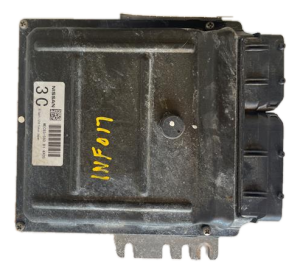
We Have This Part in Stock

The information in this article is provided for general reference and educational purposes only. Vehicle specifications, procedures, and part compatibility can vary by production date, trim level, and region. Always consult your vehicle's factory service manual and verify part numbers before purchasing or performing repairs. Safety-critical components such as airbags, seat belts, and braking systems should be installed by a qualified professional.
- Nissan ARMADA:
- 🧭 Diagnostic Flowchart
- 🎬 Helpful Videos
- 🛍️ Shop This Part
- What's Unique About the 2005-2012 Nissan ARMADA
- Symptoms You May Notice
- Most Likely Causes
- Rare But Worth Checking
- Diagnosis Steps
- Parts You'll Likely Need
- Related Codes That Often Appear With This One
- Technical Service Bulletins (TSBs) & Recalls
- Platform-Specific Known Issues
- Mechanic-Grade Diagnostic Values
- Scan Tool Commands That Help
- Wiring & Ground Locations
- Real Owner Repair Stories
- OEM Part Supersession History
- Model Year Variations Within This Range
- 🎟️ Get 5% Off