

U1010 on 2008-2013 Infiniti G37: Internal Module Failure Causes and Fixes
On a 2008-2013 Infiniti G37, code U1010 indicates an internal failure within a control module. Diagnosis requires a professional scan tool to identify the faulty module (e.g., BCM, TCM, ECM), which will then likely need to be replaced and possibly reprogrammed. The Transmission Control Module (TCM) is the most common culprit on automatic models.
- U1010 on your G37 is not a simple wiring issue; it means a control module has failed internally.
- The first and most important step is to use a professional scan tool to find out *which* module is faulty. On automatic G37s, it is most commonly the Transmission Control Module (TCM).
- Before replacing any expensive modules, always verify the battery and charging system are in excellent health, as low voltage can cause false codes.
- The TCM is integrated into the valve body inside the transmission, making replacement a labor-intensive job that is not beginner-friendly.
- Do not replace parts based on guesswork. The cost of a wrong guess (e.g., a new ECM or a full transmission) is very high.
What's Unique About the 2008-2013 Infiniti G37

While many online resources interpret U-codes as wiring or connection problems, Infiniti has a specific Technical Service Bulletin (ITB13-006C) that defines U1010 as 'Module has internal Issues'. This makes the diagnosis more direct than for other communication codes. The official diagnostic procedure for a G37 with a current U1010 code is to identify the module that set it and, after verifying its power and ground, replace it. On models with the 7-speed automatic transmission (RE7R01A) from 2009-2013, the most common failure is the Transmission Control Module (TCM), which is integrated into the valve body inside the transmission pan, making it susceptible to heat-related failures. The 2008 model uses a different 5-speed transmission (RE5R05A) with a separately located TCM.
Diagnostic Flowchart

Tap your situation to follow the diagnostic path that matches what you're seeing on this vehicle.
Symptoms You May Notice

- Check Engine Light is on
- Multiple warning lights on the dashboard (e.g., VDC, SLIP, ABS, AT)
- Transmission may enter 'limp mode,' refusing to shift or shifting harshly.
- Loss of function for systems controlled by the failed module (e.g., power windows, radio, climate control if BCM fails).
- Vehicle may not start or may stall.
- Gear position indicator on the dashboard may go blank.
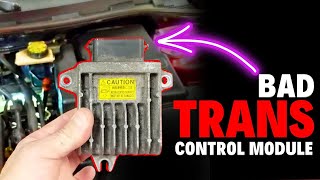
- Flashing 'AT' (Automatic Transmission) light on the dashboard. 🎬 See this breakdown of common symptoms for a failing TCM.
- Replacing wiring harnesses. While other U-codes (like U1000) often point to wiring issues between modules, U1010 specifically points to the module itself.
- Replacing the wrong module. Without a proper scan to see which module logged the code, a technician might guess and replace a perfectly good component, like replacing the ECM when the TCM is the actual failure.
- Replacing the transmission. While the most common fix involves working inside the transmission, the transmission's mechanical components are usually fine. The failure is electronic, within the valve body/TCM assembly.
Most Likely Causes

- Failed Control Module (Especially TCM) 🔴 High Probability This is the specific definition of the code per Infiniti's TSB. On 7-speed automatic models (2009+), the Transmission Control Module (TCM) is integrated into the valve body inside the transmission, where it is exposed to high heat. This can lead to solder joint failure and is the most common cause of U1010 on this platform.
How to confirm: Use a professional-grade scan tool like Infiniti CONSULT-III to perform a full network scan. The module that reports a U1010 code is the one that has failed. If the TCM is the culprit, codes like U0101 will often be stored in other modules.
Typical fix: Replace the faulty control module. For a failed TCM, this involves replacing the entire transmission valve body assembly, which includes the new TCM. The new module must be programmed to the vehicle.
Est. part cost: $600-$2700+ - Low Battery Voltage or Poor Charging System 🟡 Medium Probability → Shop Vehicle Battery Infiniti TSBs note that low voltage (under 10V) can cause modules to stop communicating and set various codes. This can sometimes trigger false internal error codes as modules behave erratically before shutting down.
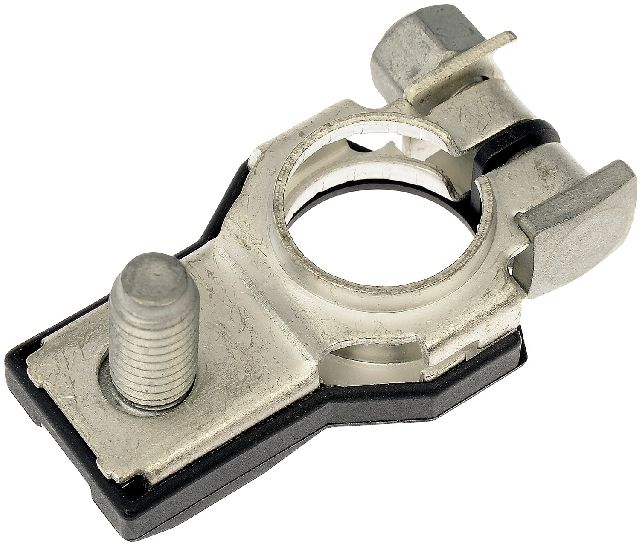
How to confirm: Test the battery with a multimeter or electronic battery tester. It should read ~12.6V when fully charged and ~13.7-14.7V when the engine is running. Check for loose or corroded battery terminals.
Typical fix: Recharge or replace the battery. If the charging voltage is low, diagnose the alternator. Clean and tighten battery terminals.
Est. part cost: $150-$350 - Poor Power or Ground Connection to the Module ⚪ Low Probability Corrosion or loose connections at the module's power feed or ground points can starve it of voltage, mimicking an internal failure. Water intrusion into the passenger footwell from clogged sunroof drains is a known G37 issue that can corrode BCM connectors.
How to confirm: After identifying the faulty module, locate its wiring diagram. Inspect and test the integrity of its main power and ground circuits using a multimeter. Check for signs of water damage near the BCM in the passenger footwell.
Typical fix: Clean or repair the corroded or loose connectors or ground points. Address the source of any water leaks.
Est. part cost: $5-$50
Diagnosis Steps
- Connect a professional-grade scan tool capable of communicating with all vehicle modules (e.g., Infiniti CONSULT or equivalent).
- Perform a full system scan or 'Control Unit Auto-Detect' to see which module is reporting the U1010 code. This is the suspected faulty module. Note any other 'U' codes, especially U0101, which strongly points to the TCM.
- Check the vehicle's battery voltage. Ensure it is above 12.4 volts with the engine off. Start the engine and verify the alternator is charging correctly (typically 13.7-14.7 volts). Address any voltage issues before proceeding.
- If the BCM is suspect, inspect the passenger footwell for dampness, which indicates clogged sunroof drains and potential water damage to the BCM and its connectors.
- Using a wiring diagram for the specific module identified in step 2, inspect its main power and ground connections for tightness and any signs of corrosion or damage.
- Verify with a multimeter that the module is receiving proper voltage and has a solid ground.
- If battery voltage, power, and ground connections are all confirmed to be good, follow the TSB recommendation: replace the control module that set the U1010 code.
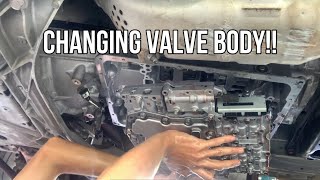
- If the TCM is being replaced, the entire valve body assembly will need to be swapped. This involves draining the transmission fluid and removing the transmission pan. 🎬 Watch: This step-by-step guide shows how to replace the valve body.
- After replacement, perform any required initialization or programming procedures as specified by the factory service manual. For a TCM, this is critical for proper operation.
Parts You'll Likely Need
- Transmission Valve Body w/ Integrated TCM
(OEM #31705-X987A (supersedes multiple previous numbers, but always verify with VIN))— This is the most common module to fail and set U1010. The TCM is not sold separately by Infiniti; it comes as a complete, pre-programmed (by some vendors) assembly with the valve body.
Trusted brands: Infiniti (OEM), Hitachi (OEM supplier), Vertex
OEM price range: $2200-$2700
Aftermarket price range: $600-$1200 (Remanufactured/Programmed) - Vehicle Battery — Low system voltage is a common cause of electronic module faults and communication errors. A weak battery should be ruled out before replacing expensive modules.
Trusted brands: Interstate, DieHard, Duralast
OEM price range: $200-$300
Aftermarket price range: $150-$250 - TCM Repair Service — A cost-effective alternative to full replacement, where the original module is sent to a specialized service to be rebuilt and repaired, fixing the internal failure.
Trusted brands: UpFix, Module Repair Pro
OEM price range: N/A
Aftermarket price range: $200-$500
Related Codes That Often Appear With This One
- U1000 — U1000 is a general CAN communication failure code. It may be present alongside U1010 if other modules lose communication with the failed module.
- U0101 — If the Transmission Control Module (TCM) is the unit that fails and sets the U1010, other modules will log U0101 (Lost Communication with TCM). This is a very common pairing.
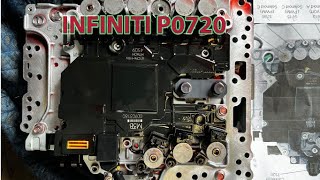
- P0720 — This code for Output Speed Sensor Circuit malfunction can occur alongside TCM communication errors, as the sensor is integrated into the TCM/valve body assembly. A failure in the TCM can disrupt this signal. 🎬 Watch: Expert tips for diagnosing P0720 and transmission communication issues.
Technical Service Bulletins (TSBs) & Recalls
- ITB13-006C: States that U1010 means 'Module has internal Issues' and the diagnostic procedure is to replace the module that sets the code.
- ITB10029A: Mentions that communication codes like U1010 should always be diagnosed first.
- ITB10-075: A TSB related to reprogramming the TCM/ECM to address harsh shifting issues, indicating that the TCM is a known area of concern on these vehicles.
Platform-Specific Known Issues
- TCM Failure in 7-Speed Automatic Models (RE7R01A): The most prevalent cause for a U1010 code on 2009-2013 automatic G37s is the failure of the Transmission Control Module (TCM). Unlike a standalone module, the G37's TCM is physically integrated into the transmission's valve body assembly, located inside the oil pan. This design exposes the electronics to significant heat and vibration, often leading to failure of internal components or solder joints. Symptoms are classic limp mode, harsh shifting, and a U1010 code stored in the TCM itself. The official Infiniti repair is to replace the entire valve body assembly, which is costly. Some third-party services offer to repair the original TCM board, which can be a more affordable option.
- BCM Water Damage from Clogged Sunroof Drains: A known issue on the G37 platform is the clogging of the front sunroof drain tubes. When clogged, rainwater overflows from the drain channel and leaks down the A-pillar directly onto the Body Control Module (BCM) and other electronics in the passenger kick panel, causing corrosion and potential U1010 codes if the BCM fails internally.
Mechanic-Grade Diagnostic Values
- CAN Bus Resistance at Module Connector — expected: ~60 ohms (at a non-terminating module) or ~120 ohms (at a terminating module like ECM/BCM). Failure: Readings significantly different from 60 or 120 ohms, or an open/shorted circuit reading.
- System Voltage during Reprogramming — expected: Must be maintained between 12.0V and 15.5V. Failure: Voltage dropping below 12.0V or exceeding 15.5V can interrupt the process and damage the module.
- CAN High/Low Voltage to Ground (Key On) — expected: Normal values are approximately 2.5V for each line, fluctuating slightly. A common failure mode shows CAN High at ~1.5V and CAN Low at ~0.9V.. Failure: Voltages that are stuck, do not mirror each other, or are pulled close to ground or battery voltage indicate a bus fault.
Scan Tool Commands That Help
- Infiniti CONSULT-III / CONSULT-III plus: CAN Diag Support Monitor — This is the primary diagnostic screen used to visualize the CAN network status, showing which modules are communicating and which are reporting errors, which is essential for isolating the source of a U1010 code.
- Infiniti CONSULT-III / CONSULT-III plus: Re/programming, Configuration > Programming — This function is required after replacing a 'blank' TCM that comes with new valve bodies. It writes the vehicle-specific software to the new module. This is different from 'Reprogramming' which just updates existing software.
- Manual Procedure (No Scan Tool): ECU Reset / TCM Relearn Procedure — After disconnecting the battery for an extended period or replacing air/fuel/throttle components, this pedal dance procedure forces the ECU and TCM to relearn idle trims and shift points. It can resolve poor shifting or idle behavior that is not caused by a hard fault.
Wiring & Ground Locations
- BCM (Body Control Module) — Located in the passenger kick panel area, behind the glove box.. The BCM is a terminating module on the CAN bus and is susceptible to water damage from clogged sunroof drains, which can cause corrosion on its connectors or internal failure, leading to a U1010 code.
- Engine Bay Ground Points — Key grounds are located on the fenders near the air intakes, on the front of the engine block, and on the strut towers.. Poor grounds between the engine, chassis, and battery negative terminal can cause voltage differentials between modules, leading to communication errors that can be misdiagnosed as an internal module failure.
- TCM Main Connector — On the exterior of the transmission housing, on the passenger side. This is the main electrical connection to the internal valve body and TCM assembly.. This connector is a primary point of failure for communication with the TCM. Checking for corrosion, bent pins, or a loose connection here is a critical step before condemning the internal TCM.
Real Owner Repair Stories
- g35driver.com forum user 'franz182' (2005 G35 (similar platform/electronics)) — Car would not start, gear position indicator on dash was blank, and the 'AT CONT' fuse was blowing repeatedly. When it did run, it was in limp mode.
❌ Tried (didn't work) Clearing codes (U1000, U1001) did not resolve the no-start issue.
✅ What actually fixed it A dealership diagnosed and repaired a wiring short in the harness between the TCM and another computer. The total repair was around $380, avoiding a costly and unnecessary transmission or module replacement. - myg37.com forum user (2011 G37X) — No crank, no start condition. All electronics would power on, but the engine would not turn over. The gear position indicator (P, R, N, D) was blank on the dash, and a solid yellow key light was displayed.
❌ Tried (didn't work) Initial thoughts pointed towards the common steering lock failure, but the symptoms were different.
✅ What actually fixed it The failure was diagnosed as the Transmission Control Module (TCM). The owner had it replaced and reprogrammed at a specialty shop, which resolved the no-start condition and brought the gear display back. - g35driver.com forum user (2007 G35x Sedan (5AT)) — Car went into limp mode with a P1757 (Front Brake Solenoid) code. After attempting a DIY repair by resoldering a broken connection inside the TCM, the car would no longer crank or start and began blowing the 'AT CONT' 10A fuse. It logged a U1000 code and the gear selector display was blank.
❌ Tried (didn't work) Resoldering the known break point in the TCM, replacing the fuse repeatedly.
✅ What actually fixed it The user did not post a final resolution, but the story highlights a critical failure pattern: a failed DIY solder repair on the TCM created a short that caused a no-start condition and blew control fuses, escalating the problem from a limp-mode to a non-drivable state.
OEM Part Supersession History
Various older part numbers for RE7R01A Valve Body/TCM→31705-X987A (and others, VIN verification is mandatory)— Revisions to address failure points in the TCM and valve body solenoids.
Heads up: While valve bodies from RWD and AWD G37s may be physically interchangeable, the TCM must be swapped from the original unit or the new unit must be reprogrammed to the car's ECU/VIN. A TCM from a Q50 with a VR30 engine cannot be reprogrammed for a G37 with a VQ37 engine, even if the valve body fits.
Model Year Variations Within This Range
- 2008: 2008 G37 Coupe and G35 Sedan models use a 5-speed automatic transmission (RE5R05A). Its TCM is a separate module, not integrated into the valve body inside the pan. This makes it less prone to the heat-soak failures seen in later models but introduces different potential failure points (external wiring, separate module failure).
- 2009-2013: These models use the 7-speed automatic transmission (RE7R01A), which features the TCM integrated directly onto the valve body inside the transmission. This design is the primary reason for the high rate of heat-related TCM failures that cause the U1010 code on this platform.
Helpful Videos
We Have This Part in Stock



The information in this article is provided for general reference and educational purposes only. Vehicle specifications, procedures, and part compatibility can vary by production date, trim level, and region. Always consult your vehicle's factory service manual and verify part numbers before purchasing or performing repairs. Safety-critical components such as airbags, seat belts, and braking systems should be installed by a qualified professional.
- Infiniti G37:
- 🧭 Diagnostic Flowchart
- 🎬 Helpful Videos
- 🛍️ Shop This Part
- What's Unique About the 2008-2013 Infiniti G37
- Symptoms You May Notice
- Most Likely Causes
- Diagnosis Steps
- Parts You'll Likely Need
- Related Codes That Often Appear With This One
- Technical Service Bulletins (TSBs) & Recalls
- Platform-Specific Known Issues
- Mechanic-Grade Diagnostic Values
- Scan Tool Commands That Help
- Wiring & Ground Locations
- Real Owner Repair Stories
- OEM Part Supersession History
- Model Year Variations Within This Range
- 🎟️ Get 5% Off