

OBD-II Code U1118: Lost Communication
What U1118 means, why it triggers, and how to fix it
- Code U1118 indicates a communication failure on the CAN bus, meaning one specific computer module stopped sending data to the rest of the vehicle.
- Test your battery and alternator first; voltage drops below 12.4V during a cold start are the number one cause of this code.
- Do not replace expensive modules without verifying power and ground at the connector; a $2 blown fuse causes the exact same symptoms.
- Driving with U1118 is highly risky because critical safety systems like the Anti-lock Brake System (ABS) or headlights disable without warning.
What Does U1118 Mean?

U1118 means a specific computer module in your car—such as the ABS, transmission, or body control module—stopped communicating with the rest of the vehicle. The main engine computer (ECU) or another module logged this code because it stopped receiving expected messages over the car's Controller Area Network (CAN) bus.
Technical definition: The SAE/OBD-II definition for U1118 is a generic communication fault, specified by the manufacturer as 'Lost Communication With...' a particular module. It indicates a required data packet was not received from a specific node on the CAN bus within the expected timeframe.
Can I Drive With U1118?
Yes, But With Caution. You can drive, but it is highly risky. This code signifies a communication failure between critical electronic modules. If the Anti-lock Brake (ABS) module is offline, you lose ABS, traction control, and stability control, increasing the risk of skidding. If the Body Control Module (BCM) fails, you experience sudden loss of headlights at night or unexpected anti-theft system engagement. Diagnose the issue immediately to restore safety systems.
Common Causes

- Weak or Failing Battery (Very Common) — Vehicle computers require stable voltage. When a battery is old or weak, voltage drops significantly during cold starts. This drop causes communication glitches between modules, instantly triggering the U1118 code.
- Damaged Wiring or Corroded Connectors (Common) — The CAN bus is a physical network of wires. Frayed wires, broken connections, or connectors compromised by water and rust block data signals. This frequently occurs in harnesses exposed to the elements or near previous repair sites.
- Failing Alternator (Common) — A failing alternator produces unstable voltage or excessive electrical noise (AC ripple). These voltage fluctuations disrupt sensitive module communications and trigger a flood of network codes, including U1118.
- Faulty Control Module or Gateway (Common) — The module supposed to send the message failed internally. This includes the ABS module, BCM, or a central gateway module (like the Chrysler TIPM) that routes all communication. 🎬 Watch: How to remove and reset a Chrysler TIPM gateway module. Internal failure prevents it from transmitting data.
- Parasitic Battery Drain (Common) — A faulty component or improperly wired aftermarket accessory (dash cam, remote starter) draws power when the car is off. This drains the battery, leading to low-voltage communication errors upon startup. 🎬 See three ways to test for parasitic battery drain.
- Blown Fuse for a Control Module (Less Common) — Every module relies on a dedicated fuse. If the fuse for the silent module blows, the module loses power entirely and drops off the network.
- Corrupted Software Update (Rare) — An interrupted or failed software update leaves a control module with corrupted firmware, preventing it from communicating correctly on the CAN bus.
Symptoms

- Check Engine Light and Multiple Warning Lights — The Check Engine Light illuminates immediately. If communication is lost with the brake module, the ABS and Traction Control lights also turn on. A failing BCM triggers a 'Christmas tree' effect of random dash lights.
- Malfunctioning Body Features — Components controlled by the silent module stop working. This causes power windows, door locks, the radio, or air conditioning to fail simultaneously if the BCM is at fault.
- No-Start or Rough Running Condition — If the engine or transmission computer loses communication, the vehicle fails to crank, refuses to start, or runs extremely poorly.
- Unresponsive Accelerator Pedal — On drive-by-wire systems, a communication loss between the ECU and other critical modules causes the ECU to ignore accelerator pedal input as a safety precaution.
Diagnostic Flowchart

Tap your situation to follow the diagnostic path that matches what you're seeing on this code.
Common Fixes & Costs
- Replace Vehicle Battery — Parts: $150-$350, Labor: $50-$150, ~0.5 hr book time (DIY)
- Repair Damaged Wiring or Connectors — Parts: $10-$50, Labor: $150-$700, ~2.5 hr book time (Professional)
- Repair/Replace TIPM (Chrysler/Dodge/Ram) — Parts: $300-$650, Labor: $100-$200, ~1.0 hr book time (DIY)
- Replace Body Control Module (BCM) — Parts: $300-$900, Labor: $250-$500, ~2.5 hr book time (Professional)
- Replace ABS Control Module — Parts: $500-$1200, Labor: $150-$300, ~1.8 hr book time (Professional)
Used vs. New Parts: Buying Guide
When a used part is worth it: Used or remanufactured parts offer significant savings for modules like a TIPM, BCM, or ABS unit on older, high-mileage vehicles.
Donor-vehicle mileage cap: roughly under 100000 miles for the part to have meaningful remaining life.
Donor quality checklist:
- Match the part number EXACTLY. Superseded numbers fail to communicate.
- Buy from a reputable seller offering a 30-90 day warranty.
- For Chrysler TIPMs, buy a pre-programmed remanufactured unit to avoid dealer fees.
Decision logic:
- If The part requires VIN programming (BCMs, ABS modules) → Factor in the $150-$300 dealer programming cost when comparing prices.
- If The vehicle is newer and the part is critical for safety → Buy a new OEM or high-quality remanufactured part with a long warranty.
- If The failure is a known, repairable issue (TIPM relays) → A remanufactured unit from a specialist is more reliable than a used part with the same factory defect.
Warranty tradeoff: Used parts have a 30-90 day warranty. New aftermarket parts offer 1-year warranties. New OEM parts carry a 1-2 year warranty.
Worst-case if a used part fails: $300-$800 if a used module fails, requiring repeat labor and programming costs.
What Happens If You Wait — Timeline
- 0-1 month: Code appears intermittently during cold starts but clears easily. The root cause is a borderline weak battery. (MPG impact: 0%% · Added cost: $0)
- 1-3 months: Code stays on permanently. Warning lights for ABS or traction control illuminate. A parasitic drain reliably kills the battery. (MPG impact: 0-2%% · Added cost: $150-$250 (Cost of a new battery ruined by parasitic drain).)
- 3-6 months: A bad wiring connection corrodes completely, causing permanent module loss. The vehicle fails to start or stalls unexpectedly. (MPG impact: 2-5%% · Added cost: $400-$1000 (Towing and diagnostic fees for a no-start condition).)
- 6+ months: Cascading failures occur. Unstable voltage permanently damages sensitive electronics. Mechanics misdiagnose the flood of codes, replacing expensive parts unnecessarily. (MPG impact: 5-10%% · Added cost: $1500-$3000+ (Cost of incorrectly diagnosed part replacements).)
Cost of Not Fixing It
- Immediate: Loss of critical safety systems like ABS, traction control, and stability control. Vehicle stalls unexpectedly. (Added cost: $0 (but high safety risk))
- 1-3 months: A chronically weak battery or failing alternator destroys the other component. Unstable voltage stresses all vehicle electronics. (Added cost: $400-$800 (for a new battery and alternator))
- 3+ months: Continued driving leads to misdiagnosis and unnecessary replacement of expensive parts. A no-start leaves you stranded. (Added cost: $1500+ (towing, diagnostic fees, and incorrect parts))
Diagnosis Steps
- Scan for All Codes in All Modules
Use an advanced OBD-II scanner to read codes from every module (ABS, BCM, TCM), not just the engine. Note all 'U' codes. The module with the most 'lost communication with...' codes stored against it is the root cause.
Tools: Advanced OBD-II Scanner (Intermediate) - Check the Battery and Charging System
Test battery voltage; it must be above 12.4 volts with the engine off. With the engine running, verify alternator output is between 13.5 and 14.5 volts. Set the multimeter to AC volts to check for alternator AC ripple; readings above 50mV indicate failing diodes.
Tools: Multimeter, Battery Tester (Beginner) - Inspect Fuses
Locate the fuse boxes using the owner's manual. Check all fuses related to the specific module that lost communication. Replace any blown fuses and retest.
Tools: Owner's Manual, Fuse Puller (Beginner) - Perform a Visual Inspection and Wiggle Test
Inspect the suspect module's connectors for green corrosion, water intrusion, or bent pins. With the key on, gently wiggle the wiring harness leading to the module. If warning lights flicker or symptoms change, you have a loose connection or broken wire.
Tools: Flashlight, Hands (Beginner) - Check for Power and Ground at the Module
Unplug the connector from the non-communicating module. Using a vehicle-specific wiring diagram, verify the power pins receive battery voltage and the ground pins show less than 1 ohm of resistance to the chassis.
Tools: Multimeter, Vehicle-Specific Wiring Diagram (Advanced) - Test Network Termination Resistors
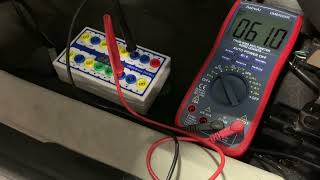
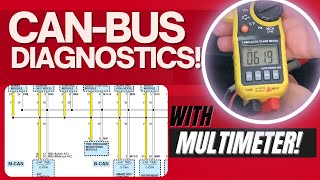
Disconnect the battery. Measure resistance between CAN High (Pin 6) and CAN Low (Pin 14) at the OBD-II port. A healthy network reads 60 ohms. 120 ohms indicates an open circuit; near 0 ohms indicates a shorted network.
Tools: Multimeter (Advanced) - Test for Parasitic Drain
If the battery chronically dies, test for parasitic draw. With the vehicle off and modules asleep (wait 30 minutes), connect a multimeter in series with the negative battery cable. Draw must be under 50-85 milliamps.
Tools: Multimeter with 10A fused capability (Advanced) - Isolate Individual Modules
If the CAN bus resistance is near 0 ohms (shorted), disconnect modules one by one (radio, door modules, ABS). When the resistance jumps back to 60 ohms, the last module disconnected contains the internal short.
Tools: Multimeter, Basic Hand Tools (Advanced) - Analyze CAN Bus with an Oscilloscope
For complex issues, use an oscilloscope to view the data signals. A healthy high-speed CAN bus shows a clean, mirror-image square wave. Stuck or noisy signals confirm a wiring fault or dead module.
Tools: Oscilloscope (Professional)
When This Code Triggers (Freeze-Frame Conditions)
- Control Module Voltage: 10.5-12.0V (Triggers during engine cranking when voltage drops.)
- Engine State: Key-On or Cranking (Fault logs immediately at startup before the engine runs.)
- Ambient Temperature: < 40°F (5°C) (Cold weather exposes a weak battery's inability to supply stable voltage.)
- Time Since Start: 0-5 seconds (The communication timeout occurs instantly after the ignition turns on.)
Related Codes
- U0001 — High Speed CAN Communication Bus. Indicates the entire high-speed network is down.
- U0100 — Lost Communication With ECM/PCM. Indicates the engine computer is the silent module.
- U0121 — Lost Communication With Anti-Lock Brake System (ABS) Control Module.
- U0140 — Lost Communication With Body Control Module (BCM).
Climate & Environmental Factors
- Cold Weather: Low temperatures drastically reduce battery cranking power. The resulting voltage drop during startup is the primary trigger for U1118.
- High Humidity & Road Salt: Moisture and road salt create a highly corrosive brine. This seeps into wiring connectors and fuse boxes, destroying pins and blocking communication signals.
How to Talk to a Mechanic About This Code
Say this: "I have a U1118 communication code and need a diagnostic appointment. Please authorize one hour to test the battery, alternator AC ripple, and check for parasitic draw. If those pass, check the CAN bus resistance before recommending module replacements."
This directs the technician to follow a logical, cost-effective process starting with voltage issues, preventing them from immediately quoting an expensive module replacement.
Avoid saying:
- 'My check engine light is on, can you fix it?'
- 'My car is acting weird, just do whatever it takes.'
- 'I think it's the BCM, can you give me a price to replace it?'
Questions to ask before authorizing the repair:
- What were the results of the battery load test and the alternator AC ripple test?
- What was the CAN bus resistance reading in ohms? Was it 60, 120, or near zero?
- Did you verify power and ground at the connector of the module you want to replace?
- If the module needs programming, is that cost included in the estimate?
- What is the warranty on this specific repair for both parts and labor?
Where to Take It: Dealer vs Independent vs Chain
- Dealer:
Recommended only if your car is under warranty or requires dealer-locked module programming.
Best for: Vehicles under warranty., Vehicles less than 3 years old., Complex issues requiring proprietary software to program a new BCM or ABS module.
Downsides: Highest labor rates, typically $180-$250 per hour., Incentivized to replace entire assemblies rather than perform detailed wiring repairs. (Typical cost: +50% vs. baseline) - Independent Shop:
Best overall fit. Vet them by asking if they perform CAN bus diagnostics and module programming.
Best for: Out-of-warranty vehicles., Shops specializing in automotive electrical diagnostics or your specific car brand.
Downsides: General mechanics lack the advanced scan tools and oscilloscope training for network diagnosis., May lack access to the latest manufacturer software for module programming. (Typical cost: +0% vs. baseline) - Chain Shop:
AVOID for initial diagnosis. They are highly likely to misdiagnose the issue and sell unnecessary parts.
Best for: Simple battery replacements (if no registration is needed).
Downsides: Technicians lack the deep diagnostic training required for complex network issues., Business model focuses on high-volume, simple jobs. (Typical cost: -10% vs. baseline)
When to Walk Away From the Repair
If the total estimated repair cost for the U1118 fault exceeds 50% of your car's private-party value, seriously consider walking away.
- Car worth $4000, fix is $2200: Walk away. The repair cost is over 50% of the car's value. Sell it as a 'mechanic's special'.
- Car worth $12000, fix is $1800: Fix it. The repair is 15% of the vehicle's value and restores safety systems.
- Car worth $3000, fix is $800: Borderline. This is a significant percentage (27%). Pay for a second diagnostic opinion before proceeding.
What Scan Tool You Need for This Code

Minimum: A scanner that reads codes from ALL vehicle modules (ABS, BCM, TCM), not just the engine. It must read manufacturer-specific 'U' codes.
A cheap $20 reader only checks the engine computer. U1118 is often logged in the ABS or Body module. Without seeing which module is complaining, diagnosis is impossible.
Budget: Autel AP200 / BlueDriver (~$60) — Performs a full system scan to identify exactly which module lost communication. This is the absolute minimum requirement.
Mid-range: Foxwell NT510 Elite / Innova 5610 (~$180) — Adds live data graphing and bidirectional controls to command components, which is critical for testing network responses.
Professional: Autel MaxiCOM MK808S (~$450) — Offers full bidirectional control, accesses all manufacturer data, and performs service functions like battery registration and module resets.
Rent vs buy: Buy a capable scanner like the Autel AP200. Free loaner tools from parts stores rarely scan all modules, making them useless for U1118.
How to Clear the Code After You Fix It
- Ensure all repairs are complete and the battery is fully charged.
- Use an advanced OBD-II scan tool to erase DTCs from all modules (ABS, BCM, TCM).
- Perform a complete OBD-II drive cycle to allow readiness monitors to run.
Drive cycle (~30 minutes): Perform a cold start, idle for 3 minutes, drive 15 minutes of mixed city/highway (steady at 55 mph), and perform several coasting decelerations without braking.
Readiness monitors affected: All non-continuous monitors reset to 'Not Ready' when codes are cleared.
Before emissions retest: drive at least 50 miles to fully set monitors.
Watch out for:
- Disconnecting the battery clears the code but resets all monitors, causing an instant emissions failure.
- The code returns immediately if the root cause (bad wiring, dead module) remains unfixed.
- Cheap scan tools only clear the engine computer, leaving U1118 active in the BCM or ABS.
Will This Fail Emissions / State Inspection?
Yes — this code typically fails an OBD-II emissions inspection.
- California: An active Check Engine Light is an automatic failure. A drive cycle must be completed to set readiness monitors.
- New York: An illuminated Check Engine Light causes an automatic failure. All safety and emissions components must function.
- Texas: In emissions-testing counties, an active Check Engine Light results in failure. The OBD-II scan detects this code immediately.
Most Commonly Affected Vehicles
- BMW 3-Series (E90/E92) (2006-2013) — Highly sensitive to battery voltage. U1118 appears frequently when the battery ages or is not properly registered after replacement.
- Dodge / Ram / Chrysler Charger, Ram 1500, Town & Country (2008-2018) — Failures of the Totally Integrated Power Module (TIPM) are the leading cause of widespread communication issues and this code.
- Peugeot / Citroen 307, C4 Picasso, 208 (2005-2015) — Commonly points to a communication failure with the Built-in Systems Interface (BSI). Requires specialized Diagbox software to diagnose.
- Ford F-150, Focus (2010-2024) — On F-150s, water leaking into the rear taillight assembly shorts the blind spot module, bringing down the entire CAN network.
- Chevrolet / GMC Silverado, Cruze, Equinox (2014-2020) — Often defined as 'Lost Communication with Class 2 Devices'. Caused by faults in the ABS module or fuel pump driver wiring.
- Subaru Outback, Forester, WRX (2015-2021) — A faulty Data Communications Module (DCM) causes a severe parasitic battery drain, leading to low voltage and communication codes.
- Mitsubishi Outlander, Lancer (4WD models) (2007-2017) — U1118 is specifically defined as a timeout error from the 4WD / Transfer Case ECU.
- Kia / Hyundai Niro EV, Ioniq 5 (2018-2022) — The electric water pump (EWP) leaks coolant internally, shorting its communication circuit and triggering U1118 (TSB 19-01-036H).
Manufacturer-Specific Notes
- BMW: Failing to 'register' a new battery causes the alternator to overcharge it, leading to premature failure and U1118 codes.
- Chrysler/Dodge/Jeep: The TIPM (fuse box and control module) is a notorious failure point causing random 'U' codes. Mail-in repair services save hundreds over dealer replacement.
- Peugeot/Citroen: Using a generic, low-quality scan tool triggers U1118 codes on its own. Diagnosis requires checking the proprietary 'BSI faults log'.
- Hyundai/Kia: On EV/Hybrid models, an internally leaking Electric Water Pump shorts the CAN bus. Always check TSB 19-01-036H before replacing major modules.
- Subaru: A parasitic drain from the Starlink DCM module kills the battery. Subaru extended the warranty for this issue via TSBs 15-317-24R and 15-318-24R.
Real Owner Stories
2011 BMW E90 M3 with 6-year-old battery
Check engine light (U1118) appeared intermittently on cold days. Car had long cranks to start.
What they tried:
- Cleared the code, but it returned.
- Used a trickle charger, but the battery failed to hold a charge.
- Disconnected a dash cam, which temporarily helped.
Outcome: The root cause was the failing battery. Replacing and registering the new battery resolved the long cranks and U1118 code permanently.
Lesson: On voltage-sensitive cars, a weak battery is the primary cause of communication codes. The voltage drop during cranking triggers the fault before the engine even starts.
2013 Dodge Ram 1500 with TIPM issues
Vehicle experienced random electrical problems and U1118 defined as 'Lost Engine Message' from the TCM.
What they tried:
- Basic scan tool pointed to the TCM.
- Shop performed a wiggle test on the TCM harness with no results.
- Advanced scan revealed U0100 stored in the TIPM.
Outcome: The Totally Integrated Power Module (TIPM) failed internally, preventing message routing. Replacing the TIPM with a remanufactured unit cleared all codes.
Lesson: The module logging the code isn't always the broken one. On Chrysler products, multiple 'U' codes point directly to a failing TIPM.
2019 Kia Niro EV with 'Check EV System' warning
Warning light appeared. Scan revealed U1118. Owner heard a pump running randomly while parked.
What they tried:
- Dealer misdiagnosed and replaced the high-voltage junction box. Code returned immediately.
Outcome: Hyundai/Kia TSB 19-01-036H identified the electric water pump leaking internally and shorting the communication circuit. Replacing the pump resolved the issue.
Lesson: Always check Technical Service Bulletins (TSBs). A known issue with a documented fix saves thousands in misdiagnosis.
2013 Citroen C4 Picasso with multiple warnings
Engine light on, cruise control and parking sensors failed. Cheap scan tool showed U1118.
What they tried:
- Cleaned engine bay fuse box contacts with WD-40. Fault remained.
Outcome: A mechanic with Diagbox software checked the proprietary 'BSI faults log' to pinpoint a faulty radio bringing down the network.
Lesson: European vehicles require manufacturer-specific diagnostic tools. Generic scanners miss critical data and lead to dead ends.
How to Prevent This Code From Triggering
- Keep Battery Terminals Clean (Every 6 months) — Corrosion acts as a resistor, causing voltage drops that trigger communication faults. Clean with a wire brush to ensure solid connections.
- Apply Dielectric Grease to Connectors (When servicing connectors) — Dielectric grease seals electrical connectors from moisture and salt, preventing the corrosion that blocks CAN bus signals.
- Secure the Battery and Wiring Harnesses (During oil changes) — Vibrations damage batteries internally and cause loose harnesses to rub against the chassis, shorting CAN bus wires.
- Use a Battery Tender for Stored Vehicles (If parked for more than 2 weeks) — Normal parasitic draw drains a battery over time. A tender maintains optimal charge, preventing low-voltage U1118 codes on startup.
- Avoid Excessive Short Trips (Daily habit) — Starting the engine consumes massive power. Short trips prevent the alternator from recharging the battery, leading to a net deficit.
Frequently Asked Questions
Can I just clear the U1118 code and keep driving?
You can clear it, but if it returns, a hard fault exists. Ignoring it leaves you without critical safety systems like ABS or stability control. Fix the root cause to ensure vehicle safety.
Can a bad alternator cause a U1118 code?
Yes. A failing alternator produces unstable voltage or excessive AC ripple that disrupts sensitive module communications. This triggers a flood of random network codes, including U1118.
My mechanic replaced my accelerator pedal because it was unresponsive, but the U1118 code is back. Why?
This is a common misdiagnosis. A CAN bus communication breakdown causes the Engine Control Unit to ignore the accelerator pedal input. The root cause is the network failure (U1118), not the pedal itself.
Can a bad ground wire cause a U1118 code?
Yes. All computer modules share a common ground to maintain a stable voltage reference. A loose or corroded main ground strap disrupts communication signals, causing multiple 'U' codes.
Why did my ABS and traction control light come on with the check engine light?
This occurs when U1118 is triggered by a loss of communication with the ABS module. When other computers lose contact with the ABS, they illuminate warning lights to indicate the system is offline.
What is battery registration and why does it matter for a U1118 code?
Many modern cars require you to 'register' a new battery with the engine computer to reset the charging algorithm. Failing to do this causes the alternator to overcharge the new battery. This leads to premature failure and electrical faults like U1118.
Is U1118 an expensive fix?
Costs range from $200 for a new battery to over $1,500 for a central control module replacement. The final price depends entirely on whether the root cause is a simple voltage issue or a failed computer requiring dealer programming.
My mechanic says they need to start with a diagnostic fee. Is this normal for a U1118 code?
Yes, this is standard and necessary. Communication codes require a step-by-step electrical testing process to pinpoint the exact failure. Paying for diagnostics prevents wasting money on unnecessary parts.
Key Takeaways
- Code U1118 indicates a communication failure on the CAN bus, meaning one specific computer module stopped sending data to the rest of the vehicle.
- Test your battery and alternator first; voltage drops below 12.4V during a cold start are the number one cause of this code.
- Do not replace expensive modules without verifying power and ground at the connector; a $2 blown fuse causes the exact same symptoms.
- Driving with U1118 is highly risky because critical safety systems like the Anti-lock Brake System (ABS) or headlights disable without warning.
Helpful Videos
![How To Test CAN BUS With A Multimeter [CAN Bus Resistance Check] Mechanic Mindset](https://img.youtube.com/vi/JPE42HSJxAk/mqdefault.jpg)

![TIPM [Dodge, Chrysler, Jeep] Removal and Solution](https://img.youtube.com/vi/qea1H85HBwU/mqdefault.jpg)

Shop the Parts Behind U1118
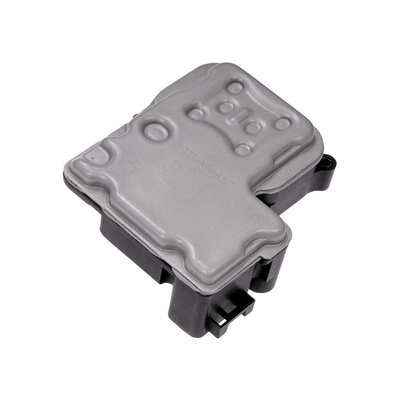
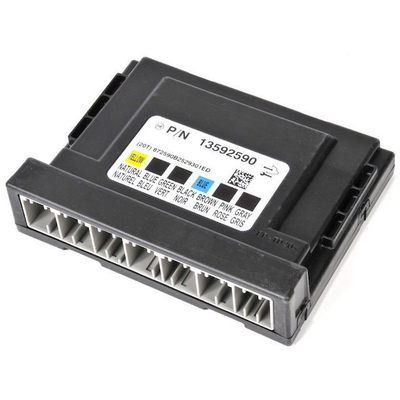
Below are the parts most often responsible for code U1118, ranked by how frequently each one is the actual culprit (per the diagnosis above). Tap any to see what we have for your vehicle.



The information in this article is provided for general reference and educational purposes only. Vehicle specifications, procedures, and part compatibility can vary by production date, trim level, and region. Always consult your vehicle's factory service manual and verify part numbers before purchasing or performing repairs. Safety-critical components such as airbags, seat belts, and braking systems should be installed by a qualified professional.
- 🧭 Diagnostic Flowchart
- 🎬 Helpful Videos
- 🛍️ Shop This Part
- What Does U1118 Mean?
- Can I Drive With U1118?
- Common Causes
- Symptoms
- Common Fixes & Costs
- Used vs. New Parts: Buying Guide
- What Happens If You Wait — Timeline
- Cost of Not Fixing It
- Diagnosis Steps
- When This Code Triggers (Freeze-Frame Conditions)
- Related Codes
- Climate & Environmental Factors
- How to Talk to a Mechanic About This Code
- Where to Take It: Dealer vs Independent vs Chain
- When to Walk Away From the Repair
- What Scan Tool You Need for This Code
- How to Clear the Code After You Fix It
- Will This Fail Emissions / State Inspection?
- Most Commonly Affected Vehicles
- Manufacturer-Specific Notes
- Real Owner Stories
- 2011 BMW E90 M3 with 6-year-old battery
- 2013 Dodge Ram 1500 with TIPM issues
- 2019 Kia Niro EV with 'Check EV System' warning
- 2013 Citroen C4 Picasso with multiple warnings
- How to Prevent This Code From Triggering
- Frequently Asked Questions
- Can I just clear the U1118 code and keep driving?
- Can a bad alternator cause a U1118 code?
- My mechanic replaced my accelerator pedal because it was unresponsive, but the U1118 code is back. Why?
- Can a bad ground wire cause a U1118 code?
- Why did my ABS and traction control light come on with the check engine light?
- What is battery registration and why does it matter for a U1118 code?
- Is U1118 an expensive fix?
- My mechanic says they need to start with a diagnostic fee. Is this normal for a U1118 code?
- Key Takeaways
- 🎟️ Get 5% Off