

OBD-II Code U1203: Vehicle Communication Bus Fault
What U1203 means, why it triggers, and how to fix it
- Code U1203 disables your 4WD/AWD system because the main computer lost communication with the drivetrain control module.
- Check your battery first; voltage drops below 12.4V frequently trigger false communication codes across the network.
- For 2014-2017 Jeep and Chrysler models, a 1-hour dealer software update often resolves this code without replacing parts.
- Diagnose the module that is completely offline, rather than replacing the module that reported the U1203 code.
- Expect to pay between $150 and $300 for a wiring repair, which fixes over 50% of U1203 faults.
What Does U1203 Mean?
Code U1203 means your vehicle's main computer lost communication with another module. Think of it like a severed telephone line between two office departments. The car still runs, but systems relying on that communication, like 4WD, shut down as a precaution.
Technical definition: The SAE/ISO definition for U1203 is a generic network communication code indicating a 'Vehicle Communication Bus Fault' or 'Lost Communication With...' a specific module. For Chrysler, Jeep, and Dodge, it usually specifies a loss of communication with the Drivetrain Control Module (DTCM) or Power Transfer Unit (PTU) on the Controller Area Network (CAN) bus. On Fords, it refers to body control modules or a Lateral G-Sensor.
Can I Drive With U1203?
Yes, But With Caution. Yes, but features like All-Wheel Drive (AWD) or Four-Wheel Drive (4WD) are disabled. The most significant risk is a sudden loss of power if the fault stems from a failing Power Transfer Unit (PTU)—a known issue in Jeep Cherokees. Additionally, if the drivetrain binds on turns, it causes excessive tire wear and stresses other components.
Common Causes
- Damaged Wiring or Corroded Connectors (Very Common) — Wires in the communication network fray, pinch, or corrode when exposed under the vehicle. Connectors linking the modules also loosen or fill with moisture, breaking the connection.
- Outdated Module Software (Common) — Manufacturers frequently release software updates (TSBs) to fix known communication glitches between modules. This is the primary cause on 2014-2017 Jeep and Chrysler models.
- Faulty Control Module (DTCM or PTU) (Common) — The Drivetrain Control Module (DTCM) or Power Transfer Unit (PTU) module fails internally. When these small computers die, they stop talking to the rest of the vehicle.
- Low Battery Voltage (Less Common) — Communication modules require stable voltage. A weak battery or failing alternator causes voltage drops that lead to temporary communication dropouts, triggering a U1203 code.
- Mechanical Failure of the Power Transfer Unit (PTU) (Rare) — Mechanical binding inside the PTU (often due to neglected fluid service) causes its electronic control module to fault and drop offline. This is a severe and expensive failure.
- Internal TCCM Cold Solder Joint Failure (GM) (Rare) — On older GM trucks, the Transfer Case Control Module (TCCM) fails due to cracked solder joints on the internal circuit board, interrupting electrical pathways.
- Interference from Aftermarket Electronics (Rare) — Poorly installed remote starters or alarms introduce electrical noise (EMI) onto the CAN bus, corrupting data packets and causing modules to lose communication.
Symptoms
- Service 4WD / Service AWD Message — A dashboard warning explicitly instructs you to service the drivetrain system.
- 4WD/AWD System Inoperative — The vehicle defaults to two-wheel drive mode and refuses to engage 4WD or AWD.
- Check Engine Light Illuminated — The engine control unit detects the network fault and illuminates the MIL.
- Flashing 4WD Mode Selector Lights — The lights on the 4WD mode selection switch blink continuously when the DTCM is offline. 🎬 Watch: How to replace the DTCM and fix startup noises.
- Clicking or Grinding Noise on Shifting — A clicking noise when shifting between gears indicates mechanical stress on drivetrain components.
- ABS or Traction Control Lights Illuminated — Because these systems share the CAN bus, a network fault triggers secondary warning lights.
Diagnostic Flowchart
Tap your situation to follow the diagnostic path that matches what you're seeing on this code.
Common Fixes & Costs
- Updating Control Module Software — Parts: $0, Labor: $150-$250, ~1.0 hr book time (Professional)
- Repairing Damaged Wiring or Connectors — Parts: $10-$50, Labor: $150-$300, ~2.0 hr book time (Intermediate)
- Replacing the Drivetrain Control Module (DTCM/TCCM)
— Parts: $150-$400, Labor: $100-$200, ~1.0 hr book time
(DIY)
Jeep Grand Cherokee (2014-2017): OEM
Ford F-150 (2015-2017): OEM
Chevrolet Silverado 1500 (2007-2013): OEM - Replacing the PTU Actuator Motor/Module
— Parts: $200-$400, Labor: $300-$600, ~3.0 hr book time
(Professional)
Jeep Cherokee (KL) (2014-2019): OEM - Replacing the entire Power Transfer Unit (PTU) assembly
— Parts: $1,500-$2,500, Labor: $800-$1,500, ~6.5 hr book time
(Professional)
Jeep Cherokee (KL) (2014-2018): OEM
Chrysler 200 (2015-2017): OEM
Used vs. New Parts: Buying Guide
When a used part is worth it: Buy used for easily accessible electronic modules (like a DTCM) from low-mileage donors. Never buy a used PTU; it is a high-wear mechanical item.
Donor-vehicle mileage cap: roughly under 80000 miles for the part to have meaningful remaining life.
Donor quality checklist:
- Verify the exact OEM part number; superseded numbers fail to communicate.
- Source modules from the exact same year and model.
- Avoid parts from rust-belt donors due to connector corrosion.
- Check donor history to avoid flood-damaged electronics.
Decision logic:
- If The part is an electronic module (DTCM) and the new OEM part exceeds $500 → Purchase a used module from a reputable recycler with a 90-day warranty.
- If The part is a mechanical component like a PTU or transfer case → Buy new OEM or a high-quality remanufactured unit. The labor cost is too high to risk a faulty used part.
- If The vehicle has over 150k miles and the budget is extremely tight → A used part is acceptable, but carries a high risk of premature failure and repeat labor costs.
Warranty tradeoff: Used parts offer 30-90 day warranties on the part only. New OEM parts carry 1-2 year warranties covering both part and labor if dealer-installed.
Worst-case if a used part fails: $1500 if a used PTU fails, requiring you to pay for the 6-hour labor job twice.
What Happens If You Wait — Timeline
- 0-4 weeks: Code sets, 'Service 4WD' light illuminates. 4WD is disabled. Vehicle drives normally in 2WD. (MPG impact: 0%% · Added cost: $0)
- 1-3 months: If mechanical, a faint whine or grinding noise begins. Fluid degrades rapidly from heat. (MPG impact: 0-2%% · Added cost: $150-$300)
- 3-6 months: Grinding noises worsen. Burning gear oil smell appears. Vehicle shudders on turns. Metal shavings contaminate the PTU. (MPG impact: 2-5%% · Added cost: $2,500-$4,000)
- 6+ months: Catastrophic failure. PTU seizes, causing a loud bang and sudden loss of power. Housing cracks and spills fluid. (MPG impact: N/A% · Added cost: $3,500-$5,000)
Cost of Not Fixing It
- Immediate: Loss of 4WD/AWD capability. The vehicle operates in 2WD only, reducing traction in poor weather. (Added cost: 0)
- 1-6 months: If caused by a failing PTU, continued driving causes fluid leaks, grinding noises, and excessive heat. Leaking fluid creates a fire hazard on the exhaust. (Added cost: $200-$500)
- 6+ months: Catastrophic PTU failure. The unit seizes, cracks its housing, or causes a sudden loss of all motive power. (Added cost: $2500-$5000)
Diagnosis Steps
- Read All Trouble Codes
Use a scanner that accesses all modules. Read codes in the PCM, TCM, ABS, and DTCM. Identify which specific module is NOT communicating. Diagnose the offline module, not the module reporting the code.
Tools: Advanced OBD-II Scanner (Beginner) - Check for Technical Service Bulletins (TSBs)
Search your vehicle's make, model, year, and 'U1203'. A manufacturer TSB often dictates a simple software update to fix the issue, bypassing the need for physical repairs.
Tools: Internet Access (Beginner) - Check Battery Voltage
Measure battery voltage with the engine off (should be ~12.6V). Start the engine and verify alternator output (13.7-14.7V). Low voltage guarantees network communication errors.
Tools: Multimeter (Beginner) - Inspect Wiring and Connectors
Visually inspect the harness going to the DTCM and PTU. Look for chafed wires, corrosion, or loose pins. These components are usually exposed near the transmission and transfer case.
Tools: Flashlight, Mirror (Intermediate) - CAN Bus 'Wiggle' Test
While monitoring the offline module with a scan tool, wiggle the wiring harness and connectors. If the module intermittently comes online, you have located a broken wire or loose pin.
Tools: Advanced OBD-II Scanner (Intermediate) - Test Module Power and Ground
Confirm the suspect module receives battery voltage at the power pin and has less than 1.0 ohm of resistance on the ground pin. A loss of either prevents communication.
Tools: Multimeter, Vehicle Wiring Diagram (Advanced) - Monitor Live Data PIDs
Watch live data for 'DTCM Status', 'PTU Motor Current', and 'Module Supply Voltage'. Inconsistent or absent data from a specific module confirms it is the root cause.
Tools: Advanced OBD-II Scanner (Advanced) - Test CAN Bus Network Resistance
Disconnect the battery. Measure resistance at OBD-II pins 6 and 14. A reading of 60 ohms is normal. 120 ohms indicates an open circuit or missing terminating resistor.
Tools: Multimeter, Vehicle Wiring Diagram (Advanced) - Scope Pattern Analysis
View the live CAN bus signal. CAN High should pulse to ~3.5V and CAN Low to ~1.5V. Distorted signals pinpoint electrical interference or a shorted wire.
Tools: Oscilloscope, Vehicle Wiring Diagram (Advanced)
When This Code Triggers (Freeze-Frame Conditions)
- Engine Coolant Temp: 180-210°F (The code sets when the vehicle is fully warmed up, indicating a heat-related module or wiring failure.)
- Vehicle Speed: 40-65 mph (Failures frequently occur during steady highway driving.)
- Engine RPM: 1500-2500 RPM (Consistent with steady-state cruising when the fault triggers.)
- Time Since Engine Start: >15 minutes (Appears after extended driving, pointing to thermal expansion in a connector or module.)
Related Codes
- U0415 — Invalid Data Received From ABS. U1203 means the DTCM is offline; U0415 means the DTCM is online but receiving nonsensical data from a faulty wheel speed sensor.
- U0402 — Invalid Data Received From TCM. U1203 disables 4WD, whereas U0402 causes direct shifting problems like limp mode.
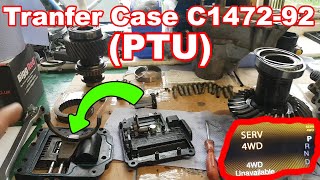
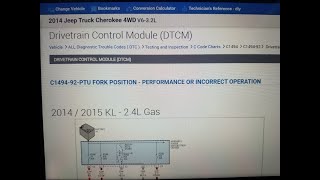
- C1496 — PTU Motor Position Performance. This Chrysler code points to an internal PTU failure. U1203 is the resulting symptom of the module shutting down.
- C14A7 — PTU Motor Current/Temperature Sensor Performance. Suggests an internal electronic failure in the PTU assembly, causing the U1203 communication loss.
Climate & Environmental Factors
- Cold Climates / Road Salt: Vehicles in the 'Salt Belt' are highly susceptible. Corrosive salt and moisture accelerate the degradation of wiring harnesses and connector pins mounted under the vehicle.
- High Humidity: Moisture ingresses into poorly sealed connectors, causing pin corrosion and high resistance. This disrupts sensitive CAN bus voltage signals.
How to Talk to a Mechanic About This Code
Say this: "I have a U1203 code and the 'Service 4WD' light is on. Please identify which module is offline and verify its power, ground, and wiring harness before recommending a module replacement."
Directs the technician to follow a logical diagnostic path, starting with cheap wiring fixes before jumping to an expensive module replacement.
Avoid saying:
- 'Just fix whatever's wrong'
- 'My check engine light is on, can you look at it?'
- 'Whatever you recommend'
Questions to ask before authorizing the repair:
- Which specific module was not communicating on the network?
- Did you successfully test for stable power and a good ground at that module's connector?
- Did you check for TSBs related to this code that suggest a software update?
- What specific test confirmed the old module was faulty and not the wiring?
- What is the warranty on this specific repair?
Where to Take It: Dealer vs Independent vs Chain
- Dealer:
Recommended for Jeep/Chrysler products requiring software updates. Essential for in-warranty repairs.
Best for: Vehicles under warranty or with an applicable recall/TSB., Repairs requiring manufacturer-specific software updates., Complex network faults requiring factory diagnostic tools.
Downsides: Highest labor rates., Quick to replace whole assemblies rather than repair wiring. (Typical cost: +50% vs. baseline) - Independent Shop:
Good fit, provided the shop has strong electrical diagnostic skills.
Best for: Out-of-warranty vehicles needing wiring repair., Getting a second opinion on a costly dealer diagnosis., Common, well-understood faults like GM TCCM failures.
Downsides: Diagnostic capability varies widely., Lacks tools for proprietary software updates. (Typical cost: +0% vs. baseline) - Chain Shop:
AVOID. U1203 requires advanced diagnostic expertise unavailable at chain shops.
Best for: Simple parts replacement like batteries., Reading the initial code for free.
Downsides: Lacks specialized training for complex network diagnostics., High potential for misdiagnosis. (Typical cost: -10% vs. baseline)
When to Walk Away From the Repair
If the estimated repair cost exceeds 40-50% of the car's Kelley Blue Book (KBB) private-party value, sell the vehicle as-is.
- Car worth $8000, fix is $3500: Walk away. A $3,500 PTU replacement on an $8,000 vehicle is a poor investment.
- Car worth $20000, fix is $850: Fix it. An $850 DTCM replacement restores a key feature well below the threshold.
- Car worth $4000, fix is $2200: Walk away. Spending over half the car's value on a drivetrain repair is not economically sound.
What Scan Tool You Need for This Code
Minimum: A scanner that performs a 'full system scan' to communicate with the ABS, TCM, BCM, and DTCM/TCCM.
A $20 code reader only checks the engine computer. It shows U1203 but cannot identify which module is offline.
Budget: Autel AP200 or TOPDON TopScan Pro (~$70) — Bluetooth dongles that offer full-system scanning to identify the non-communicating module.
Mid-range: Foxwell NT510 Elite or Autel MaxiCOM MK808S (~$160) — Provides full system scans and live data streaming from all modules. Includes bidirectional controls.
Professional: Launch X431 series or Autel MS906 Pro (~$450-1200) — Professional tools offering full bidirectional control, advanced ECU coding, and security gateway access.
Rent vs buy: Parts stores read codes for free, but their tools cannot scan all modules. Buying a budget-pick scanner is mandatory for DIY diagnosis.
How to Clear the Code After You Fix It
- Use an OBD-II scan tool to clear all diagnostic trouble codes.
- Perform a complete drive cycle to allow readiness monitors to run.
- Rescan the vehicle to confirm the U1203 code does not return.
Drive cycle (~30 minutes): A complete drive cycle involves a cold start, idling for 3 minutes, mixed city driving at 30-40 mph, and steady highway cruising at 55-60 mph for 15 minutes.
Readiness monitors affected: Comprehensive Component Monitor, CAN Bus System Checks
Before emissions retest: drive at least 100 miles to fully set monitors.
Watch out for:
- Clearing the code immediately before an emissions test results in an automatic failure due to unset readiness monitors.
- Disconnecting the battery fails to clear the code from permanent module memory.
Will This Fail Emissions / State Inspection?
Yes — this code typically fails an OBD-II emissions inspection.
- California: Automatic failure. An illuminated Check Engine Light fails the OBD-II smog inspection. All readiness monitors must complete before a retest.
- New York: Automatic failure. Any vehicle with an active Check Engine Light fails the emissions portion of the annual inspection.
- Texas: Automatic failure in the 17 required counties. The vehicle fails if the MIL is commanded on or if readiness monitors are incomplete.
Most Commonly Affected Vehicles
- Jeep Cherokee (KL) (2014-2019) — Extremely common. TSB 21-008-16 addresses this with a software flash. Recalls W47 and W4A address PTU failures causing a loss of motive power.
- Chrysler 200 (AWD models) (2015-2017) — Shares the Cherokee platform. TSB 21-008-16 applies for a software update to fix communication logic.
- Jeep Grand Cherokee (2011-2021) — Points to a failure of the DTCM/TCCM, conveniently located under the driver's seat for an easy swap.
- Dodge Durango (2011-2021) — Shares the Grand Cherokee platform and suffers identical DTCM/TCCM communication failures.
- Ram 1500 (2011-2018) — Shares platform architecture with the Grand Cherokee and experiences similar DTCM faults.
- Ford F-150 / Expedition (2013-2018) — Typically points to the Transfer Case Control Module (TCCM). On Ford cars, it refers to body modules or sensors.
- Chevrolet Silverado / Tahoe / Suburban (1999-2014) — Indicates a TCCM failure caused by cold solder joints on the module's circuit board.
- Hyundai Santa Fe (AWD models) (2012-2018) — Communication faults disabling AWD stem from mechanical failure of the transfer case or coupler.
Manufacturer-Specific Notes
- Jeep/Chrysler/Dodge (FCA/Stellantis): Overwhelmingly linked to the PTU or DTCM. TSB 21-008-16 provides a software update to fix communication logic. Recalls 20V343 and 20E037 address mechanical PTU failures.
- Ford: Highly context-dependent. On trucks, it points to the TCCM. On cars, it refers to the Lateral G-Sensor or body modules like power windows.
- General Motors (Chevrolet/GMC): On GMT800/900 trucks, the TCCM fails from cracked solder joints. Skilled DIYers successfully reflow the solder as a zero-cost fix.
- Toyota: U1203 is rare. Toyota uses C1203 for ECM communication faults, usually requiring a 'zero point' calibration procedure after replacing a module.
Real Owner Stories
2019 Jeep Cherokee Trailhawk - Misdiagnosed PTU Failure
The 'Service 4WD' light illuminated. The dealer quoted $4,400 for a PTU replacement.
What they tried:
- Dealer diagnosed a failed PTU.
- Owner sought a second opinion from an independent mechanic.
- Mechanic found the battery was failing.
Outcome: The mechanic replaced the battery for $200. The U1203 code cleared permanently. The PTU was perfectly fine.
Lesson: Always check the battery and charging system before agreeing to expensive module replacements. Low voltage mimics the failure of major components.
2017 Jeep Cherokee Trailhawk - Catastrophic PTU Failure
Vehicle made a loud 'bang' on the highway, followed by 'safe mode' where the car would not drive.
What they tried:
- Towed to the dealership.
- Diagnosis confirmed a catastrophic failure of the PTU.
Outcome: The PTU was replaced under warranty (a $3,500 value). 16,000 miles later, the replacement PTU began binding on low-speed turns.
Lesson: A sudden loud noise followed by power loss is a severe mechanical failure. Monitor replacement parts closely, as they can fail prematurely.
2013 Ford Explorer - A Story of Misdiagnosis
Owner suspected a failing PTU due to a loud rattling noise. The dealer misdiagnosed the issue.
What they tried:
- Dealer blamed worn suspension parts.
- Owner spent thousands replacing suspension components, but the noise remained.
- Dealer finally admitted the PTU was bad and quoted $3,400.
Outcome: The owner escalated to Ford Corporate after spending money on incorrect repairs based on the dealer's advice.
Lesson: If a shop's diagnosis ignores obvious symptoms like grinding noises, get a second opinion. Misdiagnosis is costly.
How to Prevent This Code From Triggering
- Change Transfer Case / PTU Fluid (Every 30,000 to 50,000 miles) — Fluid breaks down from heat. Fresh fluid prevents the mechanical overheating that destroys the electronic control module.
- Apply Dielectric Grease to Exposed Connectors (Whenever connectors are disconnected) — Seals electrical connectors from moisture and salt, preventing the corrosion that causes communication failures.
- Perform Regular Underbody Washes (Monthly during winter months) — Removes corrosive road salt, protecting wiring harnesses and ground straps from degradation.
- Inspect and Clean Battery Terminals (Every oil change) — Prevents voltage drops. Modules require stable voltage to communicate on the CAN bus.
Frequently Asked Questions
Is it safe to drive with a U1203 code?
Yes, for short-term driving. Your car defaults to two-wheel drive, but primary engine and braking functions still work. Repair it promptly, as underlying causes like a failing PTU can lead to a sudden loss of power.
What is a DTCM or TCCM?
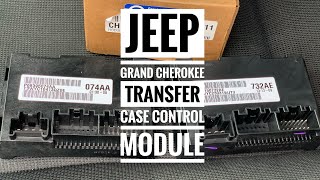
DTCM (Drivetrain Control Module) and TCCM (Transfer Case Control Module) are dedicated computers controlling the 4WD/AWD system. They take driver commands and sensor data to engage or disengage the transfer case or PTU.
Can I just reset the 'Service 4WD' light?
You can clear the code with a scanner, but it returns immediately if the underlying fault remains. Disconnecting the battery for 30 minutes temporarily clears the light, but this is not a permanent fix.
What are common misdiagnosis mistakes for a U1203 code?
A frequent mistake is replacing the module reporting the code (like the PCM) instead of the module that went silent. The actual fault is almost always with the offline module (DTCM/PTU) or its dedicated wiring. Always identify the offline module first.
Can a weak battery really cause this code?
Yes. Modern vehicle networks are highly sensitive to voltage fluctuations. A weak battery causes unpredictable electrical dropouts, triggering communication faults between modules.
Can I fix a U1203 code myself?
Yes, if the issue is a visibly damaged wire or an easily accessible module like the DTCM on a Grand Cherokee. However, diagnosing network faults or performing software updates requires specialized tools, making it a job for a professional.
Is this problem covered by a recall?
Yes, for specific vehicles like the 2014-2017 Jeep Cherokee, recalls (e.g., NHTSA 20V343) address PTU failures causing this code. Contact a dealership with your VIN to check for open campaigns or warranty extensions.
Key Takeaways
- Code U1203 disables your 4WD/AWD system because the main computer lost communication with the drivetrain control module.
- Check your battery first; voltage drops below 12.4V frequently trigger false communication codes across the network.
- For 2014-2017 Jeep and Chrysler models, a 1-hour dealer software update often resolves this code without replacing parts.
- Diagnose the module that is completely offline, rather than replacing the module that reported the U1203 code.
- Expect to pay between $150 and $300 for a wiring repair, which fixes over 50% of U1203 faults.
Helpful Videos
Shop the Parts Behind U1203
Below are the parts most often responsible for code U1203, ranked by how frequently each one is the actual culprit (per the diagnosis above). Tap any to see what we have for your vehicle.



The information in this article is provided for general reference and educational purposes only. Vehicle specifications, procedures, and part compatibility can vary by production date, trim level, and region. Always consult your vehicle's factory service manual and verify part numbers before purchasing or performing repairs. Safety-critical components such as airbags, seat belts, and braking systems should be installed by a qualified professional.
- 🧭 Diagnostic Flowchart
- 🎬 Helpful Videos
- 🛍️ Shop This Part
- What Does U1203 Mean?
- Can I Drive With U1203?
- Common Causes
- Symptoms
- Common Fixes & Costs
- Used vs. New Parts: Buying Guide
- What Happens If You Wait — Timeline
- Cost of Not Fixing It
- Diagnosis Steps
- When This Code Triggers (Freeze-Frame Conditions)
- Related Codes
- Climate & Environmental Factors
- How to Talk to a Mechanic About This Code
- Where to Take It: Dealer vs Independent vs Chain
- When to Walk Away From the Repair
- What Scan Tool You Need for This Code
- How to Clear the Code After You Fix It
- Will This Fail Emissions / State Inspection?
- Most Commonly Affected Vehicles
- Manufacturer-Specific Notes
- Real Owner Stories
- 2019 Jeep Cherokee Trailhawk - Misdiagnosed PTU Failure
- 2017 Jeep Cherokee Trailhawk - Catastrophic PTU Failure
- 2013 Ford Explorer - A Story of Misdiagnosis
- How to Prevent This Code From Triggering
- Frequently Asked Questions
- Is it safe to drive with a U1203 code?
- What is a DTCM or TCCM?
- Can I just reset the 'Service 4WD' light?
- What are common misdiagnosis mistakes for a U1203 code?
- Can a weak battery really cause this code?
- Can I fix a U1203 code myself?
- Is this problem covered by a recall?
- Key Takeaways
- 🎟️ Get 5% Off