

OBD-II Code U1465: Implausible Driver Shift Request Signal Received
What U1465 means, why it triggers, and how to fix it
- Code U1465 on a 2016-2018 Jeep Cherokee almost always requires replacing the shifter bezel and jumper harness (a $250 repair), rather than the entire shifter assembly.
- Never replace shifter components without first testing the battery, as a voltage drop below 12.0V triggers false U1465 communication errors.
- Stop driving the vehicle immediately if the 'Service Shifter' light illuminates, as the transmission can unexpectedly default to Neutral at highway speeds.
- Check your specific VIN against TSB 08-054-18 or TSB 08-051-17 before authorizing repairs to prevent shops from upselling a $600 full assembly replacement.
- Inspect the center console for sticky residue, as spilled drinks short-circuiting the shifter's internal circuit board cause over 30% of these failures.
What Does U1465 Mean?

This code means the Transmission Control Module (TCM) received an impossible signal from the electronic gear shifter. The shifter is essentially telling the computer it is in two gears at once, or requesting a shift that violates operating logic. It is a direct communication error between the electronic shifter module and the vehicle's network.
Technical definition: U1465: Implausible Driver Shift Request Signal Received. The Transmission Control Module (TCM) detects an incorrect, irrational, or out-of-sequence signal from the Electronic Shift Module (ESM) over the Controller Area Network (CAN) bus.
Can I Drive With U1465?
No — Do Not Drive. Driving is not recommended. The primary risk is becoming stranded when the shifter fails to move from Park. A rarer but more dangerous risk is the vehicle unexpectedly shifting into Neutral while driving, resulting in a sudden loss of power to the wheels. This happens without warning.
Common Causes

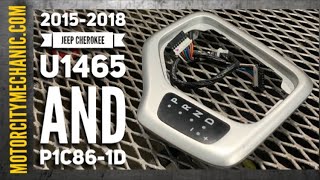
- Faulty Shifter Bezel (PRNDL) or Jumper Harness (Very Common) — On 2016-2018 Jeep Cherokees, the circuit board inside the plastic trim around the shifter fails. This component, or the small wiring harness connecting it, is the most frequent failure point addressed by TSB 08-054-18 Rev. A. 🎬 Watch: How to replace the shifter bezel and jumper harness.
- Internal Electronic Failure of the Shifter Assembly (Common) — The entire shifter unit is a complex electronic module. Internal components like position sensors, microswitches, or the main circuit board fail over time. This is the primary cause on 2014-2015 Jeep Cherokees, requiring full assembly replacement.
- Spilled Liquids or Debris Contamination (Common) — The shifter's location makes it highly vulnerable to spilled drinks. Conductive liquids short-circuit the electronics within the shifter bezel or assembly, triggering immediate communication errors.
- Low or Weak Battery Voltage (Less Common) — Shift-by-wire systems are extremely sensitive to voltage drops. A weak battery causes electronic modules to malfunction and broadcast false U1465 error codes.
- Damaged Wiring, Loose Connectors, or CAN Bus Fault (Rare) — Wiring connecting the shifter to the vehicle's network can fray, corrode, or disconnect. A short or open circuit in the CAN bus network harness disrupts the shifter's signal to the TCM.
- Outdated Control Module Software (Rare) — Software bugs in the vehicle's computers cause false U1465 codes. Manufacturers release software updates (e.g., TSB 08-051-17 for Grand Cherokee) to patch these communication logic errors.
Symptoms

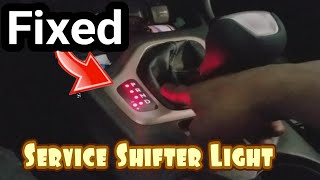
- 'Service Shifter' Warning Light — A direct dashboard message instructs the driver to service the shifter. This warning is often intermittent in the early stages of failure.
- Inability to Shift Out of Park — The vehicle gets stuck in Park. The TCM blocks the electronic shift lock release because it cannot verify the shifter's requested position.
- All Shifter Indicator Lights Turn Red — The PRNDL letters next to the shifter illuminate red simultaneously, indicating a total loss of position tracking.
- Vehicle Shifts to Neutral While Driving — The loss of a valid shifter signal causes the transmission to default to Neutral as a safety mechanism, resulting in a sudden loss of motive power.
- Vehicle Won't Start — The engine refuses to crank because the failed shifter module cannot send the required Park/Neutral safety confirmation signal.
Diagnostic Flowchart

Tap your situation to follow the diagnostic path that matches what you're seeing on this code.
Common Fixes & Costs
- Replace Shifter Bezel and Jumper Harness
— Parts: $100-$200, Labor: $100-$150, ~1.0 hr book time
(Intermediate)
2016-2018 Jeep Cherokee: OEM - Replace Entire Shifter Assembly
— Parts: $450-$600, Labor: $150-$250, ~1.5 hr book time
(Intermediate)
2014-2015 Jeep Cherokee: OEM - Clean Connectors and Apply Dielectric Grease — Parts: $10-$20, Labor: $100-$150, ~1.0 hr book time (Beginner)
- Update Control Module Software — Parts: $0, Labor: $150-$200, ~1.0 hr book time (Professional)
- Repair Damaged Wiring or Connector — Parts: $20-$50, Labor: $200-$600, ~3.0 hr book time (Professional)
Used vs. New Parts: Buying Guide
When a used part is worth it: For the common shifter assembly replacement, a used OEM part from a reputable salvage yard is a cost-effective choice. Since this is a known failure point, a tested used OEM part is often more reliable than an unproven aftermarket unit with electronic compatibility issues.
Donor-vehicle mileage cap: roughly under 60000 miles for the part to have meaningful remaining life.
Donor quality checklist:
- Visually match the part exactly to your old one, including trim color and button layout.
- Inspect electrical connectors for corrosion, bent pins, or cracked solder joints.
- Reject parts showing signs of sticky liquid residue or physical damage.
Decision logic:
- If The fix requires the bezel and jumper harness (under $150) → Buy a new OEM or quality aftermarket part (e.g., Dorman) for the warranty.
- If The fix requires the entire shifter assembly ($500+ new) → Purchase a tested, used OEM part to save hundreds of dollars.
- If Buying a used shifter assembly → Source from the newest possible donor vehicle to minimize age-related electronic degradation.
Warranty tradeoff: Used parts typically include a 30-90 day warranty. New aftermarket parts offer 1-year to lifetime warranties. New OEM parts carry a 1-2 year warranty.
Worst-case if a used part fails: $250 if a used part fails shortly after installation, primarily due to repeated diagnostic and labor costs.
What Happens If You Wait — Timeline
- 0-4 weeks: Intermittent 'Service Shifter' warning appears. All shifter lights turn red. The warning disappears after restarting the car. No functional impact yet. (MPG impact: 0%% · Added cost: $0)
- 1-3 months: The warning appears every few days. The vehicle occasionally refuses to shift out of Park, requiring restarts to clear the fault. (MPG impact: 0%% · Added cost: $150 (Potential for a single tow))
- 3-6 months: The 'Service Shifter' light stays on permanently. Getting stuck in Park is common. The risk of the transmission defaulting to Neutral while driving increases. (MPG impact: 0%% · Added cost: $300 (Repeated towing))
- 6+ months: The shifter module or bezel fails completely. The vehicle is permanently stuck in Park and refuses to start. The vehicle is inoperable. (MPG impact: 0%% · Added cost: $600-$1000 (Full repair plus final towing charge))
Cost of Not Fixing It
- Immediate: Intermittent 'Service Shifter' warnings and the inability to shift out of Park occur randomly. The fault temporarily clears after restarting the vehicle. (Added cost: $150 (Potential towing cost))
- Weeks to Months: The frequency of being stuck in Park increases, making the vehicle unreliable. The risk of the vehicle shifting into Neutral while driving becomes highly probable, creating a serious safety hazard. (Added cost: $150-$300 (Repeated towing))
- Long-Term: The shifter module fails completely, permanently stranding the vehicle in Park and preventing engine crank. The vehicle requires a tow to a repair facility. (Added cost: $600-$1000 (Full repair plus towing))
Diagnosis Steps
- Check for Technical Service Bulletins (TSBs)
Verify if the manufacturer issued a TSB for your specific VIN. Jeep and Chrysler models have specific repair instructions outlined in bulletins like 08-054-18 Rev. A, 08-051-17, and 18-001-19 REV. B.
Tools: Internet access or professional service information system (Beginner) - Test the Battery and Charging System
Verify the vehicle's electrical system health. A healthy battery reads 12.6 volts with the engine off and 13.7 to 14.7 volts running. Low voltage causes unpredictable electronic faults.
Tools: Multimeter or battery tester (Beginner) - Scan for All Codes in All Modules
Use a scanner capable of reading Transmission (TCM) and Body (BCM) codes. Code U1465 often appears with P1C86. A basic engine-only scanner cannot see these critical network codes.
Tools: OBD-II Scanner (with TCM/BCM access) (Beginner) - Inspect for Liquid Spills and Debris
Carefully inspect the shifter assembly and center console for sticky residue from spilled drinks or debris interfering with the electronics.
Tools: Flashlight (Beginner) - Inspect the Shifter Bezel (PRNDL)
Remove the console trim and inspect the shifter bezel. Look for visible damage, cracked solder joints, or signs of a poor connection on the internal circuit board.
Tools: Plastic trim removal tools, flashlight (Intermediate) - Perform Connector Wiggle Test & Pin Inspection
Monitor live data from the shifter module. Gently wiggle the main connector at the base of the shifter and the bezel connector. If the fault toggles, you have a connection issue. Inspect pins for corrosion or backing out.
Tools: Trim removal tools, advanced scan tool, magnifying glass (Advanced) - Check Shifter-Related Fuses
Inspect the fuses in the under-hood fuse box related to the transmission and shifter modules (e.g., F14, F28, F30, F53, F77, F93 on Cherokees). A blown fuse indicates an electrical short.
Tools: Fuse puller or needle-nose pliers (Beginner) - Monitor Shifter Live Data
Access the live data PIDs for the Electronic Shift Module (ESM). Monitor the 'ESM Trigger Switch'. If the status is stuck on 'Set' when the thumb button is released, the shifter handle's internal switch has failed.
Tools: Advanced bi-directional scan tool (Advanced) - Test the Shifter Assembly
If wiring and network tests pass, the fault is internal to the shifter assembly. Confirm this by reading live data from the ESM to verify it is broadcasting irrational position data.
Tools: Advanced bi-directional scan tool (Advanced) - Perform CAN Bus Network Integrity Test
Disconnect the battery. Measure resistance between Pin 6 (CAN High) and Pin 14 (CAN Low) at the OBD-II port. A healthy bus reads 60 ohms. 120 ohms indicates an open circuit; near 0 ohms indicates a short.
Tools: Multimeter (Advanced)
When This Code Triggers (Freeze-Frame Conditions)
- Vehicle State: Any (The fault logs at any time, from key-on/engine-off to steady highway driving. It is an electronic communication failure independent of engine operating parameters.)
- Vehicle Speed: 0 - 70+ mph (Occurrences happen both when stationary (stuck in Park) and while driving at speed.)
- Engine RPM: 0 - 3000 RPM (The fault occurs at idle, during acceleration, or while cruising.)
- Time Since Start: Variable (The code sets immediately upon startup or appears randomly during a drive.)
Related Codes
- P1C86 — Indicates 'ESM Display Circuit Current Out of Range'. It frequently appears with U1465. P1C86 explains why the shifter fails (a current issue in the lighting circuit), and U1465 is the resulting communication error. This combination guarantees the fault is in the shifter bezel or harness.
- U1466 — Indicates 'Implausible Driver Shift Request Signal Received On DPT CAN'. It is identical to U1465 but specifies a secondary data bus. The diagnosis and repair are exactly the same.
- U1267 — Indicates 'No Valid Data From ESM'. While U1465 means the data received is illogical, U1267 means no data is received at all. Both point to a failure in the shifter module or its network connection.
- U0103 — Indicates 'Lost Communication With Gear Shift Module'. This points strongly toward a complete communication breakdown, such as a bad connector, severed wiring, or a totally dead shifter module.
Climate & Environmental Factors
- Liquid Spills: The shifter's location directly beneath cup holders makes it extremely vulnerable. Sugar-rich liquids are conductive and short-circuit the bezel or main shifter circuit boards, directly causing this code.
- Climate (Temperature/Humidity): There is no evidence linking U1465 directly to ambient temperature or humidity. Failures stem from component wear and internal electronic faults.
How to Talk to a Mechanic About This Code
Say this: "I have a [Your Year/Make/Model] with a 'Service Shifter' light and code U1465. I know there are TSBs for this issue, particularly regarding the shifter bezel versus the entire assembly. I'd like to schedule a diagnostic to confirm which repair my vehicle needs."
This signals you are an informed consumer. It directs the technician to the known common failures, saving diagnostic time and preventing them from suggesting a full $600 shifter replacement if only the $250 bezel is needed.
Avoid saying:
- 'My 'Service Shifter' light is on, can you look at it?'
- 'The car is acting weird and won't shift sometimes.'
- 'Just fix whatever is wrong with the shifter.'
Questions to ask before authorizing the repair:
- Did you check for TSBs for my specific VIN related to code U1465?
- Is the recommended repair to replace the bezel and harness, or the entire shifter assembly?
- If you recommend the full assembly, how did you rule out the bezel/harness as the cause?
- Is a software update a possible fix for my vehicle, and are my modules current?
- What is the warranty on the recommended parts and labor?
Where to Take It: Dealer vs Independent vs Chain
- Dealer:
Recommended only if a software update is the known TSB fix for your specific model or if the vehicle is under warranty.
Best for: Vehicles where a software update is the primary recommended fix (e.g., Grand Cherokees, Pacificas)., Vehicles still under warranty., Complex cases where a wider CAN bus network issue is suspected.
Downsides: Highest labor rates., May default to replacing the expensive entire shifter assembly if not specifically challenged to diagnose the bezel first. (Typical cost: +50% vs. baseline) - Independent Shop:
Best fit for most U1465 repairs, especially the common hardware replacements on Jeep Cherokees. Vet the shop to ensure familiarity with this specific issue.
Best for: Out-of-warranty vehicles, especially Jeep Cherokees where the bezel or assembly replacement is a well-documented hardware fix., Vehicle owners looking for a cost-effective repair.
Downsides: Quality varies; ensure the shop has experience with modern FCA electronics., May lack the equipment or subscription to perform OEM software updates. (Typical cost: +0% vs. baseline) - Chain Shop:
AVOID. This is an electronics and network communication issue requiring specific diagnostic expertise, not a simple parts replacement suitable for a chain shop.
Best for: Simple maintenance like oil changes and brakes.
Downsides: Technician skill and diagnostic capability are highly variable., High risk of misdiagnosis or upselling unnecessary services. (Typical cost: -10% vs. baseline)
When to Walk Away From the Repair
If the estimated repair cost exceeds 40-50% of the car's current private-party value, pause and consider alternatives to repair.
- Car worth $10000, fix is $800: Fix it. The repair cost is only 8% of the vehicle's value, well below the threshold.
- Car worth $4000, fix is $1800: Walk away. The repair cost is 45% of the car's value. It is not economically sound to invest this much unless the car is in perfect condition.
What Scan Tool You Need for This Code
Minimum: A scanner that reads manufacturer-specific codes from the Transmission Control Module (TCM) and Body Control Module (BCM).
A basic $20 engine-only code reader shows 'No Codes'. The U1465 fault is stored in the transmission or body modules, which cheap scanners cannot access.
Budget: BlueDriver Pro Scan Tool (~$100) — Connects to a smartphone and reads the necessary TCM/BCM codes on domestic vehicles like Jeep/Chrysler. It views freeze frame data but cannot read all OEM live parameters.
Mid-range: Foxwell NT510 Elite (with Chrysler software) (~$180) — Provides full-system diagnostics for Chrysler/Jeep/Dodge. It offers bi-directional control to command components and accesses specific live data PIDs from the Electronic Shift Module (ESM).
Professional: Autel MaxiCOM MK808S (~$450) — A professional-level tool offering OE-level diagnostics for all modules, extensive live data graphing, and full bi-directional control. It matches dealership capability for this specific diagnosis.
Rent vs buy: You can rent a scanner from auto parts stores, but verify their unit reads Transmission and Body codes. Buying a capable scanner is a better investment to accurately diagnose the problem before talking to a shop.
How to Clear the Code After You Fix It
- Ensure all repairs are complete and connectors are secure.
- Reconnect the battery if disconnected during repair.
- Use an OBD-II scan tool to erase U1465 and related fault codes from the TCM, BCM, and ESM.
- Perform a complete drive cycle to run readiness monitors and confirm the fix.
Drive cycle (~20 minutes): 1. Cold start the engine and idle for 5 minutes to enter closed-loop operation. 2. Drive at a steady 40-60 mph for 8 minutes. 3. Stop and idle for 3 minutes. 4. Drive above 20 mph for 2 minutes using smooth acceleration. 5. Park and shut off the engine. This verifies the repair and sets emissions monitors.
Readiness monitors affected: Comprehensive Component Monitor, CAN Bus Communication
Before emissions retest: drive at least 50 miles to fully set monitors.
Watch out for:
- Disconnecting the battery clears the dashboard light but leaves the stored code in the modules, failing emissions tests.
- If the underlying electronic fault in the shifter remains, the code returns immediately upon shifting.
Will This Fail Emissions / State Inspection?
Yes — this code typically fails an OBD-II emissions inspection.
- California: An active U1465 code illuminating the Check Engine Light causes an automatic smog check failure. All required readiness monitors must read 'Ready'.
- New York: Any active code triggering the Malfunction Indicator Lamp (MIL), including network codes like U1465, results in an emissions test failure.
- Texas: In emissions-testing counties, an illuminated Check Engine Light is an automatic failure. This code prevents a passing result.
Most Commonly Affected Vehicles
- Jeep Cherokee (2014-2018) — The most common vehicle for this code. 2016-2018 models usually require a bezel/harness fix, while 2014-2015 models require a full assembly replacement.
- Jeep Grand Cherokee (2016-2017) — Subject to TSB 08-051-17. A software update is the first step, but if the 'PRNDM' display is dead, the shifter module requires replacement.
- Chrysler Pacifica (2017-2018) — Affected by TSB 18-001-19 REV. B, which addresses code U1465-00 via a Powertrain Control Module (PCM) software update.
- Chrysler 200 (2015-2017) — Uses a similar electronic rotary shifter and experiences identical communication failures.
- Chrysler 300 (2015-2017) — Shares electronic shifter technology with other FCA vehicles. An OEM replacement shifter assembly costs over $400.
- Dodge Charger (2012-2014) — Experiences this code due to issues with the Transmission Control Module or CAN bus communication.
- Hyundai Sonata, Elantra, Santa Fe (2020-2024) — Experiences an identical failure mode with a 'Shifter System Malfunction' warning caused by faulty position sensors and software.
- Volkswagen Tiguan, Taos (2018-2024) — Experiences a nearly identical failure of an internal shifter microswitch, causing an 'Error: Workshop!' message and inability to shift from Park.
Manufacturer-Specific Notes
- Jeep/Chrysler/Dodge (FCA): For 2014-2015 Jeep Cherokees, the entire shifter assembly requires replacement. For 2016-2018 models, the fix is replacing the cheaper shifter bezel and jumper harness (TSB 08-054-18 Rev. A). Misdiagnosing the year leads to hundreds of dollars in unnecessary parts.
- Jeep: On 2016-2017 Grand Cherokees, TSB 08-051-17 suggests a software flash. However, the bulletin explicitly notes that if the 'PRNDM' display on the shifter does not illuminate, the flash fails and the shifter module must be replaced.
- Chrysler: For the 2017-2018 Chrysler Pacifica, TSBs 18-002-19 and 18-001-19 indicate code U1465-00 resolves with a PCM software update, avoiding hardware replacement entirely.
- Jeep: When replacing the shifter bezel jumper harness on a Cherokee, official FCA procedures mandate applying dielectric grease to both ends of the new harness connector to prevent moisture intrusion.
- Jeep/Chrysler/Dodge (FCA): The U1465 code is NOT covered by existing shifter-related safety recalls (like NHTSA 16V-240 or 19V-447). U1465 is an electronic component failure addressed by TSBs at the owner's expense, not a free recall repair.
Real Owner Stories
2017 Jeep Cherokee at 75K miles - The Standard TSB Fix
Owner reported an intermittent 'Service Shifter' light that appeared and disappeared on restart. Eventually, the light stayed on permanently.
What they tried:
- Scanned the vehicle and found codes U1465 and P1C86.
- Followed the procedure outlined in TSB 08-054-18 for later model Cherokees.
Outcome: Replaced the shifter bezel (PRNDL trim) and the small jumper harness. Parts cost $150 from the dealer and the repair took 30 minutes. The codes cleared and did not return.
Lesson: For 2016-2018 Cherokees with U1465 and P1C86, the bezel and harness replacement is the definitive fix. It is a much cheaper DIY job than replacing the entire shifter assembly.
2015 Jeep Cherokee - A Misdiagnosis Story
Owner experienced the 'Service Shifter' light and all PRNDL lights turning red. Took it to a dealership.
What they tried:
- Based on the year (early 2015), the dealer recommended replacing the entire shifter assembly, a $600+ job.
- Another mechanic suggested that mid-2015 was a changeover year and the cheaper bezel fix might apply.
Outcome: The owner opted to try the cheaper fix first, replacing only the shifter bezel and harness. This resolved the problem, saving over $400.
Lesson: The 2015 model year is a transition period. Before committing to an expensive full shifter replacement, verify if your specific vehicle build date falls under the TSB for the cheaper bezel fix.
2016 Jeep Cherokee - Intermittent Fault & Dealer Frustration
Owner had a 'Service Shifter' error appear randomly at 67,000 miles. The light turned off after the vehicle restarted.
What they tried:
- Took the vehicle to the dealership. Technicians found stored codes U1465-00 and P1C86, but since the light was off, they refused to replace parts.
Outcome: The owner was left with an unresolved intermittent problem caused by the beginning of the common bezel/harness failure.
Lesson: Intermittent electronic faults are hard to diagnose. Take a picture or video of the dashboard warning and red shifter lights when it happens to provide proof to the service advisor.
2023 Jeep Cherokee - The Simple Post-Battery Change Glitch
Immediately after a DIY battery replacement, a persistent 'Service Shifter' warning appeared on the dash.
What they tried:
- The owner researched common bezel failures but couldn't find information for the 2023 model.
Outcome: The owner had the codes scanned. It was a simple low voltage code stored during the battery change. Clearing the code with a proper scan tool resolved the warning permanently.
Lesson: If U1465 appears immediately after a battery change or jump start, do not assume a part failed. It is a residual low-voltage fault code that needs clearing from the TCM and BCM.
How to Prevent This Code From Triggering
- Use caution with drinks in the center console (Daily habit) — The shifter's electronics sit directly underneath the cup holders. A spill short-circuits the bezel or shifter module, causing an immediate U1465 fault.
- Periodically clean the center console area (Every 3-6 months) — Dust and crumbs work their way into the shifter mechanism, interfering with internal components and contaminating electrical contacts.
- Apply dielectric grease to shifter connectors during service (When replacing any related part) — Official FCA service procedures mandate applying dielectric grease to new harness connectors to prevent moisture intrusion and corrosion.
- Maintain a healthy battery (Check annually after 3 years) — Shift-by-wire systems are highly sensitive to voltage. A weak battery causes the shifter module to receive insufficient power, leading to communication errors.
- Avoid aggressive or harsh shifting (Daily habit) — Slamming the electronic lever between gears accelerates wear on internal microswitches, leading to premature failure.
Frequently Asked Questions
What does 'Service Shifter' mean on my Jeep Cherokee?
It means the vehicle's computer detected an electronic fault within the gear shifter assembly or lost communication with it. This is usually caused by a failed circuit board in the shifter bezel (2016-2018 models) or a bad shifter module (2014-2015 models).
What is the difference between the fix for a 2014 and a 2017 Jeep Cherokee?
A 2014 Cherokee with code U1465 typically requires replacing the entire $500+ shifter assembly. A 2017 Cherokee almost always needs only the shifter bezel and a small jumper harness, a much cheaper repair outlined in TSB 08-054-18.
Why did the dealership say they couldn't find a problem?
This fault is often intermittent in the early stages of failure. If the 'Service Shifter' light goes out after restarting the car, the code becomes 'stored' rather than 'active'. Technicians often struggle to diagnose the exact component without an active code.
How do I get my car out of Park if the shifter is stuck?
Most vehicles have a manual shift lock override hidden under a small cover near the shifter. Insert a key or flathead screwdriver to press the internal release lever while holding the brake pedal. This manually unlocks the shifter so you can move it to Drive or Neutral.
Can I just reset the code and keep driving?
You can clear the code, but the underlying hardware failure guarantees it will return. Ignoring it risks permanent failure, leaving you stranded in Park or dangerously shifting into Neutral while driving.
Do I need to program a new shifter assembly?
No. For the most commonly affected vehicles like the Jeep Cherokee, a replacement shifter assembly or bezel is a plug-and-play component. It does not require dealer programming.
Why did my shifter fail? Is it a common problem?
Yes, this is an extremely common problem on 2014-2018 Jeep Cherokees. The electronic components inside the shifter assembly and bezel degrade over time or short out from liquid spills. The design makes them highly susceptible to internal connection failures.
Is there a recall for the U1465 code?
There is no universal safety recall for the U1465 code itself. Manufacturers address this specific electronic failure through Technical Service Bulletins (TSBs), which act as repair guides for mechanics rather than free recall repairs. Other shifter recalls exist, but they cover different mechanical issues.
Key Takeaways
- Code U1465 on a 2016-2018 Jeep Cherokee almost always requires replacing the shifter bezel and jumper harness (a $250 repair), rather than the entire shifter assembly.
- Never replace shifter components without first testing the battery, as a voltage drop below 12.0V triggers false U1465 communication errors.
- Stop driving the vehicle immediately if the 'Service Shifter' light illuminates, as the transmission can unexpectedly default to Neutral at highway speeds.
- Check your specific VIN against TSB 08-054-18 or TSB 08-051-17 before authorizing repairs to prevent shops from upselling a $600 full assembly replacement.
- Inspect the center console for sticky residue, as spilled drinks short-circuiting the shifter's internal circuit board cause over 30% of these failures.
Helpful Videos
Shop the Parts Behind U1465
Below are the parts most often responsible for code U1465, ranked by how frequently each one is the actual culprit (per the diagnosis above). Tap any to see what we have for your vehicle.



The information in this article is provided for general reference and educational purposes only. Vehicle specifications, procedures, and part compatibility can vary by production date, trim level, and region. Always consult your vehicle's factory service manual and verify part numbers before purchasing or performing repairs. Safety-critical components such as airbags, seat belts, and braking systems should be installed by a qualified professional.
- 🧭 Diagnostic Flowchart
- 🎬 Helpful Videos
- 🛍️ Shop This Part
- What Does U1465 Mean?
- Can I Drive With U1465?
- Common Causes
- Symptoms
- Common Fixes & Costs
- Used vs. New Parts: Buying Guide
- What Happens If You Wait — Timeline
- Cost of Not Fixing It
- Diagnosis Steps
- When This Code Triggers (Freeze-Frame Conditions)
- Related Codes
- Climate & Environmental Factors
- How to Talk to a Mechanic About This Code
- Where to Take It: Dealer vs Independent vs Chain
- When to Walk Away From the Repair
- What Scan Tool You Need for This Code
- How to Clear the Code After You Fix It
- Will This Fail Emissions / State Inspection?
- Most Commonly Affected Vehicles
- Manufacturer-Specific Notes
- Real Owner Stories
- 2017 Jeep Cherokee at 75K miles - The Standard TSB Fix
- 2015 Jeep Cherokee - A Misdiagnosis Story
- 2016 Jeep Cherokee - Intermittent Fault & Dealer Frustration
- 2023 Jeep Cherokee - The Simple Post-Battery Change Glitch
- How to Prevent This Code From Triggering
- Frequently Asked Questions
- What does 'Service Shifter' mean on my Jeep Cherokee?
- What is the difference between the fix for a 2014 and a 2017 Jeep Cherokee?
- Why did the dealership say they couldn't find a problem?
- How do I get my car out of Park if the shifter is stuck?
- Can I just reset the code and keep driving?
- Do I need to program a new shifter assembly?
- Why did my shifter fail? Is it a common problem?
- Is there a recall for the U1465 code?
- Key Takeaways
- 🎟️ Get 5% Off