

OBD-II Code U1467: Implausible Driver Shift Request
What U1467 means, why it triggers, and how to fix it
- Code U1467 flags a communication breakdown between the Electronic Shift Module (ESM) and the Transmission Control Module (TCM).
- Test your battery voltage (must be >12.4V) and check for dealer software updates before spending $400+ on a new shifter assembly.
- Inspect the center console for spilled liquids, as sticky residue on the shifter's circuit board is the number one physical cause of this failure.
- Stop driving immediately if the shifter gets stuck in Park or Neutral, as this creates a high risk of being stranded or experiencing a dangerous rollaway.
What Does U1467 Mean?
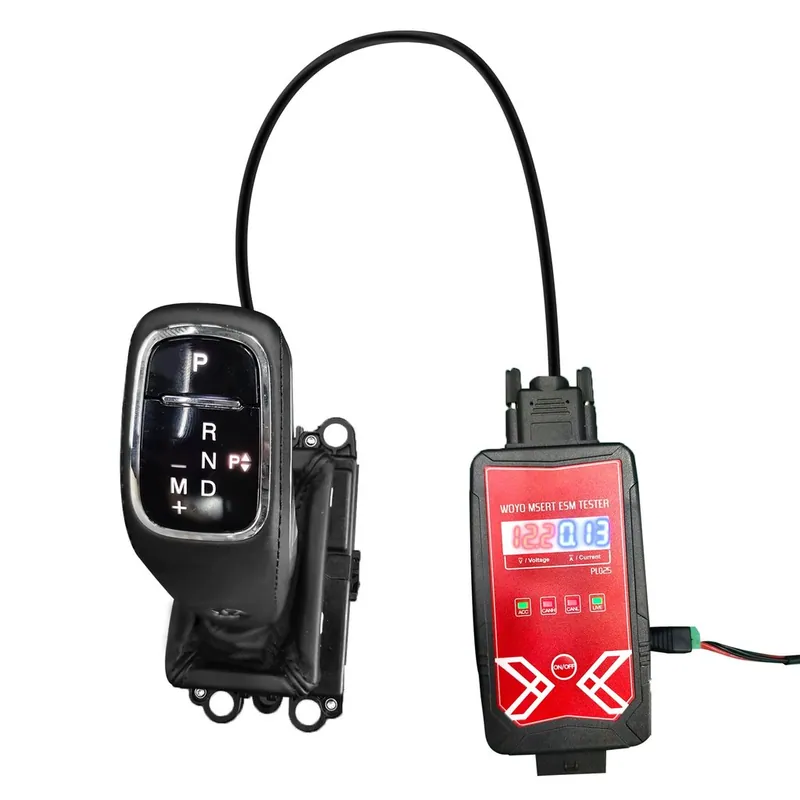
Code U1467 means the Transmission Control Module (TCM) received an illogical message from the gear shifter. For example, the shifter signals 'Park' while the vehicle moves at 40 MPH. The computer recognizes this impossibility and sets the code, indicating a CAN bus communication breakdown between the physical Electronic Shift Module (ESM) and the transmission.
Technical definition: Implausible Driver Shift Request Signal Received on CAN and D-PT CAN. The TCM monitors two separate CAN bus signals from the ESM to validate the requested gear. If one or both signals are invalid, missing, or contradictory, the TCM flags the request as implausible.
Can I Drive With U1467?
Yes, But With Caution. You can physically drive, but it is a significant gamble. The primary risk is the shifter failing to engage a gear or getting stuck in Park, Neutral, or Drive, leaving you stranded without warning. In vehicles with recalled shifters, a documented rollaway risk exists if Park fails to engage mechanically. Get the vehicle serviced promptly to avoid safety hazards.
Common Causes

- Faulty Electronic Shift Module (ESM) (Very Common) — The gear shifter assembly itself is the most frequent culprit. Electronic rotary dials and 'monostable' console shifters fail internally due to worn contacts or cracked solder joints, sending erratic signals to the transmission.
- Liquid Intrusion (Shorts the ESM) (Very Common) — Spilling a drink into the center console shorts out the unsealed circuit board inside the electronic shifter assembly, causing erratic behavior or total module failure.
- Software Glitch in Control Module (Common) — Bugs in the ESM or TCM software cause communication drops. Manufacturers frequently release software updates via Technical Service Bulletins (TSBs), like TSB 08-084-23 for 2022 Ram 1500s, to patch these specific errors.
- Low or Unstable Battery Voltage (Common) — A weak battery causes voltage drops that corrupt data signals between computer modules. This triggers U1467 before any noticeable engine starting issues appear.
- Wiring and Connection Problems (Less Common) — Damaged wires or corroded connectors between the shifter, Body Control Module (BCM), and TCM interrupt CAN bus communication. Vibration or previous console repairs often cause this.
- Use of Incompatible or Non-OEM Parts (Less Common) — Installing a used salvage yard shifter or an incompatible aftermarket part triggers this code if the hardware or software configuration mismatches the vehicle's network.
- Faulty Control Module (TCM or BCM) (Rare) — An internal failure within the Transmission Control Module or Body Control Module disrupts the network, preventing proper signal interpretation even if the shifter works perfectly.
Symptoms

- "Service Shifter" Message — A specific warning message appears on the instrument cluster display, directing you to service the shifter.
- Unable to Shift Gears — The vehicle gets stuck in Park or another gear, with the shifter knob or lever refusing to move or select a new gear. 🎬 See this quick fix for a shifter stuck in park.
- Car Has Trouble Starting or Won't Start — The engine refuses to crank because the vehicle cannot confirm it is safely in Park or Neutral.
- Flashing Gear Indicator Light — The light indicating the current gear (e.g., 'P' or 'D') flashes instead of remaining solid.
- Vehicle Rolls Away — In a critical failure associated with recalled shifters, the vehicle fails to engage Park mechanically even when the indicator says it is.
- Check Engine Light is On — The Malfunction Indicator Lamp (MIL) illuminates on the dashboard.
Diagnostic Flowchart

Tap your situation to follow the diagnostic path that matches what you're seeing on this code.
Common Fixes & Costs
- Replacing the Electronic Shifter Assembly (ESM) — Parts: $200-$500, Labor: $150-$300, ~1.5 hr book time (Intermediate)
- Reprogramming Control Module with Updated Software — Parts: $0, Labor: $150-$250, ~1.0 hr book time (Professional)
- Replacing a Weak or Dead Battery — Parts: $150-$300, Labor: $50-$100, ~0.5 hr book time (DIY)
- Repairing Damaged Wiring or Connectors — Parts: $20-$100, Labor: $200-$500, ~2.5 hr book time (Professional)
- Replacing the Transmission Control Module (TCM) — Parts: $500-$1200, Labor: $150-$300, ~1.5 hr book time (Professional)
Used vs. New Parts: Buying Guide
When a used part is worth it: A used OEM Electronic Shifter Module (ESM) from a reputable recycler is a good value for older vehicles where the cost of a new OEM part is high. It makes sense if the donor vehicle has low mileage and was not scrapped due to electronic issues.
Donor-vehicle mileage cap: roughly under 80000 miles for the part to have meaningful remaining life.
Donor quality checklist:
- Match the OEM part number exactly. There are many variations based on vehicle options, and a mismatched part will not work.
- Purchase from a seller that offers a warranty (typically 30-90 days).
- Inquire about the donor vehicle's VIN to double-check compatibility with a dealer.
- Avoid parts with any signs of liquid spills or physical damage.
Decision logic:
- If A software update (TSB) is available for your vehicle → Do not buy any part; perform the software update first.
- If The vehicle is less than 5 years old and the new OEM part is under $400 → Buy new OEM for the longer warranty and guaranteed compatibility.
- If The vehicle is older, budget is a primary concern, and a matching low-mileage donor is available → A used OEM part is an acceptable risk.
- If The replacement part requires programming (check service info) → Factor in the cost of professional programming ($100-$200) for either a new or used part.
Warranty tradeoff: Used parts typically come with a 30-90 day warranty. New aftermarket parts offer a 1-year to limited lifetime warranty. New OEM parts usually carry a 1-2 year warranty.
Worst-case if a used part fails: $300-$800 if a used part is faulty or incompatible, requiring repeat labor costs plus the purchase of another part.
What Happens If You Wait — Timeline
- 0-4 weeks: Intermittent 'Service Shifter' message appears on startup, but often clears on the next key cycle. No noticeable performance issues. (MPG impact: 0%% · Added cost: $0)
- 1-3 months: The warning light stays on consistently. The vehicle occasionally hesitates to start or requires a second push of the start button. Shifting out of Park becomes difficult. (MPG impact: 0%% · Added cost: $0 (but risk of inconvenience increases))
- 3-6 months: The vehicle frequently fails to start on the first attempt and gets stuck in Park, rendering it unreliable. A tow is likely needed. (MPG impact: 0%% · Added cost: $100-$300 (for towing and diagnostic fees))
- 6+ months: A critical failure of the Electronic Shift Module. The vehicle will not start or shift out of gear. In recalled models, the risk of a rollaway event is a constant safety concern. (MPG impact: 0%% · Added cost: $400-$1000+ (cost of towing plus mandatory replacement of shifter))
Cost of Not Fixing It
- Immediate: Vehicle fails to start or shift out of Park, leaving you stranded. This requires a tow. (Added cost: $100-$300+)
- Short-Term (Days to Weeks): Intermittent starting and shifting problems become more frequent. A critical safety risk is the vehicle failing to properly engage Park and rolling away. (Added cost: Potential for accident-related costs.)
- Long-Term (Months): The issue rarely causes cascading mechanical damage to the transmission itself, but the primary cost remains the escalating risk of being stranded and potential safety incidents. (Added cost: $0 (beyond towing and inconvenience))
Diagnosis Steps
- Check for Other Trouble Codes
Use a professional-grade OBD-II scanner to read codes from all modules (TCM, BCM, ESM). Codes like U0103 (Lost Communication with ESM) or P1DF3 (TCM Shifter Assembly Performance) are strong indicators. Write down all codes before clearing them.
Tools: Professional OBD-II Scanner (Beginner) - Inspect the Battery and Charging System
Ensure the battery is fully charged (12.4-12.6V with engine off) and terminals are clean. With the engine running, check alternator output (13.7-14.7V). Low or fluctuating voltage is a primary cause of communication codes.
Tools: Wrench set, battery terminal cleaner, multimeter (Beginner) - Inspect Shifter and Console for Liquid Damage
Visually inspect the gear shifter assembly for sticky residue from spilled drinks. Remove the center console trim for a better view of the wiring and connectors beneath the shifter. Look for corrosion on the pins.
Tools: Trim removal tools, flashlight (Intermediate) - Check Fuses
Inspect all fuses related to the Transmission Control Module (TCM), Body Control Module (BCM), and the shifter/center console. A blown fuse is a simple but often overlooked cause.
Tools: Fuse puller or needle-nose pliers (Beginner) - Check for Software Updates (TSBs)
A dealership or well-equipped independent shop must check if there are Technical Service Bulletins (TSBs) or software updates for your vehicle's ESM or TCM. TSB 08-084-23 for 2022 Ram 1500s specifically addresses this fault.
Tools: Professional scan tool, access to TSB database (Advanced) - Scan Tool Live Data Analysis (Advanced)
Using a professional scan tool, monitor live data PIDs from the ESM and TCM. Watch 'Shifter Lever Position' or 'PRNDL Status'. The data must show a clear, stable value corresponding to the gear selected. Erratic values strongly suggest a faulty ESM.
Tools: Professional OBD-II Scanner (Advanced) - Test CAN Bus Network Integrity (Advanced)
With the battery disconnected, check for resistance between Pin 6 (CAN High) and Pin 14 (CAN Low) at the OBD-II port. A healthy network reads approximately 60 ohms. A reading of 120 ohms indicates a break in the wiring; 0 ohms indicates a short circuit.
Tools: Multimeter (Advanced) - Measure CAN Bus Voltages (Advanced)
With the ignition on (engine off), measure voltage at the OBD-II port. Pin 6 (CAN High) should read ~2.6-2.7 volts. Pin 14 (CAN Low) should read ~2.3-2.4 volts. Significant deviation points to a wiring issue or a faulty module pulling the network down.
Tools: Multimeter (Advanced) - Isolate the Faulty Module (Professional)
If CAN bus voltages are incorrect, disconnect modules one by one from the network (e.g., ESM, ABS module) and re-check voltages. When the faulty module is disconnected, voltages return to normal, identifying the source.
Tools: Multimeter, wiring diagrams, trim removal tools (Professional)
When This Code Triggers (Freeze-Frame Conditions)
- Vehicle Speed: 0 MPH (During startup or when attempting to shift out of Park.)
- Engine RPM: 0 or 600-800 RPM (Key-on, engine-off, or at idle.)
- Gear Selector Position: Mismatch (Scan tool shows a different gear than what the shifter indicates (e.g., shows 'Drive' when shifter is in 'Park').)
- Battery Voltage: Below 12.0V (Often logged when battery is weak or during a low-voltage event.)
Related Codes
- U0103 — 'Lost Communication with Electric Gear Shift Module.' Indicates a total communication failure. A scan tool will not communicate with the shifter module at all, pointing to a power/ground issue or a dead module.
- P1DF3 — 'TCM Shifter Assembly Performance.' Often set by the TCM at the same time as U1467. P1DF3 indicates a general performance problem, while U1467 flags a specific illogical signal. Seeing both strongly suggests the shifter assembly is failing.
- U1267 — 'No Valid data available from ESM on CAN-C or CAN D-PT.' A very similar Chrysler-specific code pointing to the same underlying communication failure. TSB 08-084-23 addresses this code alongside U1467.
- P1C87-2A — 'Trigger Switch Stuck.' Found on some Jeep models, indicating a physical failure within the shifter handle causing it to send constant or incorrect signals. This physical failure directly causes the 'implausible' signal reported by U1467.
Climate & Environmental Factors
- Cold Weather: Extreme cold weakens a vehicle's battery, causing low voltage conditions. Low voltage is a well-documented trigger for communication codes like U1467 as modules fail to operate correctly.
- High Humidity: In humid climates, moisture accumulates on electronic components. If moisture penetrates the unsealed shifter assembly, it leads to corrosion and short circuits over time.
How to Talk to a Mechanic About This Code
Say this: "I have a 'Service Shifter' message and a U1467 code. Before replacing the shifter, please test the battery, check for open TSBs or software updates for the TCM and ESM, and inspect the console for liquid damage."
This signals you are an informed customer. It directs the mechanic to follow a logical, cost-effective diagnostic path, starting with the simplest and most common causes (battery, software) before moving to an expensive part replacement.
Avoid saying:
- 'My car won't shift right, just fix it.'
- 'The check engine light is on, can you look at it?'
- 'I think I need a new shifter.'
Questions to ask before authorizing the repair:
- What was the battery voltage and alternator output?
- Did you check my VIN for any available software updates related to the shifter?
- If you are recommending a shifter replacement, what specific tests did you perform to condemn the old part and rule out a wiring issue?
- Does the new shifter require programming to my vehicle's VIN?
- What is the warranty on the part and the labor for this repair?
Where to Take It: Dealer vs Independent vs Chain
- Dealer:
Recommended first stop if you suspect a software issue or if the vehicle is under warranty. While more expensive, they are the most likely to have access to the specific TSBs and programming tools needed.
Best for: Vehicles under warranty., Performing software updates (TSBs) which are a very common fix for U1467., Complex electrical or network diagnostics requiring proprietary tools (like wiTECH).
Downsides: Highest labor rates, typically 1.5-2x more than independent shops., May default to replacing the entire shifter assembly rather than investigating simpler causes. (Typical cost: +50% vs. baseline) - Independent Shop:
Good choice for straightforward shifter replacement or wiring repair. Verify first that they have advanced diagnostic tools capable of reading Chrysler-specific codes from the TCM and BCM.
Best for: Out-of-warranty vehicles where the cause is likely a known hardware failure (e.g., bad shifter, liquid spill)., Basic electrical diagnosis like battery testing and wiring inspection.
Downsides: May not have the expensive subscription or tools (like J2534 pass-through devices) to perform manufacturer-specific software updates., Quality and diagnostic capability vary widely; choose a shop specializing in your vehicle's brand. (Typical cost: +0% vs. baseline) - Chain Shop:
AVOID for diagnosing U1467. They can test and replace the battery, but are not equipped for the main diagnostic work required for this communication code.
Best for: Simple, related tasks like battery replacement.
Downsides: Technicians are unlikely to have the training or tools for CAN bus network diagnosis or module programming., High pressure to upsell common services, may misdiagnose complex electronic faults. (Typical cost: -10% vs. baseline)
When to Walk Away From the Repair
If the estimated repair cost for the U1467 fault exceeds 40-50% of your car's private-party value, seriously consider selling the vehicle as-is or trading it in.
- Car worth $8000, fix is $800: Fix it. The repair cost is only 10% of the vehicle's value.
- Car worth $5500, fix is $2200: Walk away. The repair cost is 40% of the car's value. This money is better put toward a down payment on a more reliable vehicle.
What Scan Tool You Need for This Code
Minimum: A scanner that reads manufacturer-specific codes (for Chrysler/Dodge/Jeep) from modules beyond the engine, such as the Transmission Control Module (TCM) and Body Control Module (BCM).
A basic $20 code reader only checks the engine module and misses 'U' codes entirely. For U1467, you must see live data from the shifter, TCM, and BCM to understand where communication fails.
Budget: BlueDriver Pro (~$90) — Reads and clears transmission, ABS, and airbag codes for Chrysler vehicles. It views live data, which is essential for seeing the shifter position data the TCM receives.
Mid-range: Autel MaxiCOM MK808 / Foxwell NT Series / iCarsoft CR Pro (~$250-400) — These scanners offer deeper access to all vehicle modules and provide bidirectional controls. For Chrysler products, AlfaOBD (software used with an OBD adapter) is a powerful choice in this price range for near-dealer-level capabilities, including programming new shifters.
Professional: Autel MaxiSys Series (MS906, Ultra S2) (~$1200+) — Provides full, dealership-level functionality. Performs advanced diagnostics like CAN bus analysis, module flashing/reprogramming (with a subscription), and guided component tests. Essential for a professional shop but overkill for a DIYer.
Rent vs buy: Rent a basic scanner from a parts store to confirm the code for free. However, to properly diagnose U1467 yourself, you must buy a scanner with manufacturer-specific live data capabilities.
How to Clear the Code After You Fix It
- Fix the root cause (e.g., replace shifter, update software).
- Use an OBD-II scan tool to clear active and stored codes.
- If a Permanent DTC (PDTC) is present, it cannot be cleared manually and requires a specific drive cycle.
Drive cycle (~30 minutes): A general drive cycle involves: a cold start (sit overnight), idle for 2-3 minutes, 15 minutes of mixed city/highway driving (including steady speeds around 55 mph), and several stops. The goal is to allow the car's computer to re-run its self-tests.
Readiness monitors affected: Comprehensive Component Monitor (CCM), This is a communication code, so it primarily affects the CCM. Other monitors are generally not impacted.
Before emissions retest: drive at least 100 miles to fully set monitors.
Watch out for:
- Simply disconnecting the battery clears the Check Engine Light but resets all readiness monitors to 'incomplete', causing an automatic emissions test failure.
- A Permanent DTC (PDTC) will not clear with a scan tool or battery disconnect. The vehicle must be driven through multiple warm-up cycles (up to 15) and for a set distance (up to 200 miles) after the repair is confirmed by the ECU.
Will This Fail Emissions / State Inspection?
Yes — this code typically fails an OBD-II emissions inspection.
- California: An illuminated Check Engine Light is an automatic failure. If the code is permanent (PDTC), it must be cleared by the vehicle's computer after a specific drive cycle (up to 200 miles and 15 warm-ups) before it passes a smog check.
- New York: An illuminated Check Engine Light causes an automatic failure of the emissions inspection. After repair, the vehicle must complete a drive cycle to set the readiness monitors before re-inspection.
- Texas: In the 17 counties requiring emissions testing, an active Check Engine Light is an automatic failure. After repairs, readiness monitors must be set to 'Ready' to pass the OBD-II test.
Most Commonly Affected Vehicles
- Ram 1500 (2013-2022) — Extremely common on models with the electronic rotary dial shifter. TSB 08-084-23 was issued for 2022 models to fix related communication codes with a software update. A new OEM shifter costs approximately $200-$350.
- Dodge Charger (2012-2014) — Very common in models with the electronic 'monostable' shifter. These years were part of Safety Recall S27 (NHTSA 16V-240) to add an 'Auto Park' software feature to prevent rollaways.
- Jeep Grand Cherokee (2014-2015) — Prone to this issue due to the same electronic 'monostable' shifter as the Charger. Also included in Safety Recall S27 for a software update to prevent rollaway incidents.
- Chrysler 300 (2012-2014) — Shares the same recalled 'monostable' electronic shifter platform as the Dodge Charger and is commonly affected. Part of Safety Recall S27.
- Chrysler 200 (2015-2017) — Models equipped with the rotary dial shifter experience this communication fault. A 2015 recall was issued for some V6 models for transmissions that were difficult to shift into park.
- Hyundai Sonata, Elantra, Santa Fe (2020-2024) — These models display a 'Shifter System Malfunction' warning with nearly identical symptoms and causes, such as faulty position sensors and software glitches requiring updates.
- Jaguar XF (2007-2015) — Models with the rotary gear selector are known for failures where the dial gets stuck. This is often accompanied by code P176C-11, a fault analogous to U1467.
- Land Rover Range Rover Evoque, Sport (2011-2019) — These vehicles use a rotary shifter prone to mechanical and electronic failure, causing it to get stuck. The common fault code is P176C-11.
Manufacturer-Specific Notes
- Chrysler/Dodge/Jeep/Ram: This code is almost exclusively found on these brands with electronic shifters. A software update from the dealer is a very common fix, confirmed by TSBs like 08-084-23.
- Chrysler/Dodge/Jeep/Ram: A temporary reset is sometimes achieved by disconnecting the negative battery terminal for 20 minutes to clear the module's memory. If a hardware fault exists, the code returns quickly.
- Chrysler/Dodge/Jeep/Ram: For rotary shifters stuck in Park due to a dead battery or electronic failure, a manual override tether exists. It is typically a red strap located under an access panel below the dashboard, which puts the vehicle into Neutral for towing.
- Chrysler/Dodge/Jeep/Ram: Safety Recall S27 (NHTSA 16V-240) was issued for 2012-2014 Charger/300 and 2014-2015 Grand Cherokee models to add an 'Auto Park' software feature, preventing rollaway incidents if a driver exits the vehicle without it being in Park.
- Chrysler/Dodge/Jeep/Ram: The manufacturer's extended warranty, FlexCare (formerly Mopar Vehicle Protection), covers the shifter assembly if the vehicle has an active 'Bumper-to-Bumper' or 'Extended Care Premium' plan.
Real Owner Stories
2013 Ram 1500 with starting issues
The 'Service Shifter' message and check engine light (U1467) appeared. The truck would sometimes only click on the first or second attempt before starting.
What they tried:
- The owner received advice to check the battery.
Outcome: Replacing the vehicle's battery resolved both the U1467 code and the starting problems.
Lesson: Always test the battery first for any electronic or communication code. Low voltage causes modules to malfunction and report errors before obvious starting issues appear.
2018 Jeep Grand Cherokee with sudden electrical failure
After spilling soda on the center console, the vehicle ran for 5 minutes before all dash lights came on, gauges failed, and 'Service Shifter' messages appeared. The vehicle was stuck in gear.
What they tried:
- Disconnecting the battery for 6 hours did not fix the issue.
- The owner replaced the shifter module, but the problem persisted.
Outcome: The liquid shorted out the CAN bus lines within the center console area. The fix required professional diagnosis to trace the short circuit beyond just the shifter module.
Lesson: A liquid spill causes damage beyond the most obvious component. If a new shifter doesn't fix the problem after a spill, the wiring harness is likely damaged.
Dodge Charger with recurring U1467 code
A U1467 code appeared on a Dodge Charger. The vehicle drove normally, but the check engine light remained on.
What they tried:
- The owner replaced the shifter assembly multiple times with used parts purchased from eBay.
- The battery and terminals were checked and confirmed good.
Outcome: The code appeared intermittently, proving the used shifters were incompatible or required VIN programming.
Lesson: Using multiple used parts without resolving the code points to a high risk of incompatibility. A new OEM part or professional programming is often required.
2014 Ram with U1467 after DIY stereo work
After unplugging the rotary shifter to install a backup camera, a 'Service Shifter' message appeared with code U1467. The code would not clear with a scan tool.
What they tried:
- The owner re-checked the connections and tried to clear the code immediately.
Outcome: The code cleared itself after several drive cycles. The vehicle's computer needed to run internal self-tests to confirm the shifter was communicating properly.
Lesson: Communication codes set after a repair do not always clear immediately. The system requires multiple key cycles to re-synchronize.
How to Prevent This Code From Triggering
- Be cautious with liquids in the center console (Daily habit) — The number one external cause of shifter failure is a spilled drink shorting out the unsealed electronics inside the shifter assembly. Using cups with secure lids prevents hundreds of dollars in repairs.
- Test battery health during regular service (Every 1-2 years) — A weak battery causes unstable voltage, corrupting data signals between computer modules and triggering communication codes like U1467.
- Ask the dealer to check for software updates (During any dealership visit) — Manufacturers frequently release software updates (TSBs) to fix communication bugs. A simple reflash permanently fixes the code if it's software-related.
- Practice gentle shifter operation (Daily habit) — Avoiding aggressive or rapid shifting reduces physical stress on the internal contacts, prolonging the life of the electronic shifter assembly.
Frequently Asked Questions
Can a weak battery really cause the U1467 code?
Yes. Modern vehicles rely on stable voltage for computer modules to communicate. A failing battery causes voltage drops that corrupt these signals, leading to U1467 before starting issues occur.
What does 'implausible' mean in this code's definition?
It means 'illogical.' The transmission received a command from the shifter that contradicts current operating conditions, like shifting into Park while moving at 40 mph.
I got a 'Service Shifter' warning. Is that the same as a U1467 code?
Yes, it is a very strong indicator. The 'Service Shifter' message is the plain-English dashboard warning displayed when the computer logs a shifter fault like U1467.
What are common misdiagnosis mistakes for U1467?
A common mistake is replacing the shifter assembly without checking battery voltage or available software updates first. Another pitfall is installing an incompatible used shifter that requires VIN programming.
Can the U1467 code clear on its own?
It only clears on its own if the underlying fault is intermittent. If stored as a Permanent Diagnostic Trouble Code (PDTC), it requires the vehicle to pass internal self-tests over multiple drive cycles to clear.
Will I damage my transmission by driving with this code?
It rarely causes direct mechanical damage to the transmission. The primary risks are electronic failures that leave you stranded in one gear, or a safety hazard if the vehicle fails to engage Park and rolls away.
How do I perform a shifter reset?
Turn the ignition to 'ON' (engine off), press the brake pedal, and slowly cycle the shifter through all gears, pausing in each. Alternatively, perform a full electronic reset by disconnecting the negative battery terminal for 20 minutes.
Is it safe to install a used shifter?
Used parts are cost-effective but carry compatibility risks. The OEM part number must match exactly, and many models require the used shifter to be programmed to your vehicle's VIN using advanced scan tools.
Key Takeaways
- Code U1467 flags a communication breakdown between the Electronic Shift Module (ESM) and the Transmission Control Module (TCM).
- Test your battery voltage (must be >12.4V) and check for dealer software updates before spending $400+ on a new shifter assembly.
- Inspect the center console for spilled liquids, as sticky residue on the shifter's circuit board is the number one physical cause of this failure.
- Stop driving immediately if the shifter gets stuck in Park or Neutral, as this creates a high risk of being stranded or experiencing a dangerous rollaway.
Helpful Videos
Shop the Parts Behind U1467
Below are the parts most often responsible for code U1467, ranked by how frequently each one is the actual culprit (per the diagnosis above). Tap any to see what we have for your vehicle.


The information in this article is provided for general reference and educational purposes only. Vehicle specifications, procedures, and part compatibility can vary by production date, trim level, and region. Always consult your vehicle's factory service manual and verify part numbers before purchasing or performing repairs. Safety-critical components such as airbags, seat belts, and braking systems should be installed by a qualified professional.
- 🧭 Diagnostic Flowchart
- 🎬 Helpful Videos
- 🛍️ Shop This Part
- What Does U1467 Mean?
- Can I Drive With U1467?
- Common Causes
- Symptoms
- Common Fixes & Costs
- Used vs. New Parts: Buying Guide
- What Happens If You Wait — Timeline
- Cost of Not Fixing It
- Diagnosis Steps
- When This Code Triggers (Freeze-Frame Conditions)
- Related Codes
- Climate & Environmental Factors
- How to Talk to a Mechanic About This Code
- Where to Take It: Dealer vs Independent vs Chain
- When to Walk Away From the Repair
- What Scan Tool You Need for This Code
- How to Clear the Code After You Fix It
- Will This Fail Emissions / State Inspection?
- Most Commonly Affected Vehicles
- Manufacturer-Specific Notes
- Real Owner Stories
- 2013 Ram 1500 with starting issues
- 2018 Jeep Grand Cherokee with sudden electrical failure
- Dodge Charger with recurring U1467 code
- 2014 Ram with U1467 after DIY stereo work
- How to Prevent This Code From Triggering
- Frequently Asked Questions
- Can a weak battery really cause the U1467 code?
- What does 'implausible' mean in this code's definition?
- I got a 'Service Shifter' warning. Is that the same as a U1467 code?
- What are common misdiagnosis mistakes for U1467?
- Can the U1467 code clear on its own?
- Will I damage my transmission by driving with this code?
- How do I perform a shifter reset?
- Is it safe to install a used shifter?
- Key Takeaways
- 🎟️ Get 5% Off