

OBD-II Code U1611: Lost Communication With Engine Computer
What U1611 means, why it triggers, and how to fix it
- Check for GM Technical Service Bulletin (TSB) #24-NA-025 before replacing parts, as a simple 1-hour dealer software update fixes U1611 on most 2024-2025 GM vehicles.
- Test your battery's cranking voltage with a multimeter; a drop below 9.6 volts during startup is the second most common cause of U1611 communication failures.
- Unplug any aftermarket insurance trackers or performance tuners from your OBD-II port immediately, as these devices frequently disrupt the 60-Ohm CAN bus network.
- Drive the vehicle normally if you own a GM model and experience zero performance issues, but schedule a diagnostic appointment within 30 days to clear the active Check Engine Light.
- Refuse any $800+ Body Control Module (BCM) replacement quotes until a technician definitively proves the module is dead using an oscilloscope or advanced scan tool.
What Does U1611 Mean?

The trouble code U1611 means one of your car's computers, usually the Body Control Module (BCM), temporarily lost its connection with the main Engine Control Module (ECM). This acts like a dropped phone call between two critical parts of your car's brain. This communication happens over a high-speed network called the Controller Area Network (CAN) bus.
Technical definition: The official definition for this manufacturer-specific code, primarily used by General Motors (GM), is "Loss of Communication with the Engine Control Module (ECM) on CAN Bus 2". This indicates a module failed to receive expected data packets from the ECM within a specified millisecond timeframe.
Can I Drive With U1611?
Yes, But With Caution. You can safely drive most GM vehicles with a U1611 code, as it rarely causes performance issues. The primary risk is that the active Check Engine Light masks new, more serious problems. If a critical engine fault occurs while this light is already on, you will not be notified, risking severe component damage. On other makes like Hyundai, a similar code indicates a loss of power steering, making the vehicle unsafe to drive.
Common Causes

- Control Module Software Anomaly (Very Common) — A software glitch causes this code on many newer GM vehicles, including the 2024-2025 Chevrolet Corvette and Silverado. 🎬 Watch: What GM says about this Corvette software glitch. General Motors acknowledges this flaw in Technical Service Bulletins (TSBs), such as #24-NA-025, which requires a dealer software update to resolve.
- Low Battery Voltage or Weak Battery (Common) — A weak battery causes communication errors between modules. If the voltage drops below 9.6 volts during engine cranking, modules fail their startup sequence and cannot 'talk' to each other, triggering the U1611 code. Stable battery voltage is mandatory for CAN bus operation.
- Aftermarket Accessory Interference (Common) — Devices plugged into the OBD-II port (insurance trackers, tuners) or improperly wired into the electrical system (remote starters, alarms) disrupt the CAN bus network. These accessories draw unauthorized power or send unexpected data, crashing network communication.
- Damaged Wiring or Poor Connections (Less Common) — Vibrations, moisture, or rodents damage the twisted-pair wires of the CAN bus network. A corroded main ground wire connection for the BCM or ECM also creates voltage drops that sever communication.
- Intermittent Glitch from Quick Start/Stop Cycles (Less Common) — Starting the engine and shutting it off immediately prevents vehicle modules from completing their boot-up handshake sequence. This logs a temporary communication fault flag that often clears itself.
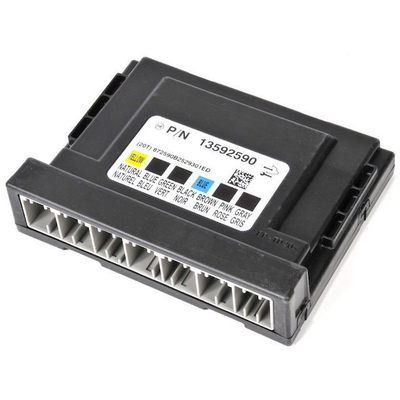
- Failing Body Control Module (BCM) (Rare) — The BCM controls features like lights, windows, and locks. Because it reports the U1611 code, an internal hardware failure within the BCM itself severs its connection to the ECM.
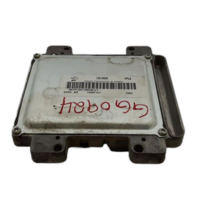
- Failing Engine Control Module (ECM) (Rare) — An internal hardware failure prevents the ECM from broadcasting messages. On certain Hyundai models (setting code C1611), failed capacitors inside the ECM cause this communication loss alongside severe drivability symptoms.
- Faulty Terminating Resistor (Rare) — The CAN bus network relies on two 120-Ohm terminating resistors. If one resistor fails, the total network resistance shifts from 60 Ohms to 120 Ohms, instantly crashing communication 🎬 See how to perform a CAN bus resistance check. between all modules.
Symptoms

- Check Engine Light is On — The light illuminates steadily. This is the most common and often the only symptom.
- No Drivability Issues — The car runs, drives, and shifts completely normally, confirming the issue is a software glitch rather than a mechanical failure.
- Check Engine Light Turns Off On Its Own — The communication loss is temporary, causing the Check Engine Light to turn off after 3 to 5 start/stop cycles once the modules reconnect.
- Severe Drivability Issues (Other Makes) — On non-GM vehicles (like Hyundai with C1611), ECM communication loss causes heavy power steering, a dead speedometer, and a blank gear indicator.
- Other Warning Lights or Electrical Glitches (also visible on scanner) — You see 'Service Safety Restraint System' warnings or experience malfunctioning power locks and radios, typically caused by aftermarket accessory interference.
- Inability to Pass Emissions Test (scan-tool only — no driver-felt sign) — An active Check Engine Light and a stored 'U' code trigger an automatic failure during state emissions inspections.
Diagnostic Flowchart
Tap your situation to follow the diagnostic path that matches what you're seeing on this code.
Common Fixes & Costs
- Software Update at Dealership — Parts: $0, Labor: $150 - $250 (Free if under warranty), ~1.0 hr book time (Professional)
- Replace Car Battery — Parts: $150 - $300, Labor: $25 - $100, ~0.5 hr book time (DIY)
- Remove/Repair Aftermarket Accessory — Parts: $0 - $50, Labor: $0 - $150, ~0.5 hr book time (DIY)
- Repair Damaged Wiring or Ground — Parts: $5 - $50, Labor: $150 - $500, ~2.5 hr book time (Intermediate)
- Replace Body Control Module (BCM) — Parts: $400 - $800, Labor: $150 - $250, ~1.5 hr book time (Professional)
- Replace Engine Control Module (ECM) — Parts: $800 - $1,500, Labor: $150 - $300, ~1.2 hr book time (Professional)
Used vs. New Parts: Buying Guide
When a used part is worth it: A used Body Control Module (BCM) is rarely a viable DIY repair. It makes sense only if a professional shop with advanced programming tools sources a compatible, reset-able unit from a reputable salvage yard.
Donor-vehicle mileage cap: roughly under 60000 miles for the part to have meaningful remaining life.
Donor quality checklist:
- Part number must be an exact match.
- Verify the donor vehicle did not have a factory theft system if your vehicle does not.
- Ensure the seller guarantees the module is not VIN-locked.
Decision logic:
- If The fix is a known software TSB → buy nothing; pay for the dealer software update labor.
- If You are a DIYer without professional programming tools → buy a new OEM part and have it installed and programmed by a dealer.
- If Budget is the absolute priority and you accept the risk → a used BCM saves money on the part, but labor for programming remains, and the used part may be faulty.
Warranty tradeoff: Used BCMs have a 30-90 day warranty and may be VIN-locked. New OEM modules come with a 1-year warranty and are guaranteed programmable.
Worst-case if a used part fails: $500 - $1000 if a used BCM fails or cannot be programmed, requiring repeat labor.
What Happens If You Wait — Timeline
- 0-1 month (GM Software Glitch Scenario): Check Engine Light illuminates with code U1611. There are no drivability symptoms. The light may turn off and on by itself. (MPG impact: 0%% · Added cost: $0)
- 1-6 months (GM Software Glitch Scenario): The primary consequence is failing a state emissions inspection. The main risk is masking a new, more serious problem. (MPG impact: 0%% · Added cost: $50 - $200 (for failed inspection fees and basic diagnostic charges))
- 3-12 months (Rare Hardware Failure Scenario): If the cause is a failing BCM or corroding wire, you notice intermittent issues like flickering interior lights or battery drain overnight. (MPG impact: 0-2%% · Added cost: $150 - $350 (for professional electrical diagnosis).)
- 12+ months (Rare Hardware Failure Scenario): A complete failure of the BCM leads to a no-start condition. A major wiring short causes cascading failures of other modules. (MPG impact: N/A (Vehicle may not start)% · Added cost: $800 - $2,500+ (for BCM replacement or extensive wiring harness repair).)
Cost of Not Fixing It
- Short-Term (0-3 months): In most GM cases, none. The primary risk is masking a new, more serious fault behind the active Check Engine Light. (Added cost: $0)
- Medium-Term (3-12 months): Automatic failure of state emissions inspections. Potential for intermittent electrical issues if the cause is degrading wiring. (Added cost: $50 - $200 (for inspection re-test fees and minor diagnostics))
- Long-Term (1+ years): If caused by a failing BCM, leads to a no-start condition or significant battery drain. On Hyundai vehicles, ignoring C1611 means driving without power steering. (Added cost: $500 - $1500+ (if a critical module fails completely))
Diagnosis Steps

- Check for Technical Service Bulletins (TSBs)
Search online for your vehicle's year, make, model, and 'U1611 TSB' to see if a dealer software update is the required fix. For example, TSB #24-NA-025 fixes this exact code on 2024-2025 Corvettes.
Tools: Internet access (Beginner) - Test Your Car Battery Under Load
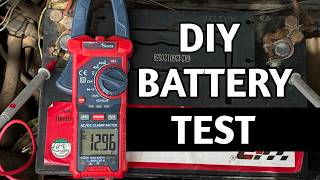
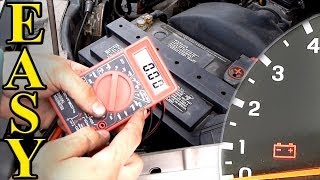
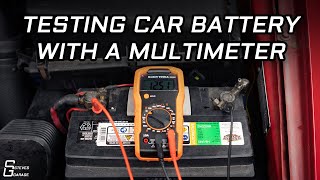
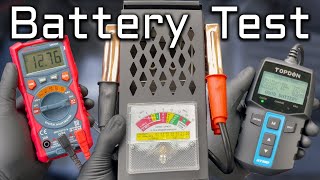
Use a multimeter to check battery voltage while a helper starts the car. If the voltage drops below 9.6 volts during cranking, the battery is weak and causes modules to fail their startup sequence. Replace the battery if it fails this load test.
Tools: Multimeter (Beginner) - Unplug Aftermarket Accessories
Unplug any insurance trackers, tuners, or power steps from the OBD-II port. Inspect wiring for aftermarket stereos or alarms. Clear the code with a scanner and drive the vehicle. Improper installations frequently cause CAN bus errors.
Tools: OBD-II scanner (Beginner) - Visually Inspect Wiring and Grounds
Check for frayed or corroded wires around the ECM, BCM, and under the dashboard. Verify the main ground straps from the battery and engine to the car's frame are clean and tightly bolted.
Tools: Flashlight, socket set (Intermediate) - Check CAN Bus Resistance
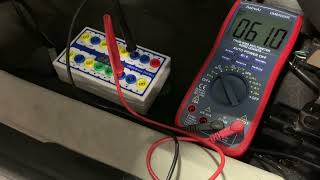
Disconnect the battery. Use a multimeter set to Ohms to measure resistance between Pin 6 (CAN High) and Pin 14 (CAN Low) on the OBD-II port. A healthy network reads 60 Ohms. A reading of 120 Ohms indicates a broken wire; 0 Ohms indicates a short circuit.
Tools: Multimeter (Advanced) - Scan Tool Network Test
Use a professional scan tool to 'ping' each module on the CAN bus. If a specific module fails to respond, the problem isolates to that module or its direct wiring harness.
Tools: Professional OBD-II Scan Tool (Advanced) - Pro Tip: Module Isolation
If the resistance reading is incorrect, monitor the multimeter at the OBD-II port while unplugging modules one by one. When the resistance returns to 60 Ohms, the last module unplugged (or its wiring) is the source of the short or interference.
Tools: Multimeter, vehicle wiring diagram, panel removal tools (Advanced) - Pro Tip: Oscilloscope Waveform Analysis
Connect an oscilloscope to Pin 6 and Pin 14. A healthy CAN bus shows two clean, mirror-image square waves toggling between 1.5V and 3.5V. Distortion or noise pinpoints specific network interference that a multimeter cannot detect.
Tools: Oscilloscope (Professional) - Professional Diagnosis
If simple steps fail, take the vehicle to a dealer or specialized shop equipped with GM SPS2 programming tools. They will monitor CAN bus data directly to pinpoint the exact source of the communication loss.
Tools: Professional diagnostic equipment, GM SPS2 software (Professional)
When This Code Triggers (Freeze-Frame Conditions)
- Engine State: Startup or Cruise (Sets immediately at startup due to low voltage or during steady-state driving when a brief communication timeout occurs.)
- Engine Coolant Temp: Any (Occurs on a cold start (below 122°F) if battery related, or when fully warmed up (180-210°F) if it is a software issue.)
- Battery Voltage: <11.5V or 13.5-14.5V (Triggers from low voltage during engine cranking or from electrical noise even at normal charging voltage.)
- Vehicle Speed: 0 MPH or 55-65 MPH (Logged at key-on (0 MPH) or during steady highway cruising, aligning with GM drive cycle module checks.)
Related Codes
- U0401 — Means 'Invalid Data Received From ECM/PCM'. U1611 is the cause (BCM lost communication), and U0401 is the effect (TCM receives invalid data). TSB #24-NA-025 notes U0401 sets alongside U1611 due to the same software fault.
- P0700 — Means 'Transmission Control System Malfunction'. The TCM sets P0700 to request the ECM to illuminate the Check Engine Light when it stores a U0401 fault. The chain is U1611 -> U0401 -> P0700.
- U0100 — The generic SAE-standard code for 'Lost Communication With ECM/PCM'. U1611 is GM's specific version of this fault, tied to documented software issues, whereas U0100 is a general starting point.
- U0073 — Means 'Control Module Communication Bus A Off'. Indicates the entire CAN bus is down. Seeing U0073 with U1611 points to a major wiring short or a failure of both terminating resistors.
Climate & Environmental Factors
- Low Temperatures: Cold weather reduces a battery's cranking power. A weak battery shows symptoms during a cold start, dropping voltage low enough to cause modules to fail their startup communication sequence.
- High Humidity / Moisture: Water intrusion accelerates corrosion on wiring, connector pins, and module ground points. This corrosion increases resistance, disrupting the sensitive voltage signals on the CAN bus.
How to Talk to a Mechanic About This Code
Say this: "I have a U1611 code on my [Vehicle Year, Make, Model] with zero drivability issues. Please check for relevant Technical Service Bulletins, like TSB #24-NA-025, and test the battery cranking voltage before quoting any module replacements."
This directs the service advisor toward the most likely and cheapest fix first (a software update) and prevents them from immediately quoting an expensive, unnecessary module replacement.
Avoid saying:
- 'My check engine light is on, can you just fix it?'
- 'I think I need a new computer.'
- 'Just do whatever you think is best.'
Questions to ask before authorizing the repair:
- Did you check for TSBs, and is my vehicle's software calibration the latest version available from GM?
- If you recommend a module replacement, what diagnostic steps ruled out a software update, a bad battery, or a wiring issue?
- Is the software update covered under my vehicle's powertrain or emissions warranty?
- Does your estimate include the cost of programming the new module to my vehicle?
Where to Take It: Dealer vs Independent vs Chain
- Dealer:
Recommended. The dealer is the most reliable choice for the primary cause of this code (software update).
Best for: Vehicles under warranty where the TSB software update is free., The most common cause of U1611 on GM vehicles, which requires proprietary GM tools (SPS2).
Downsides: Higher labor rates than independent shops for non-warranty work., Less willing to diagnose non-standard issues like aftermarket accessory interference. (Typical cost: +50% vs. baseline) - Independent Shop:
Acceptable with caution. Only use if they prove they have dealer-level programming capabilities.
Best for: Diagnosing secondary causes like a weak battery, bad grounds, or wiring faults., Out-of-warranty vehicles where the cause is confirmed NOT to be a software issue.
Downsides: Many independent shops lack the J2534 Pass-Thru device and GM Techline Connect subscription required for software updates. (Typical cost: +0% vs. baseline) - Chain Shop:
AVOID. This is a complex diagnostic code. Do not take your vehicle here for a U1611 diagnosis.
Best for: Free battery testing.
Downsides: Technicians lack the training and tools to diagnose network communication codes correctly., High risk of misdiagnosis leading to expensive module replacements. (Typical cost: -10% vs. baseline)
When to Walk Away From the Repair
If the estimated repair cost for a worst-case scenario (e.g., BCM/ECM replacement) exceeds 50% of your car's private-party value, pause and consider alternatives.
- Car worth $45000, fix is $250: Fix it. A software update on a new Corvette is a negligible cost.
- Car worth $15000, fix is $1200: Fix it. A worst-case BCM replacement on an out-of-warranty Silverado is well below the 50% threshold.
- Car worth $3000, fix is $1800: Walk away. If a 12-year-old Hyundai needs a $1,800 ECM replacement, the repair cost is 60% of the car's value.
What Scan Tool You Need for This Code
Minimum: A scanner that reads manufacturer-specific 'U' (Network) codes from all modules, including the BCM, TCM, and ECM.
A basic $20 code reader only reads generic 'P' (Powertrain) codes from the ECM. It misses the U1611 code stored in the BCM, leaving you with an incomplete diagnosis.
Budget: BlueDriver Pro (~$119) — Reads and clears enhanced codes from systems like the BCM and TCM on GM vehicles, showing the full picture of the software glitch.
Mid-range: Foxwell NT510 Elite for GM (~$180) — Offers deeper GM-specific diagnostics, including full system scans and bidirectional controls to verify wiring and component function.
Professional: Autel MaxiCOM MK808S (~$450) — Provides full bidirectional control and features a network topology map that makes it easy to see which modules are offline.
Rent vs buy: Rent a basic scanner from an auto parts store to confirm battery health. To properly diagnose a U1611 yourself, you must BUY a scanner capable of reading manufacturer-specific codes.
How to Clear the Code After You Fix It
- Reconnect battery if disconnected for repair
- Use an OBD-II scan tool to formally clear the Diagnostic Trouble Code
- Perform a complete GM drive cycle to allow readiness monitors to run
Drive cycle (~20 minutes): Cold start (coolant < 122°F), idle for 2.5 mins with electrical loads ON. Accelerate to 55 MPH and hold steady for 3 mins. Coast down to 20 MPH without braking. Accelerate to 55-60 MPH and hold steady for 5 mins. Coast down again.
Readiness monitors affected: Catalyst (CAT), Evaporative System (EVAP), Oxygen (O2) Sensor
Before emissions retest: drive at least 50 miles to fully set monitors.
Watch out for:
- Disconnecting the battery clears the light but fails to reset the permanent code or readiness monitors.
- The code returns immediately if the root cause (software bug, faulty accessory) is not fixed.
- Failing to perform a full drive cycle leaves readiness monitors incomplete, causing an emissions test failure.
Will This Fail Emissions / State Inspection?
Yes — this code typically fails an OBD-II emissions inspection.
- California: An illuminated Check Engine Light results in an automatic failure. All OBD-II readiness monitors must be set to 'Ready'.
- New York: Any active 'U' code that illuminates the Check Engine Light causes the vehicle to fail the emissions portion of the test.
- Texas: In the 17 counties requiring emissions testing, the code must be cleared and readiness monitors set before the vehicle passes.
Most Commonly Affected Vehicles
- Chevrolet Corvette (Z06) (2024-2025) — A documented software anomaly causes this code, addressed by GM TSB #24-NA-025. The fix requires an ECM and TCM software update.
- Chevrolet Silverado 1500 (2022-2024) — TSB PIT5907A advises ignoring this code if found in the Park Assist Module without symptoms. TSB #23-NA-206 advises ignoring it in the Transfer Case Control Module.
- GMC Sierra 1500 (2022-2024) — Similar to the Silverado, TSB PIT5907A and TSB #23-NA-206 advise ignoring asymptomatic U1611 history codes in specific modules.
- Chevrolet Tahoe (2022-2023) — GM bulletin PIT5907A notes this code appears in the Park Assist Module due to a timing issue and should be ignored if no other symptoms exist.
- Cadillac Escalade (2022-2023) — TSB PIT5907A states code U1611 in the Park Assist Module is a known quirk and not a cause for concern unless drivability problems occur.
- Hyundai Accent, Elantra, Sonata (2011-2017) — Presents as code C1611 ('CAN Timeout EMS'). Symptoms include loss of power steering and dead gauges, caused by internal ECM capacitor failure.
- Ford F-150, Expedition, Fusion (2013-2021) — Communication codes link to wiring harness issues or failures in peripheral modules like the Blind Spot Information System (BLIS) or ABS.
- Chrysler / Dodge / Jeep Grand Cherokee, Ram 1500, Charger (2007-2018) — Communication codes frequently link to a failing Totally Integrated Power Module (TIPM), which disrupts network communication across the vehicle.
Manufacturer-Specific Notes

- General Motors (Chevrolet, GMC, Cadillac): U1611 is a known software glitch. GM issues bulletins (like #24-NA-025) instructing technicians to perform a software update or ignore the code if stored in 'history' without symptoms. The fix is covered under the Bumper-to-Bumper or Emissions warranty.
- Hyundai / Kia: The equivalent code is C1611. Unlike GM's benign software glitch, C1611 indicates a serious hardware failure within the ECM, causing loss of power steering and requiring module repair or replacement.
- Ford: The HS-CAN network is highly sensitive. A failure in a peripheral module (like BLIS or ABS) floods the network with bad data, causing other modules to log communication codes like U0100 or U0401.
- Chrysler / Dodge / Jeep (Stellantis): The Totally Integrated Power Module (TIPM) is a common failure point. Internal TIPM failures cause widespread communication issues, resulting in a flood of U-codes.
Real Owner Stories
2024 Chevrolet Corvette Z06 at 800 miles
Check Engine Light came on with no symptoms. OnStar report showed U1611 with a note to 'Ignore Unknown DTC'.
What they tried:
- Owner contacted dealer service who confirmed it was safe to drive.
- Another owner cleared the code themselves and continued driving.
Outcome: This is the classic presentation of the software glitch covered by GM TSB #24-NA-025. The final fix is a dealer software update.
Lesson: On a new GM vehicle, U1611 with no symptoms is almost certainly the known software bug. Check for TSBs before approving part replacements.
2018 Chevrolet Silverado with aftermarket accessories
Intermittent Check Engine Light for U1611 appeared after installing a plug-in insurance tracking dongle.
What they tried:
- A mechanic suggested replacing the BCM for $900.
- Owner removed the insurance dongle from the OBD-II port.
Outcome: After unplugging the tracker and clearing the codes, U1611 did not return. The dongle was interfering with CAN bus communications.
Lesson: Always suspect aftermarket electronics first. Unplug any device from the OBD-II port before paying for a complex diagnosis.
2015 GMC Yukon at 110K miles
Vehicle intermittently would not start, accompanied by a U1611 code and flickering lights.
What they tried:
- Replaced the battery, but the problem returned.
- Shop checked the alternator, which tested good.
Outcome: An advanced load test showed the new battery failed to hold a charge during cranking, dropping below 9.5V. A higher-quality AGM battery and a cleaned ground cable resolved the codes.
Lesson: A weak battery passes a basic test but fails under load, causing startup communication errors. Always perform a cranking voltage drop test.
2012 Hyundai Elantra with 130K miles
Check Engine Light on with code C1611. The power steering felt heavy, and the gear indicator was blank.
What they tried:
- Dealer quoted $1,800 to replace the ECM.
Outcome: Owner sent the original ECM to an electronics repair service, which replaced failed internal capacitors for $250. All symptoms disappeared.
Lesson: On Hyundai vehicles, communication codes point to a repairable hardware failure inside the ECM. An electronics repair service fixes the original module for a fraction of the cost.
How to Prevent This Code From Triggering
- Test Battery Health Annually (Once per year (especially before winter)) — An annual load test identifies a failing battery before it causes low-voltage glitches during startup, preventing modules from failing their boot sequence.
- Use a Battery Tender for Stored Vehicles (During any storage period longer than 2 weeks) — Maintains a stable charge and prevents battery voltage from dropping to levels that trigger communication faults upon restart.
- Avoid Low-Quality OBD-II Port Devices (Always) — Poorly designed insurance dongles constantly draw power and send garbage data onto the CAN bus, directly causing communication errors like U1611.
- Ensure Professional Installation of Wired Accessories (During any aftermarket installation) — Improperly splicing into CAN bus wires introduces electrical noise that disrupts network communication.
- Keep Battery Terminals and Grounds Clean (Inspect every oil change) — Corrosion creates unwanted resistance, disrupting the sensitive voltage levels required for clean CAN bus communication.
- Install Over-the-Air (OTA) Software Updates Promptly (As they become available) — Installing official updates fixes the known software bugs that cause U1611. Delaying updates leads to recurring codes.
Frequently Asked Questions
My mechanic wants to replace my car's computer for a U1611 code. Is this correct?
Exercise extreme caution, as a software bug—not a failed part—causes U1611 on most modern GM vehicles. Ask the mechanic to check for Technical Service Bulletins (TSBs) for your specific year and model. The official fix is usually a software reprogram, not an expensive module replacement.
Can I fix code U1611 myself?
You can fix it yourself if the cause is a weak battery or an aftermarket accessory plugged into the OBD-II port. However, the common GM software glitch requires a proprietary update that only a dealer or specialized shop can perform.
Will clearing the code make it go away?
Clearing the code turns off the light temporarily, but it returns if the underlying software bug, weak battery, or bad wire is not fixed.
Is U1611 covered under warranty?
The software update detailed in GM TSBs is covered if your vehicle is under the powertrain or emissions warranty. Out-of-warranty part failures or damage from aftermarket accessories are not covered.
Why did the Check Engine Light turn on but the car drives fine?
The communication loss between modules is often so brief (milliseconds) that it logs a fault and triggers the light, but does not affect engine performance.
My OnStar report says 'Ignore Unknown DTC' for U1611. What does that mean?
This confirms GM identified the code as a benign software issue that does not indicate an actual component failure. No immediate action is needed, though a future software update prevents it from recurring.
What is the CAN bus and why does it fail?
The Controller Area Network (CAN) bus is the twisted-pair wiring network that allows your car's computers to talk to each other. It fails when wires short out, modules send bad data, or electrical interference disrupts the signal.
Key Takeaways
- Check for GM Technical Service Bulletin (TSB) #24-NA-025 before replacing parts, as a simple 1-hour dealer software update fixes U1611 on most 2024-2025 GM vehicles.
- Test your battery's cranking voltage with a multimeter; a drop below 9.6 volts during startup is the second most common cause of U1611 communication failures.
- Unplug any aftermarket insurance trackers or performance tuners from your OBD-II port immediately, as these devices frequently disrupt the 60-Ohm CAN bus network.
- Drive the vehicle normally if you own a GM model and experience zero performance issues, but schedule a diagnostic appointment within 30 days to clear the active Check Engine Light.
- Refuse any $800+ Body Control Module (BCM) replacement quotes until a technician definitively proves the module is dead using an oscilloscope or advanced scan tool.
Helpful Videos
![How To Test CAN BUS With A Multimeter [CAN Bus Resistance Check] Mechanic Mindset](https://img.youtube.com/vi/JPE42HSJxAk/mqdefault.jpg)

Shop the Parts Behind U1611
Below are the parts most often responsible for code U1611, ranked by how frequently each one is the actual culprit (per the diagnosis above). Tap any to see what we have for your vehicle.


The information in this article is provided for general reference and educational purposes only. Vehicle specifications, procedures, and part compatibility can vary by production date, trim level, and region. Always consult your vehicle's factory service manual and verify part numbers before purchasing or performing repairs. Safety-critical components such as airbags, seat belts, and braking systems should be installed by a qualified professional.
- 🧭 Diagnostic Flowchart
- 🎬 Helpful Videos
- 🛍️ Shop This Part
- What Does U1611 Mean?
- Can I Drive With U1611?
- Common Causes
- Symptoms
- Common Fixes & Costs
- Used vs. New Parts: Buying Guide
- What Happens If You Wait — Timeline
- Cost of Not Fixing It
- Diagnosis Steps
- When This Code Triggers (Freeze-Frame Conditions)
- Related Codes
- Climate & Environmental Factors
- How to Talk to a Mechanic About This Code
- Where to Take It: Dealer vs Independent vs Chain
- When to Walk Away From the Repair
- What Scan Tool You Need for This Code
- How to Clear the Code After You Fix It
- Will This Fail Emissions / State Inspection?
- Most Commonly Affected Vehicles
- Manufacturer-Specific Notes
- Real Owner Stories
- 2024 Chevrolet Corvette Z06 at 800 miles
- 2018 Chevrolet Silverado with aftermarket accessories
- 2015 GMC Yukon at 110K miles
- 2012 Hyundai Elantra with 130K miles
- How to Prevent This Code From Triggering
- Frequently Asked Questions
- My mechanic wants to replace my car's computer for a U1611 code. Is this correct?
- Can I fix code U1611 myself?
- Will clearing the code make it go away?
- Is U1611 covered under warranty?
- Why did the Check Engine Light turn on but the car drives fine?
- My OnStar report says 'Ignore Unknown DTC' for U1611. What does that mean?
- What is the CAN bus and why does it fail?
- Key Takeaways
- 🎟️ Get 5% Off