

OBD-II Code U1818: Lost Communication With a Control Module
What U1818 means, why it triggers, and how to fix it
- Code U1818 indicates a communication failure on the CAN bus network, most frequently pointing to an offline Audio Control Module (radio).
- Expect an immediate loss of infotainment functions and audible safety warnings, such as the seatbelt chime or turn signal clicks.
- Test the 12V battery and inspect the dedicated radio/BCM fuses before replacing any expensive electronic modules.
- On 2014-2019 GM trucks and SUVs, a U1818 code almost guarantees a failed radio module requiring a $125-$250 dealer software update or a $450+ hardware replacement.
What Does U1818 Mean?
U1818 indicates your car's main computer lost contact with another electronic module. Most often, this code points to a failed radio or audio control module, but it also involves systems like the Body Control Module (BCM). The fault logs when a primary module, like the Serial Data Gateway Module (SDGM), fails to receive a periodic status message from a specific network module.
Technical definition: The SAE definition for U1818 is "Lost Communication With ECM/PCM A on Bus B". A gateway module on the vehicle's Controller Area Network (CAN bus) did not receive an expected periodic message from another control module. For example, the Serial Data Gateway Module (SDGM) sets this code if it fails to receive a status message from the Engine Control Module (ECM) on a secondary data bus.
Can I Drive With U1818?
Yes, But With Caution. You can drive with a U1818 code, but you will lose functions like your radio, infotainment screen, or other electronic features. A significant risk is the loss of audible safety warnings, such as the seat belt chime or the 'key in ignition' alert, which is a safety compliance failure. If multiple warning lights illuminate or driveability suffers, diagnose the issue promptly to avoid unpredictable electrical behavior or a drained battery.
Common Causes
- Blown Module Fuse (Very Common) — A blown fuse is the most frequent and easiest-to-fix cause. Modules like the radio, amplifier, or BCM have dedicated fuses. If one blows, the module loses power and drops off the communication network.
- Weak or Failing Battery (Common) — Low battery voltage causes electronic modules to behave erratically and fail their initialization sequence. This happens during startup or while driving if the alternator output fluctuates.
- Failed Audio Control Module (Radio) (Very Common) — On many GM and Ford vehicles, the audio control module is a known failure point. It fails internally due to hardware faults, causing it to stop communicating and trigger a U1818 code.
- Software Glitches or Corrupted Firmware (Common) — A module's firmware can become corrupted or enter a 'logic lock' state. This is highly prevalent in GM radios and requires a dealer-performed software update to resolve.
- Wiring, Connector, or Ground Issues (Common) — Damaged CAN bus wires, loose connector pins, or corroded ground wires interrupt the data signal. Water intrusion into connectors, particularly at the BCM or radio, is a frequent culprit.
- Aftermarket Device Interference (Common) — Malfunctioning aftermarket accessories, such as USB chargers, LED headlight bulbs, or plug-in OBD-II tuners, introduce radio frequency interference (RFI) onto the CAN bus, disrupting communication.
- Failed Body Control Module (BCM) (Less Common) — The BCM acts as a central hub for electronic functions. If the BCM fails, it cannot talk to other modules and falsely reports them as offline. BCM failure is a known issue in 2015-2020 Ford F-150s.
Symptoms
- Dead or Malfunctioning Radio/Infotainment Screen — The radio does not turn on, the screen is blank or frozen, or speakers emit popping noises. This is the most prevalent symptom, especially in GM vehicles.
- Loss of Audible Chimes and Safety Alerts — Warning chimes for seat belts, key in ignition, and door ajar route through the audio system. A U1818 code disables them, posing a safety risk.
- Multiple Warning Lights on Dash — The airbag, ABS, or traction control lights illuminate alongside the check engine light because multiple systems rely on the lost communication data.
- Loss of Other Electronic Features — Depending on the offline module, you lose control of power windows, door locks, climate controls, or the security system.
- Check Engine Light is On — The check engine light illuminates to alert you that the on-board diagnostic system detected a network fault.
Diagnostic Flowchart
Tap your situation to follow the diagnostic path that matches what you're seeing on this code.
Common Fixes & Costs
- Replace Blown Fuse — Parts: $1-$5, Labor: $0, ~0.1 hr book time (DIY)
- Module Reprogramming or Software Update — Parts: $0, Labor: $125-$250, ~1.0 hr book time (Professional)
- Replace Audio Control Module (Radio)
— Parts: $300-$800, Labor: $150-$300, ~1.5 hr book time
(Intermediate)
2014-2019 Chevrolet Silverado / GMC Sierra: OEM - Repair Damaged Wiring or Connectors — Parts: $10-$50, Labor: $150-$400, ~2.5 hr book time (Professional)
- Replace Body Control Module (BCM)
— Parts: $300-$800, Labor: $200-$500, ~2.0 hr book time
(Professional)
2015-2020 Ford F-150: OEM
DIY vs Professional
- Replace Blown Fuse — Beginner:
- Module Reprogramming or Software Update — Beginner:
- Replace Audio Control Module (Radio) — Beginner:
- Repair Damaged Wiring or Connectors — Beginner:
- Replace Body Control Module (BCM) — Beginner:
Used vs. New Parts: Buying Guide
When a used part is worth it: A used Audio Control Module from a reputable salvage yard is cost-effective for older vehicles where a new OEM part is expensive. It makes sense when the cost savings exceed 50%.
Donor-vehicle mileage cap: roughly under 100000 miles for the part to have meaningful remaining life.
Donor quality checklist:
- Match the part number exactly to your original module; a single letter difference indicates incompatibility.
- Buy from sellers offering a start-up warranty (30-90 days) and accepting returns.
- Avoid parts from flood-damaged vehicles.
- Verify the used module does not have 'component protection' active, or budget for dealer programming.
Decision logic:
- If The part requires complex VIN programming and security relearns (like a BCM) → Purchase a new OEM part or a professional remanufacturing service that programs it to your VIN before shipping.
- If Vehicle is over 10 years old and the budget is tight → A used Audio Control Module is an acceptable risk, provided you match the part number exactly.
- If The price difference between a used part and a professionally refurbished part with a warranty is less than $100 → Buy the refurbished part for better peace of mind and quality assurance.
Warranty tradeoff: Used parts offer a 30-90 day functional warranty. Remanufactured parts come with a 1-year or limited lifetime warranty. New OEM parts carry the manufacturer's standard warranty.
Worst-case if a used part fails: 300-600
What Happens If You Wait — Timeline
- 0-1 month: Code is set, MIL is on. Loss of a non-critical module function (radio, safety chimes). The issue is primarily an inconvenience. (MPG impact: 0% · Added cost: 0)
- 1-4 months: The faulty offline module causes an intermittent parasitic battery drain. The owner experiences slow cranking or a dead battery after the vehicle sits. (MPG impact: 0% · Added cost: 150-300)
- 4-8 months: The communication fault becomes severe. If the BCM is the cause, other systems act erratically. The parasitic drain becomes constant, killing the battery overnight. (MPG impact: 0% · Added cost: 300-600)
- 8+ months: Catastrophic failure of the root-cause module. The vehicle experiences intermittent no-start conditions or shuts down while driving, creating a major safety hazard. (MPG impact: 0% · Added cost: 1000-2500)
Cost of Not Fixing It
- Immediate: Loss of functionality from the offline module (no radio, no infotainment screen). Loss of audible safety alerts like seatbelt or key-in-ignition chimes. (Added cost: 0)
- 1-3 months: A faulty module causes a parasitic battery drain, leading to a dead battery overnight or after a few days of sitting. (Added cost: 150-300)
- 3+ months: Ignoring a failing BCM causes intermittent no-start conditions or the vehicle shutting off while driving, creating a severe safety hazard. (Added cost: 500-2000)
Diagnosis Steps
- Check for Other Codes
Use a full-system OBD-II scanner to read stored codes from all modules (BCM, ECM, Radio). U1818 often appears with codes specific to the failed module, providing the exact root cause.
Tools: Full-System OBD-II Scanner (Beginner) - Inspect Fuses
Locate the fuse boxes and visually inspect the fuses for the radio, infotainment system, amplifier, and BCM. Use a multimeter to test for continuity, as a fuse can look intact but still be blown.
Tools: Fuse puller, Digital Multimeter (Beginner) - Test the Battery and Charging System
Check the battery voltage. A fully charged battery reads 12.6 volts with the engine off. With the engine running, the charging system must maintain 13.7 to 14.7 volts.
Tools: Digital Multimeter (Beginner) - Perform a Hard Reset
Disconnect both battery terminals and hold the positive and negative cables together for 60 seconds. This drains residual power from the modules and clears temporary software 'logic locks'. Reconnect the battery and retest.
Tools: Wrench for battery terminals (Intermediate) - Visually Inspect Wiring and Connectors
Look for damage to the wiring harnesses connected to the suspect module. Check for corrosion, pushed-out pins, chafed wires, or water intrusion in the passenger footwell.
Tools: Flashlight, Inspection mirror (Intermediate) - Pro Tip: Test CAN Bus Resistance at the OBD-II Port
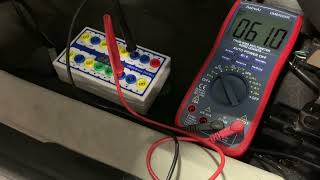
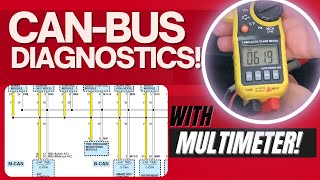
With the battery disconnected, measure resistance between Pin 6 (CAN High) and Pin 14 (CAN Low) at the OBD-II port. A healthy network reads 60 Ohms. A reading of 120 Ohms indicates an open circuit or a missing terminating resistor inside a failed module.
Tools: Digital Multimeter (Advanced) - Pro Tip: Test CAN Bus Voltage at the OBD-II Port
With the ignition on (engine off), measure DC voltage. Pin 6 (CAN High) should be 2.6-2.7 volts, and Pin 14 (CAN Low) should be 2.3-2.4 volts. If both lines are stuck at 0V, 2.5V, or battery voltage, the network has a short circuit.
Tools: Digital Multimeter (Advanced) - Isolate the Faulty Module
If CAN bus resistance is 120 Ohms, disconnect modules one by one. When the resistance returns to 60 Ohms at the OBD-II port, you have isolated the faulty module or wiring branch.
Tools: Digital Multimeter, Trim removal tools, Vehicle-specific wiring diagrams (Advanced)
When This Code Triggers (Freeze-Frame Conditions)
- Vehicle Speed: 0 mph (During startup or immediately after)
- Battery Voltage: 10.5-11.8V (Low voltage during engine crank)
- Engine State: Off / Cranking (Fault occurs during the module initialization sequence)
- Module Status: No Communication (One module fails to report its status to the gateway)
Related Codes
- U0140 — Lost Communication With Body Control Module. If other modules store U0140, the BCM is the primary suspect. A failing BCM causes other modules to flag a U1818 code. Diagnose U0140 first.
- U0100 — Lost Communication With ECM/PCM 'A'. This is a severe fault indicating the main engine computer is offline, usually causing a no-start. If U0100 is present, ECM power and grounds are the primary focus.
- U0184 — Lost Communication With Radio. This directly points to the radio module being offline. On GM vehicles, U0184 and U1818 appear together and share the same root cause: a failed radio or software glitch.
- B124D — On GM vehicles, this indicates an Audio Control Module internal fault, directly pointing to a failed radio. On Ford F-150s, TSB 23-2218 links B124D to Radio Frequency Interference disrupting network communications.
Climate & Environmental Factors
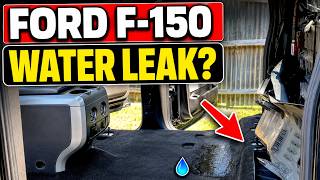
- High Humidity / Water Intrusion: On the 2015-2020 Ford F-150, water leaks into the cabin through poorly sealed windshields or clogged A/C drains. This water drips directly onto the BCM, causing corrosion and internal short circuits that trigger a U1818 code.
- Extreme Cold: Low temperatures reduce a battery's cranking power. During cold startups, voltage drops low enough to cause electronic modules to fail their initialization sequence, triggering transient U-codes.
How to Talk to a Mechanic About This Code
Say this: "I have a U1818 communication code and my radio/infotainment screen is not working. I checked the related fuses and the battery is strong. I need a diagnostic appointment to trace the network failure. Please scan all modules for related 'U' codes and check for relevant TSBs before recommending a module replacement."
This shows you understand it is a network issue, not a simple part failure. It directs the technician toward a logical diagnostic process (checking TSBs, scanning all modules) and prevents unnecessary parts swapping.
Avoid saying:
- 'My radio is broken, can you fix it?'
- 'My check engine light is on, can you look at it?'
- 'Just do whatever it takes to fix it.'
Questions to ask before authorizing the repair:
- Did you find any other communication codes in other modules, like the BCM or SDGM?
- How did you confirm this specific module failed? Did you test its power, ground, and communication lines?
- Does the new module require programming to my vehicle's VIN, and is that cost included in the estimate?
- What is the warranty on both the replacement part and the labor?
Where to Take It: Dealer vs Independent vs Chain
- Dealer:
Strongly Recommended. The dealer has direct access to the required software updates and programming tools necessary to fix a U1818 code correctly.
Best for: Vehicles under warranty., Known issues covered by a Technical Service Bulletin (TSB) requiring a specific software update., Complex module replacements (like a BCM) requiring manufacturer-specific programming tools.
Downsides: Highest labor rates., May default to replacing a module when a wiring repair suffices. (Typical cost: +50% vs. baseline) - Independent Shop:
Recommended, with caution. Choose a top-rated shop highlighting electrical expertise. Ask if they have a J2534 pass-thru device for module programming.
Best for: Out-of-warranty vehicles where the cause is a common failure (e.g., failed radio on a GM truck)., Shops specializing in automotive electronics.
Downsides: May lack the latest manufacturer-specific programming tools., Success depends entirely on the technician's skill with electrical diagnostics. (Typical cost: +0% vs. baseline) - Chain Shop:
NOT Recommended. This fault is outside the scope of chain shops. They will likely misdiagnose the issue or refer you to the dealer after charging a fee.
Best for: Simple maintenance like oil changes, tires, and brakes.
Downsides: Not equipped for complex network or electrical diagnostics., High risk of misdiagnosis and unnecessary parts replacement., Technicians are not trained for advanced module programming. (Typical cost: -10% vs. baseline)
When to Walk Away From the Repair
If the total estimated repair cost exceeds 50% of your car's private-party market value, consider not fixing it. Get a firm diagnostic quote first, as a U1818 is either a $5 fuse or a $1,500 module.
- Car worth $4000, fix is $2000: Walk Away. The repair cost is 50% of the vehicle's value, making it a poor financial decision.
- Car worth $15000, fix is $1200: Fix It. The repair cost is 8% of the car's value, a reasonable investment to restore full functionality.
- Car worth $3000, fix is $450: Borderline - Fix It. At 15% of the vehicle's value, the repair is worthwhile if the car is otherwise in good condition.
What Scan Tool You Need for This Code
Minimum: A scanner that reads codes from ALL vehicle modules (ECM, BCM, ABS, Radio), known as an 'All-System' scanner.
A basic code reader only communicates with the Engine Control Module. U1818 is a network problem, and critical clues are stored in other modules. A basic reader leaves you blind to the real issue.
Budget: BlueDriver Pro (~$99) — Connects to your smartphone and performs a full system scan on popular makes, allowing you to see codes from the BCM and radio.
Mid-range: Autel MaxiCOM MK808S (~$180-350) — Provides full system diagnostics, access to live data from all modules, and limited bidirectional controls to test components.
Professional: XTOOL D8S (~$500-700) — Offers robust bidirectional controls and network topology mapping. Visually shows which modules are online, dramatically speeding up diagnosis.
Rent vs buy: Buy. Free 'loan-a-tool' scanners from auto parts stores are basic readers that only check the engine. They cannot read the BCM or other modules needed to diagnose U1818.
How to Clear the Code After You Fix It
- Fix the underlying cause (replace fuse, repair wiring, replace module).
- Reconnect the battery if disconnected for the repair.
- Use a full-system OBD-II scan tool to clear the DTCs from all modules.
- Perform a complete drive cycle to allow the vehicle's readiness monitors to run.
Drive cycle (~30 minutes): A generic drive cycle includes a cold start, 2-3 minutes of idling, followed by a mix of city driving and 10-15 minutes of steady highway driving at 55 mph.
Readiness monitors affected: Clearing any 'U' code resets all emissions readiness monitors to 'Not Ready' status.
Before emissions retest: drive at least 50 miles to fully set monitors.
Watch out for:
- Disconnecting the battery clears the code temporarily, but it returns immediately if the fault exists.
- Taking the vehicle for an emissions test before the readiness monitors set to 'Ready' results in an automatic failure.
Will This Fail Emissions / State Inspection?
Yes — this code typically fails an OBD-II emissions inspection.
- California: An illuminated Check Engine Light is an automatic failure. After clearing the code, readiness monitors must be set to 'Ready' before a retest.
- New York: An illuminated Malfunction Indicator Lamp (MIL) causes the vehicle to fail. For 2001 and newer vehicles, only one readiness monitor is allowed to be 'Not Ready'.
- Texas: In the 17 counties requiring emissions testing, an illuminated Check Engine Light is an automatic failure.
Most Commonly Affected Vehicles
- Chevrolet Silverado 1500/2500/3500 (2014-2019) — Extremely common for the Audio Control Module to fail or suffer a software glitch, causing a blank screen and setting a U1818 code. GM issued recalls #15808 and #17130 to reprogram the radio for loss of safety chimes.
- GMC Sierra 1500/2500/3500 (2014-2019) — Shares the same platform and failure-prone Audio Control Module as the Chevrolet Silverado. Symptoms and fixes are identical.
- Cadillac Escalade (2015-2020) — Prone to communication issues involving the HMI (Human Machine Interface) module and the radio module, mirroring the Silverado/Sierra issues.
- Ford F-150 (2015-2020) — Experiences network communication failures due to a failing Body Control Module (BCM), damaged by water intrusion from a poorly sealed windshield or a clogged A/C drain tube (TSB 20-2170).
- Ford Focus / Fusion (2012-2018) — The Audio Control Module (ACM) is a known weak point, leading to radio failure, battery drain, and communication codes.
- Subaru Outback / Legacy (2015-2019) — Communication faults arise from various systems. TSB 06-87-22R addresses a faulty electronic parking brake connector that causes network codes.
- Kia Sorento / Optima (2016-2018) — Network codes trigger from failing components, such as a backup camera shorting out the CAN bus.
- Honda Accord / Odyssey (2018-2022) — A cascade of warning lights and communication codes triggers from a single failing component, such as a wheel speed sensor disrupting the CAN network.
Manufacturer-Specific Notes
- General Motors (GM): On 2014-2019 trucks and SUVs, U1818 is almost always caused by the failure of the main radio module or a software lock-up. Attempt a 'hard reset' or a dealer software update (TSB #16-NA-115) before replacing the radio.
- Ford: On F-150s, a cascade of U-codes triggers from water intrusion into the BCM located in the passenger-side kick panel. Inspect this area for moisture before condemning the module.
- Jeep: This code triggers after using aftermarket electronic devices that plug into the OBD-II port, such as performance tuners. The issue requires a full vehicle reset and multiple sleep cycles to resolve.
- Cadillac: While most GM vehicles use U1818 for network communication loss, older Cadillac service information defines U1818 as a fault with a 'Brake Booster Pressure Sensor Short Circuit to Ground'. Use a scanner that reads manufacturer-specific definitions.
Real Owner Stories
2016 Ford F-150 at 65K miles with intermittent chaos
Truck experienced bizarre electrical issues: random 'Service Electrical System' warnings, alarm triggering, hazards flashing, and door locks spasming. Eventually, the truck shut off while driving.
Outcome: The owner identified a water leak at the bottom passenger-side corner of the windshield dripping onto the BCM. Replacing the BCM and cloning the data resolved all problems. Total cost was $750.
Lesson: On Ford F-150s, bizarre electrical behavior is often caused by a water-damaged BCM. Check the passenger footwell for moisture before replacing parts. Fixing the water leak is mandatory.
Jeep Wrangler with aftermarket tuner
After updating firmware on an aftermarket OBD-II tuning device, the check engine light illuminated with multiple communication codes, including U1818 and U0100.
Outcome: After several normal short drives and 3-4 engine restarts, the vehicle's system reset itself. The check engine light turned off, and the codes cleared without further intervention.
Lesson: Aftermarket OBD-II devices cause software conflicts triggering communication codes. The fix involves a specific software reset procedure and multiple vehicle sleep/wake cycles.
2015 Chevy Silverado with dead radio
The infotainment screen went black, the radio stopped working, and the U1818 code appeared. The owner lost all audio, including safety chimes.
Outcome: The owner found a secondary fuse box inside the driver's side dash. The 15A radio fuse looked fine visually but failed a continuity test. Replacing the $2 fuse instantly restored all functions and cleared the code.
Lesson: Always start with the simplest fixes. A module that is 'offline' is often just without power. Check all related fuses with a multimeter before assuming a complex module failure.
How to Prevent This Code From Triggering
- Periodically clean and protect key electrical connectors (Every 2-3 years or during other repairs) — Applying dielectric grease to BCM or radio connectors prevents moisture intrusion and corrosion, which are primary causes of communication failures.
- Check for and clear cowl and drain plug blockages (Annually, especially before rainy seasons) — On vehicles like the Ford F-150, debris clogs cowl and A/C drains, causing water to leak directly onto the BCM. Keeping drains clear prevents water damage.
- Use a battery tender for stored or infrequently driven vehicles (Whenever the vehicle sits for more than 2-3 weeks) — Maintains stable battery voltage, preventing modules from dropping offline due to low voltage during startup.
- Be cautious with aftermarket plug-in devices (Ongoing) — Poorly made USB chargers or OBD-II tuners introduce electrical noise that disrupts CAN bus communication. Remove them first if electrical gremlins appear.
Frequently Asked Questions
Can a bad battery cause code U1818?
Yes, absolutely. A weak battery provides unstable voltage, causing electronic control modules to drop offline and set a U1818 code. Always test the battery before starting complex diagnostics.
What is the first thing to check for a U1818 code?
Inspect the fuses for the radio, amplifier, and BCM. A blown fuse is the most common and inexpensive cause for a module to go offline.
Can aftermarket accessories cause a U1818 code?
Yes. Low-quality electronic devices, especially those plugging into the 12V outlet or OBD-II port, generate electromagnetic interference. This noise disrupts the CAN bus network, triggering U1818 even if no module has failed.
What are common misdiagnosis mistakes when diagnosing U1818?
A frequent mistake is immediately replacing the 'lost' module without proper diagnosis. The actual cause is often a blown fuse, a bad ground, or a software glitch requiring a dealer update. Always check for Technical Service Bulletins (TSBs) first.
Will replacing my radio fix the U1818 code?
If the code stems from a failed Audio Control Module (common in 2014-2019 GM trucks), replacing the radio fixes the problem. However, proper diagnosis is required to rule out wiring, power, or ground issues before buying parts.
How much does it cost to fix code U1818?
Costs range from $5 for a replacement fuse to $125-$250 for a dealer software update. Major component replacements, like a Body Control Module or radio, cost between $450 and $1,300 including parts and programming.
Can I just clear the code and keep driving?
You can clear the code with a scanner, but it will return immediately if the underlying fault persists. The communication error must be physically repaired or updated for the code to stay cleared.
What is a CAN bus?
The Controller Area Network (CAN) bus is the internal communication network allowing your car's computers to talk to each other. Code U1818 indicates a broken connection or missing message on this specific network.
Key Takeaways
- Code U1818 indicates a communication failure on the CAN bus network, most frequently pointing to an offline Audio Control Module (radio).
- Expect an immediate loss of infotainment functions and audible safety warnings, such as the seatbelt chime or turn signal clicks.
- Test the 12V battery and inspect the dedicated radio/BCM fuses before replacing any expensive electronic modules.
- On 2014-2019 GM trucks and SUVs, a U1818 code almost guarantees a failed radio module requiring a $125-$250 dealer software update or a $450+ hardware replacement.
Helpful Videos
Shop the Parts Behind U1818
Below are the parts most often responsible for code U1818, ranked by how frequently each one is the actual culprit (per the diagnosis above). Tap any to see what we have for your vehicle.


The information in this article is provided for general reference and educational purposes only. Vehicle specifications, procedures, and part compatibility can vary by production date, trim level, and region. Always consult your vehicle's factory service manual and verify part numbers before purchasing or performing repairs. Safety-critical components such as airbags, seat belts, and braking systems should be installed by a qualified professional.
- 🧭 Diagnostic Flowchart
- 🎬 Helpful Videos
- 🛍️ Shop This Part
- What Does U1818 Mean?
- Can I Drive With U1818?
- Common Causes
- Symptoms
- Common Fixes & Costs
- DIY vs Professional
- Used vs. New Parts: Buying Guide
- What Happens If You Wait — Timeline
- Cost of Not Fixing It
- Diagnosis Steps
- When This Code Triggers (Freeze-Frame Conditions)
- Related Codes
- Climate & Environmental Factors
- How to Talk to a Mechanic About This Code
- Where to Take It: Dealer vs Independent vs Chain
- When to Walk Away From the Repair
- What Scan Tool You Need for This Code
- How to Clear the Code After You Fix It
- Will This Fail Emissions / State Inspection?
- Most Commonly Affected Vehicles
- Manufacturer-Specific Notes
- Real Owner Stories
- 2016 Ford F-150 at 65K miles with intermittent chaos
- Jeep Wrangler with aftermarket tuner
- 2015 Chevy Silverado with dead radio
- How to Prevent This Code From Triggering
- Frequently Asked Questions
- Can a bad battery cause code U1818?
- What is the first thing to check for a U1818 code?
- Can aftermarket accessories cause a U1818 code?
- What are common misdiagnosis mistakes when diagnosing U1818?
- Will replacing my radio fix the U1818 code?
- How much does it cost to fix code U1818?
- Can I just clear the code and keep driving?
- What is a CAN bus?
- Key Takeaways
- 🎟️ Get 5% Off