

U2106 on 2008-2014 Cadillac CTS: Fixing Lost Communication with the TCM
This code almost always points to a poor connection at the main transmission wiring harness connector (X1). Inspecting and securing the pins in this connector is the most common fix and should be your first step. A faulty Transmission Control Module (TCM) is a less likely cause.
- U2106 on your CTS means the Transmission Control Module (TCM) has stopped communicating on the vehicle's network.
- Before suspecting expensive parts, follow GM's own advice (TSB #PIC4740E) and check the main wiring connector at the transmission for loose pins.
- This is not a code to ignore; the vehicle's transmission may behave unpredictably, making it unsafe to drive.
- A visual inspection and 'tug test' on the wires at the transmission connector solves this problem in a majority of cases.
- If you replace the TCM, it will require professional programming to work with your vehicle.
What's Unique About the 2008-2014 Cadillac CTS
For this specific generation of the Cadillac CTS, General Motors issued a Technical Service Bulletin (TSB #PIC4740E, later superseded) that identifies a common cause for this code: unseated or poorly fitting terminal pins within the main transmission wiring harness connector, known as X1. This makes a faulty connector a much higher probability than a failed TCM, which might be the primary suspect on other vehicles. The fix often involves securing the connection rather than replacing expensive modules. The TSB also notes that on the CTS and ATS, the harness should be inspected for chafing at a securing bracket on the passenger side of the bell housing.
Diagnostic Flowchart
Tap your situation to follow the diagnostic path that matches what you're seeing on this vehicle.
Symptoms You May Notice
- Check Engine Light is on
- Transmission may be stuck in one gear (limp mode)
- Harsh or erratic shifting
- Inability to shift out of Park
- Service Stabilitrak or Traction Control warning lights may illuminate
- Scan tool may be unable to communicate with the TCM
- Vehicle may not crank or start
- Door locks may cycle intermittently while driving
- Replacing the Transmission Control Module (TCM) without first inspecting the X1 connector and wiring. The TSB clearly indicates the connector is the most likely culprit.
Most Likely Causes
- Loose or Unseated Pins in Transmission Connector (X1) 🔴 High Probability → Shop Transmission Assembly As identified in GM Technical Service Bulletin #PIC4740E and its successors, the pins in the main transmission harness connector can become loose or have a poor fit, leading to intermittent communication loss. The TSB warns that a side load on the wires during inspection can give a false positive that the pin is locked in.
How to confirm: With the vehicle safely raised, disconnect the large X1 connector on the side of the transmission. Visually inspect for corrosion or damage. Gently tug on each individual wire leading into the connector to ensure it is fully seated and locked in place.
Typical fix: Reseat any loose pins. If the connector housing or terminals are damaged, they may need to be repaired or replaced. Dielectric grease can be applied to the connector seal before reconnecting to prevent moisture intrusion.
Est. part cost: $0-$50 - Damaged Wiring Harness 🟡 Medium Probability The wiring harness to the transmission runs underneath the vehicle and is exposed to heat, vibration, and potential road debris. The TSB specifically calls out an inspection for harness chafing at the securing bracket on the passenger side of the transmission bell housing for the CTS.
How to confirm: Visually inspect the wiring harness leading to the transmission for any signs of physical damage, chafing (especially where it's secured by brackets), or melting from contact with the exhaust. Pay close attention to the bell housing bracket area.
Typical fix: Repair the damaged section of wire. This may involve soldering, using quality butt connectors with heat shrink, and properly securing the harness away from heat sources or sharp edges.
Est. part cost: $5-$25 - Faulty Transmission Control Module (TCM) ⚪ Low Probability → Shop Transmission Assembly
How to confirm: This is diagnosed by exclusion. If the wiring, connector, power, and grounds to the TCM are all confirmed to be good, but communication is still not possible, the TCM itself is likely faulty. This requires a professional-level scan tool to confirm.
Typical fix: Replace the Transmission Control Module. The new module will require programming to the vehicle's VIN.
Est. part cost: $200-$600
Rare But Worth Checking
- Poor Power or Ground to TCM: The TCM needs a stable voltage supply and a solid ground connection to function. A corroded ground point or a problem with the power supply fuse/relay can cause communication to drop out. Forum users have reported melted ground eyelets causing widespread electrical issues.
- Low Battery Voltage: Control modules are sensitive to system voltage. A weak or failing battery can cause a variety of unpredictable communication errors, including U2106.
Diagnosis Steps
- Check for other stored DTCs. Multiple 'U' codes can point to a widespread network issue, as listed in TSB PIC4740E and its successors.
- Safely raise and support the vehicle on jack stands.
- Locate the main transmission wiring harness connector (X1) on the side of the transmission.
- Disconnect the X1 connector. Inspect for any bent pins, corrosion, or moisture.
- Carefully and gently tug on each individual wire going into the back of the connector. A loose wire will pull out or feel insecure, indicating an unseated terminal. The TSB warns that a side load can create a false positive lock.
- Inspect the wiring harness leading to the connector, paying special attention to the securing bracket on the passenger side of the bell housing for any signs of chafing, melting, or physical damage.
- If the connector and wiring appear perfect, the next step is to use a multimeter to verify battery power and a solid ground connection at the TCM connector pins, which requires a wiring diagram.
- If all else fails, the issue may be an internal fault within the Transmission Control Module (TCM), which would need to be replaced and programmed.
Parts You'll Likely Need
- Transmission Connector Terminals or Pigtail
(OEM #ACDelco PT2106 (multi-purpose, verify fitment))— If pins are found to be loose or damaged during the TSB inspection, the individual terminals or the entire connector pigtail may need to be replaced to ensure a secure connection.
Trusted brands: ACDelco, Dorman
OEM price range: $20-$80
Aftermarket price range: $15-$50 - Transmission Control Module (TCM)
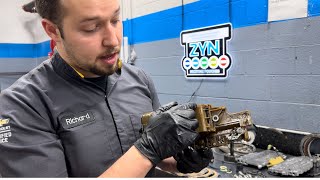
(OEM #88988938 (verify by VIN))— This is a last resort replacement if all wiring and connectors are verified to be in good condition. The module itself has failed internally. 🎬 Watch: Why a mechanic replaces the TCM during transmission rebuilds.
Trusted brands: ACDelco
OEM price range: $400-$600
Aftermarket price range: $200-$450
Related Codes That Often Appear With This One
- P0700 — P0700 is a generic code indicating the TCM has requested the Check Engine Light to be turned on. It's a common companion to any transmission-specific fault code and is listed in the TSB.
- U0100 — This code indicates a lost communication with the ECM. It can appear with U2106 if the network disruption is severe, affecting multiple modules.
- U0121 — Lost Communication with ABS Control Module. The transmission relies on wheel speed data from the ABS module, so a network fault can trigger multiple 'U' codes.
- U0140 — Lost Communication with Body Control Module. The BCM is often a central gateway for communication networks in the vehicle and is listed in the associated TSB.
Technical Service Bulletins (TSBs) & Recalls
- PIC4740E: Addresses multiple communication DTCs, including U2106, and directs technicians to inspect the transmission X1 connector for loose or poorly fitting terminals. This TSB has been superseded but the information is still relevant.
- 08-07-30-021H: A successor TSB that expands on communication issues, including the U-codes, and points to the transmission harness connector as a primary inspection point across a wide range of GM trucks and cars.
Platform-Specific Known Issues
- A known issue, documented in GM TSB #PIC4740E (and successors), points to unseated pins in the transmission X1 connector as a primary cause for this code and other related communication DTCs.
- For the CTS and ATS specifically, the TSB directs technicians to also inspect the wiring harness for chafing where it is secured by a bracket on the passenger side of the transmission bell housing.
Mechanic-Grade Diagnostic Values
- CAN Bus Network Resistance — expected: ~60 Ohms. Failure: A reading of ~120 Ohms indicates a missing termination resistor or an open circuit in one of the CAN lines. A reading significantly less than 60 Ohms (e.g., 40 Ohms or 0 Ohms) suggests an extra termination resistor or a short between the CAN lines.
- CAN Bus Voltage (Key On, Engine Off) — expected: CAN High (CAN-H): ~2.5-3.5V. CAN Low (CAN-L): ~1.5-2.5V. Both voltages should be steady and mirror each other.. Failure: A line at 0V suggests a short to ground. A line stuck at a higher voltage (e.g., 4-5V) could indicate a faulty driver in a control module. If CAN-L voltage is higher than CAN-H, the wires may be reversed.
Scan Tool Commands That Help
- GDS2 / Tech2: Service Programming System (SPS) — This function is required to program a new Transmission Control Module (TCM) to the vehicle after replacement. The new module will not function correctly without being programmed with the vehicle's specific VIN and software calibration.
- GDS2 / Tech2: Service Fast Learn Adapts — After programming a new TCM, this procedure must be performed to allow the module to learn the specific characteristics and hydraulic values of the transmission solenoids and clutches for smooth shifting.
Wiring & Ground Locations
- TCM (TEHCM) — For the 2008-2014 CTS with 6-speed automatic transmissions (like the 6L45, 6L50, 6L80, 6L90), the Transmission Control Module is an internal component called a TEHCM (Transmission Electro-Hydraulic Control Module). It is located inside the transmission, mounted on the valve body, and is accessed by removing the transmission side cover or pan.. Knowing the TCM is internal is critical. Unlike an external module, checking its connections requires draining transmission fluid and removing the pan/cover, making it a more involved diagnostic step. This reinforces why checking the external X1 connector first is paramount.
- G101 (example, varies by exact year/engine) — Typically located at the front of the engine on the lower block. Wiring diagrams show this ground is shared by the Engine Control Module and the Transmission Control Module.. A loose or corroded G101 can cause a voltage drop or loss of ground reference for both the ECM and TCM, directly leading to communication codes like U2106. It's a critical point to check if wiring harness issues are suspected.
- Transmission Bell Housing Bracket — On the passenger side of the vehicle, where the transmission bell housing attaches to the engine block.. TSB PIC4740E and its successors specifically identify this bracket as a potential chafe point for the wiring harness on the CTS. Engine movement can cause the harness to rub against this bracket, eventually wearing through the insulation and causing shorts on the CAN bus wires.
Real Owner Repair Stories
- YouTube video on a 2015 Chevrolet Captiva with a similar 6T-series transmission and codes (2015 Chevrolet Captiva Sport 2.4L (with 6T45 transmission, which shares architecture with the CTS's 6L series)) — Intermittent loss of power, slamming into gear, multiple dash warning lights (Service Stabilitrak), and the gear selection indicator (PRNDL) disappearing. Codes U0101 and U2106 were present.
❌ Tried (didn't work) The owner initially suspected a faulty TCM was needed.
✅ What actually fixed it The problem was intermittent and occurred when system voltage dropped (e.g., when the radiator fan turned on). The fix was to thoroughly clean the pins on both sides of the main transmission harness connector. The owner used a toothbrush head with electrical cleaner on the male pins inside the transmission housing to remove unseen residue or oxidation that was causing high resistance.
Model Year Variations Within This Range
- 2008-2011 (with 3.6L LLT engine): Early second-generation CTS models with the 3.6L LLT V6 engine were known to have issues with premature timing chain stretching. While not a direct cause of U2106, major engine work to replace timing chains could potentially disturb the nearby engine and transmission wiring harnesses, leading to communication issues if not re-secured properly. A Reddit user noted that models from 2011 and later had improvements in this area.
- 2008-2014: Throughout this generation, the CTS was available with different transmissions depending on the engine and drivetrain (RWD/AWD), including the 6L45, 6L50, 6L80, and 6L90. While the diagnostic principle of checking the X1 connector and harness remains the same, the exact routing of the harness and the location of the side cover for accessing the internal TCM (TEHCM) may vary slightly between these different transmission models.
Helpful Videos
We Have This Part in Stock

The information in this article is provided for general reference and educational purposes only. Vehicle specifications, procedures, and part compatibility can vary by production date, trim level, and region. Always consult your vehicle's factory service manual and verify part numbers before purchasing or performing repairs. Safety-critical components such as airbags, seat belts, and braking systems should be installed by a qualified professional.
- Cadillac CTS:
- 🧭 Diagnostic Flowchart
- 🎬 Helpful Videos
- 🛍️ Shop This Part
- What's Unique About the 2008-2014 Cadillac CTS
- Symptoms You May Notice
- Most Likely Causes
- Rare But Worth Checking
- Diagnosis Steps
- Parts You'll Likely Need
- Related Codes That Often Appear With This One
- Technical Service Bulletins (TSBs) & Recalls
- Platform-Specific Known Issues
- Mechanic-Grade Diagnostic Values
- Scan Tool Commands That Help
- Wiring & Ground Locations
- Real Owner Repair Stories
- Model Year Variations Within This Range
- 🎟️ Get 5% Off