

U2300 on 2017-2018 Lincoln MKZ: Airbag Light and RCM Configuration Fault Guide
On a 2017-2018 Lincoln MKZ, code U2300 almost always means the Restraints Control Module (RCM) has a software glitch that turns on the airbag light. This is a known issue documented in Lincoln's Technical Service Bulletins (TSBs). The fix is not a part replacement but a software reprogram performed by a dealer or qualified shop using Ford's IDS software.
- U2300 on a 2017-2018 Lincoln MKZ is a known software issue with the airbag computer (RCM), not a faulty part.
- The primary symptom is an illuminated airbag warning light, which means the safety system may be disabled.
- Do not replace any parts. The fix is a software reprogram that must be done by a dealer or a shop with Ford/Lincoln diagnostic tools, as outlined in TSBs SSM 46901 and SSM 46109.
- This is a safety-critical fault that should be addressed immediately.
- The Ford Fusion from the same years shares this exact problem and fix.
What's Unique About the 2017-2018 Lincoln MKZ
For this specific generation of Lincoln MKZ and its Ford Fusion counterpart, the U2300 code is a well-documented issue. Lincoln acknowledged a software glitch in the Restraints Control Module (RCM) through Technical Service Bulletins. This makes the problem less of a mystery; it's a known software bug with a specific fix, rather than a random hardware failure that requires extensive guesswork. The TSBs apply to a specific range of vehicles, making diagnosis highly probable if the symptoms and vehicle build date match.
Diagnostic Flowchart
Tap your situation to follow the diagnostic path that matches what you're seeing on this vehicle.
Symptoms You May Notice
- Airbag warning light is continuously illuminated on the dashboard.
- A warning message like 'Airbag Not Operational' may appear in the instrument cluster.
- On some vehicles, a 'SYNC 911 assist not operational' message may also be displayed, as this feature is tied to the RCM.
- Replacing airbag sensors
- Replacing the clockspring
- Replacing the Occupant Classification Sensor (OCS)
Most Likely Causes
- Restraints Control Module (RCM) Software Glitch 🔴 High Probability → Shop Air Bag Lincoln issued TSBs #SSM 46901 and #SSM 46109 specifically for this issue on 2017-2018 MKZ and Fusion models, indicating a known software problem. TSB 46109 applies to vehicles built on or before August 18, 2016, while TSB 46901 applies to vehicles built on or before October 27, 2017.
How to confirm: A technician can use a Ford/Lincoln compatible scan tool (like IDS) to check if the vehicle's build date and stored codes (U2300, U3000, U2100, etc.) match the criteria in the TSBs.
Typical fix: Reprogramming the RCM to the latest software version using IDS release 102.03 or higher (for TSB 46109) or 107.04 or higher (for TSB 46901). This is a dealer or specialty shop procedure.
Est. part cost: $0 - Improper Module Replacement/Configuration ⚪ Low Probability This is not specific to the vehicle but is a universal issue with modern module replacement. After a collision repair, if the RCM is replaced, it must be configured.
How to confirm: This is likely if the code appeared immediately after the RCM, BCM, or another major electronic module was replaced. A new RCM will always store a U2300:55 (Not Configured) code until it is programmed with the vehicle's 'as-built' data.
Typical fix: Performing the correct Programmable Module Installation (PMI) procedure using a diagnostic tool like Ford IDS or FORScan to configure the module with the vehicle's specific 'as-built' data.
Est. part cost: $0
Rare But Worth Checking
- Failing Restraints Control Module (RCM): → Shop Air Bag While software is the most common culprit, the module itself can fail internally. This is usually suspected only after a software reprogram fails to resolve the code. A replacement module for a 2017-2018 MKZ is part number HP5Z-14B321-A (or a superseding number like HP5Z-14B321-E).
- Weak or Failing Vehicle Battery: Low system voltage during startup can cause communication and configuration errors between modules, sometimes triggering faults like U2300. It's a simple and important check before proceeding to more complex diagnostics.
- CAN Bus Network Communication Error: Since the RCM receives its configuration from the Body Control Module (BCM) over the vehicle's network, a wiring or communication issue between them could theoretically cause this code. This is uncommon compared to the TSB-documented software issue.
Diagnosis Steps
- Scan the vehicle with a professional-grade scan tool capable of reading manufacturer-specific codes from all modules, especially the RCM. Advanced DIYers may use FORScan with a compatible adapter for diagnostics.
- Confirm the presence of U2300 and note any other codes stored, particularly the long list of codes included in TSBs SSM 46901 and SSM 46109.
- Check the vehicle's 12V battery health and system voltage. A weak battery can cause various electronic issues and should be ruled out first.
- Check the vehicle's build date. If it is a 2017 model built on or before Aug 18, 2016, TSB 46109 applies. If it is a 2017-2018 model built on or before Oct 27, 2017, TSB 46901 applies.
- If the codes and vehicle build date align with the TSBs, the primary diagnosis is a software issue requiring an RCM reprogram.
- Connect the vehicle to the Ford Integrated Diagnostic System (IDS) or equivalent J2534 tool to check the RCM's current software level.
- If an update is available, perform the RCM reprogram procedure as directed by the TSB. This must be done by a professional, as an error can damage the module.
- After reprogramming, perform an 'as-built' configuration of the RCM as instructed by the TSB.
- Clear all Diagnostic Trouble Codes (DTCs), cycle the ignition, and re-scan to ensure the code does not return.
- If the code persists after reprogramming, further diagnosis of the RCM hardware and CAN bus wiring between the RCM and BCM is necessary.
Parts You'll Likely Need
- Restraints Control Module (RCM) Reprogramming — This is not a physical part, but a software service. It is the most common and manufacturer-recommended fix for the known glitch causing code U2300 on this vehicle, as per TSBs 46901 and 46109.
Trusted brands: Ford/Lincoln Dealer Service
OEM price range: $150-$300 - Restraints Control Module (RCM)
(OEM #HP5Z-14B321-A (superseded by HP5Z-14B321-E))— This part is only needed in the rare event that reprogramming fails, indicating a hardware failure within the module itself. It will require programming upon installation.
Trusted brands: Motorcraft
OEM price range: $480-$650
Aftermarket price range: $200-$400
Related Codes That Often Appear With This One
- U3000 — A general 'Control Module' fault code often listed with U2300 in TSBs SSM 46901 and SSM 46109 for RCM issues.
- U2100 — Means 'Initial Configuration Not Complete' and is often seen with U2300, especially if a module has been replaced or has a software fault.
- U2101 — Means 'Control Module Configuration Incompatible', directly related to the U2300 fault and listed in the same TSBs.
- U0452 — Indicates 'Invalid Data Received From Restraints Control Module', another code mentioned in the TSBs pointing to the RCM as the source of the problem.
Technical Service Bulletins (TSBs) & Recalls
- SSM 46901: For 2017-2018 models built on or before 27-Oct-2017, advises reprogramming the RCM using IDS/FJDS 🎬 Watch: A professional guide to flashing a Ford RCM. 107.04 or higher if U2300 and other related codes are present with an airbag light.
- SSM 46109: For 2017 models built on or before 18-Aug-2016, also advises reprogramming the RCM using IDS 102.03 or higher for U2300 and a list of associated airbag system codes.
Platform-Specific Known Issues
- Lincoln has issued Technical Service Bulletins #SSM 46901 and #SSM 46109 for the 2017-2018 Lincoln MKZ and its platform-mate, the Ford Fusion. These bulletins directly address an issue where the airbag lamp may be on and DTCs like U2300, U3000, and U2100 are stored in the RCM. The official fix is to reprogram the RCM to the latest software level, not to replace any hardware.
Mechanic-Grade Diagnostic Values
- RCM Fastener Torque — expected: 12 Nm (9 lb-ft). Failure: N/A - This is an installation specification.
- CAN Bus Resistance at RCM Connector — expected: Approximately 60-120 Ohms. Failure: Significantly higher or lower resistance can indicate a wiring problem or a faulty module on the network.
Hidden / Shadow Codes Worth Checking
- U2300:55: Central Configuration: Not Configured. This is the default state of a new RCM before it receives configuration data from the BCM. (see via Ford IDS, FORScan, or other professional scan tools capable of reading manufacturer-specific DTCs with suffixes.)
- U2300:56: Central Configuration: Invalid/Incompatible Data. The module has received configuration data, but it is incorrect or not compatible with the module's hardware/software. (see via Ford IDS, FORScan, or other professional scan tools capable of reading manufacturer-specific DTCs with suffixes.)
- U2300:64: Central Configuration: Signal Plausibility Failure. The RCM received configuration data that does not match the data it had previously stored from the first ignition cycle after installation. (see via Ford IDS, FORScan, or other professional scan tools capable of reading manufacturer-specific DTCs with suffixes.)
Scan Tool Commands That Help
- Ford IDS/FDRS: Programmable Module Installation (PMI) — This function is required when installing a new RCM. It automatically retrieves the vehicle's 'as-built' data from the old module (if available) or from Ford's servers and writes it to the new module to ensure it is configured correctly for the specific vehicle.
- Ford IDS/FDRS: Module Reprogramming — This is the specific function used to execute the fix described in TSBs 46901 and 46109. It updates the internal software (calibration) of the existing RCM to a newer version that corrects the glitch causing the U2300 code.
- FORScan: Module Configuration (As-Built format) — For advanced DIYers, FORScan can be used to manually write 'as-built' data to a new or existing RCM. This can be a workaround if the official IDS/FDRS programming fails, or for retrofitting modules. It requires obtaining the correct data for the vehicle's VIN.
Wiring & Ground Locations
- Restraints Control Module (RCM) — Under the center console, between the front seats, bolted to the floor pan. Access requires removing side trim panels and potentially the entire center console assembly.. This is the location of the module itself. Physical access is required for replacement. Damage to the module or its connector from liquid spills into the console could be a rare cause of this code.
- RCM Fuses — In the Body Control Module (BCM)/Junction Box, typically located under the instrument panel to the left of the steering column. For the 2017 MKZ, these are listed as fuses 14 (10A) and 35 (5A).. Loss of power to the RCM would cause a loss of function and could potentially set communication DTCs. These fuses are part of the official SRS depowering procedure.
- Chassis Ground Points — Factory ground points are typically metal studs or bolts attached to the vehicle's bare metal frame. Common locations are in the driver/passenger kick panel areas or behind dash panels.. A poor ground connection for the RCM could cause intermittent or persistent communication and configuration faults. Verifying the RCM's ground integrity is a valid diagnostic step if software fixes fail.
Real Owner Repair Stories
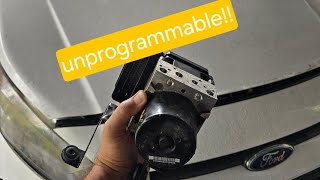
- YouTube user 'G Auto Repair' (2015 Ford Transit Connect (different model, but same Ford U2300 code behavior)) — After replacing a failed ABS module with a used one, a persistent U2300 'Central Configuration' code was present. The ABS and traction control lights were on.
❌ Tried (didn't work) Programming the module using an Autel scan tool's PMI function., Programming the module using the official Ford FJDS software and a paid subscription.
✅ What actually fixed it Successfully programming the module using the FORScan software. For unknown reasons, FORScan was able to complete the configuration and clear the U2300 code when the other professional tools could not.
OEM Part Supersession History
HP5Z-14B321-A→HP5Z-14B321-B, HP5Z-14B321-C, HP5Z-14B321-D, and finally HP5Z-14B321-E— Standard part revisions for hardware or internal software improvements.
Heads up: While the parts are listed as interchangeable, using a much newer module (like -E) in a vehicle that originally had an older one (-A) may increase the likelihood of requiring a software update on other modules (like the BCM) to ensure full compatibility. Always perform a PMI after replacement.
Model Year Variations Within This Range
- 2017 models built on or before 18-Aug-2016: These vehicles are covered by TSB #SSM 46109, which specifies reprogramming the RCM with IDS release 102.03 or higher.
- 2017-2018 models built on or before 27-Oct-2017: These vehicles are covered by TSB #SSM 46901, which specifies reprogramming the RCM with the newer IDS/FJDS release 107.04 or higher.
Helpful Videos




The information in this article is provided for general reference and educational purposes only. Vehicle specifications, procedures, and part compatibility can vary by production date, trim level, and region. Always consult your vehicle's factory service manual and verify part numbers before purchasing or performing repairs. Safety-critical components such as airbags, seat belts, and braking systems should be installed by a qualified professional.
- Lincoln MKZ:
- 🧭 Diagnostic Flowchart
- 🎬 Helpful Videos
- What's Unique About the 2017-2018 Lincoln MKZ
- Symptoms You May Notice
- Most Likely Causes
- Rare But Worth Checking
- Diagnosis Steps
- Parts You'll Likely Need
- Related Codes That Often Appear With This One
- Technical Service Bulletins (TSBs) & Recalls
- Platform-Specific Known Issues
- Mechanic-Grade Diagnostic Values
- Hidden / Shadow Codes Worth Checking
- Scan Tool Commands That Help
- Wiring & Ground Locations
- Real Owner Repair Stories
- OEM Part Supersession History
- Model Year Variations Within This Range
- 🎟️ Get 5% Off