

U3002 on 2021-2025 Ford F-150: VIN Not Programmed or Mismatch Explained
Code U3002 on a 2021-2025 F-150 means a control module has the wrong Vehicle Identification Number (VIN) or is not programmed. This is almost always a software issue, not a parts failure. The fix requires a dealer or qualified shop to reprogram the module using Ford's specific software (FDRS).
- U3002 on your F-150 is a software problem, not a broken part.
- Do not replace expensive modules like the Cruise Control Module before attempting a software fix.
- The repair requires a trip to a Ford dealer or a shop with Ford's FDRS diagnostic software.
- The code is often accompanied by U2100, and the fix for both is the same reprogramming procedure.
- Driving is safe, but your adaptive cruise control and/or blind-spot monitoring will not work until it's fixed.
What's Unique About the 2021-2025 Ford F-150

The 14th generation F-150 (2021-present) is heavily dependent on complex software and inter-module communication. Ford has issued multiple, successive Technical Service Bulletins (TSBs) for this exact issue, where modules for driver-assist systems lose their configuration or are improperly configured after replacement. Unlike older trucks where a bad part was the usual culprit, on this platform, the problem is most often a software configuration error that requires dealer-level tools to resolve. The TSBs explicitly state the fix is a software procedure, not a hardware replacement.
Diagnostic Flowchart

Tap your situation to follow the diagnostic path that matches what you're seeing on this vehicle.
Symptoms You May Notice

- Inoperative Adaptive Cruise Control
- "Adaptive Cruise Not Available" message on the dashboard
- Blind Spot Information System (BLIS) warning light illuminated
- "Blind Spot System Fault" message on the dashboard
- "Cross Traffic System Fault" message on the dashboard
- Disabled blind spot or side obstacle detection features
- Check engine light or other malfunction indicators may be on
- BlueCruise or Lane Centering may be inoperative
- Replacing the Cruise Control Module (CCM) or Side Obstacle Detection (SOD) modules without first attempting to reprogram them. The issue is almost always software-based, and replacing the hardware is unnecessary and expensive, as confirmed by Ford's own service bulletins.
Most Likely Causes

- Module Software/Configuration Glitch 🔴 High Probability As documented in multiple Ford TSBs (SSM 53569, 53018, 51903), modules on this platform can lose their VIN configuration. This is the most common cause and is a known software issue acknowledged by Ford.
How to confirm: A Ford-specific scan tool (FDRS) is needed to check the VIN stored in the affected module and compare it to the vehicle's actual VIN.
Typical fix: Perform a module configuration or VIN write procedure using the FDRS software. This does not involve any parts.
Est. part cost: $0 - Improperly Programmed Replacement Module 🟡 Medium Probability If a module (like the CCM or SODL/R) was recently replaced, especially with a used part from another vehicle or after collision repair, it must be programmed with the new vehicle's VIN. Failure to do so will set this code. TSB 53569 explicitly notes this scenario.
How to confirm: Check vehicle service history for recent module replacements. Use a scan tool to verify the VIN in the new module. The TSB warns that swapping radar modules between vehicles without programming will trigger this DTC.
Typical fix: Use the FDRS 'VIN Write' or 'Programmable Module Installation (PMI)' function to correctly program the replacement module.
Est. part cost: $0 - Low Battery Voltage or Power Interruption ⚪ Low Probability Voltage spikes or a weak battery can sometimes corrupt the memory (EEPROM) in a control module, leading to data loss, including the VIN. The 14th-gen F-150's Battery Management System (BMS) is sensitive, and owners report various electrical issues after battery replacement if the BMS reset procedure isn't followed, which requires an 8-hour undisturbed sleep period for the truck to relearn the battery's state of charge.
How to confirm: Test the battery's health, voltage, and charging system. Check for any other codes related to low voltage. Review if the issue started after a battery replacement or jump-start.
Typical fix: Charge or replace the battery and perform the BMS reset procedure. Then, the module may still need to be reprogrammed with FDRS to restore the VIN.
Est. part cost: $150-$400
Rare But Worth Checking
- Failed Control Module: While rare, the module itself can fail internally, preventing it from storing the VIN correctly. This should only be considered after all software and programming steps have failed. This would necessitate purchasing and programming a new module.
- Wiring Harness or Connector Issue: Damage to the CAN bus wiring or a corroded connector for the specific module could prevent it from communicating its VIN properly. This is more common after an accident. A YouTube repair on a 2021 F-150 with similar codes found a damaged wire at the SOD module connector. Other communication codes would also likely be present.
Diagnosis Steps
- Verify the battery is fully charged and in good health. Address any low voltage issues first. If the battery was replaced, ensure the BMS reset procedure was performed (allowing the truck to sit undisturbed for 8 hours).
- Connect a diagnostic scan tool capable of reading manufacturer-specific codes from all modules (e.g., FORScan, FDRS).
- Identify which module(s) are storing the U3002 and/or U2100 codes (e.g., CCM, SODL, SODR, SODMC, SODMD).
- Connect the vehicle to the Ford Diagnosis and Repair System (FDRS). A subscription is required.
- Navigate to the 'Toolbox' and then the 'Multi-Module' tab.
- Run the 'Vehicle Identification Number (VIN) Write' application for the affected module(s).
- Alternatively, if the module is a replacement, run the 'Programmable Module Installation (PMI)' procedure.
- Follow the on-screen prompts to completion. 🎬 Watch: Important tips for a successful Ford module programming session.
- Clear all Diagnostic Trouble Codes (DTCs).
- Cycle the ignition off and on, then re-scan to confirm the fault is cleared and the associated feature (e.g., adaptive cruise control) is working.
Parts You'll Likely Need
- No Parts Typically Required — The most common and prescribed fix is a software procedure (module reprogramming) that does not require any new parts. Replacing hardware is rarely the solution for this specific code on this vehicle.
OEM price range: $0
Aftermarket price range: $0 - Cruise Control Module (CCM)
(OEM #ML3Z-9E731-E (supersedes ML3T-9G768-AL))— Only needed if the module has physically failed and will not accept reprogramming. This is a rare cause. Part number is an example; always verify with VIN.
Trusted brands: Ford
OEM price range: $350-$500
Aftermarket price range: $200-$350 (Used/Reman) - Side Obstacle Detection Module (SODL/SODR)
(OEM #ML3T-14H031-AK)— Only needed if the module, often located in or near the tail light assembly 🎬 Watch: How to code a new side obstacle detection module., has failed from physical or water damage and will not accept reprogramming. Part number is an example; always verify with VIN.
Trusted brands: Ford
OEM price range: $250-$400
Aftermarket price range: $150-$250 (Used)
Related Codes That Often Appear With This One
- U2100 — This code means 'Initial Configuration Not Complete.' It is cited in the exact same Ford TSBs (SSM 53569, 53018, 51903) as U3002 and indicates the module is not properly set up to work in the vehicle. They often appear together as a pair and are resolved with the same PMI or VIN Write procedure.
Technical Service Bulletins (TSBs) & Recalls
- SSM 53569: The latest bulletin for 2021-2025 Ford/Lincoln vehicles. Explicitly states U3002 can be set when a module is configured with an incorrect VIN (e.g., from a donor vehicle). Recommends the FDRS 'VIN Write' application as the fix.
- SSM 53018: A previous version of the bulletin for 2021-2024 vehicles with the same codes and recommended software fix.
- SSM 51903: An earlier version for 2021-2023 vehicles, confirming U3002 is due to an incorrect VIN and is fixed with the FDRS 'VIN Write' application. It lists F-150, Expedition, and Navigator among the affected vehicles.
Platform-Specific Known Issues
- Ford has released multiple Technical Service Bulletins for this exact issue on 2021-2025 vehicles, indicating it is a known software problem affecting driver-assist modules. [Bulletin #SSM 53569, Bulletin #SSM 53018, Bulletin #SSM 51903]
- The issue is frequently triggered by module replacement after collision repairs, where a body shop may not have the required Ford-specific tools to perform the final VIN programming.
Hidden / Shadow Codes Worth Checking
- U3002:62: This sub-code, or Failure Type Byte, indicates a 'Signal Compare Failure'. It specifies that the VIN message received from a primary module (like the BCM or PCM) over the CAN bus does not match the VIN stored within the faulting module (e.g., ABS, CCM, SODL). (see via A scan tool that can read Ford-specific manufacturer codes, such as FDRS or FORScan.)
- U3002 with byte 62 AF: A technician using FORScan noted this specific byte combination on a 2023 F-150 when diagnosing a SODR module that needed to be coded. The 'AF' is a status byte, while the '62' is the failure type. (see via Visible in FORScan's DTC list.)
Scan Tool Commands That Help
- Ford Diagnosis and Repair System (FDRS): Vehicle Identification Number (VIN) Write — This is the official Ford procedure, as per TSB SSM 51903, to correct a VIN mismatch. It is found under the 'Toolbox' > 'Multi-Module' tab and is used to write the correct vehicle VIN to the affected module.
- Ford Diagnosis and Repair System (FDRS): Programmable Module Installation (PMI) — This function is used when a new module is installed. It configures the module and writes the VIN as part of the setup process. It can also be used on a used module if the original module's data is not available.
- FORScan: Module Configuration (As-Built format) — This is a powerful non-dealer tool function. It allows a user to load the vehicle's original 'As-Built' data (downloaded from Ford's servers) into a replacement (new or used) module. This process overwrites the incorrect VIN and configuration, effectively programming the module to the truck.
Wiring & Ground Locations
- SODL/SODR Module — Located directly behind the rear tail light assemblies on each side of the truck bed. The module is often integrated with or mounted to the tail light housing itself.. This location is vulnerable to water intrusion if the tail light lens is cracked or has a bad seal, which can cause module failure or communication issues, leading to various codes including U3002 after replacement.
- CCM (Cruise Control Module) — At the front of the vehicle, typically mounted in the lower grille area or behind the bumper cover, as it functions as the radar sensor for the adaptive cruise control.. Its exposed location makes it susceptible to collision damage. Replacement with a used part without reprogramming is a common trigger for U3002.
- TCU (Telematics Control Unit) — According to owner forums, the TCU in the 2021+ F-150 is located behind the rear passenger seat backrest, behind the fabric liner.. While less likely to set U3002 itself, its software level can impact the ability to program other modules on the network. A faulty TCU can cause a wide range of network issues.
- Main Battery Ground — On the 13th generation (2015-2020) F-150, a primary ground point from the battery negative terminal connects to the body just in front of the washer fluid reservoir in the engine bay. Locations are similar on the 14th gen.. Poor grounding can cause low voltage conditions and unpredictable behavior in electronic modules, potentially leading to data corruption (loss of VIN) or communication faults.
Real Owner Repair Stories
- YouTube channel 'Ford Boss Me' (2021 Ford F-150) — Vehicle sent from a body shop after a deer collision with multiple codes, including U2100 (Initial Configuration Not Complete) in the passenger SOD module (SODMD) and lost communication with the driver SOD module (SODMC).
❌ Tried (didn't work) The body shop replaced one of the front SOD modules but could not program it, triggering the U2100 code.
✅ What actually fixed it The technician used a licensed version of FORScan. First, he connected to the truck and selected the SODMD module configuration. He used the 'Load factory ASBUILT' function to download the correct configuration data from Ford's server and wrote it to the new module, clearing the U2100 code. The lost communication code for the other module was traced to a broken wire at the connector, which was then repaired. - YouTube channel 'ADD AUTOMOBILE SERVICES' (2019 Ford F-150) — Code U3002 was present in the CCM (Cruise Control Module) after the original was replaced with a used part.
❌ Tried (didn't work) Simply installing the used module did not work, as it retained the VIN from the donor vehicle.
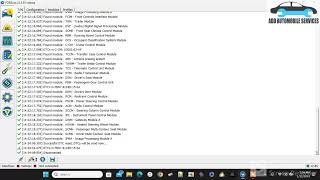
✅ What actually fixed it Using FORScan, the technician accessed the CCM's As-Built configuration. FORScan automatically downloaded the correct As-Built data for the vehicle's VIN from Ford's servers. The technician then used the 'Write' function to program this correct data onto the used CCM, which resolved the VIN mismatch and cleared the U3002 code. - Ford F150 Forum thread (2020 Ford F-150 Lariat) — "Blind Spot System Fault" and "Cross Traffic System Fault" messages after replacing a water-damaged right rear tail light/SOD module with a used part from eBay.
❌ Tried (didn't work) Installing the used part and clearing codes.
✅ What actually fixed it A forum member advised that the As-Built data needed to be written to the new module using FORScan. The process involves reading the As-Built data from the working module on the other side (e.g., SODL), using that as a template for the replacement module (SODR), and letting FORScan calculate the new checksum before writing the data. This is the equivalent of a PMI procedure.
OEM Part Supersession History
ML3Z-9E731-D→ML3Z-9E731-E— Standard part revision by the manufacturer.
Heads up: ML3Z-9E731-E also replaces ML3Z-9E731-A and ML3Z-9E731-C. As the latest revision, it should be used for all repairs.
Model Year Variations Within This Range
- 2021-2025: The governing Technical Service Bulletin (TSB) for this issue has been progressively updated to include newer model years. SSM 51903 covered 2021-2023, SSM 53018 covered 2021-2024, and the latest, SSM 53569, covers 2021-2025. This indicates the underlying software configuration issue persists across the 14th generation F-150 platform and is not isolated to early production years.
Helpful Videos


The information in this article is provided for general reference and educational purposes only. Vehicle specifications, procedures, and part compatibility can vary by production date, trim level, and region. Always consult your vehicle's factory service manual and verify part numbers before purchasing or performing repairs. Safety-critical components such as airbags, seat belts, and braking systems should be installed by a qualified professional.
- Ford F-150:
- 🧭 Diagnostic Flowchart
- 🎬 Helpful Videos
- What's Unique About the 2021-2025 Ford F-150
- Symptoms You May Notice
- Most Likely Causes
- Rare But Worth Checking
- Diagnosis Steps
- Parts You'll Likely Need
- Related Codes That Often Appear With This One
- Technical Service Bulletins (TSBs) & Recalls
- Platform-Specific Known Issues
- Hidden / Shadow Codes Worth Checking
- Scan Tool Commands That Help
- Wiring & Ground Locations
- Real Owner Repair Stories
- OEM Part Supersession History
- Model Year Variations Within This Range
- 🎟️ Get 5% Off