

U3003 on 2020-2023 Ford Escape Hybrid/PHEV: Battery Voltage Causes and Fixes
This code means the 12V battery system has a problem. On the Escape Hybrid/PHEV, the most likely cause is a blown 300-amp mega fuse that prevents the 12V battery from being charged, as noted in Ford TSB SSM 52201. Do not just replace the battery; the charging system must be inspected first, as the underlying fault will drain a new battery.
- U3003 on an Escape Hybrid/PHEV is a serious code indicating a failure in the 12V battery charging system.
- Do not automatically replace the 12V battery. The most probable cause is a blown 300-amp fuse (Part No. MU5Z14526K), per Ford TSB SSM 52201.
- Diagnosis and repair should be performed by a professional technician due to the involvement of high-voltage systems.
- If the 12V battery does need replacement, consider upgrading from the stock H4/T4 size to a larger H6 group size AGM battery for improved longevity.
- A Battery Management System (BMS) reset is mandatory after replacing the 12V battery to ensure proper charging.
What's Unique About the 2020-2023 Ford Escape
Unlike a traditional car with an alternator, the Escape Hybrid/PHEV uses a DC/DC converter to charge its 12V battery. A very specific and documented issue for this platform is the failure of a 300-amp mega fuse (Ford Part No. MU5Z14526K) located in the high-current battery junction box, which cuts off power from the DC/DC converter to the 12V battery. This is so common that Ford issued Technical Service Bulletin (TSB) SSM 52201 to address it across the Escape, Lincoln Corsair, and Ford Maverick platforms. Owners also report frequent failures of the undersized factory-installed H4 or T4 group size 12V battery, leading many to upgrade to a larger H6-size AGM battery for better reliability.
Symptoms You May Notice
- Check Engine Light or Wrench Light illuminated
- "Stop Safely Now" message on the dashboard
- "Remote features disabled to preserve battery" or "Deep Sleep Mode" message from FordPass app
- Vehicle will not start or has a dead 12V battery
- Audio system inoperative or chimes defaulting to a different speaker
- Power liftgate or window switches may be inoperative
- Remote start fails to operate
- Dimming or flickering interior and exterior lights
- Replacing the 12V battery without checking the 300-amp fuse. If the fuse is blown, the new battery will not be charged and will quickly die, leading to a repeat of the problem and a stranded driver.
Most Likely Causes
- Blown 300-Amp High-Current Fuse 🔴 High Probability This is a well-documented failure point addressed by Ford TSB SSM 52201 for this specific vehicle and its platform mates (Lincoln Corsair, Ford Maverick). A technician on a forum noted the fuse can develop a hairline crack from vibration, sometimes testing fine with a multimeter but failing under load.
How to confirm: A technician must access the high-current battery junction box (BJB) in the engine compartment and perform Pinpoint Test H as described in the workshop manual (WSM Section 414-05) to check continuity of the F4 300-amp fuse.
Typical fix: Replace the blown 300-amp mega fuse (Part No. MU5Z14526K or N00000008338). The 12V battery must also be fully recharged and tested, as it may have been damaged by the deep discharge.
Est. part cost: $20-$60 - Weak or Failing 12V AGM Battery 🟡 Medium Probability → Shop Vehicle Battery The factory-installed 12V battery (often a small H4/T4 size) is known to be undersized and prone to premature failure, leading to numerous owner complaints and repeat replacements, sometimes yearly. Manufacturer TSB Bulletin #SSM 50151 notes that U3003 often occurs at vehicle key-on and may be difficult to reproduce, advising technicians to diagnose the 12V system first if low voltage (less than 10V) is observed in the DTC snapshot.
How to confirm: Perform a professional load test on the 12V battery. A resting voltage below 12.4V or a cranking voltage drop below 9.6V indicates a bad battery.
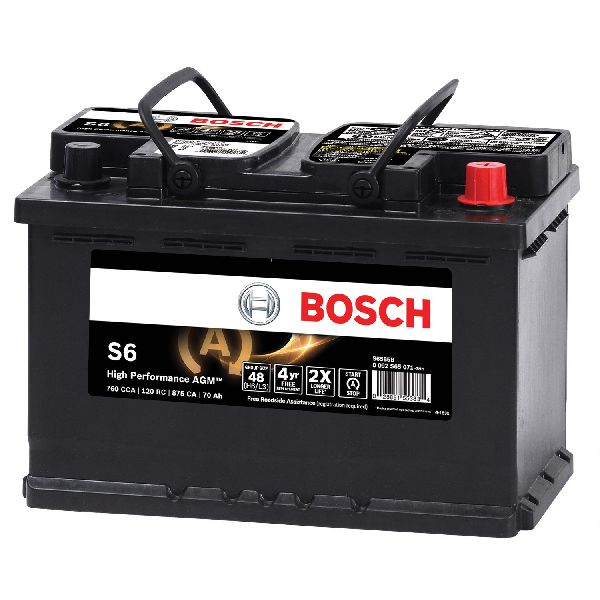
Typical fix: Replace the 12V AGM battery, located under the rear cargo floor inside the spare tire well. Many owners recommend upgrading to a larger H6 group size battery (e.g., Motorcraft BAGM-48H6-760). The battery tray has a secondary mounting hole to accommodate the larger battery. A Battery Management System (BMS) reset using a scan tool or manual procedure (e.g., high beam flashes and brake presses 🎬 Watch: How to perform a manual Battery Management System reset) is required after replacement.
Est. part cost: $200-$350 - Software/Module Logic Error ⚪ Low Probability For PHEV models, TSB 22-2169 addresses a software issue where the 12V battery can be discharged while the high-voltage battery is charging. Other TSBs (like the superseded TSB 24-2288) have been issued for parasitic drains caused by modules failing to enter sleep mode correctly.
How to confirm: If the 300A fuse and 12V battery are confirmed to be good, the issue is likely software-related. Check with a dealer for any open TSBs or software updates for the PCM, BECM, or DC/DC modules.
Typical fix: A Ford dealership needs to reprogram various modules (PCM, BECM, SOBDMC, ABS) with the latest available firmware to fix parasitic drains or incorrect charging logic.
Est. part cost: $0 (if under warranty) or 1-2 hours labor
Rare But Worth Checking
- Faulty DC/DC Converter Control Module: → Shop Power Converter While rare, if the fuse is good and a new, fully charged battery does not resolve the issue, the DC/DC converter itself (OEM Part #NZ6Z-10B687-A for some applications) may have an internal failure.
- Loose or Corroded Battery Terminals/Grounds: → Shop Vehicle Battery Always a possibility on any vehicle. Before replacing parts, check that the 12V battery terminals and the main chassis ground connections are clean and tight.
- Faulty Battery Monitoring System (BMS) Sensor: → Shop Vehicle Battery The BMS sensor is located on the negative battery terminal. If it provides incorrect data to the charging system, it can lead to undercharging or overcharging, potentially triggering U3003. A failure of this sensor can sometimes be inferred if a new battery fails quickly despite a BMS reset.
Diagnosis Steps
- Scan all modules for DTCs. Note if U3003 is present with suffixes :62 or :16 in the DC/DC Converter Control Module.
- Follow the diagnostic procedure outlined in Ford TSB SSM 52201.
- Have a qualified technician inspect the 300-amp mega fuse (labeled F4) in the high-current battery junction box for an open circuit. This is done by following Pinpoint Test H from the Workshop Manual (Section 414-05).
- If the fuse is blown, replace it with OEM part MU5Z14526K.
- Regardless of the fuse condition, perform a professional load test on the 12V battery to verify its health. Per TSB Bulletin #SSM 50151, if low voltage (less than 10V) is observed in the DTC snapshot, the 12V system should be the primary focus.
- If the battery is replaced, perform a BMS (Battery Management System) reset using a compatible scan tool (like FORScan) or the manual procedure.
- If the fuse and battery are good, check for available software updates at a Ford dealership, specifically referencing TSBs like 22-2169 for PHEV charging drains.
Parts You'll Likely Need
- High-Current Mega Fuse, 300 Amp
(OEM #MU5Z14526K (also seen as N00000008338))— This is the most likely cause of the no-charge condition as identified in Ford TSB SSM 52201.
Trusted brands: Motorcraft, Bussmann
OEM price range: $20-$60
Aftermarket price range: $15-$40 - 12V AGM Battery (H6 Group Size Upgrade)
(OEM #BAGM-48H6-760)— The factory H4/T4 battery is prone to failure. If the original is weak or has been deeply discharged, it requires replacement. The part number listed is for the larger, recommended H6 group size that fits in the stock location.
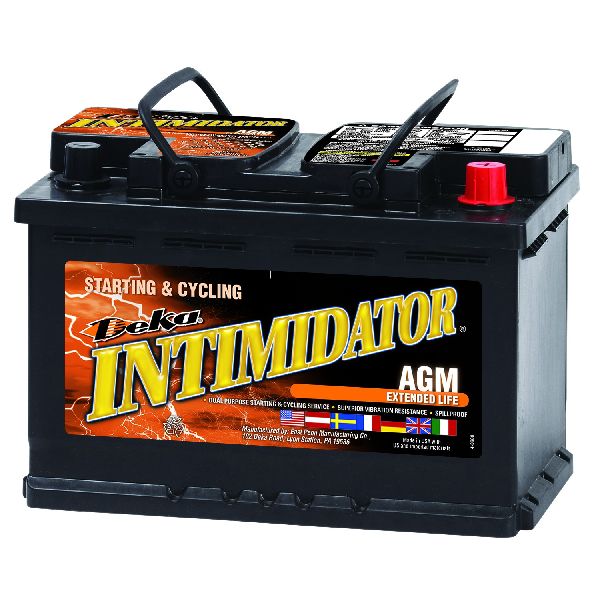
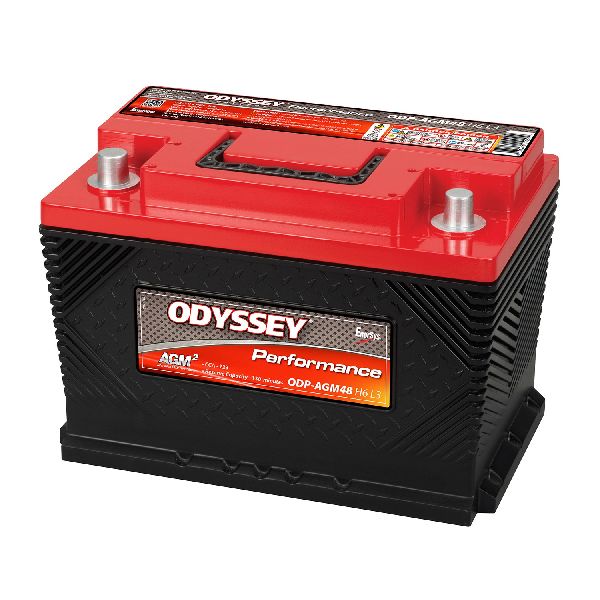
Trusted brands: Motorcraft, EverStart, Deka, Odyssey
OEM price range: $250-$350
Aftermarket price range: $200-$300
Related Codes That Often Appear With This One
- U3003:62 — This specific sub-code for 'Signal Compare Failure' is the primary DTC mentioned in TSB SSM 52201 related to the blown 300-amp fuse.
- U3003:16 — This means 'Circuit Voltage Below Threshold' and is a direct result of the 12V battery being discharged because it is not being charged. It is also mentioned in TSB SSM 52201.
- U3000:04 — This 'Control Module: System Internal Failures' code can be logged in the DC/DC module when it fails self-tests due to the power supply issue, as noted in TSB SSM 52201.
- U3003:17 — This sub-code for 'Circuit Voltage Above Threshold' is less common but indicates the module is seeing voltage higher than specified (e.g., over 15.0V), which can also trigger faults.
Technical Service Bulletins (TSBs) & Recalls
- SSM 52201: Directly addresses a low or discharged 12V battery with DTC U3003:62, U3003:16, and/or U3000:04, pointing to an open 300-amp high-current fuse (F4) as the cause for Escape, Corsair, and Maverick hybrids.
- TSB Bulletin #SSM 50151: Notes that U3003 can occur at vehicle key-on and may be difficult to reproduce; it recommends diagnosing the 12V system first if voltage drops below 10V.
- TSB 22-2169: Specific to PHEV models, this TSB addresses a 12V battery that discharges while the main high-voltage battery is charging, requiring a software update to fix.
- TSB 24-2288 (Superseded): Mentioned by owners in forums as a fix for persistent 12V battery drains caused by modules not entering sleep mode correctly.
Platform-Specific Known Issues
- A known issue documented in TSB SSM 52201 involves a blown 300-amp fuse (F4 in the BJB) preventing the DC/DC converter from charging the 12V battery.
- Widespread owner complaints exist regarding the short lifespan of the undersized factory 12V battery, often leading to no-start conditions and owners upgrading to a larger H6 AGM battery.
- Software glitches in various control modules can incorrectly trigger faults and parasitic drains, requiring dealer reprogramming to fix per TSBs like 22-2169 (for PHEVs).
Mechanic-Grade Diagnostic Values
- DC/DC Converter Charging Voltage — expected: 13.5V - 14.5V (with vehicle in 'Ready' mode). Failure: A reading near battery resting voltage (~12.0V-12.6V) or lower indicates the battery is not being charged. A reading above 15.0V indicates an over-voltage fault.
- 300-Amp Mega Fuse Resistance — expected: < 1.0 Ohm. Failure: Any reading significantly higher than 0 ohms, or an open circuit (OL), confirms the fuse is blown. Note that a hairline crack may allow it to pass a simple continuity test but fail under load.
- 12V Battery Cranking Voltage — expected: Should not drop below 9.6V. Failure: A voltage drop below 9.6V during engine crank signifies a weak battery that cannot handle the load.
- FCIM Low Voltage Threshold — expected: Above 10.0V. Failure: DTC U3003:16 can be set by the Front Controls Interface Module (FCIM) if its supply voltage drops below 10 volts for more than 10 seconds.
Scan Tool Commands That Help
- Ford IDS / FORScan: BMS Reset (Battery Management System Reset) — This is a required step after replacing the 12V battery. It resets the battery's age and state-of-health parameters in the BCM, ensuring the new battery is charged correctly. Failure to perform the reset can lead to premature battery failure.
- Ford IDS / FORScan: Pinpoint Test H — This is the specific, guided diagnostic routine referenced in TSB SSM 52201 to test the 300-amp mega fuse circuit when U3003:62 is present.
- Ford IDS / FORScan: High Voltage Battery Balance — While not a direct fix for U3003, this service function can be used to equalize the voltage across the cells of the main high-voltage battery. It is a useful maintenance procedure to ensure the health of the HV battery, which is the source of power for the DC/DC converter.
Wiring & Ground Locations
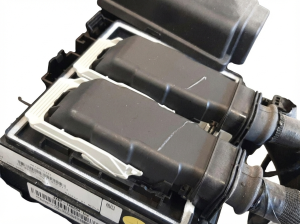
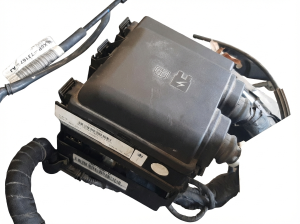
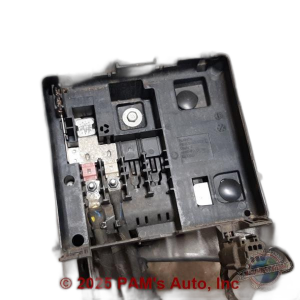
- High-Current Battery Junction Box (BJB) — Located in the engine compartment. The 300A fuse is designated as F4 within this box.. This box contains the 300-amp mega fuse that is the most common point of failure for the U3003 no-charge condition.
- Battery Monitoring System (BMS) Sensor Connector — A small electrical connector attached to the sensor on the negative 12V battery terminal.. A poor connection or corrosion at this connector can prevent the BCM from accurately monitoring the battery's state, leading to incorrect charging and potential U3003 codes.
- DC/DC Converter — Under the hood, this liquid-cooled power electronics module has high-voltage (orange) connectors from the HV battery, low-voltage output connectors to the 12V system, and a multi-pin control connector.. This is the component responsible for charging the 12V battery. All power flows through it, making its connectors and wiring critical points of inspection for corrosion or damage if the fuse and battery are good.
Real Owner Repair Stories
- Reddit user @ai-ndroid43 (2008 Ford Escape Hybrid (Note: Older model, but demonstrates the diagnostic principle)) — Car would start with low RPM, rev lightly, then stall with a 'pull over safely' message. Multiple codes including P0A1F (Battery Energy Control Module) and P1A10 (Hybrid Powertrain Control Module Battery Prohibited).
❌ Tried (didn't work) Mechanic diagnosed that the hybrid battery was not communicating with the car., O'Reilly's tested the 12V battery and said it was good, but their scanner blamed the alternator (DC/DC converter)., Resetting the Battery Control Module and Powertrain Control Module with FORScan had no effect.
✅ What actually fixed it The 12V battery was, in fact, bad and unable to hold a charge, despite a previous 'good' test. Replacing the 12V AGM battery resolved all symptoms and codes. - NHTSA ODI #11427314 (Cross-manufacturer reference) — An owner reported a vehicle throwing a long list of codes including U3003 and U3008, which eventually left them without a vehicle after attempting various repairs.
OEM Part Supersession History
N00000008338→MU5Z14526K— This appears to be a standard part number consolidation or update by Ford. Both part numbers refer to the same 300-amp mega fuse.
Model Year Variations Within This Range
- 2023: The 2023 model year introduced a significant cosmetic refresh and updated interior technology, including a larger optional 13.2-inch screen with SYNC 4. However, the underlying powertrain options, including the 2.5L Hybrid/PHEV system and its 12V charging architecture, remained fundamentally the same as the 2020-2022 models. Therefore, the causes and fixes for U3003 are consistent across the 2020-2023 range.
Diagnostic Flowchart
Used vs. New Parts: Buying Guide for This Vehicle
When a used part is the smart pick: For this specific repair, buying used parts is generally not recommended. The primary failure items are a low-cost fuse and a 12V battery, both of which should always be purchased new. A used DC/DC converter is a gamble with unknown history.
Donor-vehicle mileage cap: roughly under 30000 miles for the part to have meaningful remaining life.
What to inspect on the donor part:
- If considering a used Battery Junction Box (BJB), inspect thoroughly for any signs of water intrusion, corrosion on terminals, or melted plastic.
- Verify the donor vehicle was not a flood or fire victim.
OEM-only on this vehicle (don't cheap out):
- High-Current Mega Fuse (300 Amp): While aftermarket versions from brands like Bussmann exist, the OEM Motorcraft part is inexpensive and is the proven, reliable choice.
- DC/DC Converter Control Module: This is a complex, high-voltage electronic component. Due to the safety risks and potential for hidden damage, a new or OEM-remanufactured unit is strongly advised over a used part from a salvage yard.
Aftermarket brands forum-validated for this vehicle:
- 12V AGM Battery: Many owners successfully use and recommend brands like EverStart (Walmart), Deka, and Odyssey as reliable alternatives to the OEM Motorcraft battery.
Brands owners have reported issues with on this vehicle:
- There are no specific aftermarket brands widely reported to avoid for this repair, but it is always best to stick with reputable battery manufacturers.
Real Owner Stories
Aggregated from forums and TSBs cited above. Mileages and costs reflect what owners reported in those sources.
2023 Ford Escape Hybrid — 35000 miles
Symptoms: Received frequent 'Remote features disabled to preserve battery' messages. Eventually, the dome lights wouldn't work without the engine running, and a 'Turn off the vehicle or start it' message would appear right after shutting down.
What fixed it: After a dealer replacement with the same stock battery failed to solve the problem, the owner learned the permanent solution was to install the larger H6 AGM battery (Motorcraft part BAGM48H6760).
Source hint: Reddit: 2023 Ford Escape Hybrid Frequent Battery Failure
2020-2023 Ford Escape Hybrid/PHEV
Symptoms: Experienced frequent 12V battery failures, leading to a dead battery and no-start conditions.
What fixed it: Found success by replacing the smaller stock battery with a larger H6-size AGM battery, such as the Motorcraft BAGM-48H6-760.
Source hint: Go-Parts (summary of fordescape.org/Reddit)
2022-2023 Ford Maverick Hybrid
Symptoms: Vehicle would not start and showed a U3003 code, indicating a 12V charging system fault, even after the 300A fuse tested 'good' for continuity with a multimeter.
What fixed it: A technician discovered the 300A mega fuse had a hairline crack from vibration that caused it to fail under load. Replacing the fuse (Part No. MU5Z14526K) resolved the issue.
Source hint: MaverickTruckClub.com
Related OBD-II Codes
Frequently Asked Questions
My FordPass app says 'Remote features disabled to preserve battery.' Is this related to code U3003?
What is Ford TSB SSM 52201 and does it apply to my Escape Hybrid?
My 12V battery failed again. Can I install a bigger one in my 2021 Escape Hybrid?
I have an Escape PHEV and the 12V battery dies while the main high-voltage battery is charging. What's the fix?
The dealer says my 300-amp fuse is blown. What part number do I need?
My mechanic tested the 300A fuse and said it has continuity, but I still have the 'Stop Safely Now' message. Could it still be the fuse?
Helpful Videos

Used OEM Parts in Stock
New Aftermarket Parts Available


The information in this article is provided for general reference and educational purposes only. Vehicle specifications, procedures, and part compatibility can vary by production date, trim level, and region. Always consult your vehicle's factory service manual and verify part numbers before purchasing or performing repairs. Safety-critical components such as airbags, seat belts, and braking systems should be installed by a qualified professional.
- Ford Escape:
- 🧭 Diagnostic Flowchart
- 🎬 Helpful Videos
- 🛍️ Shop This Part
- What's Unique About the 2020-2023 Ford Escape
- Symptoms You May Notice
- Most Likely Causes
- Rare But Worth Checking
- Diagnosis Steps
- Parts You'll Likely Need
- Related Codes That Often Appear With This One
- Technical Service Bulletins (TSBs) & Recalls
- Platform-Specific Known Issues
- Mechanic-Grade Diagnostic Values
- Scan Tool Commands That Help
- Wiring & Ground Locations
- Real Owner Repair Stories
- OEM Part Supersession History
- Model Year Variations Within This Range
- Used vs. New Parts: Buying Guide for This Vehicle
- Real Owner Stories
- 2023 Ford Escape Hybrid — 35000 miles
- 2020-2023 Ford Escape Hybrid/PHEV
- 2022-2023 Ford Maverick Hybrid
- Related OBD-II Codes
- Frequently Asked Questions
- 🎟️ Get 5% Off