

Ford Galaxie Ignition Switch Guide: 1959-1967 Replacement and Diagnosis
Everything a Galaxie owner needs to know about diagnosing and replacing a faulty ignition switch.
- A bad ignition switch can cause a no-start, stalling, or flickering lights; these are common issues for a 1959-1967 Galaxie due to age.
- Replacement is a simple DIY task, usually taking less than an hour with basic tools and a paperclip.
- Choose a quality aftermarket brand like Standard Ignition, as cheap, unbranded parts can be unreliable.
- Verify the part is correct for your specific model year, as different switches were used throughout the 1959-1967 production run.
Is Your Galaxie's Ignition Switch Failing?

After more than 50 years of use, the original ignition switch in a Ford Galaxie is a common failure point. It’s a mechanical part with electrical contacts that gets used every time you drive. Wear and tear can lead to poor connections, leaving you with a car that won't start or has frustrating electrical gremlins. If you're having strange issues, the ignition switch is a smart place to start your diagnosis.
Symptoms of a Bad Ignition Switch

A failing ignition switch can show up in several ways. You might notice one or more of these problems, which can start intermittently before the switch fails completely.
🎬 Watch: 8 common symptoms of a failing ignition switch.- Car Won't Start or Crank: You turn the key and get nothing but silence. This is the most common sign of a completely failed switch.
- Engine Stalls Unexpectedly: The engine may start but then die as soon as you let go of the key. This happens when the switch doesn't keep power flowing to the ignition system in the 'ON' position.
- Flickering Dash Lights: Gauges or warning lights on your dashboard may flicker or cut out while driving or when turning the key. This points to a loose internal connection.
- Accessories Don't Work: The radio, heater fan, or other electrical components may not turn on in the 'ACC' or 'ON' positions.
- Key Feels Loose or Binds: While often related to the lock cylinder, a damaged switch can sometimes make the key hard to turn or feel sloppy. In some cases, the switch itself can physically break or fall apart behind the dash.
Choosing the Right Aftermarket Switch

Finding a new ignition switch from Ford isn't possible for these classic cars. The good news is that the aftermarket provides quality replacements. However, not all aftermarket parts are created equal.
OEM vs. Aftermarket Quality
For a 1959-1967 Galaxie, you must rely on aftermarket parts. Some owners report that cheap, generic switches feel flimsy and may not function correctly, sometimes failing to spring back from the 'START' position. It is better to spend a little more on a reputable brand. Brands like Standard Ignition are well-regarded in the classic car community for making parts that fit and function like the originals, often using high-quality materials like copper alloy conductors for reliability.
Aftermarket Ignition Switch Cost
| Part Quality | Our Inventory Price Range | Notes |
|---|---|---|
| Standard Ignition | $31.73 - $59.14 | A trusted brand with a reputation for quality fit and function. Recommended choice. |
| New OEM (Ford) | Not Available | Original parts have not been produced for decades. |
| Used OEM | Varies | Risky due to age. The used part is likely as old and worn as the one you are replacing. |
Common Ordering Mistake
The ignition switch for the Ford Galaxie changed several times between 1959 and 1967. There are different parts for year ranges like 1959, 1962-64, and 1965-67. Always verify that the part you are ordering is specifically listed for your vehicle's exact year to ensure it fits and has the correct electrical connections.
Frequently Asked Questions (FAQ)

Do I need to replace the lock cylinder too?
Not always. The ignition switch is the electrical part, and the lock cylinder is the mechanical tumbler your key fits into. They are separate components. If your key turns smoothly but the car has electrical symptoms, you probably only need the switch. If your key is sticking or hard to turn, you may need a new lock cylinder as well.
Is this a difficult job to do myself?
No, this is a very DIY-friendly job for most owners. It requires basic hand tools and can usually be done in under an hour. Access is typically from under the dashboard. The process involves disconnecting the battery, removing the lock cylinder (often with a paperclip), unscrewing the bezel from the dash, and unplugging the wiring harness.
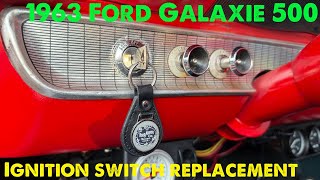
🎬 See this walkthrough on replacing the tumbler and switch.Are there any recalls on the Galaxie ignition switch?
No. There are no open or relevant recalls for the ignition switch on any 1959-1967 Ford Galaxie. Major Ford ignition switch recalls from the 1990s concerned different models from a much later era and do not apply to your vehicle.
What tools do I need for the replacement?
You will likely need a basic socket or wrench set, a screwdriver, and a paperclip or a similar small, stiff wire to depress the pin to remove the lock cylinder. It's also a good idea to have a flashlight to see up under the dashboard.
Should I inspect the wiring?
Yes. While you are replacing the switch, take a close look at the wiring connector (pigtail). After 50+ years, the plastic can become brittle and the terminals can corrode. If the connector looks cracked, melted, or damaged, it should be replaced at the same time to ensure a good connection and prevent future problems.
🎬 Watch: A helpful guide to Galaxie ignition and starter wiring.Helpful Videos


Technical Specifications
The ignition switch for the 1959-1967 Ford Galaxie is a dash-mounted, multi-position rotary switch. It is a separate component from the key and lock cylinder. Aftermarket replacements from quality brands often feature copper alloy conductors to ensure good electrical conductivity. The specific design and wiring connections vary by model year.
We Have This Part in Stock


The information in this article is provided for general reference and educational purposes only. Vehicle specifications, procedures, and part compatibility can vary by production date, trim level, and region. Always consult your vehicle's factory service manual and verify part numbers before purchasing or performing repairs. Safety-critical components such as airbags, seat belts, and braking systems should be installed by a qualified professional.