

Porsche 911 Ignition Coil Guide for 1971-1975 Models
Understanding the unique ignition coil requirements for your classic air-cooled 911.
- Your 1971-1975 911 has a CDI ignition that requires a specific CDI-compatible coil, not a standard one.
- Test your existing coil with a multimeter; primary resistance should be 0.4-0.6Ω and secondary 650-790Ω.
- Be cautious of modern 'silver' Bosch replacement coils, as many owners report poor reliability.
- Aftermarket coils from specialists like Parts Klassik or performance brands like MSD are popular alternatives.
Understanding Your 911's Ignition System
Before replacing your ignition coil, it's important to know that 1971-1975 Porsche 911s do not use a simple, standard ignition coil. They use a Bosch Capacitive Discharge Ignition (CDI) system that requires a specific type of coil, which is technically an ignition transformer. This system sends a high-voltage pulse (around 450 volts) from the CDI control unit to the coil. The coil then transforms this into the extremely high voltage needed for the spark plugs.
Signs of a Failing Ignition Coil
Ignition coil failure in these 911s can be sudden. The car may run perfectly one moment and then fail to start the next. Common symptoms include:
- No-Start Condition: The engine cranks but will not fire up. This is the most common symptom.
- Engine Stalling: The engine may cut out unexpectedly while driving and refuse to restart.
- Hesitation and Misfiring: The car may stutter or run poorly, especially under acceleration or at high RPM.
- No Spark: A simple test of pulling the main wire from the distributor and checking for a spark against a ground point will show no spark if the coil or CDI has failed.
Is it the Coil or the CDI Box? A failing CDI box can produce the same symptoms as a bad coil. A common sign of a working CDI box is a high-pitched whining sound from the unit when the key is in the 'on' position. If you don't hear this whine, the CDI box itself may be the problem. Testing the coil's resistance is the best way to isolate the fault.
🎬 Watch: Troubleshooting and repairing your Porsche CDI systemChoosing the Right Aftermarket Ignition Coil
Finding a quality replacement is key. While original parts are scarce, several aftermarket options exist. Quality can vary significantly.
OEM Brand: Bosch
Bosch was the original manufacturer for these coils. However, the quality of modern replacements is a major point of discussion among owners.
- Original "Black" Coils: The original German-made Bosch coils had black bodies and are considered very reliable. If you have a working original, it is highly valued.
- Modern "Silver" Coils: Newer Bosch coils, often made in Brazil or Mexico, have a silver body. Forum users frequently report that these coils are unreliable and have a high failure rate, sometimes failing within months.
Aftermarket Brands
Given the issues with modern Bosch coils, many owners turn to aftermarket specialists.
- Tier 1 (Specialty Brands): Companies like Parts Klassik have developed their own coils specifically to be a high-quality replacement for the original Bosch CDI coil. These are often recommended on forums as a reliable alternative.
- Tier 2 (Performance Brands): Brands like MSD offer CDI-compatible coils, such as the Blaster Coil. These are a popular choice, especially when upgrading the entire ignition system. 🎬 See how to install a modern CDI ignition upgrade However, some purists argue they are not perfectly matched to the original Bosch CDI box and may not provide optimal performance without other changes.
- Tier 3 (Standard Replacements): Brands like Beru also offer replacement coils. Be sure to verify that any replacement is explicitly stated to be for CDI systems.
| Part Type | Estimated Cost | Notes |
|---|---|---|
| New OEM (Bosch Silver) | $80 - $150 | Widely available but user reviews report questionable reliability. |
| New Aftermarket | $100 - $250 | Includes specialty CDI-specific coils (Parts Klassik) and performance coils (MSD). |
| Used OEM (Bosch Black) | $150+ | Hard to find. Valued for its original quality and reliability. |
| Shop Labor | $75 - $150 | Typically less than one hour of labor. |
Frequently Asked Questions (FAQ)
How do I test my ignition coil?
You can test your coil with a multimeter. Disconnect it from the car. The primary resistance, measured between the two small terminals, should be between 0.4 and 0.6 Ohms. The secondary resistance, measured between one small terminal and the large high-tension center tower, should be between 650 and 790 Ohms. Readings far outside this range, especially an infinite reading, indicate a bad coil.
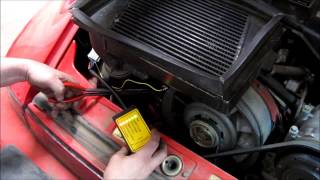
🎬 Watch: Using a specialized tool to test your CDIAre there any recalls for the ignition system on these cars?
Yes, there was one recall issued for the 1974 Porsche 911SC concerning the ignition system (NHTSA Campaign ID: 75V067000). However, details on this 50-year-old recall are limited, and it may not apply to all models or issues.
Can I just bypass the CDI and use a standard coil?
While it has been done, it is not recommended. Bypassing the CDI box and wiring in a standard 12V inductive coil will result in significantly reduced engine performance, especially at higher RPMs where the CDI system excels. It is better to repair the CDI system with the correct components.
Is replacing the ignition coil a difficult DIY job?
No, this is a very straightforward job for a DIY mechanic. It involves disconnecting the battery, labeling and removing three electrical wires, and unbolting the coil from its bracket in the engine bay. Access is a bit tight, but no special tools are required.
Helpful Videos
![1974 Porsche 911 coupe: Engine install and Startup! [4K] Ep123](https://img.youtube.com/vi/tB_tOagBH6k/mqdefault.jpg)
Technical Specifications
OEM Part Numbers: 901.602.502.00 0221121001 221-121-006
System Type: Capacitive Discharge Ignition (CDI) Primary Resistance: 0.4 - 0.6 Ohms Secondary Resistance: 650 - 790 Ohms

The information in this article is provided for general reference and educational purposes only. Vehicle specifications, procedures, and part compatibility can vary by production date, trim level, and region. Always consult your vehicle's factory service manual and verify part numbers before purchasing or performing repairs. Safety-critical components such as airbags, seat belts, and braking systems should be installed by a qualified professional.