

Chevrolet G10 Distributor Ignition Pickup Guide (1981-1987)
Troubleshooting the common no-spark and stalling issues in your 1981-1987 Chevrolet G10 van.
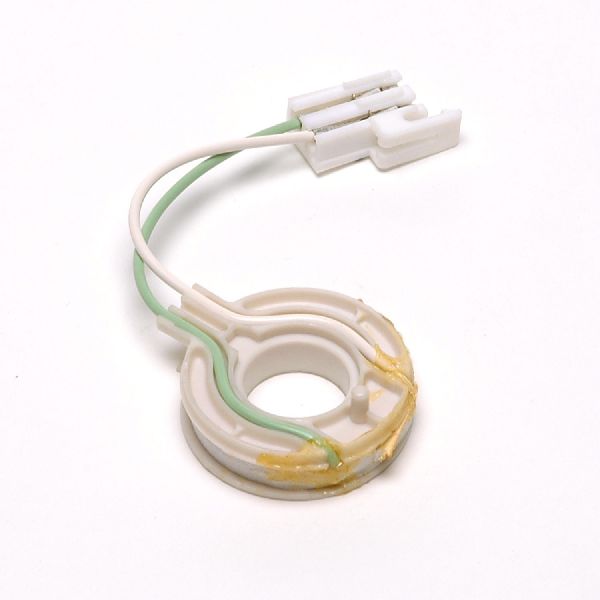
- A failing ignition pickup typically causes a sudden no-start or stalling condition.
- Test the coil with a multimeter for resistance (500-1500 ohms); wiggle the wires to check for internal breaks.
- Replacement requires removing and disassembling the distributor, so marking its position is critical for timing.
- For best results, choose a quality brand like Delphi (OE-style) or Standard Motor Products (reputable aftermarket).
Is Your G10's Ignition Pickup Failing?
The GM High Energy Ignition (HEI) system in your 1981-1987 G10 is generally reliable, but its internal parts can fail with age. The ignition pickup is a common weak point. Its failure is often sudden and can leave you stranded. Unlike some parts that degrade slowly, a pickup coil tends to work one moment and fail completely the next.
Key Failure Symptoms
A bad ignition pickup coil usually causes very specific, severe symptoms. If you experience the following, the pickup coil is a primary suspect:
- Engine Cranks but Won't Start: This is the most common sign. The starter will turn the engine over, but it will never fire up because the spark plugs are not receiving a spark.
- Sudden Engine Stalling: The engine may run perfectly fine and then suddenly shut off as if you turned the key. This often happens after the engine has warmed up. It might restart after cooling down for a while, but the problem will return and get worse.
- No Spark: If you test for spark at the spark plug wires and find there is none, the pickup coil, ignition control module (ICM), or main ignition coil are the most likely culprits. The wires leading to the pickup coil can also break internally from years of movement with the vacuum advance, causing an intermittent no-spark condition.
Choosing the Right Aftermarket Pickup Coil
For a vehicle like the '81-'87 G10, new OEM parts are generally unavailable. The aftermarket offers good quality replacements that meet or exceed the original specifications. Your choice comes down to a balance of quality and cost.
Brand Quality Tiers
- Tier 1: Delphi
Delphi was an original equipment (OE) manufacturer for General Motors, so their parts are engineered to the same standards as the factory components. Choosing Delphi is the closest you can get to an original GM part, ensuring excellent fit, material quality, and long-term reliability. For a critical part that can leave you stranded, Delphi is a top choice. - Tier 2: Standard Motor Products (SMP)
Standard is a well-respected aftermarket brand with a long history of making quality ignition components for American vehicles. They often provide reliable parts that perform well. When choosing SMP, it's best to select their main product line (often in a red box) or their premium Blue Streak line, as some users report their budget lines can be less reliable.
Estimated Part & Labor Costs
| Part or Service | Estimated Cost |
|---|---|
| New Aftermarket Ignition Pickup | $28.95 - $77.02 |
| Shop Labor | $190 - $300 |
| Total Estimated Cost | $218.95 - $377.02 |
Frequently Asked Questions (FAQ)
How can I test my G10's ignition pickup?
You can test it with a multimeter set to ohms. Disconnect the two small wires from the pickup coil at the ignition module. Connect the multimeter leads to these two wires. You should see a steady resistance reading between 500 and 1500 ohms. While watching the meter, gently wiggle the wires where they enter the coil body. If the reading jumps around or goes to infinite (open), the wires are broken internally and the coil is bad.
Should I replace the whole distributor instead?
It depends. Replacing just the pickup coil requires removing the distributor and taking it apart. 🎬 Watch this detailed walkthrough on how to rebuild a GM HEI distributor. Given the age of the vehicle, other parts inside the distributor (like the shaft bushings or advance mechanism) may also be worn. If the labor cost is a concern, or if you want to refresh the entire ignition system, installing a complete new distributor can be a more time-effective and reliable long-term repair.
What's the difference between the pickup coil and the ignition module?
They are two separate parts inside the distributor that work together. The pickup coil creates the timing signal (the "trigger"). The ignition control module (ICM) receives that signal and acts as a switch, turning the main ignition coil on and off to create the spark. Both can cause a no-spark or stalling condition, but the ICM is more known for failing when hot.
What is a common mistake when replacing this part?
A common mistake is not properly marking the position of the distributor and rotor before removing it. This will throw off your ignition timing, and the engine won't run correctly, if at all. 🎬 See how to properly remove and replace a GM pickup coil. Another mistake is forgetting to apply new thermal paste to the bottom of the ignition control module if you remove it to get to the pickup coil. Without the paste, the module will quickly overheat and fail.
Helpful Videos
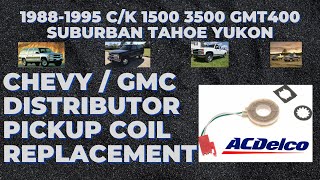

Technical Specifications
System Type: GM High Energy Ignition (HEI) Location: Inside Distributor Resistance Specification: 500 - 1500 Ohms
We Have This Part in Stock


The information in this article is provided for general reference and educational purposes only. Vehicle specifications, procedures, and part compatibility can vary by production date, trim level, and region. Always consult your vehicle's factory service manual and verify part numbers before purchasing or performing repairs. Safety-critical components such as airbags, seat belts, and braking systems should be installed by a qualified professional.
- Chevrolet G10: