

BMW 535i Fuel Pump Guide: Understanding and Replacing Your 1985-1989 Fuel System
Solving engine hesitation and no-start issues in your classic E28 or E34 5-Series.
- First, identify your model: 1985-1988 (E28) has two separate fuel pumps, while the 1989 (E34) has one in-tank assembly.
- Symptoms like engine sputtering, hard starts, and whining from the tank are strong indicators of a failing fuel pump.
- Always replace the fuel filter and pump strainer at the same time to protect your new pump and validate its warranty.
- Aftermarket pumps like US Motor Works offer a budget-friendly alternative to the more expensive OEM Bosch parts.
Is Your 535i an E28 or E34? It Matters for Your Fuel System
Before you buy any parts, you need to know which BMW 5-Series chassis you have. The 1985-1989 model years span two different generations with two different fuel pump setups.
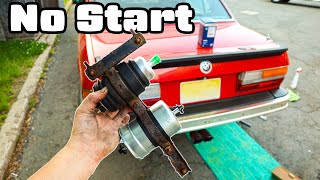
- 1985-1988 BMW 535i (E28): These cars have two fuel pumps. A low-pressure "lift" pump is inside the fuel tank, and a main high-pressure pump is mounted externally, under the car near the rear axle. 🎬 Watch this guide on replacing the external pump and filter. Both must work correctly for the car to run properly.
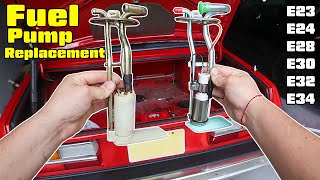
- 1989 BMW 535i (E34): This model has a single in-tank fuel pump assembly that combines the pump and the fuel level sending unit. 🎬 Follow this walkthrough for replacing the E34 fuel pump assembly.
Symptoms of a Failing Fuel Pump
A weak or failing fuel pump can cause a range of frustrating problems. You might notice one or more of these signs:
- Engine Sputtering Under Load: The car may hesitate or lose power when you accelerate, go uphill, or carry a heavy load. This happens because the pump can't supply the extra fuel the engine demands.
- Difficulty Starting: A long crank time before the engine starts is a classic symptom. A failing pump struggles to build enough initial pressure.
- Sudden Stalling: The engine may die unexpectedly while driving or idling, which can be a serious safety hazard.
- Loud Whining Noise: You may hear a distinct humming or whining sound coming from the fuel tank area (under the rear seat or in the trunk). This is the sound of the electric pump motor straining to work.
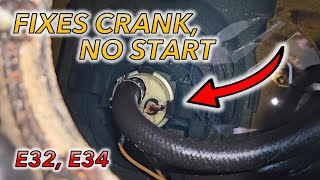
- No-Start Condition: The most severe symptom is the engine cranking but never starting because it's not receiving any fuel.
Pro Tip for E28 Owners: If your car starts but runs poorly and sputters under acceleration, the in-tank lift pump may have failed. 🎬 See how to replace the in-tank fuel pump on an E28. If the car won't start at all, the main external high-pressure pump is a more likely suspect.
Choosing Your Aftermarket Fuel Pump: OEM vs. Aftermarket
When your fuel pump fails, you have a choice between original equipment (OEM) parts and aftermarket alternatives. For this vehicle, the original pumps were made by Bosch, which is considered the gold standard for reliability.
- OEM (Bosch/VDO): These pumps are known for their long life and perfect fit. They are the most expensive option but provide peace of mind. Many owners who want to maintain originality or demand the highest reliability choose this path.
- Aftermarket (US Motor Works): Aftermarket brands like US Motor Works offer a cost-effective solution. These pumps are designed to meet original specifications and can be a good value. They are built with modern, fuel-resistant materials. While they may not have the same long-term track record as Bosch, they provide a functional replacement at a much lower price point, backed by a warranty.
Cost Comparison
| Part/Service | Estimated Cost |
|---|---|
| New OEM Fuel Pump (Bosch/VDO) | $125 - $500+ (Varies by E28/E34 and pump location) |
| New Aftermarket Fuel Pump (US Motor Works) | $219.38 |
| Shop Labor for Replacement | $150 - $350 |
Frequently Asked Questions (FAQ)
Do I have one fuel pump or two?
It depends on your model year. 1985-1988 (E28) models have two pumps: one in the tank and one under the car. 1989 (E34) models have only one pump, located in the tank.
My car is an E28. Should I replace both pumps at the same time?
While not strictly necessary, it is often recommended. The pumps are the same age, and if one has failed, the other may be nearing the end of its life. Replacing both provides reliability and peace of mind, especially since you are already working on the fuel system.
Is US Motor Works a good brand for my BMW?
US Motor Works is an aftermarket brand that produces parts designed to be a cost-effective alternative to OEM components. They use quality materials compatible with modern fuels and build their pumps to meet OE performance specifications. For a daily driver or a budget-conscious repair, it is a viable option. For maximum longevity, many purists prefer OEM Bosch.
What else should I replace with my fuel pump?
Always replace the fuel filter and the pump's strainer when you install a new fuel pump. A clogged filter or strainer can restrict fuel flow and cause the new pump to fail prematurely. This is often a condition of the part's warranty. It's also a good time to inspect the fuel lines and clamps for any cracks or rust.
Are there any recalls for the fuel pump on my 1985-1989 535i?
No. Searches of the National Highway Traffic Safety Administration (NHTSA) database did not show any open recalls for the fuel pumps on the 1985-1989 BMW 535i models. Recalls for BMW fuel pumps typically involve much newer vehicles.
Helpful Videos

Technical Specifications
OEM Part Numbers: 16141181354 16141178839 16141178751 16141179232 16141179425
System Type: Dual Pump (1985-1988 E28) or Single Pump (1989 E34). Voltage: 12V. Operating Mode: Electric.
We Have This Part in Stock


The information in this article is provided for general reference and educational purposes only. Vehicle specifications, procedures, and part compatibility can vary by production date, trim level, and region. Always consult your vehicle's factory service manual and verify part numbers before purchasing or performing repairs. Safety-critical components such as airbags, seat belts, and braking systems should be installed by a qualified professional.
- BMW 535i: