

Porsche 928 Engine Coolant Temperature Sensor Guide (1985-1995)
Your 928 has two different engine coolant temperature sensors, and replacing the wrong one won't fix your problem.
- Your 1985-1995 Porsche 928 has two different coolant sensors; identify symptoms carefully to replace the correct one.
- A faulty Temp Sensor II (for the ECU) is a critical failure that causes poor running, black smoke, and bad fuel economy.
- For the critical Temp Sensor II, it is highly recommended to use the OEM supplier brand, Bosch, as other aftermarket brands have been reported to not work correctly.
- Replacement is simple and can be done in under 30 minutes with basic tools.
Understanding Your 928’s Two Coolant Sensors

Pro Tip: Before you buy, you must identify which sensor has failed. The 1985-1995 Porsche 928 has two distinct sensors that are often confused. One controls your gauge (Temp Sensor I), and the other controls the engine's computer (Temp Sensor II). They have different functions and different failure symptoms.
Temp Sensor I: For the Dashboard Gauge
This sensor's only job is to report the coolant temperature to the gauge in your instrument cluster. On some models, it also triggers the red overheat warning light. If this sensor fails, your engine will likely run fine, but you won't have an accurate temperature reading. This can be risky, as you won't know if the engine is actually overheating.
Symptoms of a bad Temp Sensor I:
- Temperature gauge reads zero or is stuck on cold. 🎬 See how to troubleshoot and fix a faulty dashboard gauge.
- Temperature gauge reading is erratic or jumps around.
- Gauge reads very high, even when the engine is not overheating.
- Overheat warning light comes on when the engine temperature is normal.
Temp Sensor II (NTC II): For the Engine Computer (ECU)
This sensor is vital for proper engine operation. It provides the data your fuel injection and ignition computers need to run the engine efficiently. A failure here tells the computers the wrong temperature, leading to significant performance problems. The car might think it's -20°F outside when it's actually 80°F, causing it to inject far too much fuel. This is the more critical of the two sensors.
Symptoms of a bad Temp Sensor II:
- Check Engine Light is on.
- Black smoke from the exhaust due to a rich fuel mixture.
- Poor fuel economy.
- Difficulty starting, especially when the engine is warm.
- Rough or high idle.
- Engine hesitates or misfires. 🎬 Watch a mechanic track down engine misfires caused by sensors.
Choosing the Right Aftermarket Sensor

While many brands are available, not all are created equal, especially for a complex car like the 928. Owner experiences suggest that sticking with an OEM-supplier brand is the safest bet.
Aftermarket Brand Quality Tiers
| Tier | Brands | Assessment |
|---|---|---|
| Tier 1: OEM Supplier | Bosch | Bosch is a known original equipment supplier for Porsche. Forum members report that for the critical Temp Sensor II, only the Bosch part worked correctly, while other brands failed to perform. This is the most recommended choice for reliability. |
| Tier 2: Reputable Aftermarket | Hella, Vemo | These are well-regarded German brands that often produce quality parts. They can be a good alternative if a Bosch part is unavailable, but Bosch is still preferred for the Temp II sensor. |
| Tier 3: Standard / Budget | Facet, Four Seasons, Walker, Standard Ignition, etc. | These brands offer a lower price point. While they may function, their long-term reliability and accuracy on a sensitive system like the 928's engine management are less certain. Given the low cost of even top-tier sensors, saving a few dollars here may not be worth the risk of poor engine performance. |
Known Issues, Recalls, and Service Bulletins
There are no active recalls or Technical Service Bulletins (TSBs) from the NHTSA specifically for the engine coolant temperature sensors on the 1985-1995 Porsche 928. Searches found recalls for much newer Porsche models relating to different cooling system components, but none apply to this part on this vehicle.
Frequently Asked Questions (FAQ)

How do I know which sensor to replace?
Diagnose the problem based on the symptoms. If your dashboard gauge is wrong but the car runs well, you likely need Temp Sensor I. If the car runs poorly (bad mileage, black smoke, rough idle) but the gauge might seem fine, you need Temp Sensor II.
Where are the coolant temperature sensors located?
Both sensors are located at the top front of the engine on the coolant bridge (also called the thermostat housing), between the two banks of cylinders. The Temp II sensor often has a blue electrical connector.
Can I replace the sensor myself?
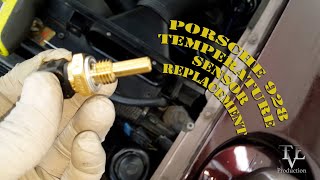
Yes, this is a very DIY-friendly job for most owners. 🎬 Watch this step-by-step guide to replacing your temperature sensors. Access is straightforward at the top of the engine. The process involves unplugging the electrical connector, using a deep socket (often 19mm) to unscrew the old sensor, and quickly screwing the new one in. Very little coolant will be lost if you are quick. Always use a new sealing washer.
Why is my new aftermarket sensor not working?
First, ensure you bought the correct sensor (Temp I vs. Temp II). They are not interchangeable. Second, some 928 owners have reported that only genuine Bosch Temp II sensors work correctly, and that other aftermarket brands caused persistent running issues. The sensor must also have a clean connection and be properly grounded through its threads to the engine block.
Helpful Videos
Technical Specifications
OEM Part Numbers: 92860620101 92860620103 92860612600 92860612501
Location: Engine Coolant Bridge/Thermostat Housing. Quantity: 2 sensors with different functions (Temp I for gauge, Temp II for ECU). Common Tools: 19mm deep socket wrench. Note: Part numbers have been superseded over the years and can vary by specific model year and engine type. Always verify the correct part number for your vehicle's VIN before ordering.
We Have This Part in Stock



The information in this article is provided for general reference and educational purposes only. Vehicle specifications, procedures, and part compatibility can vary by production date, trim level, and region. Always consult your vehicle's factory service manual and verify part numbers before purchasing or performing repairs. Safety-critical components such as airbags, seat belts, and braking systems should be installed by a qualified professional.
- Porsche 928:
- 🎬 Helpful Videos
- 🛍️ Shop This Part
- Understanding Your 928’s Two Coolant Sensors
- Temp Sensor I: For the Dashboard Gauge
- Temp Sensor II (NTC II): For the Engine Computer (ECU)
- Choosing the Right Aftermarket Sensor
- Aftermarket Brand Quality Tiers
- Known Issues, Recalls, and Service Bulletins
- Frequently Asked Questions (FAQ)
- 🎟️ Get 5% Off