

Ford F-150 Engine Control Module (ECM) Guide for 1992-2000 Models
Is your F-150 running rough, stalling, or refusing to start? Your engine's computer might be the problem.
- For 1992-1996 models, failing capacitors are the most common cause of ECM failure; a remanufactured unit is the best fix.
- Symptoms are broad and can include no-start, stalling, rough idle, and poor performance, often mimicking other sensor failures.
- You must match the part number from your old ECM exactly to ensure compatibility with your truck's engine, transmission, and features.
- Models from 1997-2000 with an anti-theft system (PATS) will likely require a locksmith or dealer to reprogram your keys to the new ECM.
Is Your F-150's Brain Failing?

The Engine Control Module (ECM) is central to your truck's operation. When it starts to fail, the symptoms can be confusing because they often mimic other problems. A bad ECM can cause everything from a simple check engine light to a truck that won't run at all. Because it controls so many different systems, symptoms can appear suddenly and seem unrelated.
Known Issue for 1992-1996 F-150s: Leaking Capacitors
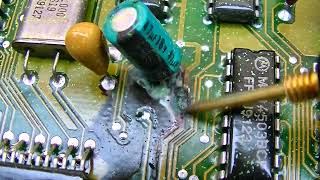
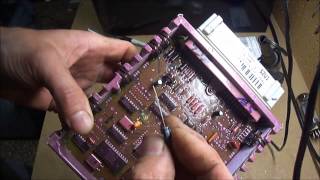
If you own a 1992-1996 F-150, the most common reason for ECM failure is leaking internal capacitors. After decades of service, these small electronic parts can leak fluid onto the circuit board, causing corrosion and electrical shorts. This leads to a wide range of erratic engine behaviors. Often, the best way to diagnose this is to open the ECM and visually inspect the board for black or fishy-smelling residue around the three capacitors.
🎬 Watch: See what leaking capacitor damage looks like up close.Common Symptoms of a Bad ECM

- No Start or Hard Starting: The engine cranks but won't start, or takes many tries to fire up.
- Engine Stalling or Rough Idle: Your truck may stall unexpectedly, idle erratically, or hesitate when you press the gas.
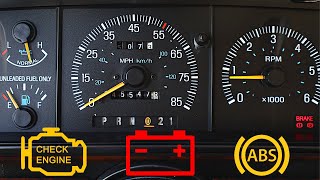
- Check Engine Light: The light may stay on, or it might not come on at all during the key-on bulb check.
- Poor Performance and Fuel Economy: A failing ECM can't manage the engine efficiently, leading to power loss and more trips to the gas station.
- Erratic Transmission Shifting (Automatics): You might experience hard shifts, or the transmission may seem to hunt for the right gear.
- Fuel Pump Stays On: The fuel pump continues to run with the key on instead of priming for a few seconds and shutting off.
- Inability to Read Codes: A mechanic may be unable to connect their scan tool to the truck's computer.
Choosing the Right Aftermarket ECM

For a vehicle of this age, finding a brand-new OEM (Original Equipment Manufacturer) computer is nearly impossible. The market consists almost entirely of remanufactured units, which are often sold as "new aftermarket" parts. Reputable brands like Cardone take original Ford ECMs, test them to find out why they failed, and replace weak components (like those leaky capacitors) with new, updated parts. They are then fully tested to ensure they meet or exceed original performance.
Match Your Part Number Exactly!
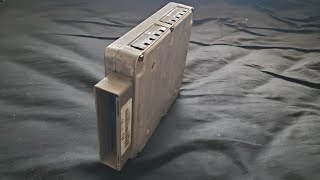
You cannot use an ECM from just any F-150. You must match the part number or calibration code from your original unit. This code is found on a sticker on the ECM itself and sometimes on a sticker in the driver's side door jamb. Using the wrong module will result in a truck that won't start or run correctly.
Cost of Replacing Your F-150 ECM
Here is a general cost breakdown for replacing the ECM on a 1992-2000 F-150. Prices can vary based on your specific truck and location.
| Part Type | Estimated Cost |
|---|---|
| New OEM | Not Generally Available |
| Remanufactured Aftermarket | $134 - $244 |
| Used (Junkyard) | $50 - $100 (Not Recommended) |
| Shop Labor | $100 - $200 |
Frequently Asked Questions

Can I replace the ECM myself?
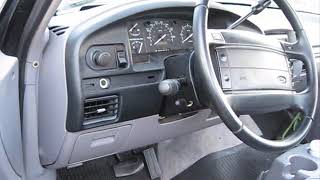
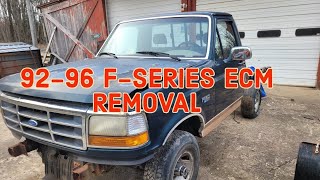
Yes, this is a job most DIY mechanics can handle. The ECM is typically located behind the driver's side kick panel. The process involves disconnecting the battery, removing the interior panel, unplugging the main harness connector in the engine bay (usually a single 10mm bolt), and sliding the module out. 🎬 See this walkthrough for removing the ECM on OBS trucks. It can be a tight fit, but it requires basic hand tools and about an hour of your time.
Does the new ECM need to be programmed?
For 1992-1996 models (OBD-I), programming is not usually required if you have the correct part number. For 1997-2000 models (OBD-II) equipped with Ford's PATS anti-theft system, the new ECM must be synced with your keys. Many remanufacturers will pre-program the unit to your truck's VIN, but you may still need a locksmith or a shop with the right tools to perform a "key relearn" procedure.
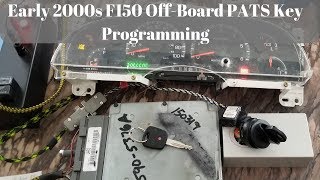
🎬 Watch: How to program your keys for the new module.Why not just get a cheap ECM from a junkyard?
While it's the cheapest option, it's also the riskiest. A used ECM from a junkyard is the same age as the one that failed in your truck. For 1992-96 models, it likely has the same failing capacitors and could fail shortly after you install it. A quality remanufactured unit has had these common failure points corrected.
Is it called an ECM, PCM, or ECU?
These terms are often used interchangeably. ECM stands for Engine Control Module. ECU is Engine Control Unit. For these Ford trucks, the most accurate term is PCM, or Powertrain Control Module, because this single computer manages both the engine and the transmission. However, most people and parts stores will know what you mean regardless of which term you use.
Helpful Videos
Technical Specifications
Part numbers vary significantly by year, engine, transmission, and emissions calibration. The most critical specification is matching the engineering or calibration code printed on the sticker of the original ECM.
We Have This Part in Stock







The information in this article is provided for general reference and educational purposes only. Vehicle specifications, procedures, and part compatibility can vary by production date, trim level, and region. Always consult your vehicle's factory service manual and verify part numbers before purchasing or performing repairs. Safety-critical components such as airbags, seat belts, and braking systems should be installed by a qualified professional.
- Ford F-150: