

Suspension Strut and Coil Spring Assembly Guide for 1992-2002 Honda Civic
Restore your Civic's ride quality and handling by understanding how to choose the right new aftermarket strut assembly.
- Verify your Civic's year; 1992-2000 models use a different front suspension (double-wishbone) than 2001-2002 models (MacPherson strut).
- Always replace strut assemblies in pairs (both front or both rear) to ensure even handling and safety.
- KYB is considered an OEM-quality replacement, while Monroe and Moog are solid mid-tier options.
- A wheel alignment is essential after replacing front struts to prevent uneven tire wear.
Is Your Civic's Ride Getting Bumpy?
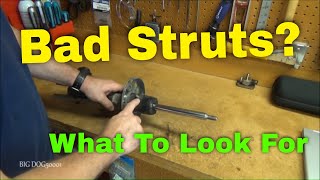
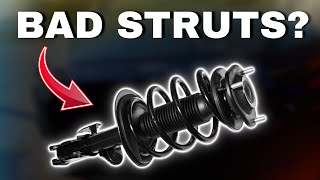
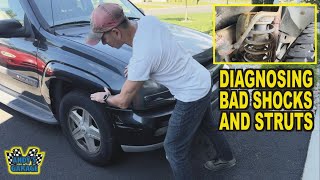
As a 1992-2002 Honda Civic ages, its suspension parts wear out. The strut and coil spring assemblies are critical for ride comfort and safety. When they fail, you'll notice it. Common signs include a bouncy ride, clunking noises over bumps, the front of the car diving when you brake hard, or the rear squatting when you accelerate. You might also see uneven tire wear or notice the car doesn't feel stable on the highway. A simple way to check is the "bounce test": push down hard on one corner of the car and let go. If it bounces more than once, the strut is likely worn out.
🎬 Watch: A pro shows you how to test for bad struts.A Critical Suspension Change
It is very important to know your Civic's exact year. The front suspension changed in 2001.
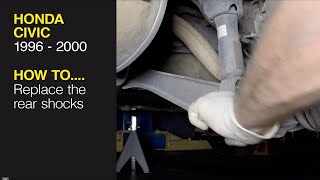
- 1992-2000 Honda Civic: Uses a double-wishbone front suspension. 🎬 See this step-by-step front strut replacement for 1996-2000 models.
- 2001-2002 Honda Civic: Uses a MacPherson strut front suspension. 🎬 Watch: 2001-2005 Civic strut replacement with torque specs.
These two designs use different strut assemblies. Ordering the wrong part for your year is a common and costly mistake. Always verify the part's fitment for your specific year and sub-model (DX, LX, EX, Si).
Choosing the Right Aftermarket Strut Assembly
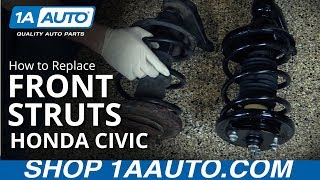
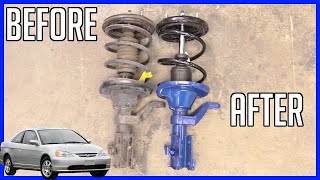
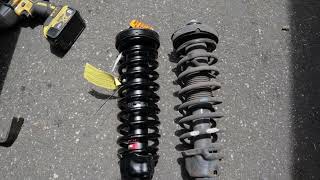
For a vehicle of this age, original equipment (OEM) parts from Honda are often discontinued or very expensive. Aftermarket parts are the most practical choice. They come in a wide range of quality and price. A "quick strut" or "complete strut assembly" is highly recommended. It includes the strut, spring, mount, and all hardware in one unit, which makes installation much easier and safer than swapping individual components.
Aftermarket Brand Tiers for Honda Civic
Based on owner feedback and general reputation, aftermarket brands can be grouped into tiers:
- Best (OEM Quality or Better): KYB is widely regarded as an OEM supplier for Honda, meaning their parts are very similar in quality and performance to the original factory parts. Many owners report that KYB provides a ride feel that is the same as or better than stock.
- Better (Reputable Aftermarket): Monroe and Moog are well-known brands that offer a good balance of quality and value. They are a solid choice for daily driving and are generally considered a step up from budget options. Some users have had mixed experiences, but they are a reliable choice for most drivers.
- Good (Economy/Budget): Brands like FCS, Unity, PRT, and Sen-Sen offer the most affordable options. They are a viable choice if you're on a tight budget or don't plan to keep the car for many more years. While they can restore a safe and comfortable ride compared to completely worn-out struts, their long-term durability and ride refinement may not match the higher-tiered brands.
Pro Tip: Always replace struts in pairs (both front or both rear). Replacing only one can cause uneven handling and instability.
Known Issues, Recalls, and Service Bulletins
For the 1992-2002 Honda Civic, there are no major recalls directly for the strut assemblies themselves. However, there have been some Technical Service Bulletins (TSBs) related to suspension noises. For example, TSB #00-006 mentioned a "clunk from rear suspension" caused by broken trailing arm bushings on some 2000 models. For 2002 models, TSBs were issued for noises like a "twang, creak, or pop" from the front suspension, sometimes related to the strut or damper. These are not recalls and repairs are not free unless the vehicle is under warranty.
| Part Type | Estimated Cost (Parts Only) |
|---|---|
| New Aftermarket (Economy) | $130 - $200 |
| New Aftermarket (Mid-Range/Premium) | $200 - $330 |
| Shop Labor | $200 - $500 |
Frequently Asked Questions
Do I need a wheel alignment after replacing the struts?
Yes, it is highly recommended. Replacing the strut assembly, especially on the front, will change the suspension geometry. The mounting bolts that connect the strut to the steering knuckle often have enough play to affect camber and toe angles. Driving without an alignment can lead to poor handling and rapid, uneven tire wear. Plan for the cost of an alignment after the job is done.
Can I install a strut assembly myself?
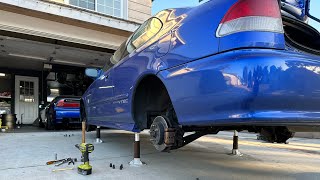
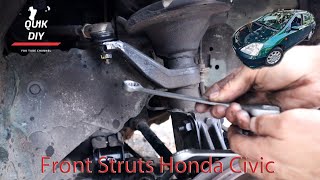
For a mechanically inclined person with the right tools, this is a feasible DIY job. Using a complete strut assembly avoids the dangerous task of compressing the coil spring. The process involves lifting the vehicle, removing the wheel, detaching the brake line from the strut, unbolting the strut from the steering knuckle, and then unbolting the top mount from inside the engine bay or trunk. However, if you are not comfortable with this, a professional mechanic can do the job safely.
What's the difference between a shock, a strut, and a coilover?
A shock absorber is just the hydraulic part that dampens movement. A strut is a structural part of the suspension that combines the shock absorber and coil spring into one unit. All 1992-2002 Civics use a strut assembly design. A coilover is typically an aftermarket performance part that combines the coil spring and shock but often offers adjustments for ride height and damping, which standard strut assemblies do not.
Should I replace the strut mounts at the same time?
Yes. A complete strut assembly includes a new strut mount. If you were to replace only the strut cartridge, you would be foolish not to replace the mount. The mount contains a bearing that allows the strut to turn with the wheels and rubber to absorb vibrations. A worn mount can cause clunking noises, poor steering feel, and memory steer (where the steering wheel doesn't return to center easily).
Helpful Videos



Technical Specifications
OEM Part Numbers: 171946 1336322L 1336322R
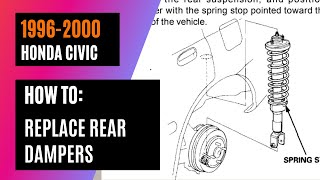
Suspension design changes between generations. 1992-2000 models feature a double-wishbone front suspension. 2001-2002 models feature a MacPherson strut front suspension. Rear suspension is also a double-wishbone type for most of this period but part compatibility must be verified by sub-model and year.
We Have This Part in Stock


The information in this article is provided for general reference and educational purposes only. Vehicle specifications, procedures, and part compatibility can vary by production date, trim level, and region. Always consult your vehicle's factory service manual and verify part numbers before purchasing or performing repairs. Safety-critical components such as airbags, seat belts, and braking systems should be installed by a qualified professional.
- Honda Civic: