

Ford Explorer Neutral Safety Switch Guide (1996-2011)
Having trouble starting your Explorer? It might be the Neutral Safety Switch. This guide explains what you need to know.
- A failing Neutral Safety Switch can cause a no-start condition or a serious safety hazard where the vehicle can start in gear.
- Common symptoms include the engine only starting in Neutral (not Park), no reverse lights, and a Check Engine Light.
- Aftermarket brands like Standard Ignition and Replacement are reliable and cost-effective options for this repair.
- Proper alignment of the new switch during installation is critical for it to function correctly; improper installation is a common DIY mistake.
Understanding the Neutral Safety Switch in Your Explorer

The Neutral Safety Switch (NSS) on a 1996-2011 Ford Explorer is an essential safety component. It ensures your vehicle will only start when the gear selector is in Park or Neutral. On many Explorers, this part is also called the Transmission Range Sensor (TRS) because it performs multiple jobs. It communicates the selected gear to the powertrain control module (PCM) and operates the backup lights. The switch is typically located on the driver's side of the transmission, connected to the gear shift linkage.
Common Symptoms of a Failing Switch

When the neutral safety switch starts to fail, your Explorer will give you clear signs. Recognizing them early can save you from being stranded.
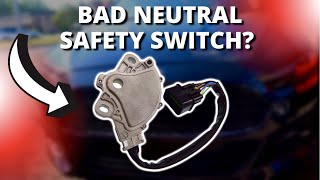
🎬 Watch this video to identify common failure signs.- No-Start in Park or Neutral: The most common symptom is the engine not cranking at all, or only starting in one gear (e.g., starts in Neutral but not Park). You might have to jiggle the shifter to get it to start.
- Starts in Any Gear: A very dangerous symptom is when the engine can start in Reverse or Drive. This indicates a complete failure of the switch's safety function and should be addressed immediately.
- Reverse Lights Don't Work: If your backup lights are out, and the bulbs and fuses are good, the NSS is a likely culprit.
- Check Engine Light: A failing switch can trigger a Check Engine Light. A common code associated with this issue is P0705 (Transmission Range Sensor Circuit Malfunction). A Reddit user with a 2004 Explorer reported a P1717 code related to the NSS.
- Erratic Shifting: In some cases, a bad switch can send incorrect signals to the transmission, causing rough or improper shifting.
Critical Safety Warning
If your Explorer starts in any gear other than Park or Neutral, it can move unexpectedly upon starting. This is a serious safety hazard. Do not continue to drive the vehicle and have the switch replaced as soon as possible.
Choosing a New Aftermarket Neutral Safety Switch

For a vehicle in the 1996-2011 age range, a new aftermarket switch is a practical and affordable choice. The original OEM switches can be expensive or hard to find new. Aftermarket brands like Standard Ignition and Replacement offer direct-fit parts that meet or exceed original specifications.
- Standard Ignition: A well-regarded brand in the aftermarket industry, often seen as a higher-tier option. Their switches feature robust designs and are 100% tested for both mechanical and electrical performance. They are a reliable choice for durability.
- Replacement Brand: This brand offers a cost-effective solution that provides good value. These parts are designed to be a direct replacement for the factory switch, ensuring proper fit and function for your Explorer.
When choosing, the most important factor is ensuring the part is listed as compatible with your specific year, model, and engine. There are variations in the switch design across the 1996-2011 model years.
| Part/Service | Estimated Cost |
|---|---|
| New Aftermarket Switch (Replacement, Standard Ignition) | $53.33 - $109.49 |
| Shop Labor for Installation | $78 - $150 |
Installation Pro-Tip
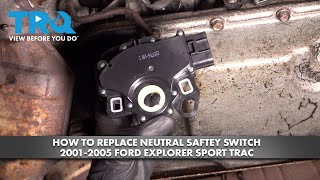
Replacing the switch is a feasible DIY job for those with some mechanical experience. However, correct alignment is crucial. The switch has slotted mounting holes for adjustment. If it's not aligned perfectly, you'll experience the same no-start or incorrect gear reading issues. Many DIYers report problems after installation because of improper alignment, sometimes requiring a trip to a mechanic to get it right.
🎬 See a step-by-step guide for replacing the switch yourself.Frequently Asked Questions

Where is the neutral safety switch located on my Ford Explorer?
For most 1996-2011 Ford Explorers with an automatic transmission, the neutral safety switch is mounted externally on the driver's side of the transmission case. It is connected to the shift lever arm.
🎬 View the exact location of the switch on your transmission.Can I drive my Explorer with a bad neutral safety switch?
It is strongly discouraged. If the switch allows the vehicle to start in gear, it's a major safety risk. If it causes a no-start condition, you could be left stranded. It's best to get it replaced as soon as symptoms appear.
Are there any recalls for the neutral safety switch on these Explorers?
Searches for the 1996-2011 model years did not show any specific recalls for the neutral safety switch itself. Later model Explorers have had recalls and TSBs related to transmission and rollaway risks, but these do not apply to the 1996-2011 generation.
What's the difference between a Neutral Safety Switch and a Transmission Range Sensor?
For this generation of Explorer, the terms are often used for the same part. The component serves the safety function of a neutral safety switch while also sensing the full range of gear positions for the computer, like a transmission range sensor (TRS).
Helpful Videos
Technical Specifications
OEM Part Numbers: 5L2Z7F293AA
Located on the driver's side of the transmission. It is a multi-function switch that acts as a neutral safety switch, transmission range sensor, and controls the backup lights. It typically has an 11-pin rectangular electrical connector.
We Have This Part in Stock


The information in this article is provided for general reference and educational purposes only. Vehicle specifications, procedures, and part compatibility can vary by production date, trim level, and region. Always consult your vehicle's factory service manual and verify part numbers before purchasing or performing repairs. Safety-critical components such as airbags, seat belts, and braking systems should be installed by a qualified professional.
- Ford Explorer: