

Engine Harmonic Balancer Guide for 1998-2006 Honda Accord
Understanding vibrations, noises, and charging issues related to your Accord's crankshaft pulley.
- A failing balancer on an Accord often causes charging system problems, like a battery light, which is a key diagnostic clue.
- Replacement is not possible without a special 50mm hex tool to hold the pulley while removing the extremely tight crank bolt.
- It is critical to inspect and correctly align the woodruff key during installation to prevent severe engine damage.
- While the balancer is off, always replace the front crankshaft oil seal to prevent future leaks.
Is Your Accord's Harmonic Balancer Failing?
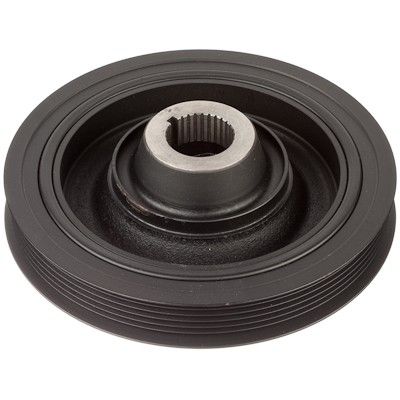
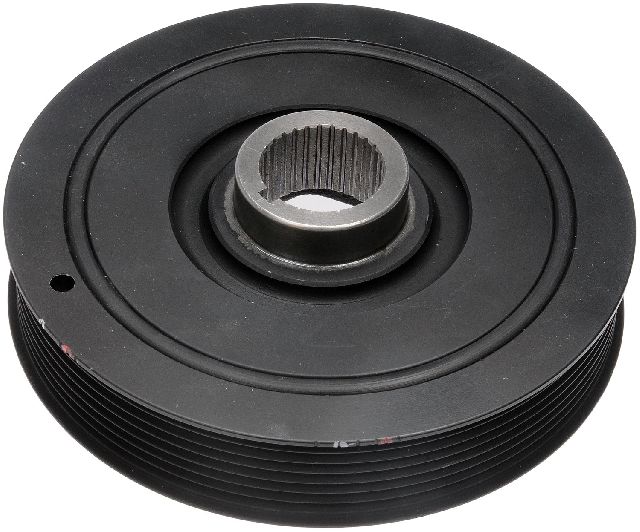
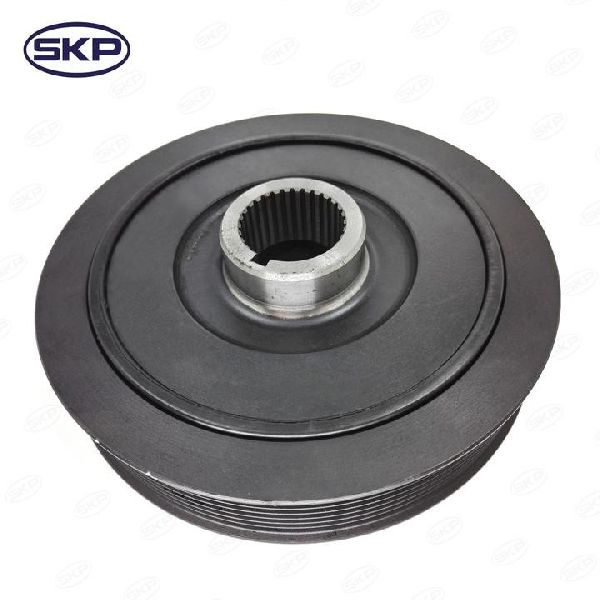
The rubber inside the harmonic balancer doesn't last forever. Over time, engine heat and oil exposure cause the rubber to get brittle and crack. When this happens, the outer ring of the pulley can slip, wobble, or even separate completely from the hub. This can cause a range of problems, from annoying vibrations to a complete loss of power to your accessories.
Key Failure Symptoms
- Engine Vibration: The most common sign is a new or worsening vibration. You might feel it in the steering wheel or through the entire car, and it often gets worse as engine RPMs increase.
- Rattling or Chirping Noises: A rhythmic squeaking, chirping, or rattling sound from the front of the engine that changes with speed often points to a failing balancer. The noise can sometimes be mistaken for a more serious internal engine problem.
- Charging System Problems: A unique symptom on these Accords is an issue with the electrical system. If the balancer's outer ring slips, it won't spin the alternator fast enough, leading to a battery light on the dash or dimming headlights.
- Visible Wobble: If you look at the crankshaft pulley with the engine running, you may see it wobbling instead of spinning smoothly. Use extreme caution when observing the engine bay while the car is running.
- Damaged Belts: A wobbling pulley can quickly shred your accessory belts or cause them to fly off. 🎬 Watch: See these 5 common failure signs in action.
Pro Tip: The Chalk Test
If you suspect the outer ring is slipping, you can check it with the engine off. Use chalk or a paint pen to draw a straight line from the center hub across to the outer ring. Run the engine for a few minutes, then turn it off and check your mark. If the line is no longer straight, the outer ring has slipped and the balancer must be replaced.
Choosing the Right Aftermarket Part
For a daily-driven Accord, a quality aftermarket harmonic balancer offers performance and reliability that can be comparable to the original Honda part, often at a much lower cost. The most important factor for a long-lasting repair is correct installation. Here’s a breakdown of available brands:
- Premium Aftermarket (OEM-Equivalent): Brands like Dayco and ATP are often considered top-tier aftermarket choices. Dayco is well-regarded for its durable, injection-bonded rubber that aims for OEM performance. ATP also designs parts to meet or exceed original specifications. These are excellent choices for owners seeking the best quality and longevity outside of the dealership.
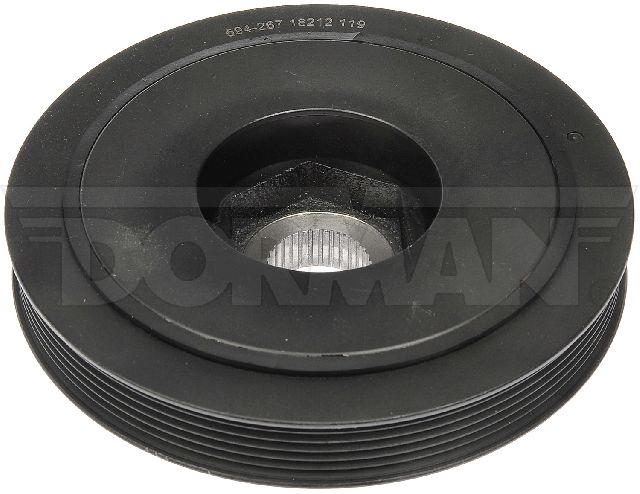
- Standard Aftermarket (Value): Dorman and Pioneer are solid, reliable options that provide good value. Dorman parts are designed to directly match the fit and function of the original. While some mechanics report a shorter lifespan compared to premium brands, they are a very common and dependable choice for standard repairs.
- Budget Aftermarket: Brands like Skyward and other private labels offer the most affordable path to repair. While they meet basic requirements, their long-term durability may not match that of more established brands.
Known Issues, Recalls, and Bulletins
Searches of the National Highway Traffic Safety Administration (NHTSA) database show no specific recalls for the engine harmonic balancer on 1998-2006 Honda Accord models. The most significant known issue is not a part defect but an installation challenge: the main crankshaft pulley bolt is notoriously difficult to remove and must be torqued to a very high specification during installation. Failure to tighten the bolt correctly can cause it to back out, leading to a wobbling pulley, damaged keyway, and potentially severe crankshaft damage.
Installation Tips & Common Mistakes
Special Tool Required: This is not a job for a standard set of wrenches. You will need a special 50mm hex crank pulley holder tool and a long breaker bar to hold the pulley stationary while you remove and install the 19mm center bolt. Attempting to remove it without this tool can be frustrating and lead to other damage.
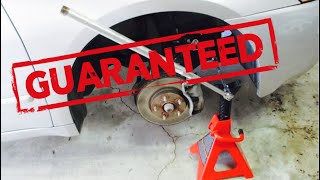
🎬 See this guaranteed method for removing a stubborn V6 crank bolt.- Replace the Front Crank Seal: While you have the balancer off, you have direct access to the front crankshaft oil seal. It is highly recommended to replace this seal as a preventive measure to avoid future oil leaks.
- Watch the Woodruff Key: There is a small metal piece called a woodruff key that aligns the balancer on the crankshaft. Make sure this key does not fall out and is properly seated when you install the new balancer. An improperly installed key can lead to catastrophic engine damage.
- Torque is Critical: Do not use a standard impact gun to tighten the crank bolt. You must use a torque wrench with the holder tool to achieve the correct, high torque specification (V6 models can be over 180 ft-lbs).
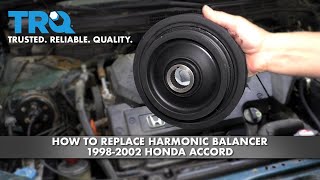
- Verify Your Engine: The 1998-2006 Accord came with different 4-cylinder (F23, K24) and V6 (J30) engines. These require different balancers. Always verify your engine size before ordering. 🎬 Watch: Step-by-step harmonic balancer replacement for 1998-2002 Accords.
| Part/Service | Estimated Cost |
|---|---|
| New Aftermarket Part | $54 - $185 |
| New OEM Honda Part | $250 - $400+ |
| Shop Labor | $150 - $375 |
| Total Professional Replacement (Aftermarket) | $204 - $560 |
Frequently Asked Questions (FAQ)
Can I drive my Accord with a bad harmonic balancer?
No. If the balancer is wobbling or making noise, it could fail completely at any moment. If the outer ring separates, you will immediately lose power steering and the alternator will stop charging the battery, which can leave you stranded. It can also cause further engine damage.
Do I really need the special Honda crank pulley tool?
Yes. The crank bolt is torqued on extremely tight from the factory. It is nearly impossible to remove safely without the 50mm holder tool to keep the engine from turning. This tool is readily available for purchase or rent from most auto parts stores.
What is the difference between the 4-cylinder and V6 harmonic balancer?
They are different parts and are not interchangeable. The V6 and 4-cylinder engines have different crankshafts, belt configurations, and vibration characteristics, so they use balancers with different diameters, weights, and pulley grooves. Always order the part specific to your engine.
Should I replace the crank bolt?
While not always required, it is good practice to replace the crankshaft pulley bolt, especially if the old one was difficult to remove or shows any sign of stretching or damage. Given the high torque involved, starting with a new bolt is cheap insurance for a secure installation.
Helpful Videos
Technical Specifications
OEM Part Numbers: 13810-P8A-A01 13810-RAA-A01 13810-PNA-013 13810-RAA-A03 13810-RRA-A01
Fitment varies between 4-cylinder (F23A/K24A) and V6 (J30A) engines, and between generations (1998-2002 and 2003-2006). The part is secured by a 19mm crankshaft bolt. A 50mm hexagonal tool is required for holding the pulley during service.
We Have This Part in Stock

The information in this article is provided for general reference and educational purposes only. Vehicle specifications, procedures, and part compatibility can vary by production date, trim level, and region. Always consult your vehicle's factory service manual and verify part numbers before purchasing or performing repairs. Safety-critical components such as airbags, seat belts, and braking systems should be installed by a qualified professional.
- Honda Accord: