

A Guide to Replacing the CV Axle Shaft on Your 2001-2005 Mitsubishi Eclipse
Hearing a clicking noise when you turn? Your Eclipse's CV axle might be the culprit.
- A clicking noise when turning is the most common sign of a bad CV axle on an Eclipse.
- Driving on a failing axle is risky; a complete failure will leave you stranded.
- New aftermarket axles are a cost-effective solution, as OEM parts are very expensive for this model.
- Ensure your replacement axle has an ABS ring or that you can safely transfer your old one.
Is Your Eclipse's CV Axle Failing?

A CV axle doesn't have a set replacement schedule; it's replaced when it fails. The most common failure is when the protective rubber boot tears. This boot holds special grease that lubricates the joint. When it rips, grease slings out, and dirt and water get in, quickly destroying the sensitive joint. For the 2001-2005 Eclipse, this leads to some very specific symptoms.
Key Failure Symptoms:
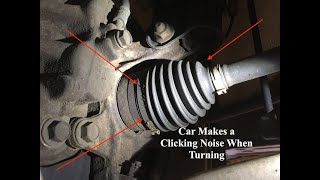
- Clicking or Popping Noise When Turning: This is the classic sign of a bad outer CV joint. 🎬 Watch: Hear what a failing CV joint sounds like when turning. The noise is most noticeable during sharp, low-speed turns, like in a parking lot.
- Vibration During Acceleration: A worn inner CV joint can cause a noticeable vibration or shudder that you feel through the car when you're on the gas. This vibration often goes away when you let off the accelerator.
- Grease on the Inside of Your Wheel: If you see thick, dark grease splattered on the inner side of your wheel, on the suspension parts, or on the ground, it's a sure sign the CV boot has torn.
Don't Ignore a Bad CV Axle
While you can drive for a short time on a clicking axle, it's not safe. If the joint fails completely, the axle will separate, and your Eclipse will lose all power to that wheel, leaving you stranded. It's crucial to address the issue as soon as symptoms appear.
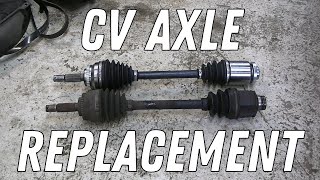
🎬 See this guide on identifying symptoms and replacing the axle.Choosing a New Aftermarket Axle for Your Eclipse

When shopping for a new CV axle, you'll face a choice between expensive Original Equipment Manufacturer (OEM) parts and more affordable aftermarket options.
OEM vs. Aftermarket Quality
For an older vehicle like the 2001-2005 Eclipse, a new OEM axle from Mitsubishi can be very expensive. While OEM axles are generally considered higher quality with better materials and balancing, the cost is often too high for most owners. Some mechanics even suggest that rebuilding an original OEM axle with good joints is better than buying a cheap new aftermarket one.
Aftermarket axles are a practical and popular choice. Brands like Surtrak (also sold as Trakmotive) are widely available. Forum discussions among car owners suggest these are budget-friendly parts that get the job done. While they may not have the same long-term durability as an OEM part, many come with a lifetime warranty, making them a cost-effective solution for keeping your Eclipse on the road.
🎬 Watch: Step-by-step passenger side CV axle replacement for your Eclipse.Check the ABS Ring
Your Eclipse is equipped with an Anti-lock Braking System (ABS). The CV axle has a toothed ring, called an ABS ring, that the wheel speed sensor reads. When buying a new axle, ensure it comes with this ring. If it doesn't, you must carefully transfer the ring from your old axle to the new one. Damaging it can cause ABS problems.
Known Issues, Recalls, and Service Bulletins
Searches of the National Highway Traffic Safety Administration (NHTSA) database and technical service bulletin (TSB) libraries did not find any specific recalls or TSBs related to the CV axle shafts for the 2001-2005 Mitsubishi Eclipse. Recalls issued for this generation of Eclipse were for unrelated components like sun visors.
Frequently Asked Questions (FAQ)

Can I just replace the torn boot instead of the whole axle?
You can, but it's often not worth it. If the boot has been torn for a while, dirt and water have already contaminated the joint, and it will likely fail soon anyway. Also, the labor cost to remove the axle, replace the boot, and re-pack it with grease is often close to the cost of a completely new aftermarket axle assembly. Replacing the entire axle is usually the faster and more reliable repair.
How do I know if the driver's side or passenger's side axle is bad?
A clicking outer joint will typically make noise when you turn. If the noise is loudest when you turn right, the left (driver's side) axle is usually the problem. If it's loudest when you turn left, the right (passenger's side) axle is the likely culprit. A vibration under acceleration is harder to pinpoint and may require a mechanic to inspect the inner joints for excessive play.
Are the left and right CV axles the same part?
No, they are not interchangeable. The driver's side (left) and passenger's side (right) axles are different lengths and have different designs where they connect to the transmission. You must order the correct part for the specific side you are replacing.
What happens if the CV axle breaks while I'm driving?
If a CV axle breaks completely, the connection between the transmission and the wheel is lost. The engine will run, but the car won't move, as if it were in neutral. This can be very dangerous if it happens at high speed, as you will lose power suddenly. This is why it's important to replace a failing axle as soon as you notice symptoms.
Helpful Videos
Technical Specifications
OEM Part Numbers: MR357811 MR410041
Varies by engine (2.4L I4 or 3.0L V6) and transmission type (manual or automatic). Axles for models with ABS will include a 43-tooth ABS ring. The axle nut is typically a 32mm castle nut.
We Have This Part in Stock


The information in this article is provided for general reference and educational purposes only. Vehicle specifications, procedures, and part compatibility can vary by production date, trim level, and region. Always consult your vehicle's factory service manual and verify part numbers before purchasing or performing repairs. Safety-critical components such as airbags, seat belts, and braking systems should be installed by a qualified professional.
- Mitsubishi Eclipse:
- 🎬 Helpful Videos
- 🛍️ Shop This Part
- Is Your Eclipse's CV Axle Failing?
- Key Failure Symptoms:
- Don't Ignore a Bad CV Axle
- Choosing a New Aftermarket Axle for Your Eclipse
- OEM vs. Aftermarket Quality
- Check the ABS Ring
- Known Issues, Recalls, and Service Bulletins
- Frequently Asked Questions (FAQ)
- 🎟️ Get 5% Off