

A Comprehensive Guide to the 2006-2010 Audi A4 CV Axle Shaft
Hearing clicking or feeling vibrations? Your CV axle may be the culprit—here's what you need to know before you buy a replacement.
- A clicking noise when turning is the number one sign of a failing CV axle.
- Check the inside of your front wheels for grease splatter, which indicates a torn CV boot.
- For this Audi, you must replace the entire axle assembly, not just the joint.
- Premium aftermarket brands like GKN are highly recommended by owners, while budget brands like Surtrak are a trade-off between cost and potential longevity.
Is Your Audi A4 CV Axle Failing?
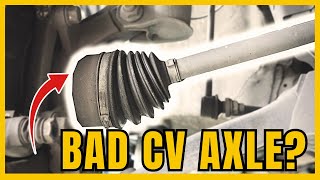
The CV axle is a hard-working part that eventually wears out. The most common failure begins when the protective rubber boot over the CV joint tears. This boot holds special grease that lubricates the joint. When it rips, the grease flies out, and dirt and water get in, quickly destroying the sensitive internal bearings. Ignoring the signs of a bad CV axle can lead to a complete failure, leaving your car unable to move and potentially causing a dangerous loss of control.
Symptoms of a Bad CV Axle Shaft
🎬 Watch: See and hear these 5 common CV axle symptoms- Clicking or Popping Noise When Turning: This is the most classic sign of a failing outer CV joint. The noise is usually most noticeable during sharp, slow-speed turns, like in a parking lot.
- Vibrations While Driving: A damaged or unbalanced axle can cause a vibration that you feel through the steering wheel or the floor. This often gets worse as you accelerate.
- Grease on the Inside of Your Wheel: If you see dark, thick grease splattered on the inner barrel of your wheel or on nearby suspension parts, the CV boot has likely failed.
- Clunking or Knocking Sounds: A heavy clunk when you accelerate, brake, or shift from park to drive can point to a worn inner CV joint that has too much slack.
Choosing the Right Aftermarket CV Axle
For the 2006-2010 Audi A4, you have a few options when it comes to buying a new CV axle. Audi does not sell the joints separately, so you must replace the entire axle assembly. Understanding the difference between OEM and various aftermarket tiers is key to making the right choice for your car and budget.
| Brand Tier | Description | Best For |
|---|---|---|
| OEM / Premium Aftermarket (e.g., GKN/Loebro) | Original Equipment Manufacturer (OEM) or the company that supplies the original part to Audi. These offer the best fit, material quality, and longest lifespan. Forum users often recommend GKN as a top choice if you can't get an OEM part. | Owners who want maximum reliability and plan to keep their A4 for a long time. |
| Quality Aftermarket (e.g., DSS) | Brands like DSS (Diversified Shafts Solutions) aim to provide a product that meets or exceeds original specifications. Reviews suggest they can be a durable alternative to more expensive OEM parts, with some users noting they are built well. | The daily driver looking for a solid balance of quality and cost, without the high price of an OEM part. |
| Economy Aftermarket (e.g., Surtrak) | Surtrak and similar brands are budget-friendly options. While they offer significant cost savings, forum discussions indicate their long-term durability can be inconsistent compared to premium brands. They can be a practical choice if budget is the primary concern. | Quick repairs, older vehicles with high mileage, or owners on a tight budget. |
A Note on Quattro Models
Your Audi A4 has four CV axles if it is a Quattro (AWD) model and two if it is a Front-Wheel Drive model. The front and rear axles, as well as the left and right side axles, are often different parts and are not interchangeable. Always verify the exact part number and fitment for your specific vehicle's position (e.g., front right, rear left) before ordering.
Frequently Asked Questions (FAQ)
Do I need to replace my axles in pairs?
No, you typically only need to replace the specific axle that has failed. However, since the axles on both sides of the car have endured the same mileage and conditions, it's not uncommon for the other side to fail soon after. If your budget allows, replacing them in pairs can save you from doing the same job twice.
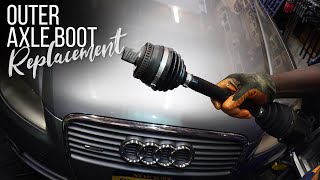
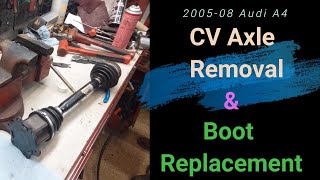
Can I just replace the torn CV boot? 🎬 Watch: How to rebuild and replace an outer CV boot
If you catch a torn boot very early before any noise or vibration starts, you can replace just the boot and repack the joint with grease. However, if the joint is already making noise, it is already damaged, and the entire axle assembly should be replaced. Given the labor involved, most mechanics recommend replacing the full axle.
Are there any recalls for the 2006-2010 Audi A4 CV axle?
No, searches of the National Highway Traffic Safety Administration (NHTSA) database and other sources did not find any specific recalls for the CV axle shafts on the 2006-2010 Audi A4. Recalls for rear axle components have been issued for much newer Audi models (2019-2021) but do not apply to this generation.
What special tools are needed for this job?
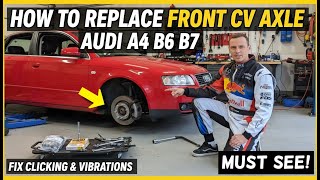
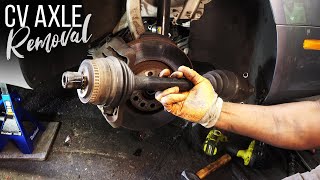
Replacing the CV axle on an A4 requires a few specific tools. You will need a large 17mm Allen socket or a similar large hex socket for the main axle bolt at the wheel hub. You will also need a 10mm triple-square (12-point) socket for the six bolts that connect the inner CV joint to the transmission flange. Using the wrong tool, like a Torx bit, will strip these bolts.
Helpful Videos
Technical Specifications
OEM Part Numbers: 8E0407451PX 8E0407271AT 8E0407272AT
The front axles connect to the transmission via a flange with six M10 triple-square bolts. The outer end is secured to the wheel hub with a large central bolt, typically a 17mm Allen head. Axles are side-specific (left and right) and differ between FWD and Quattro models.
We Have This Part in Stock


The information in this article is provided for general reference and educational purposes only. Vehicle specifications, procedures, and part compatibility can vary by production date, trim level, and region. Always consult your vehicle's factory service manual and verify part numbers before purchasing or performing repairs. Safety-critical components such as airbags, seat belts, and braking systems should be installed by a qualified professional.
- Audi A4: