

Honda Civic Transmission Control Solenoid Guide (2012-2017)
Experiencing rough shifting or a check engine light in your Honda Civic? A faulty transmission solenoid could be the cause.
- First, identify your transmission: 2012-2013 models likely have a 5-speed automatic, while 2014-2017 models likely have a CVT. Parts are not interchangeable.
- If you have a 2014-2015 CVT model, check if NHTSA Recall 15V574000 for a software update has been performed.
- Symptoms like harsh shifting, limp mode, and a check engine light (P07xx codes) strongly point to a solenoid issue.
- For Honda transmissions, using high-quality OEM or top-tier aftermarket parts (like Standard Ignition) is critical for a lasting repair.
Is Your Civic a 5-Speed Automatic or a CVT?

Before you buy any parts, you must know which transmission your Civic has. The 2012-2017 generation used two different automatics, and the parts are not interchangeable.
- 5-Speed Automatic: Mostly found in 2012 and 2013 models. When you drive, you can feel distinct shift points as the car accelerates.
- Continuously Variable Transmission (CVT): Common in 2014-2017 models. This transmission provides smooth, seamless acceleration with no noticeable gear shifts. Some models have paddle shifters that simulate gears, but the underlying technology is different.
Check your owner's manual or a dealership with your VIN if you are unsure.
Common Symptoms of a Failing Solenoid

A bad transmission solenoid will cause noticeable problems with how your car drives. Because the solenoid controls fluid pressure, a failure can feel like a major transmission issue. Common signs include:
- Harsh or Delayed Shifting: The car may hesitate or slam into gear, especially between first and second gear on 5-speed models.
- Stuck in Gear (Limp Mode): The transmission may lock itself into a single gear (usually 2nd or 3rd) to prevent further damage. Your check engine light will be on.
- Check Engine Light: A failing solenoid will trigger a Diagnostic Trouble Code (DTC). Common codes include P0741, P0753, P0776, and P0962. 🎬 Watch this walkthrough for diagnosing and fixing a P0976 code.
- Engine Revs High, Car Doesn't Accelerate: This is known as transmission slipping, where the engine RPMs increase but the power isn't reaching the wheels.
- Shuddering or Jerking: Especially common in CVT models, you may feel a shudder or vibration during acceleration.
Known Issues: CVT Recall and TSB

For the 2014-2015 Honda Civic with a CVT, a significant recall was issued.
NHTSA Recall 15V574000: This recall addressed a problem where the transmission control software could put excessive stress on the transmission's drive pulley shaft, potentially causing it to break. A broken shaft could lead to a loss of power while driving or even cause the front wheels to lock up. The fix was a software update performed by Honda dealers to reduce the internal hydraulic pressure. Before replacing any parts on a 2014-2015 CVT model, ensure this recall has been performed on your vehicle.
Choosing the Right Aftermarket Part

When it comes to transmission electronics on a Honda, quality matters. While OEM parts from the dealer are the safest bet, they are also the most expensive. A reputable aftermarket brand like Standard Ignition offers a good balance of quality and cost. These parts are designed to match the original's performance specifications. Avoid cheap, unbranded solenoids from online marketplaces, as forum users frequently report them failing quickly, forcing you to do the job twice.
You will also see options for individual solenoids or complete solenoid packs. For the 5-speed automatic, the solenoids are often grouped together and replacing the entire pack can be a good preventative measure. For CVT models, solenoids are often integrated into the valve body, making individual replacement more difficult.
| Part/Service | Estimated Cost |
|---|---|
| New Aftermarket Solenoid(s) | $43 - $710 |
| New OEM Solenoid(s) | $250 - $800+ |
| Shop Labor | $150 - $600 |
Cost ranges are estimates. The wide aftermarket price range reflects the difference between buying a single solenoid versus a complete solenoid pack or valve body assembly. Labor costs vary based on transmission type (CVT is more expensive) and local shop rates.
FAQ

Is replacing a transmission solenoid a DIY job?
For the 5-speed automatic, yes, it is a feasible DIY project for someone with moderate mechanical skill. The solenoids are typically located on the outside of the transmission, accessible after removing a splash shield. For the CVT, it is not recommended for beginners. The solenoids are often internal, requiring removal of the transmission pan and valve body, which is a more complex and sensitive job.
How many solenoids does my Civic transmission have?
Automatic transmissions use multiple solenoids for different functions—shift solenoids, pressure control solenoids, and torque converter clutch solenoids. A 2012 Civic with a 5-speed automatic, for example, has at least four shift solenoids (A, B, C, D). The exact number depends on your specific transmission. A diagnostic scan is the best way to identify which specific solenoid has failed.
🎬 See how to troubleshoot a P0741 torque converter clutch code.Should I replace one solenoid or the whole pack?
If one solenoid has failed due to age and electrical wear, others may not be far behind. If the solenoids are sold as an accessible external pack (common on the 5-speed), replacing the entire assembly is often the most reliable long-term repair. If the failure is due to a random defect, replacing only the faulty one is acceptable.
Will changing the transmission fluid fix a solenoid problem?
Sometimes, but not usually. If the solenoid is sticking due to dirty, contaminated fluid, a complete fluid flush might help. However, if the solenoid has failed electrically (a common issue), a fluid change will not fix it. You should always use the correct Honda-specific ATF (DW-1 for the 5-speed, HCF-2 for the CVT) when refilling.
🎬 Watch: Step-by-step guide for changing your Civic CVT fluid.Helpful Videos

Technical Specifications
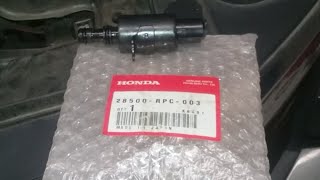
OEM Part Numbers: 28260-RG5-004 28250-PLX-305 28260-PRP-014 28250-RPC-003 28200-PLX-003
Vehicle fitment is dependent on the specific transmission type (5-Speed Automatic vs. CVT). Solenoids can be individual or sold as a pack. Always verify the part number and transmission type before ordering.
We Have This Part in Stock


The information in this article is provided for general reference and educational purposes only. Vehicle specifications, procedures, and part compatibility can vary by production date, trim level, and region. Always consult your vehicle's factory service manual and verify part numbers before purchasing or performing repairs. Safety-critical components such as airbags, seat belts, and braking systems should be installed by a qualified professional.
- Honda Civic: