

Volkswagen GTI Fuel Pump Driver Module Guide (2012-2019)
Solve stalling, no-start, and hesitation issues by understanding your GTI's fuel pump controller.
- A failing module can cause dangerous stalling; do not drive if you suspect an issue.
- Check for open recalls (NHTSA 17V509 / VW 20AE) before buying a new part, as a dealer may replace it for free.
- Replacement is a simple, plug-and-play DIY job located under the rear passenger seat that takes less than an hour.
- Symptoms like stalling when hot that resolve after cooling down strongly point to a failing module rather than the pump itself.
Is Your GTI's Fuel Pump Driver Module Failing?

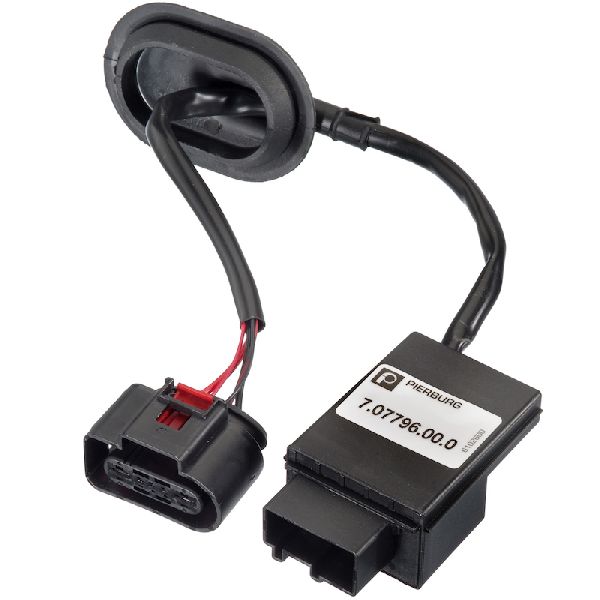
A faulty Fuel Pump Driver Module (FPDM) in a 2012-2019 VW GTI can cause symptoms that are easy to misdiagnose. The module's main job is to control the in-tank fuel pump, and when it fails, it can starve the engine of fuel. Failures are often caused by the module overheating, which can sometimes cause visible melting on the plastic case. Because symptoms can appear suddenly, it's important to recognize the warning signs.
Common Symptoms of a Bad FPDM

- Sudden Engine Stalling: The most serious symptom is the engine shutting off without warning while driving. This can happen at any speed and may not allow for a restart, creating a significant safety risk.
- Engine Cranks but Won't Start: You'll hear the starter trying to turn the engine over, but it never fires up because the fuel pump isn't being activated 🎬 Watch: Diagnosing an extended crank and fuel pump priming issue. to build pressure. This may be intermittent, especially when the module is hot.
- Hesitation and Sputtering: When you accelerate, the engine may stumble or hesitate because the module isn't telling the pump to send enough fuel to meet the demand.
- Check Engine Light: A failing module will often trigger fault codes related to low fuel pressure or fuel system performance. Common codes include P310B (fuel pressure below specification) and P2293 (fuel pressure regulator malfunction).
- Drained Battery: In some cases, the module can fail in the 'on' position, causing the fuel pump to run continuously even when the car is off, draining the battery.
Known Issues & Recalls
Volkswagen issued a safety recall for the Fuel Pump Control Module on some vehicles (NHTSA Campaign 17V509, VW Recall 20AE). This recall addressed modules that could have an electrical interruption, leading to stalling. The fix involved replacing the module and relocating it, suggesting the original location was problematic. Another recall (NHTSA 15V229) affected some 2015 models for a separate issue with the fuel pump itself. Always check with a VW dealer or on the NHTSA website to see if your specific GTI has an open recall before purchasing parts.
Choosing the Right Aftermarket Fuel Pump Driver Module

When replacing the FPDM, you have several aftermarket options. Given the module's history of overheating and the critical safety function it performs, choosing a quality replacement is important.
Brand Tiers for Your GTI
- Tier 1 (OEM Supplier Quality): Hella
Hella is a well-regarded German brand and often an Original Equipment Manufacturer (OEM) for Volkswagen. Choosing Hella provides confidence that the part meets or exceeds the original specifications for performance and durability. It is often considered a top choice for European vehicles. - Tier 2 (Trusted Aftermarket): Standard Ignition (SMP), Dorman
Standard Motor Products (SMP) is a long-standing brand known for producing reliable electronic components that are a solid alternative to OEM. Dorman offers an OE FIX line that sometimes improves on the original design, such as by using a more durable backing plate to resist heat and corrosion. While Dorman's quality can be variable depending on the part, their electronic modules are generally considered a viable repair option. - Tier 3 (Budget-Friendly): Replacement
"Replacement" branded parts are the most affordable option. These are a good choice for budget-conscious repairs, but may not offer the same long-term durability or precise engineering as higher-tiered brands. For a critical part like the FPDM, it's worth considering the potential trade-off between cost and longevity.
Installation & Location
On the Mk6 and Mk7 GTI, the Fuel Pump Driver Module is located under the rear passenger-side seat. You must remove the rear seat bottom cushion to access a small cover plate. The module itself unplugs from the top of the fuel pump assembly cover. The replacement is a straightforward, plug-and-play job that doesn't require special programming 🎬 See this DIY walkthrough for replacing the fuel pump controller., making it very DIY-friendly. The most difficult part is often just removing the rear seat cushion without breaking any clips.
Cost of Replacing a VW GTI Fuel Pump Driver Module

| Part Type | Estimated Cost |
|---|---|
| New Aftermarket Module | $152 - $256 |
| New OEM Module | $60 - $150 |
| Shop Labor | $137 - $201 |
Frequently Asked Questions
Is it the fuel pump or the control module that's bad?
It can be hard to tell without diagnostics. A common failure mode for the module is overheating, so if the car stalls when hot and restarts after cooling down, the module is a strong suspect. A mechanic can test the voltage going from the module to the pump. If correct voltage is sent but the pump doesn't run, the pump is bad. If no voltage is sent, the module is the culprit.
Where is the fuel pump driver module located on a 2012-2019 GTI?
The module is located under the rear seat on the passenger side. You need to lift the rear seat cushion and remove a small access panel to find it clipped into the fuel pump assembly cover.
Is replacing the FPDM a DIY job?
Yes, this is a very DIY-friendly job. The only tools needed are basic hand tools to remove the rear seat and access the module. The module itself is plug-and-play and does not require any programming. The entire process typically takes less than an hour.
Do I need to drain the fuel tank to replace the module?
No. The Fuel Pump Driver Module is mounted externally on top of the fuel pump assembly cover, under the rear seat. You are not opening the fuel tank itself, so there is no need to drain any fuel. You are only disconnecting an electrical component.
Helpful Videos

Technical Specifications
OEM Part Numbers: 5Q0906093C 5Q0906093A 1K0906093J 5Q0906093
Controls the voltage for the in-tank low-pressure fuel pump using a pulse-width modulated (PWM) signal from the ECM. Located under the rear passenger seat.
We Have This Part in Stock


The information in this article is provided for general reference and educational purposes only. Vehicle specifications, procedures, and part compatibility can vary by production date, trim level, and region. Always consult your vehicle's factory service manual and verify part numbers before purchasing or performing repairs. Safety-critical components such as airbags, seat belts, and braking systems should be installed by a qualified professional.
- Volkswagen GTI:
- 🎬 Helpful Videos
- 🛍️ Shop This Part
- Is Your GTI's Fuel Pump Driver Module Failing?
- Common Symptoms of a Bad FPDM
- Known Issues & Recalls
- Choosing the Right Aftermarket Fuel Pump Driver Module
- Brand Tiers for Your GTI
- Installation & Location
- Cost of Replacing a VW GTI Fuel Pump Driver Module
- Frequently Asked Questions
- 🎟️ Get 5% Off