

BMW M5 Ambient Air Temperature Sensor Guide for 2012-2022 Models
Seeing wild temperature swings on your M5's dash? Your ambient air temperature sensor is the likely cause.
- A faulty sensor is the top cause for incorrect outside temperature readings and A/C issues.
- The sensor's location differs between F10 (wheel well) and F90 (front grille) M5 models.
- Before buying a new sensor, always check the wiring and connector for damage or corrosion.
- This is an easy DIY replacement that can be done in under an hour with basic tools.
Is Your M5 Displaying the Wrong Outside Temperature?
If your BMW M5's instrument cluster is showing a temperature that is clearly wrong, like -40°F on a summer day, a faulty ambient air temperature sensor is the most common culprit. This sensor is exposed to the elements and can fail from road debris, moisture, or age. When it fails, it can cause annoying issues with your automatic climate control and may even trigger a check engine light.
Common Symptoms of a Bad Ambient Temp Sensor
- Dashboard temperature display is stuck, incorrect, or fluctuates wildly (e.g., shows -40° or 122°).
- Automatic climate control does not work properly; the A/C may not blow cold air.
- Check Engine Light is on.
Choosing the Right Aftermarket Sensor
When replacing this sensor, you have options. The BMW original equipment (OEM) part is available from dealers, but a quality aftermarket part can offer the same performance for a similar or better price. For a high-performance vehicle like an M5, it's best to avoid the cheapest online options, which can be unreliable. A reputable aftermarket brand like Standard Ignition provides a dependable alternative that meets or exceeds original specifications without the high dealer markup. This ensures your climate control and engine management systems receive accurate data, just like the original part.
Pro Tip: Before replacing the sensor, always inspect the wiring and connector. Sometimes, a reading of -40° is caused by a damaged wire or corroded connector, not a failed sensor. 🎬 Watch how to repair the sensor wiring and fix incorrect readings. This is a common issue on many BMW models.
Cost of Replacing the Ambient Air Temperature Sensor
| Part Type | Estimated Cost |
|---|---|
| New OEM (Dealer) | $55 - $75 |
| New Aftermarket (Standard Ignition) | $57.72 |
| Shop Labor | $60 - $120 |
Frequently Asked Questions
Where is the ambient air temperature sensor located on my M5?
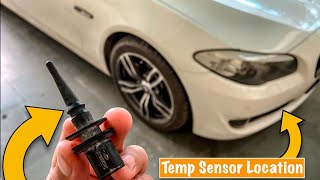
The location depends on your M5's generation. For the F10 M5 (2012-2016), the sensor is typically found in the passenger-side front wheel well, inserted into the brake cooling duct. 🎬 See exactly where the sensor is located on F10 models. For the F90 M5 (2018-2022), it is usually located behind the main kidney grilles.
Why does my dashboard display read -40 degrees?
A reading of -40°F or -40°C is a default value that BMW systems display when there is an "open circuit" from the ambient air temperature sensor. This means the car's computer is not receiving any signal from the sensor. This is almost always caused by a failed sensor, a disconnected plug, or a broken wire.
Can I replace this sensor myself?
Yes, this is a very DIY-friendly job. For most owners, it will take less than an hour with basic tools. Accessing the sensor, which is usually behind the front bumper or in a wheel well liner, is the main task. Once located, the sensor typically unplugs and twists out of its mounting bracket.
🎬 Watch this step-by-step guide to replacing the sensor on an F10.Are there any recalls for the BMW M5 temperature sensor?
No, there are no active recalls or Technical Service Bulletins (TSBs) from the NHTSA specifically for the ambient air temperature sensor on the 2012-2022 BMW M5.
Helpful Videos
Technical Specifications
OEM Part Numbers: 65816905133 65816936953
The sensor is a negative temperature coefficient (NTC) thermistor that changes its resistance based on the surrounding air temperature.
We Have This Part in Stock


The information in this article is provided for general reference and educational purposes only. Vehicle specifications, procedures, and part compatibility can vary by production date, trim level, and region. Always consult your vehicle's factory service manual and verify part numbers before purchasing or performing repairs. Safety-critical components such as airbags, seat belts, and braking systems should be installed by a qualified professional.
- BMW M5: