

Jaguar Radiator Failures (2003-2020): Main, Auxiliary, and Critical Plastic Pipe Leaks
Many Jaguar XF, XJ, F-Type, S-Type, and XK models experience coolant leaks not just from the radiator, but from a network of failure-prone plastic pipes and water pumps.
- The most common cooling system failures on these Jaguars are not the radiator core, but brittle plastic components like coolant pipes, the thermostat housing, and the water pump.
- Crucially identify if you need the main engine radiator or a smaller auxiliary/charge cooler radiator for supercharged models.
- When replacing any part of the cooling system, it is highly advisable to replace all other known plastic failure points at the same time to avoid repeated repairs.
- Always use the Jaguar-specified OAT coolant (STJLR.651.5003) and properly bleed the system of all air after the repair to prevent overheating.
Main Radiator, Auxiliary Radiator, or Charge Cooler? An Essential Guide
Before diagnosing a problem or ordering a part, it's critical to identify which part of the cooling system is affected. These Jaguar vehicles were available with several engine options, and the cooling system design varies significantly, especially between naturally aspirated and supercharged models.
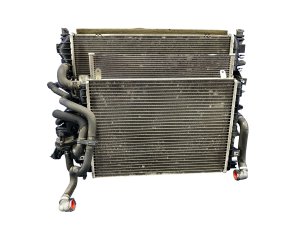
Warning: The term 'radiator' is used for multiple, distinct parts. Supercharged models have a main engine radiator AND a separate radiator (or two) for the supercharger's cooling system. Verify part numbers and visual fitment before ordering.
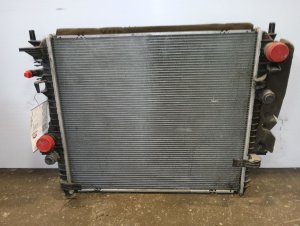
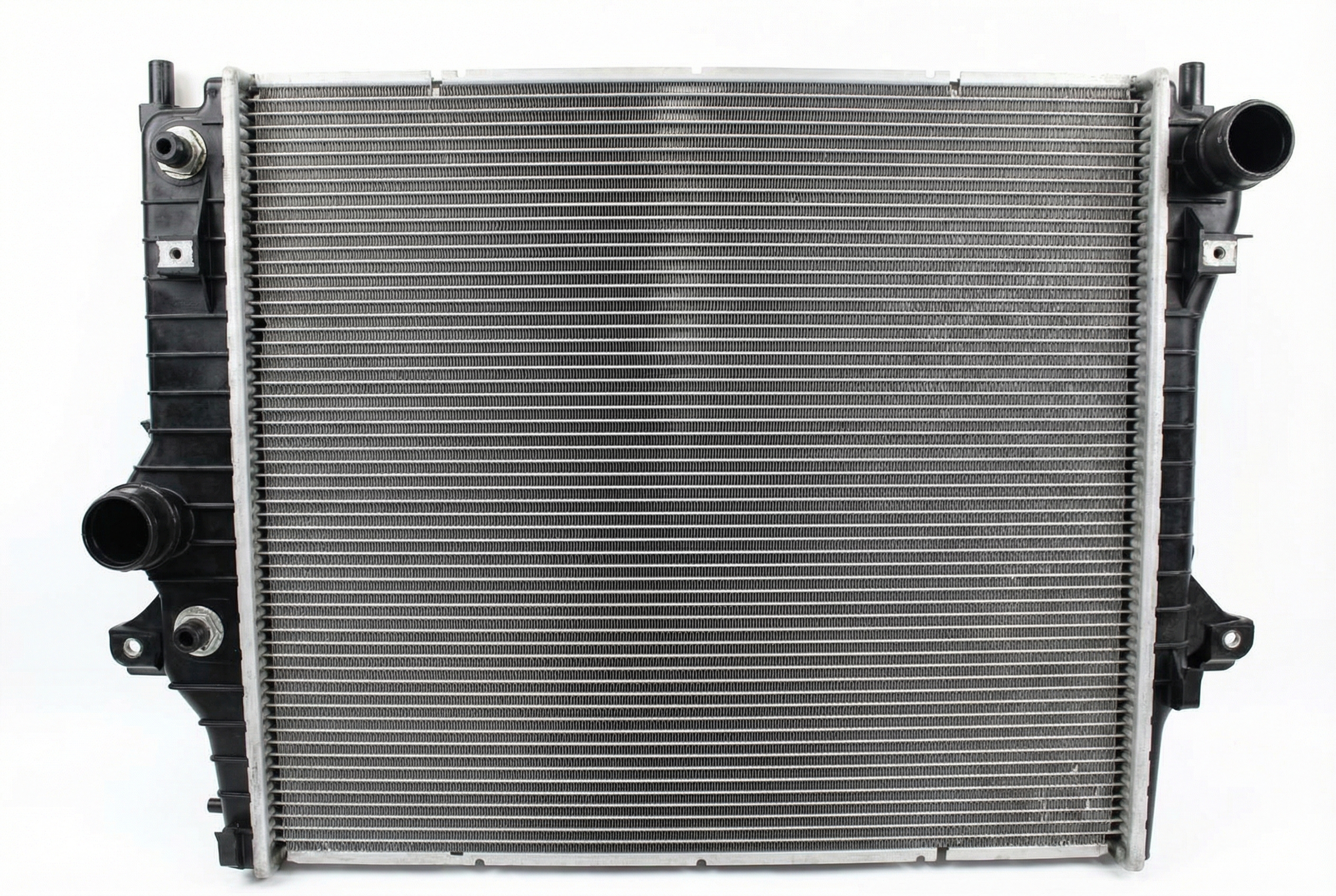
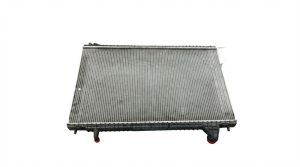
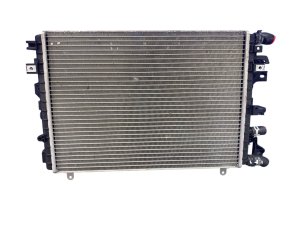
- Main Engine Radiator: This is the largest heat exchanger, typically mounted directly behind the grille. It cools the engine itself and is present on all models.
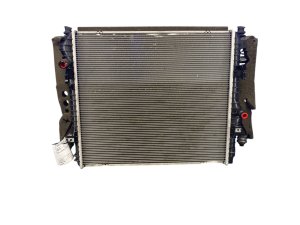
- Auxiliary Radiator / Charge Cooler: These are smaller radiators used on supercharged models (and some turbocharged 2.0L engines) to cool the intake air. They are part of a separate, low-temperature coolant circuit. A failure here will reduce engine performance and may trigger a 'Restricted Performance' warning, but not necessarily cause the engine to overheat immediately.
- Auxiliary Engine Radiator: Some high-performance models also have smaller radiators plumbed into the main engine cooling system for additional capacity. A leak in one of these will cause the main system to lose coolant and overheat.
Symptoms of a Failing Radiator or Cooling System
Radiator failure symptoms are often symptoms of a leak somewhere in the cooling system, which includes many plastic components prone to failure on these vehicles.
- Engine Overheating: The most obvious sign. The temperature gauge will climb into the red, and you may see a dashboard warning message like 'Engine Temperature High'. Do not continue to drive the vehicle if it is overheating.
- Visible Coolant Leaks: You may find puddles of pink or orange fluid under the front of your car. The coolant has a distinct, sweet smell. Leaks often originate from the plastic end tanks of the radiator or the numerous plastic hose connections.
- Low Coolant Warning Light: A 'Coolant Level Low' message on the instrument cluster is a common first sign of a leak.
- Steam from Engine Bay: If coolant leaks onto hot engine components, it will boil off as steam, which is often visible coming from under the hood and accompanied by a strong sweet smell.
- Noises: The radiator itself does not make noise when it fails. However, a failing water pump, a critical related component, can cause grinding or whining noises from the front of the engine.
Common Jaguar Cooling System Failure Points
While the aluminum core of the radiator is fairly robust, the plastic components of the cooling system are a well-documented weak point across this generation of Jaguar engines.
Plastic End Tank and Seam Leaks
The most common radiator failure is not in the metal core, but where the plastic end tanks are crimped to the aluminum core. Over time, heat cycles cause the plastic to become brittle and the seals to degrade, leading to leaks at the seams.
Plastic Coolant Pipes and Hoses
This is the single biggest issue for these vehicles. Jaguar used plastic for many critical coolant pipes that become brittle and crack with age and heat exposure. A coolant leak is more likely to come from one of these pipes than from the radiator itself. Key culprits include:
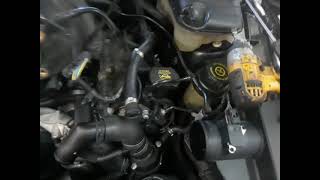
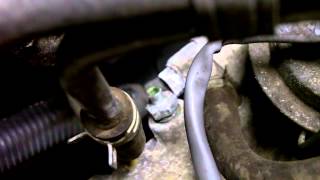
- The coolant outlet pipe (Y-pipe) located under the supercharger. 🎬 See how to remove and upgrade these brittle plastic pipes.
- The rear coolant crossover pipe at the back of the engine.
- Various small plastic hoses and connectors that link the system together.
Water Pump Failure
The water pumps on the 3.0L V6 and 5.0L V8 engines are known to fail, sometimes at relatively low mileage. The internal bearing seal fails, allowing coolant to leak out from a weep hole, often dripping onto the front of the engine.
🎬 Watch this step-by-step guide to replacing the water pump.Auxiliary Radiator Cracks (TSB JTB00672NAS1)
Jaguar issued a technical service bulletin for some 2016-onward XF, XE, and F-Pace models regarding the auxiliary radiators. The bulletin notes that flexing within the mounting structure can cause the plastic on the auxiliary radiator to crack and leak. While this TSB applies to a slightly later XF, the design principle is similar on earlier models.
Buying a Used Radiator
A used OEM radiator can be a smart purchase, offering original-equipment quality and fitment at a significant discount. However, careful inspection is key.
- Physical Inspection: Check the plastic end tanks for any chalky residue, which indicates a slow leak. Look for hairline cracks, especially around the hose connections. Inspect the aluminum core for signs of corrosion (white, powdery buildup) and check that the cooling fins are mostly straight and not clogged with debris.
- Verify Compatibility: This is the most critical step. Match the OEM part number from your old radiator to the used one. Be absolutely sure if you need a main, auxiliary, or charge cooler radiator. For the S-Type, pay close attention to the VIN cutoff (M45255).
- Mileage vs. Condition: For a radiator, physical condition and age are more important than mileage. A 5-year-old radiator with 80,000 miles is likely in better shape than a 15-year-old radiator with 40,000 miles. The plastic degrades over time regardless of use.
- Why Used OEM is a Good Choice: A high-quality, inspected used OEM radiator is often superior to a cheap, new aftermarket part. OEM units have the correct fin density, tube design, and material quality for optimal cooling performance and perfect fitment, which can be a problem with some aftermarket brands.
Vehicle and Part-Specific Information
2003-2008 Jaguar S-Type
VIN Specific Fitment: For 2003 and later models, the main radiator fitment depends on your Vehicle Identification Number (VIN). Part number C2C36506 fits vehicles with a VIN of M45255 or higher. Always verify your VIN before ordering.
2009-2015 Jaguar XF
Fitment varies by engine (2.0L, 3.0L, 4.2L, 5.0L) and whether it is supercharged. The plastic coolant pipes and water pump are very common failure points on the V6 and V8 models. Part number C2C36506 is common for earlier 3.0L and 4.2L models, while C2D38733 is often listed for 2.0L models.
2004-2019 Jaguar XJ
This long production run saw many changes. Early X350 models (2004-2009) share parts like the C2C36506 radiator with the S-Type and XF. Later X351 models (2010-2019) with the 5.0L and 3.0L engines suffer from the same plastic pipe and water pump issues as the XF and F-Type.
2014-2020 Jaguar F-Type
As it shares the 3.0L and 5.0L supercharged engines, the F-Type is susceptible to all the same cooling system weaknesses, including water pump and plastic pipe failures. The cooling system is complex, often featuring multiple auxiliary radiators for the supercharger circuit.
2010-2015 Jaguar XK
The XK (X150) with the 5.0L engine is also known for coolant leaks from the water pump and brittle plastic valley pipes. Due to the tight packaging, some leaks can be difficult to trace without a pressure test.
Cost of Replacement
Replacing a radiator on these Jaguar models can be expensive, largely due to the cost of the part and the labor required to access it. Prices are for the main engine radiator.
| Item | Estimated Cost |
|---|---|
| New OEM Radiator | $450 - $1,600 |
| New Aftermarket Radiator | $150 - $400 |
| Used OEM Radiator | $100 - $300 |
| Shop Labor | $400 - $800 |
| Total Cost (Shop) | $600 - $2,400+ |
Related Parts to Inspect and Replace
When replacing a radiator, it's the perfect time to address other known failure points in the cooling system. Labor often overlaps, saving you money in the long run.
Pro Tip: If you are paying for labor to access the cooling system, it is highly recommended to replace all known-failure plastic components like the water pump, thermostat, and coolant pipes at the same time. It is very common for a brittle plastic pipe to break during a radiator replacement, turning a straightforward job into a major repair.
- Water Pump: If it hasn't been replaced recently, change it.
- Thermostat & Housing: These are plastic and prone to cracking and leaking.
- Coolant Hoses & Pipes: Inspect all hoses for swelling or cracking. Strongly consider replacing the plastic 'Y' pipe and rear crossover pipe on V6/V8 models if they are original.
- Coolant Expansion Tank: The plastic can become brittle and the level sensor can fail.
- Coolant: Always refill the system with new coolant that meets Jaguar specification (typically an OAT coolant, specification STJLR.651.5003). Do not use universal coolant.
Frequently Asked Questions (FAQ)
Is this the main radiator or the supercharger radiator?
You must identify this based on your vehicle's engine and the location of the part. The main radiator is large and cools the engine. The supercharger radiators (charge coolers) are smaller and cool the intake air on supercharged models. Check part numbers and diagrams for your specific vehicle.
Do I need to bleed the cooling system after replacing the radiator?
Yes, this is a critical step. Air trapped in the system will cause hot spots and lead to overheating, even with a new radiator. The system must be properly bled according to the manufacturer's procedure, which often involves opening a bleed screw on the expansion tank or a high point in the system.
Can I use universal coolant in my Jaguar?
No. It is strongly recommended to use coolant that meets the specific Jaguar OAT (Organic Acid Technology) specification, which is typically orange or pink. The correct specification is usually STJLR.651.5003. Using the wrong coolant can lead to corrosion and damage to cooling system components.
My radiator was just replaced, but the car is still overheating. What's wrong?
The most common cause is air trapped in the system from an improper bleed procedure. Other possibilities include a faulty new thermostat, a failing water pump that wasn't replaced, or another leak in the system that was missed (like a cracked plastic pipe).
Helpful Videos



Technical Specifications
OEM Part Numbers: 9W838K230AB C2C1448 C2C36506 C2C39565 C2D26048 C2D26542 C2D38733 C2D38735 C2Z10786 C2Z10787 XR847964
Varies by part number. Core materials are typically aluminum with plastic end tanks. Coolant required is OAT-based, meeting specification STJLR.651.5003.
We Have This Part in Stock

The information in this article is provided for general reference and educational purposes only. Vehicle specifications, procedures, and part compatibility can vary by production date, trim level, and region. Always consult your vehicle's factory service manual and verify part numbers before purchasing or performing repairs. Safety-critical components such as airbags, seat belts, and braking systems should be installed by a qualified professional.
- Jaguar XF:
- Jaguar XJ:
- Jaguar F-Type:
- Jaguar S-Type:
- Jaguar XK:
- 🎬 Helpful Videos
- 🛍️ Shop This Part
- Main Radiator, Auxiliary Radiator, or Charge Cooler? An Essential Guide
- Symptoms of a Failing Radiator or Cooling System
- Common Jaguar Cooling System Failure Points
- Plastic End Tank and Seam Leaks
- Plastic Coolant Pipes and Hoses
- Water Pump Failure
- Auxiliary Radiator Cracks (TSB JTB00672NAS1)
- Buying a Used Radiator
- Vehicle and Part-Specific Information
- 2003-2008 Jaguar S-Type
- 2009-2015 Jaguar XF
- 2004-2019 Jaguar XJ
- 2014-2020 Jaguar F-Type
- 2010-2015 Jaguar XK
- Cost of Replacement
- Related Parts to Inspect and Replace
- Frequently Asked Questions (FAQ)
- 🎟️ Get 5% Off