

2020-2024 Tesla Model Y & 2021-2024 Model 3 Heat Pump Failure: No Heat, A/C, and Refrigerant System Guide
This guide covers the common failures in the heat pump thermal management system—from sensors to the Octovalve and compressor—that can leave you without climate control.
- This guide is ONLY for heat pump-equipped vehicles: all 2020-2024 Model Ys and 2021-2024 Model 3s. It does not apply to earlier Model 3s.
- A loud, high-pitched squeal in cold weather is a critical warning of impending compressor failure. Address it immediately to avoid contaminating the entire A/C system with metal debris.
- Two major documented issues exist: a software recall (NHTSA 22V-063) for loss of heat and a service bulletin (SB-21-18-002) for faulty refrigerant sensors. Both can cause a total loss of climate control.
- Replacement is a complex, 5/5 difficulty job for professionals only. It requires specialized A/C equipment and Tesla's diagnostic software to commission the new parts.
Vehicle Fitment and Important Compatibility Notes
This guide applies specifically to Tesla models equipped with the heat pump thermal management system:
- 2020-2024 Tesla Model Y (all models)
- 2021-2024 Tesla Model 3 (all models)
Warning: This system and its components are NOT compatible with 2017-2020 Tesla Model 3 vehicles. Those earlier models use a different Positive Temperature Coefficient (PTC) resistive heater. Attempting to fit heat pump components to a non-heat-pump car will not work.
Known Issues, Recalls, and Service Bulletins
The heat pump system in these vehicles is known for several widespread issues, leading to official recalls and service bulletins. Many owners experience a loss of heat in cold climates, which can be a significant safety issue.
NHTSA Recall 22V-063: Loss of Heat from Software Error
In February 2022, Tesla issued a recall for over 26,000 vehicles, including the 2020-2022 Model Y and 2021-2022 Model 3. A software error could cause a valve in the heat pump to open unintentionally in cold temperatures (below 14°F / -10°C), trapping refrigerant. This would cause the compressor to enter a fail-safe mode and shut down, resulting in a total loss of cabin heat and the inability to defrost the windshield. Tesla's fix was an over-the-air (OTA) software update (version 2021.44.30.7 or later), which resolved the software command issue. However, some owners report that the event may have stressed physical components, leading to hardware failures later on.
Service Bulletin SB-21-18-002: Faulty Refrigerant Sensors
One of the most common hardware failures is addressed by Tesla Service Bulletin SB-21-18-002. Certain Model 3 and Model Y vehicles were built with refrigerant pressure/temperature (P/T) sensors that can fail over time. These faulty sensors provide incorrect data to the climate control system, which then shuts down the heat pump as a protective measure. The symptom is a sudden loss of heating and cooling. The official repair is to replace all three P/T sensors in the system with updated parts.
Catastrophic Compressor Failure
The most severe failure is a mechanical breakdown of the A/C compressor. This is often preceded by a loud, high-pitched squeal (sometimes called the 'squeal of death') during preconditioning in cold weather. When the compressor fails, it can send metal shavings and debris throughout the entire sealed refrigerant system. This contaminates the Supermanifold (Octovalve), chiller, and all connecting lines. A simple compressor replacement is not enough in this case; the entire system must be flushed, and multiple components often require replacement to prevent the new compressor from failing immediately.
Symptoms of a Failing Heat Pump System
| Symptom | Description |
|---|---|
| No Cabin Heat or A/C | The most common symptom is a complete loss of climate control. The fans will blow, but the air is at ambient temperature. This is a critical failure in extreme weather. |
| Loud Squeal or Grinding Noise | A high-pitched, metallic squeal from the front of the car, especially in the cold, is a critical warning of impending compressor failure. Ignoring this can lead to a much more expensive, system-wide repair. |
| Inability to Defrost Windshield | Because the system cannot produce heat, it cannot defrost or defog the windshield. This severely reduces driver visibility and is a major safety hazard that prompted an official recall. |
| On-Screen Error Messages | The system will report faults on the main screen. Common alerts include 'Cabin climate control system requires service', 'VCFRONT_a447', 'VCFRONT_a160' (Compressor Inhibited), and 'BHI_a180'. |
| Reduced Performance or Slow Charging | The thermal system also cools the battery. If it fails, the vehicle may limit performance and DC fast charging speeds to protect the battery from overheating. |
Buying a Used Tesla Heat Pump Assembly
Given the high cost of new parts, a used OEM assembly can be a smart purchase. However, because these are complex and sensitive components, careful inspection is critical.
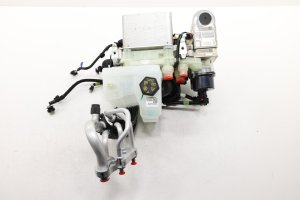
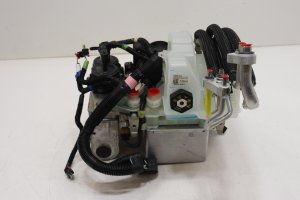
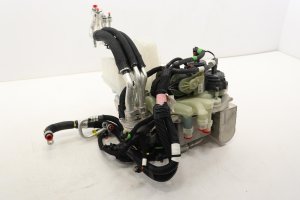
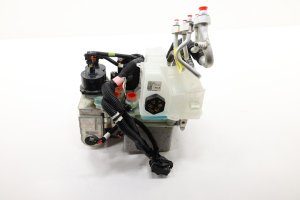
Pro Tip: The term 'Refrigerant Part' is a misnomer. You are likely looking for one of three main components: the A/C Compressor, the Supermanifold/Octovalve assembly (P/N 1506859-00-E is a common one), or the Chiller/Auxiliary Pump (P/N 1523003-00-B is a known part). Correctly diagnosing which part has failed is the first step.
- Verify the Donor Vehicle's History: This is the most important step. Ask the seller if the donor car had a compressor failure. If the compressor failed and sent metal through the system, any other component from that system (like the Supermanifold) is likely contaminated and should be avoided.
- Physically Inspect the Part: Carefully examine the entire assembly. Look for cracks in the black plastic housing, damage to the aluminum lines, and bent or broken electrical connector pins. Check for oily residue around fittings, which indicates a refrigerant leak.
- Match Part Numbers Carefully: Tesla uses many part number revisions. While the list of known numbers is long, you should try to match the part number from your failed component exactly. If you can't, consult with a knowledgeable seller who can verify compatibility. The newest revision part is often the most reliable.
- Look for Intact Ports: Ensure the refrigerant line ports are clean, capped, and undamaged. Debris or moisture entering the system during storage can cause premature failure of a replacement part.
Cost Comparison
Repairing the heat pump system out of warranty is one of the most expensive maintenance items for these vehicles.
| Part/Service | Estimated Cost (USD) | Notes |
|---|---|---|
| New OEM Full System Replacement (at Tesla) | $3,000 - $5,500+ | This often includes the compressor, Supermanifold, lines, and labor. One owner reported a final bill of $3,694. Another reported a quote of nearly $5,700 CAD. |
| New OEM P/T Sensor Replacement (at shop) | $450 - $900 | This is for the common sensor failure (TSB SB-21-18-002) and includes parts, labor, and an A/C system recharge. |
| Used OEM A/C Compressor | $300 - $600 | Part cost only. Represents a significant savings over new. |
| Used OEM Supermanifold/Octovalve | $350 - $500 | Part cost only. |
| Shop Labor for Major Component Replacement | $1,600 - $2,400+ | This is a labor-intensive job that takes several hours. |
Replacement Difficulty: Is This a DIY Job?
- Difficulty Rating: 5 out of 5 (Professional Only)
- Estimated Time: 4-6 hours
Replacing any major component of the heat pump system is not a DIY task. The job requires specialized, expensive equipment to safely recover, vacuum, and recharge the R-1234yf refrigerant. The system is also tied into the vehicle's high-voltage battery and coolant loops. Access requires placing the vehicle into Service Mode and using Tesla's Toolbox 3 diagnostic software to run procedures like 'Thermal Fill/Drain' and 'Heat Pump Commissioning' to properly bleed the system and verify the repair. Failure to perform these steps correctly will result in the new parts not working or being damaged.
Frequently Asked Questions (FAQ)
What type of refrigerant and oil does the Tesla heat pump system use?
The heat pump system in the Model 3 and Model Y uses R-1234yf refrigerant. The specified compressor oil is POE ND-11 or an equivalent. Do not use any other type of refrigerant or oil.
My heat failed right after a software update. Is it a hardware problem?
It could be either. The official recall (22V-063) was for a software bug that caused heat failure. However, software updates can sometimes change system parameters and expose a borderline hardware issue, like a failing sensor, that was previously working. If an OTA update doesn't fix the problem, a hardware fault is likely.
Can I just replace a single faulty sensor on the Supermanifold?
Yes, the pressure/temperature (P/T) sensors can be replaced individually. However, Tesla's own service bulletin (SB-21-18-002) recommends replacing all three at the same time, as they are a known failure point. This prevents you from having to do the same expensive repair again if another original sensor fails.
Is the heat pump failure covered under warranty?
Yes, if the vehicle is still within its Basic Vehicle Limited Warranty period (typically 4 years / 50,000 miles), this repair should be covered. However, many of these vehicles are now outside of that warranty, and the repair can be very expensive. Some owners have had success getting 'goodwill' assistance from Tesla for out-of-warranty repairs, but this is not guaranteed.
Technical Specifications
OEM Part Numbers: 150202200E 150680300F 1506859-00-E 1523003-00-B 1523003-80-B 1547595-00-D 1547595-00-F 1547595-03-H 1547595-98-E 1547595-A0-F 1547595-A2-F 1549902-00-C 1613703-00-B 1625000-99-B 1501256-01-M 1510047-00-B 1510048-00-B
Refrigerant Type: R-1234yf. Compressor Oil: POE ND-11 or equivalent.
We Have This Part in Stock

The information in this article is provided for general reference and educational purposes only. Vehicle specifications, procedures, and part compatibility can vary by production date, trim level, and region. Always consult your vehicle's factory service manual and verify part numbers before purchasing or performing repairs. Safety-critical components such as airbags, seat belts, and braking systems should be installed by a qualified professional.
- Tesla Y:
- Tesla 3:
- 🛍️ Shop This Part
- Vehicle Fitment and Important Compatibility Notes
- Known Issues, Recalls, and Service Bulletins
- NHTSA Recall 22V-063: Loss of Heat from Software Error
- Service Bulletin SB-21-18-002: Faulty Refrigerant Sensors
- Catastrophic Compressor Failure
- Symptoms of a Failing Heat Pump System
- Buying a Used Tesla Heat Pump Assembly
- Cost Comparison
- Replacement Difficulty: Is This a DIY Job?
- Frequently Asked Questions (FAQ)
- 🎟️ Get 5% Off