

2017-2025 Honda Ridgeline Subwoofer & Speaker Diagnostic Guide
Diagnosing common audio problems, from a faulty subwoofer to crackling door speakers, and understanding the Ridgeline's standard vs. premium sound systems.
- The most common reason for speaker replacement in the Ridgeline is to upgrade for better sound quality, not due to frequent failures.
- The OEM subwoofer (Part No. 39120-T6Z-A21) fits all 2017-2025 trims equipped with a sub, but door speakers may differ between the 7-speaker standard and 8-speaker premium audio systems.
- Symptoms of a bad speaker include crackling, buzzing, or a total loss of sound from one location. A lack of bass is the key symptom of a failed subwoofer.
- Replacement is DIY-friendly; door speakers require removing the door panel, while the subwoofer requires removing the rear seat assembly.
Symptoms of Speaker & Subwoofer Failure

Speaker issues in the 2017-2025 Honda Ridgeline are more often a result of owner dissatisfaction with audio quality rather than outright failure. However, when a speaker does fail, the symptoms are usually obvious. Diagnosing the problem often starts with using the balance and fader controls on your radio to isolate the sound to a specific corner of the truck.
- Crackling or Popping Sounds: This is a classic sign of a blown speaker. The noise is often most noticeable at higher volumes or during bass-heavy music passages and can be caused by a damaged voice coil or a torn speaker cone.
- Buzzing or Rattling: A persistent buzz, especially with low-frequency notes, may indicate the speaker cone has separated from its suspension or that the speaker itself is loose in its mounting.
- No Sound from One Speaker: If a single speaker is silent, the speaker itself may have failed completely, or there could be a wiring issue between it and the amplifier or head unit. Use your stereo's balance and fader controls to confirm the issue is with only one speaker.
- Weak or "Flat" Sound: A sudden loss of bass and a thin, tinny sound often points to a failed subwoofer. Since the subwoofer (part number 39120-T6Z-A21) handles the lowest frequencies, its failure will be immediately noticeable as a lack of depth in the music.
- Muffled or Distorted Audio: If the sound is fuzzy or unclear even at low volumes, the speaker's voice coil or cone is likely damaged. If distortion only happens at high volumes, you may be over-driving the speaker with an underpowered factory amplifier.
Known Issues, TSBs, and Recalls
As of early 2026, there are no specific recalls or Technical Service Bulletins (TSBs) from Honda related to the speakers or subwoofer in the 2017-2025 Ridgeline. Most owner complaints center on the perceived low quality of the standard audio system, which drives many to pursue aftermarket upgrades.
It is worth noting that a recall (NHTSA Campaign ID: 24V321000) was issued for the 2020-2024 Ridgeline concerning the rearview camera's tailgate wiring harness. This issue can cause the backup camera to fail but is unrelated to the audio system's speakers.
Audio System Variants: Standard vs. Premium

Understanding which audio system your Ridgeline has is critical for ensuring part compatibility. The primary difference lies in the amplification and total speaker count.
- Standard Audio System: Found on lower trims like the Sport, this is a 215-watt system with 7 speakers. This includes a speaker in each of the four doors, two tweeters in the front A-pillars, and the subwoofer on the rear cab wall.
- Premium Audio System: Found on higher trims like the RTL-E, TrailSport, and Black Edition, this is a 540-watt system with 8 speakers. It uses a more powerful amplifier and adds a center-dash speaker to the standard 7-speaker layout.
Pro Tip: The OEM subwoofer, Honda part number 39120-T6Z-A21, is used in all trims that are equipped with a subwoofer from the factory, including both standard and premium systems. However, the door speakers and tweeters may have different impedance ratings or power handling capabilities between the two systems. When replacing these, it's important to match them to your vehicle's specific audio package.
Buying a Used Speaker or Subwoofer
Purchasing a used OEM speaker can be a cost-effective solution, especially since these speakers are not a common failure point. A used OEM unit ensures perfect fitment and maintains the original sound balance of the vehicle.
What to Inspect:
- Cone and Surround: Visually inspect the speaker cone (the main paper or plastic cone) for any rips, tears, or holes. Check the flexible rubber or foam ring around the cone, known as the surround, for any signs of cracking, brittleness, or rot.
- Electrical Connector: Ensure the plastic connector is not cracked or broken and that the metal pins inside are not corroded or bent.
- Subwoofer Enclosure: The OEM subwoofer (39120-T6Z-A21) is mounted in a polymer enclosure. Check that this enclosure is not cracked and that all mounting tabs are intact.
- Part Number Verification: Always match the part number exactly. For the subwoofer, confirm the part is 39120-T6Z-A21. For door speakers, it is best to remove the old speaker first to verify its part number before ordering a replacement.
Replacement Overview
Replacing the speakers in a Ridgeline is a manageable DIY project for most people with basic tools.
- Front & Rear Door Speakers: This requires removing the interior door panel. 🎬 Watch this video to see how to remove the door panel. The process involves removing a few screws (often hidden behind small covers in the door handle and armrest area) and then carefully prying the panel off with a plastic trim removal tool to release the clips. The speaker is then simply unscrewed and its wiring harness disconnected.
- Front Tweeters: The tweeters are located in the A-pillar trim panels next to the windshield. This panel is typically removed by prying it away from the frame to release its clips.
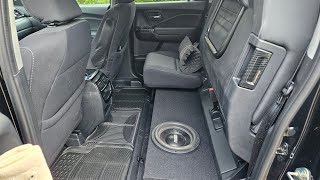
- Subwoofer: This is the most involved replacement. Accessing the subwoofer requires the removal of the rear seat assembly. 🎬 See how to access the subwoofer by removing the rear seats. While not overly complex, it involves unbolting the seats and can be cumbersome. Having a helper is recommended.
Warning: When installing aftermarket speakers, you will likely need speaker adapter brackets to fit the new speaker into the factory location and a wiring harness adapter to connect to the factory plug without cutting wires. The factory subwoofer has a low impedance (2 ohms), so replacing it with a standard 4-ohm aftermarket sub will result in lower volume unless you also install a compatible aftermarket amplifier.
🎬 Check out this custom subwoofer and amplifier installation walkthrough.Cost Comparison
Prices for speakers can vary significantly based on type and brand. The costs below are estimates for the factory subwoofer (39120-T6Z-A21) and a pair of typical aftermarket 6.5-inch door speakers.
| Part Type | Estimated Cost |
|---|---|
| New OEM Subwoofer (39120-T6Z-A21) | $150 - $225 |
| Used OEM Subwoofer | $60 - $100 |
| New Aftermarket Door Speakers (Pair) | $80 - $200+ |
| Shop Labor (Door Speaker, 1 Door) | $100 - $150 |
| Shop Labor (Subwoofer) | $200 - $300 |
Frequently Asked Questions (FAQ)
How do I know if I have the standard or premium audio system?
The easiest way is to check your vehicle's trim level. RTL-E, TrailSport, and Black Edition trims typically have the 8-speaker, 540-watt premium system. Lower trims like the Sport have the 7-speaker, 215-watt standard system. Visually, the premium system includes a speaker grille in the center of the dashboard near the windshield, which the standard system lacks.
Is a crackling sound always a bad speaker?
Not always, but it is the most common cause. A crackling or static sound can also be caused by a poor connection at the speaker, a faulty amplifier, or a problem with the head unit itself. The best way to check is to swap the suspect speaker with a known good one from another door. If the problem moves with the speaker, the speaker is bad. If the problem stays in the same location, the issue is likely with the wiring or amplifier channel.
Can I replace just one speaker?
Yes. If you are replacing a failed speaker with an identical used OEM unit, there is no need to replace them in pairs. However, if you are upgrading to aftermarket speakers, it is highly recommended to replace them in pairs (both front doors or both rear doors) to ensure a balanced sound stage.
Will aftermarket speakers sound better with the factory radio?
Often, yes. Many aftermarket speakers are more efficient and made from higher-quality materials than the basic factory paper-cone speakers, which can result in improved clarity and detail even with the factory radio's power. However, to get the most significant improvement, especially in volume and bass response, an aftermarket amplifier is often necessary.
Helpful Videos
Technical Specifications
OEM Part Numbers: 39120-T6Z-A21
The factory subwoofer has a 2-ohm impedance. The standard audio system is 215 watts, and the premium system is 540 watts.

The information in this article is provided for general reference and educational purposes only. Vehicle specifications, procedures, and part compatibility can vary by production date, trim level, and region. Always consult your vehicle's factory service manual and verify part numbers before purchasing or performing repairs. Safety-critical components such as airbags, seat belts, and braking systems should be installed by a qualified professional.
- Honda Ridgeline: