

2004-2012 Ford Taurus, Flex, MKS, MKT & Sable Steering Knuckle: Diagnosing Clunks, Pulling, and Tire Wear
This guide covers the common failure symptoms, vehicle-specific issues, and replacement costs for the steering knuckles on two generations of Ford and Lincoln vehicles.
- This guide covers two different vehicle platforms; parts are NOT interchangeable between the 2004-2007 Taurus/Sable and the 2010-2012 Taurus/Flex/MKS/MKT.
- A bad knuckle causes noises, steering pull, and uneven tire wear. Failure is usually from an impact or corrosion.
- When replacing the knuckle, it is critical to also replace the wheel hub/bearing assembly and use new, one-time-use fasteners.
- A professional wheel alignment is mandatory after replacing a steering knuckle to ensure safety and prevent tire damage.
Vehicle Compatibility Warning: Two Platforms, Two Different Parts
This guide covers a range of Ford, Lincoln, and Mercury vehicles that use similar, but not interchangeable, steering knuckles. The listed vehicles are built on two completely different platforms. It is critical to identify which group your vehicle belongs to before sourcing a part.
- Group 1 (D186 Platform): 2004-2007 Ford Taurus, 2004-2005 Mercury Sable. These vehicles 🎬 See a full front suspension replacement on this platform use older style knuckles, such as OEM part number 4F1Z-3K185-AA.
- Group 2 (D3/D4 Platform): 2010-2012 Ford Taurus, 2010-2012 Ford Flex, 2010-2012 Lincoln MKS, 2010-2012 Lincoln MKT. These vehicles use a newer, distinct knuckle design, such as OEM part number AA5Z-3K185-A.
Warning: The steering knuckles for these two groups are not compatible. Installing the wrong part will result in incorrect suspension geometry, making the vehicle unsafe to drive.
Symptoms of a Bad Steering Knuckle
A steering knuckle is a solid piece of metal, so it doesn't 'wear out' like a brake pad. Failure is almost always caused by an impact (like hitting a curb or large pothole), severe corrosion, or damage from a failed wheel bearing. Here are the most common signs of a bad knuckle.
Abnormal Noises
Clunking, popping, or grinding sounds, especially when turning at low speeds like in a parking lot, are a primary symptom. While these noises 🎬 Watch: How to diagnose common front-end suspension noises can also be caused by bad ball joints or tie rod ends, a cracked or damaged knuckle can cause components to shift and make noise.
Steering and Handling Problems
A bent steering knuckle will alter your wheel alignment, leading to several handling issues:
- Vehicle Pulling: The car consistently pulls to one side, even after a recent alignment.
- Crooked Steering Wheel: You have to hold the steering wheel off-center to drive straight.
- Loose or Vibrating Steering: The steering may feel vague, or you might feel vibrations through the wheel. This indicates a connection in the front suspension is no longer tight.
Uneven Tire Wear
A bent knuckle changes the camber or toe angle of the wheel, causing tires to wear down rapidly on the inner or outer edge. If you see one tire wearing out much faster than the others, a damaged knuckle is a likely suspect.
Known Issues, Recalls, and TSBs
There are no major recalls specifically for steering knuckle failure on the vehicles covered in this guide. However, there are related issues to be aware of:
- Power Steering Failure (Group 2): Many 2010-2012 Ford Flex, Taurus, and Lincoln MKS/MKT vehicles were part of recall 15S18 for a potential loss of electronic power steering assist. This is a failure of the steering gear or its control module, not the knuckle itself. However, the symptom—difficulty steering—can be confusing. If your steering suddenly becomes very heavy, this recall may be relevant.
- Corrosion: Vehicles operated in salt-belt states are prone to severe corrosion. While the knuckle itself is robust, rust can seize the wheel hub assembly, making it impossible to remove without damaging the knuckle. In these cases, replacing the knuckle and hub together is the only option.
Buying a Used Steering Knuckle: What to Look For
A used OEM steering knuckle can be an excellent value, as it's a durable factory part without the high cost of a new one. Here’s how to inspect a used knuckle to ensure you’re getting a good part.
Pro Tip: An OEM used knuckle is often a better choice than a cheap, new aftermarket part. Factory parts are made from high-quality materials with precise geometry. Some aftermarket knuckles can have casting flaws or slight dimensional errors that cause persistent alignment problems.
1. Thorough Visual Inspection
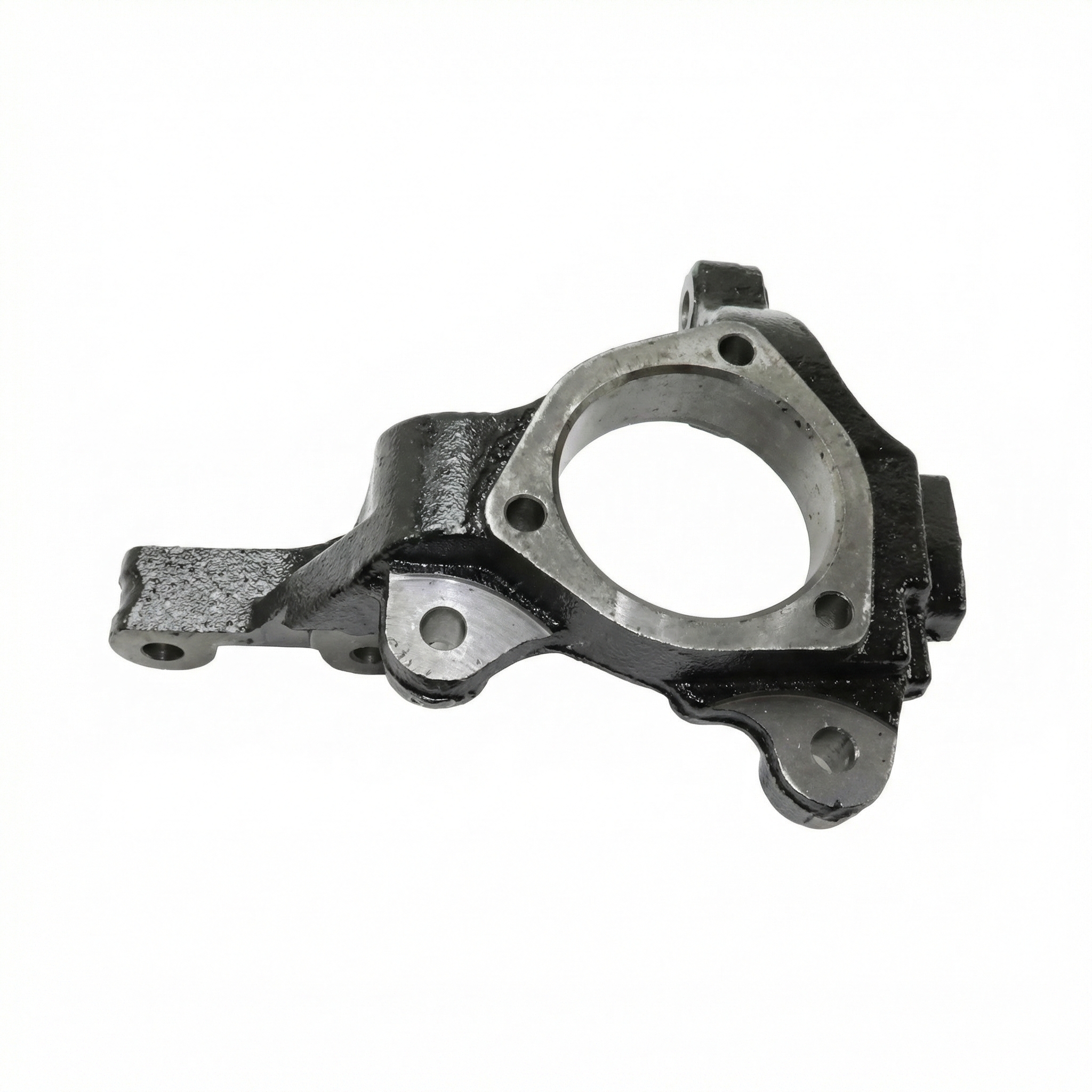
- Check for Cracks: This is the most important check. Pay close attention to the area where the wheel bearing presses in (the bore), the mounting tabs for the brake caliper, and the points where the strut and ball joint attach. Any visible crack means the part is junk.
- Inspect the Bearing Bore: Look for scoring, gouges, or signs of a bearing spinning inside the knuckle. If a wheel bearing failed catastrophically, it could have damaged the knuckle's inner surface, making it impossible for a new bearing to fit tightly.
- Examine for Bends or Impact Damage: Compare the knuckle to a picture of a new one. Look for any signs that it has been bent or deformed from an accident. Check that all mounting holes are round and not elongated.
- Check for Corrosion: Surface rust is normal, but avoid parts with deep, flaking rust that compromises the part's structural integrity, especially around mounting points.
2. Verify Compatibility
- Platform Match: Ensure the part is from the correct vehicle group (Group 1 or Group 2 as defined above).
- Side Match: Knuckles are specific to the driver (left) or passenger (right) side. They are not interchangeable.
- Drivetrain Match (FWD vs. AWD): For some models, there may be differences between Front-Wheel Drive and All-Wheel Drive knuckles. The primary difference is often the splined opening for the axle shaft. Always confirm the part you are buying matches your vehicle's drivetrain.
3. Mileage and Included Parts
Unlike moving parts, mileage is less of a concern for a solid knuckle. The history of the donor car is more important; a part from a car with no collision damage is ideal. Avoid knuckles sold with the old wheel hub still attached. The hub and bearing should be considered a wear item and replaced new during the installation.
🎬 Watch: Step-by-step guide for hub, axle, and knuckle replacementReplacement Overview and Related Parts
Replacing a steering knuckle is a labor-intensive job that requires significant disassembly of the suspension. A wheel alignment is mandatory after the job is complete.
Warning: This repair is critical to your safety. If you are not comfortable with major suspension work and do not have the right tools, this job should be left to a professional technician.
Parts to Replace at the Same Time:
- Wheel Hub & Bearing Assembly: It is highly recommended to install a new wheel bearing and hub with a replacement knuckle. The old bearing is often damaged during removal or is near the end of its service life anyway.
- Ball Joints & Tie Rod Ends: Since you have to disconnect these parts anyway, inspect them for wear. If they are original or show any signs of play, now is the perfect time to replace them.
- Fasteners: Many of the nuts and bolts, particularly the axle nut and strut-to-knuckle bolts, are designed for one-time use (torque-to-yield). Always install new fasteners as specified by the manufacturer.
Cost to Replace a Steering Knuckle
The total cost can vary significantly based on your vehicle, local labor rates, and which related parts you replace at the same time.
| Item | Estimated Cost (per side) |
|---|---|
| New OEM Steering Knuckle | $250 - $550+ |
| New Aftermarket Steering Knuckle | $100 - $250 |
| Used OEM Steering Knuckle | $50 - $150 |
| Shop Labor | $250 - $500 (2-4 hours) |
| Mandatory Wheel Alignment | $100 - $200 |
Torque Specifications
Using a torque wrench is critical for this job. Overtightening or undertightening suspension components can lead to premature failure or a catastrophic separation. These values are for reference only; always consult a model-specific service manual.
| Fastener | Group 1 (2004-07 Taurus / Sable) | Group 2 (2010-12 Taurus / Flex / MKS / MKT) |
|---|---|---|
| Axle Hub Nut | 184 lb-ft | 258 lb-ft (350 Nm) |
| Strut-to-Knuckle Bolts/Nuts | 70-95 lb-ft | 129 lb-ft (175 Nm) |
| Tie Rod End Nut | 23-35 lb-ft | 85 lb-ft (115 Nm) |
| Lower Ball Joint Nut | 40-55 lb-ft | 111 lb-ft (150 Nm) |
Frequently Asked Questions
Do I really need an alignment after replacing a steering knuckle?
Yes, absolutely. A wheel alignment is not optional. The steering knuckle is the central component that dictates the wheel's angles (camber, toe, and caster). Replacing it guarantees these angles will be incorrect. Driving without an alignment will cause poor handling and destroy your tires in a very short time.
Can I just replace the wheel bearing instead of the whole knuckle?
Yes, if the knuckle itself is not damaged. The wheel bearing is a serviceable part. However, if the knuckle was damaged by an impact, or if the bearing bore is scored or corroded from a previous bearing failure, installing a new bearing into the old knuckle is a waste of money and labor.
What's the difference between a steering knuckle and a spindle?
The terms are often used interchangeably, but they technically refer to different designs. A spindle typically refers to a solid, non-driven axle shaft that the wheel bearings ride on (common on older RWD vehicles). A steering knuckle is a more complex housing that the wheel hub/bearing assembly bolts or presses into, and it has a hole for a FWD or AWD axle shaft to pass through. All the vehicles in this guide use steering knuckles.
Does this part fit both Front-Wheel Drive (FWD) and All-Wheel Drive (AWD) models?
Sometimes, but not always. For the Group 2 vehicles (Flex, MKS, MKT, later Taurus), the front knuckles are often the same for FWD and AWD versions because both use a CV axle shaft that passes through the knuckle. However, you must always verify the part number for your specific application. Do not assume they are interchangeable.
Helpful Videos
Technical Specifications
OEM Part Numbers: 4F1Z-3K185-AA AA533K171AA AA533K171AB AA533K171AC AA5Z-3K185-A AA5Z-3K186-A
Material: Cast Iron or Cast Aluminum. Location: Front Suspension, Left or Right side specific.
We Have This Part in Stock

The information in this article is provided for general reference and educational purposes only. Vehicle specifications, procedures, and part compatibility can vary by production date, trim level, and region. Always consult your vehicle's factory service manual and verify part numbers before purchasing or performing repairs. Safety-critical components such as airbags, seat belts, and braking systems should be installed by a qualified professional.
- Ford Taurus:
- Ford Flex:
- Lincoln MKS:
- Lincoln MKT:
- Mercury Sable:
- 🎬 Helpful Videos
- 🛍️ Shop This Part
- Vehicle Compatibility Warning: Two Platforms, Two Different Parts
- Symptoms of a Bad Steering Knuckle
- Abnormal Noises
- Steering and Handling Problems
- Uneven Tire Wear
- Known Issues, Recalls, and TSBs
- Buying a Used Steering Knuckle: What to Look For
- 1. Thorough Visual Inspection
- 2. Verify Compatibility
- 3. Mileage and Included Parts
- Replacement Overview and Related Parts
- Parts to Replace at the Same Time:
- Cost to Replace a Steering Knuckle
- Torque Specifications
- Frequently Asked Questions
- 🎟️ Get 5% Off