

2018-2026 Jeep Wrangler & Gladiator Steering Knuckle: Noises, Failures, and Upgrades
This guide covers the common failure points of the aluminum steering knuckle and its integrated wheel bearing for the Jeep Wrangler (JL) and Gladiator (JT).
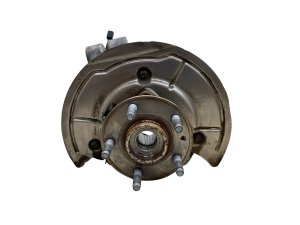
- The OEM aluminum knuckle includes a bolt-on wheel bearing, and symptoms can point to either a bad bearing (humming noise) or a bent knuckle (pulling, tire wear).
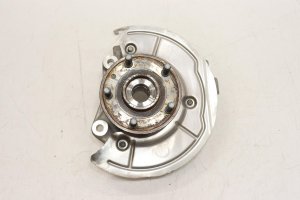
- The wheel bearing hub can be replaced separately (Mopar P/N 68272624AC) if the knuckle itself is not damaged.
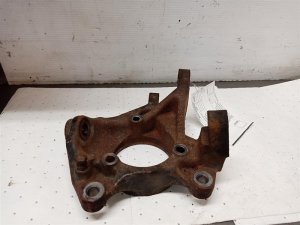
- When buying a used knuckle, the most critical inspection is of the tapered holes for the ball joints and tie rod; any wear or distortion means the part is unusable.
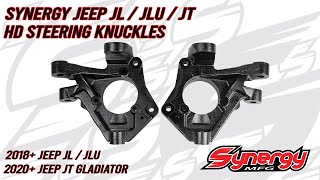
- For Jeeps with large tires used for heavy off-roading, upgrading to stronger aftermarket cast iron knuckles is a common and recommended modification to prevent failure.
Symptoms of a Failing Steering Knuckle or Wheel Bearing
Because this part is an assembly of both the knuckle and the wheel bearing, failure symptoms can point to either component. A bent or cracked knuckle will cause different problems than a worn-out bearing.
Noises and Vibrations
- Humming, Whining, or Growling: The most common sign of a bad wheel bearing is a noise that starts as a faint hum and develops into a louder growl or whine. This noise is speed-dependent—it gets louder and higher-pitched as you accelerate. It may change or disappear when turning as the weight shifts off the bad bearing.
- Grinding or Clicking: A more severe grinding noise, especially during turns, indicates a very worn bearing that has lost its internal lubrication and is creating metal-on-metal contact. You may also hear clicking or popping when turning.
- Steering Wheel Vibration: A worn wheel bearing can cause vibrations you feel in the steering wheel. This may be subtle at first and worsen as the bearing deteriorates.
- Clunking Over Bumps: A clunking sound when going over bumps can be a sign of worn ball joints, but it can also indicate a problem with how the knuckle is connected to other suspension parts. A TSB was issued for a clunking noise when turning that was traced to improperly torqued lower ball joints connecting to the knuckle.
Handling and Steering Problems
- Vehicle Pulling to One Side: If the knuckle itself is bent from an impact like hitting a curb or a large pothole, it will throw off the wheel alignment. This often results in the vehicle persistently pulling to one side, a problem that a standard alignment cannot fix.
- Loose or Sloppy Steering: A worn wheel bearing or damaged knuckle can create excessive play, making the steering feel less precise or responsive. The Jeep Wrangler and Gladiator are already known for steering wander, and a bad knuckle assembly can make this much worse.
- Uneven Tire Wear: A bent knuckle or a wheel bearing with excessive play will cause the wheel to sit at an incorrect angle. This leads to rapid and uneven tire wear, typically on the inner or outer edges of a single tire.
Known Issues for 2018-2026 Wrangler (JL) & Gladiator (JT)
Premature Wheel Bearing Failure
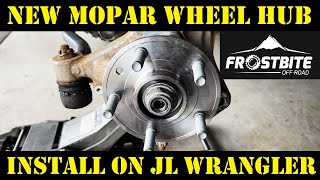
Owners have reported front wheel bearing failures at relatively low mileage, sometimes as early as 20,000 to 50,000 miles. The cause is often attributed to the stresses of larger aftermarket tires and off-road use. Since the wheel bearing is part of the knuckle assembly, this is a primary reason for replacing the unit. However, the wheel bearing hub (Mopar part #68272624AC) can be purchased and replaced separately if the knuckle itself is still in good condition.
🎬 Watch: Step-by-step guide for installing a new wheel hub assembly.Aluminum Knuckle Weakness & Upgrades
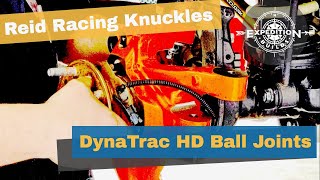
The OEM steering knuckles on these Jeeps are made of aluminum to save weight. For most driving conditions, this is not an issue. However, for owners who do serious off-roading or run large tires (37 inches or more), the aluminum can be a weak point. The tapered holes for the ball joints and tie rod can wear out or "wallow," leading to loose steering that can't be fixed by replacing just the joints. In extreme cases of impact or stress, the aluminum knuckle can crack or break, often at the ball joint mounting points. Because of this, many aftermarket companies like Synergy and Reid Racing offer heavy-duty cast iron replacement knuckles that are significantly stronger.
🎬 See how heavy-duty iron knuckles compare to the stock aluminum parts.Related Steering TSBs and Recalls
While there are no specific recalls for the steering knuckle itself, several service bulletins address symptoms that can be confused with a bad knuckle:
- Steering Shimmy (Warranty Extension XF1 / TSB 23-079-23): Many owners experience a steering wheel shimmy after hitting a bump. This is often caused by air trapped in the steering damper. Jeep has issued a warranty extension to replace the steering damper on affected 2018-2020 Wranglers and 2020 Gladiators.
- Steering Wander (TSB 08-074-20): A common complaint is a loose or wandering steering feel. A TSB was released to replace the original aluminum steering gear box with an updated steel version and update software to improve steering feel on 2018-2020 models.
- Low-Speed Clunk (TSB 02-004-21): A clunking noise from the front end when turning at low speeds may be caused by improperly torqued lower ball joint nuts. The TSB instructs technicians to check and correct the torque.
Important: A wheel alignment is mandatory after replacing a steering knuckle. Failure to do so will result in poor handling and rapid tire wear.
Buying a Used Steering Knuckle: What to Inspect
A used OEM steering knuckle can be a cost-effective solution, but careful inspection is crucial. Given the known failure points, here’s what to look for:
- Inspect the Tapered Holes: This is the most critical check. Look closely at the tapered holes where the ball joints and tie rod end mount. They should be perfectly round and smooth. Any sign of elongation, distortion, or damage (a condition known as "wallowing") means the knuckle is junk and should be rejected. A worn taper will not allow a new ball joint or tie rod to seat properly, leading to persistent steering looseness. 🎬 Watch: How to install upgraded knuckles and heavy-duty ball joints.
- Check for Cracks or Bends: Visually inspect the entire knuckle, especially around the ball joint mounts and steering arm. Look for any hairline cracks or signs of impact, such as deep gouges or bent sections. A bent knuckle will cause alignment issues that cannot be corrected.
- Evaluate the Wheel Bearing: A used knuckle assembly will come with a wheel bearing. Ask for the mileage of the donor vehicle. Given that these bearings can fail under 50,000 miles, consider any included bearing with higher mileage to be near the end of its life. Spin the bearing by hand; it should be smooth and silent. If it feels gritty, notchy, or makes noise, it needs to be replaced.
- Why Used OEM vs. New Aftermarket: For a standard replacement, a verified-good used OEM knuckle is often preferable to a cheap, new aftermarket part. The OEM part guarantees correct geometry and material specifications. However, if you plan on heavy off-road use, a new heavy-duty cast iron knuckle from a reputable brand is a worthwhile upgrade over both OEM and standard aftermarket options.
Cost to Replace a Jeep Wrangler or Gladiator Steering Knuckle
The total replacement cost depends on the parts you choose and local labor rates. Replacing just the bolt-on wheel hub is significantly cheaper than replacing the entire knuckle assembly.
| Part / Service | Estimated Cost | Notes |
|---|---|---|
| New OEM Knuckle Assembly (Mopar) | $700 - $1,100 | Includes knuckle and wheel bearing. Price from dealer or online Mopar stores. |
| New Aftermarket Knuckle Assembly | $350 - $500 | Standard aluminum replacement. Quality can vary by brand. |
| New Heavy-Duty Cast Iron Knuckle | $400 - $500 (per side) | Upgrade for off-road use. Does not typically include wheel bearing. |
| Used OEM Knuckle Assembly | $150 - $400 | Price varies by condition and included bearing's mileage. |
| New OEM Wheel Bearing Hub Only | $250 - $350 | An option if only the bearing is bad and the knuckle is okay. |
| Shop Labor | $250 - $600 | Typically 2-4 hours of labor per side. Rust can increase time. |
| Wheel Alignment | $100 - $200 | Required after knuckle replacement. |
Key Torque Specs & Replacement Notes
Proper torque is critical for safety and performance. Always use a calibrated torque wrench. These specs are for factory components on the Jeep Wrangler (JL) and Gladiator (JT).
Pro Tip: Many of the nuts and bolts, especially the large axle nut, are single-use torque-to-yield fasteners and should be replaced whenever they are removed.
| Component | Torque Spec | Socket Size |
|---|---|---|
| Axle Shaft Nut (Hub Nut) | 100 ft-lbs | 36mm |
| Hub/Bearing to Knuckle Bolts | 75 ft-lbs | 13mm (12-point) |
| Upper Ball Joint Nut | 55 ft-lbs | 22mm |
| Lower Ball Joint Nut | 15 ft-lbs (initial) then 33-59 ft-lbs (final) | 22mm |
| Tie Rod End to Knuckle Nut | 47 ft-lbs | 21mm |
| Brake Caliper Bracket to Knuckle Bolts | 148 ft-lbs | 21mm |
| Wheel Lug Nuts | 130 ft-lbs | 22mm |
Frequently Asked Questions (FAQ)
Can I drive with a bad wheel bearing or steering knuckle?
It is not recommended. A bad wheel bearing will get progressively worse and can eventually seize or fail completely, which could cause you to lose control of the vehicle. A bent or cracked steering knuckle is a critical safety issue that makes the vehicle unsafe to drive, as it can lead to wheel detachment or total loss of steering.
Do I have to replace the whole knuckle if only my wheel bearing is bad?
No. On the 2018+ Wrangler (JL) and 2020+ Gladiator (JT), the wheel bearing is a bolt-on hub assembly that can be purchased and replaced separately from the steering knuckle. This is a more cost-effective repair if your knuckle is not bent, cracked, or otherwise damaged.
Why is a wheel alignment required after replacing the knuckle?
The steering knuckle is the central component that sets the angles for your wheel alignment (specifically camber and toe). Removing and replacing it will always alter these settings. Skipping the alignment will cause the vehicle to handle poorly, pull to one side, and cause premature, uneven tire wear.
Why would I upgrade to a cast iron knuckle instead of using the stock aluminum one?
Upgrading to a heavy-duty cast iron knuckle is recommended for Jeeps with large tires (37"+) that are used for frequent or intense off-roading. The stock aluminum knuckles can wear out their ball joint tapers or even crack under the high stress of these conditions, while cast iron versions are significantly stronger and more durable.
Helpful Videos
Technical Specifications
OEM Part Numbers: 68388828AA (Front Right) 68463620AA (Front Right, superseded) 68388829AA (Front Left) 68463621AA (Front Left, superseded) 68272624AC (Wheel Bearing Hub Only)
Material: Cast Aluminum (OEM). Axle Nut Torque: 100 ft-lbs. Hub to Knuckle Bolt Torque: 75 ft-lbs. Upper Ball Joint Torque: 55 ft-lbs.
We Have This Part in Stock

The information in this article is provided for general reference and educational purposes only. Vehicle specifications, procedures, and part compatibility can vary by production date, trim level, and region. Always consult your vehicle's factory service manual and verify part numbers before purchasing or performing repairs. Safety-critical components such as airbags, seat belts, and braking systems should be installed by a qualified professional.
- Jeep Wrangler:
- Jeep Gladiator:
- 🎬 Helpful Videos
- 🛍️ Shop This Part
- Symptoms of a Failing Steering Knuckle or Wheel Bearing
- Noises and Vibrations
- Handling and Steering Problems
- Known Issues for 2018-2026 Wrangler (JL) & Gladiator (JT)
- Premature Wheel Bearing Failure
- Aluminum Knuckle Weakness & Upgrades
- Related Steering TSBs and Recalls
- Buying a Used Steering Knuckle: What to Inspect
- Cost to Replace a Jeep Wrangler or Gladiator Steering Knuckle
- Key Torque Specs & Replacement Notes
- Frequently Asked Questions (FAQ)
- 🎟️ Get 5% Off