

2016-2025 Tesla Model S & Model X Steering Knuckle: Noises, Issues, and Replacement Guide
This guide covers the common failure symptoms, part variations, and replacement costs for the front steering knuckle on all 2016-2025 Tesla Model S and Model X vehicles.
- The most common failure is the integrated wheel bearing, which causes a humming or grinding noise that changes with speed.
- Parts are different for pre-refresh (2016-2020) and refresh/Plaid (2021+) models and are not interchangeable. Always verify the OEM part number.
- A four-wheel alignment is mandatory after replacement to prevent unsafe handling and premature tire wear.
- When buying a used knuckle, the primary concern is the condition and mileage of the integrated wheel bearing. Ensure there is zero play in the hub.
Symptoms of a Failing Steering Knuckle Assembly
On the Tesla Model S and Model X, the steering knuckle is a single assembly that includes the wheel bearing and hub. Therefore, most "knuckle failures" are actually failures of the integrated wheel bearing. A bent or cracked knuckle from a severe impact is possible but less common.
1. Humming, Whirring, or Grinding Noises
The most common sign of a bad wheel bearing inside the knuckle is a noise that changes with wheel speed. It often starts as a faint hum or whirring sound that gets louder as you accelerate. The sound may change or disappear when turning, as the load shifts from one side of the bearing to the other. As the failure progresses, this can turn into a loud grinding noise.
2. Clunking or Knocking Over Bumps
A clunking or knocking sound, especially at low speeds over bumps or when turning into a driveway, can indicate excessive play in the suspension. While this is often caused by worn control arm bushings or sway bar links, a severely worn wheel bearing can also contribute to these sounds. The noise comes from the hub shifting within the worn bearing race.
3. Vibration During Acceleration
Some Model S and Model X vehicles may experience a vibration or "shudder" during hard acceleration. This is often related to the front CV axles, and Tesla has issued a technical service bulletin (SB-21-39-001) to address this by replacing the halfshafts. While not a direct failure of the knuckle, the vibration puts additional stress on the wheel bearing and is a related issue to be aware of during diagnosis.
4. Loose or Vague Steering
A worn wheel bearing can create play or looseness in the wheel assembly. This can translate to a feeling of vague or imprecise steering. The vehicle may wander slightly on the highway, requiring more steering correction from the driver.
Known Issues, TSBs, and Recalls
While the steering knuckle itself is a robust part, it is connected to other components that have been subject to investigation and service bulletins.
NHTSA Investigation into Front Suspension Links
The National Highway Traffic Safety Administration (NHTSA) conducted an investigation into front suspension fore link failures on 2015-2017 Model S and 2016-2017 Model X vehicles. The investigation found over 400 instances of these links failing, mostly at low speeds during parking maneuvers. While the investigation was closed without a formal recall, NHTSA noted that drivers were able to maintain control of the vehicle after a failure. Tesla had previously issued a service bulletin (SB-17-31-001) in 2017 to replace these links on some vehicles.
TSB for Squeaking Stabilizer Bar
Tesla issued Service Bulletin SB-20-31-001 for some 2019-2020 Model S and Model X vehicles that may have a squeak from the front stabilizer bar when driving over bumps. This is caused by improperly vulcanized bushings and is not related to the knuckle, but the noise can be confused with other suspension issues.
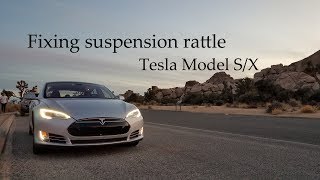
🎬 Watch: How to identify and fix common suspension rattlesTSB for Halfshaft Vibration
Service Bulletin SB-21-39-001 addresses customer complaints of excessive vibration during hard acceleration on 2014-2020 Model S and Model X vehicles. The fix involves replacing both front halfshafts with updated parts. This vibration can accelerate wear on the wheel bearings within the knuckle assembly.
Vehicle and Part Number Compatibility
It is critical to get the correct steering knuckle for your specific Model S or Model X. There was a significant design change with the "Refreshed" (also known as 'Palladium' or 'Plaid') versions that began in the 2021 model year.
- 2016-2020 Models: These earlier models use a different knuckle design. Common part numbers include 1027311-00-F and 1027316-00-F.
- 2021+ Models (Refresh/Plaid): These newer models have an updated suspension and require a different knuckle. Part numbers for these vehicles often start with 14xxxx or 16xxxx, such as 1620311-00-K.
Warning: The parts for pre-refresh (2016-2020) and refresh (2021+) models are not interchangeable. Always verify the part number against your vehicle's VIN before purchasing.
Additionally, all steering knuckles for these models are for All-Wheel Drive (AWD) vehicles only. There may also be differences between Plaid and non-Plaid performance versions on the newer models, so verifying the exact OEM part number is essential.
Buying a Used Steering Knuckle
A used OEM steering knuckle assembly can be a cost-effective and reliable alternative to a new part, especially since the knuckle itself rarely fails. The primary concern is the condition of the integrated wheel bearing.
What to Inspect
- Check for Play: With the knuckle off the car, try to wiggle the hub flange. There should be absolutely zero play or roughness. Any movement or grinding indicates a worn bearing, and the part should be rejected.
- Visual Inspection: Look for any signs of impact damage, such as cracks, deep gouges, or bends, particularly around the mounting points for the control arms and tie rod. Check for corrosion, especially if the part came from a region where roads are salted in winter.
- ABS Sensor: Ensure the wheel speed sensor is intact and the wiring is not damaged. Sometimes these are damaged during removal.
- Mileage: Ask the seller for the mileage of the donor vehicle. A wheel bearing from a low-mileage vehicle (under 80,000 miles) is a much safer bet than one from a high-mileage car. Failures become more common as mileage increases.
Why Used OEM is Often a Good Choice
Original Equipment Manufacturer (OEM) parts are designed and tested by Tesla for a perfect fit and to meet specific performance standards. A low-mileage used OEM knuckle assembly is often higher quality and more durable than a new, inexpensive aftermarket part. Aftermarket bearings may not have the same longevity or noise characteristics as the original part.
Replacement Cost Breakdown
The cost to replace a steering knuckle assembly can vary based on your location and the source of the part. An alignment is required after replacement, which adds to the total cost.
| Part Source | Estimated Part Cost (per side) |
|---|---|
| New OEM (from Tesla) | $600 - $900 |
| New Aftermarket | $250 - $500 |
| Used OEM | $150 - $450 |
| Shop Labor | $250 - $450 |
| Wheel Alignment | $150 - $250 |
Pro Tip: Because replacing the knuckle requires disassembling most of the front suspension, it's a good time to inspect the control arm bushings, ball joints, and tie rod ends for wear. Replacing any worn related parts at the same time can save you from paying for duplicate labor costs in the near future.
Key Torque Specs and Installation Notes
Proper torque is critical for safety and performance. Always use a torque wrench and replace any single-use nuts as specified by the manufacturer. Suspension bolts should receive their final torque with the vehicle at normal ride height to avoid pre-loading the bushings.
| Connection Point | Torque Value (Model S/X) | Notes |
|---|---|---|
| Upper Control Arm to Knuckle | 60 Nm (44.2 lb-ft) | Replace nut. |
| Lower Fore Link to Knuckle | 180 Nm (132.7 lb-ft) | Replace nut. Counter-hold stud. |
| Lower Aft Link to Knuckle | 180 Nm (132.7 lb-ft) | Replace nut. Counter-hold stud. |
| Tie Rod End to Knuckle | 102-104 Nm (75.2-76.7 lb-ft) | Replace nut. |
| Stabilizer Bar Link to Knuckle | 70 Nm (51.6 lb-ft) | Replace nut. Counter-hold stud. |
| Axle Nut to Hub | 245 Nm (180.7 lb-ft) | Replace nut. |
Warning: Failure to properly torque suspension components can lead to noise, premature wear, and a loss of vehicle control. Always follow the manufacturer's service procedures.
Frequently Asked Questions (FAQ)
Do I need to replace both front knuckles at the same time?
No, it is not necessary to replace them in pairs. You only need to replace the side that has failed. However, since wheel bearings wear based on mileage, it's not uncommon for the other side to fail in the not-too-distant future.
Is a wheel alignment always necessary after replacing a steering knuckle?
Yes, absolutely. The steering knuckle is a primary component that determines the wheel's alignment angles (camber and toe). A four-wheel alignment is mandatory after replacement to ensure proper handling, safety, and to prevent rapid tire wear.
Can I replace just the wheel bearing instead of the whole knuckle assembly?
While technically possible with a hydraulic press, it is not the standard repair procedure. The bearing is pressed into the knuckle with high force, and the process is labor-intensive. For both DIY and professional repair, replacing the entire knuckle assembly with the pre-installed bearing is faster, simpler, and generally recommended.
What is the difference between a steering knuckle and a spindle?
The terms are often used interchangeably, but they have a slight technical difference. A spindle is a shaft on which the wheel hub and bearings ride. A knuckle is the entire assembly that connects to the suspension and steering links. On the Tesla Model S and X, the part is a knuckle assembly that incorporates the wheel hub, making it a single integrated unit.
Helpful Videos
Technical Specifications
OEM Part Numbers: 1027311-00-F 102731100F 1027316-00-F 1420416-00-G 1620311-00-K 162031100G 162031100J 1620316-00-K 1620415-00-G 1620416-00-G 1620416-00-H 6007018-00-B 1030606-00-D 104431100E
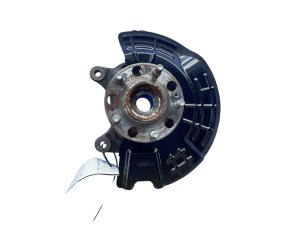
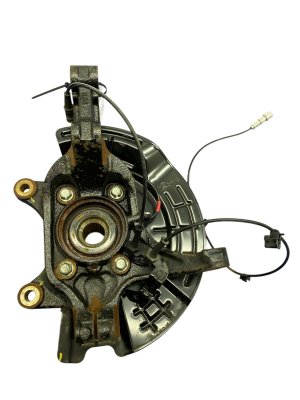
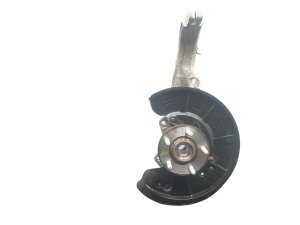
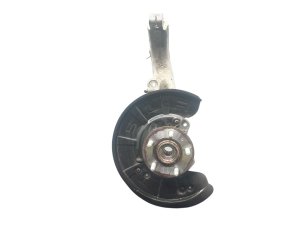
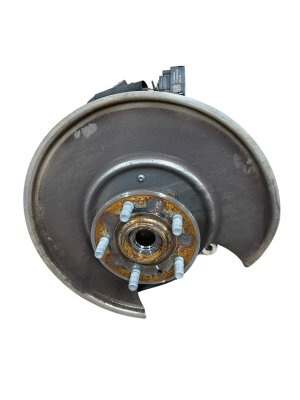
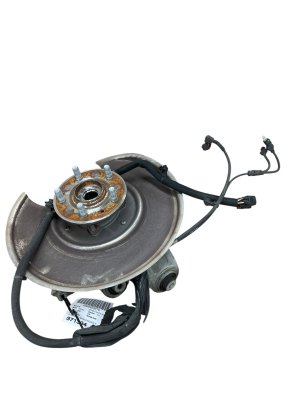
The steering knuckle assembly includes the knuckle, wheel hub, and a pressed-in wheel bearing. It is designed for All-Wheel Drive (AWD) models only.
We Have This Part in Stock

The information in this article is provided for general reference and educational purposes only. Vehicle specifications, procedures, and part compatibility can vary by production date, trim level, and region. Always consult your vehicle's factory service manual and verify part numbers before purchasing or performing repairs. Safety-critical components such as airbags, seat belts, and braking systems should be installed by a qualified professional.
- Tesla Model X:
- Tesla Model S:
- 🎬 Helpful Videos
- 🛍️ Shop This Part
- Symptoms of a Failing Steering Knuckle Assembly
- 1. Humming, Whirring, or Grinding Noises
- 2. Clunking or Knocking Over Bumps
- 3. Vibration During Acceleration
- 4. Loose or Vague Steering
- Known Issues, TSBs, and Recalls
- NHTSA Investigation into Front Suspension Links
- TSB for Squeaking Stabilizer Bar
- TSB for Halfshaft Vibration
- Vehicle and Part Number Compatibility
- Buying a Used Steering Knuckle
- What to Inspect
- Why Used OEM is Often a Good Choice
- Replacement Cost Breakdown
- Key Torque Specs and Installation Notes
- Frequently Asked Questions (FAQ)
- 🎟️ Get 5% Off