

2016-2025 Tesla Model S & Model X Steering Knuckle: Noises, Part Numbers, and the Critical 2021 Refresh
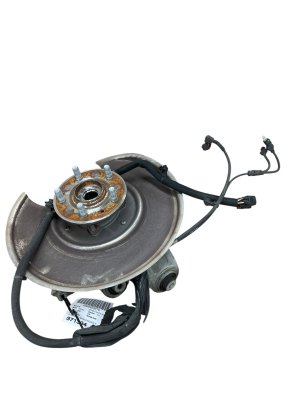
This guide decodes the crucial suspension changes, failure symptoms, and part numbers for the 2016-2025 Tesla Model S and Model X steering knuckle and hub assembly.
- A critical suspension redesign in mid-2021 ('Palladium'/'Refresh') makes knuckles for pre- and post-2021 Model S/X completely incompatible. Verify your part number.
- The most common failure is the bolt-on wheel hub/bearing assembly, which causes a humming/grinding noise. The knuckle itself only needs replacement if bent or cracked from an impact.
- There are different part numbers for Plaid and non-Plaid 'Refresh' models; compatibility must be verified for your specific trim.
- A four-wheel alignment is mandatory after replacing the knuckle to ensure vehicle safety and prevent rapid tire wear.
Symptoms of a Failing Steering Knuckle Assembly
On the Tesla Model S and Model X, the steering knuckle is the main structural component, but the part that most commonly fails is the separate, bolt-on wheel hub and bearing assembly. Because they work together, symptoms can be related to either part.
- Humming, Whirring, or Grinding Noises: This is the most common sign of a bad wheel bearing inside the hub assembly. The noise is often described as a hum or a growl that starts at a certain speed (e.g., above 40 mph) and gets louder as speed increases. The sound may also change pitch or intensity when turning, as weight shifts from one side of the car to the other.
- Clunking or Knocking Over Bumps: A clunking or knocking sound, especially at low speeds over bumps or when turning into a driveway, often points to wear in the ball joints of the control arms that attach to the knuckle. While not a failure of the knuckle itself, it's a very common source of noise in the front suspension assembly. 🎬 See how to diagnose and fix suspension rattles
- Vehicle Pulling to One Side: If the knuckle itself is bent from hitting a curb or a severe pothole, it can throw the wheel alignment out of specification. This will cause the vehicle to persistently pull to the left or right, requiring constant steering correction.
- Uneven or Rapid Tire Wear: A bent knuckle directly impacts alignment angles like camber and toe. This forces the tire to make improper contact with the road, leading to accelerated wear on the inner or outer edges.
- Loose or Vibrating Steering Wheel: Excessive play in a worn wheel bearing or damage to the knuckle can translate into a feeling of looseness or vibration in the steering wheel.
Known Issues, Recalls, and Service Bulletins
While there are no major recalls specifically for the steering knuckle itself, several related issues and investigations are important for owners of the 2016-2025 Tesla Model S and Model X to be aware of.
- NHTSA Investigation PE20-014 (Front Suspension Fore Links): The National Highway Traffic Safety Administration (NHTSA) investigated failures of the front suspension fore links on 2015-2017 Model S and 2016-2017 Model X vehicles. The investigation found hundreds of failures, mostly occurring at low speeds. While it was closed without a formal recall, Tesla had previously issued a service bulletin (SB-17-31-001) to address the issue on some vehicles. A failed link can affect wheel position and control. 🎬 Watch: How to fix squeaky Tesla suspension issues
- NHTSA Campaign 22V818000 (Loss of Power Steering): This recall affected certain 2017–2021 Model S and Model X vehicles. A software issue could cause a loss of power steering assist after driving over rough roads or hitting a pothole. Tesla addressed this with an over-the-air (OTA) software update.
- Corroded Steering Rack Bolts: Earlier models (pre-April 2016 Model S and pre-October 2016 Model X) were recalled for aluminum steering gear bolts that could corrode and break, leading to a loss of power steering. The fix involved replacing the aluminum bolts with steel ones.
Crucial Compatibility Guide: Pre-Refresh vs. 2021+ Palladium/Plaid
Warning: The single most important factor when buying a steering knuckle for a Model S or Model X is the vehicle's build date. A major suspension redesign occurred in mid-2021 for the 'Refreshed' (also called 'Palladium' or 'Plaid') models. Parts are not interchangeable across these generations.
Pre-Refresh Models (approx. 2016 - early 2021)
These vehicles use a distinct knuckle design. Part numbers for this era typically begin with a prefix like 102xxxx or 600xxxx. Always confirm the part number on your original part before ordering.
- Common Part Numbers: 1027311-00-F (Front Left), 1027316-00-D/F (Front Right), 6007018-00-C (Front Right, earlier models).
- Identification: These knuckles connect to a different set of control arms compared to the later models. Visual comparison is essential.
Refresh 'Palladium' & Plaid Models (approx. mid-2021 - 2025)
The refreshed models feature an updated suspension architecture, requiring a completely different knuckle. Part numbers for this generation typically start with a prefix like 14xxxxx or 16xxxxx.
- Common Part Numbers: Part numbers in this series often denote front/rear and left/right for the newer design.
- Plaid vs. Non-Plaid: There are specific knuckles for Plaid performance models, likely to accommodate different braking or suspension loads. For example, part numbers 1420311-00-F and 1420416-00-G have been identified on Plaid models. It is critical to verify the correct part for your specific trim.
Pro Tip: The steering knuckles are specific to the front or rear axle and the left (driver) or right (passenger) side. They are not interchangeable. All knuckles for these Model S and Model X years are for All-Wheel Drive (AWD) vehicles only.
Buying a Used Steering Knuckle: What to Inspect
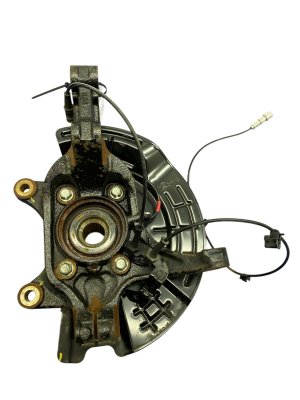
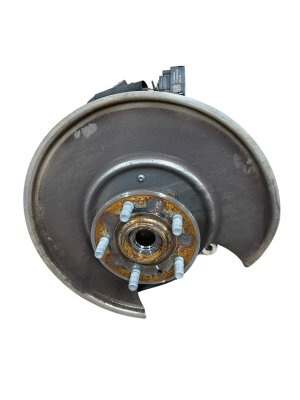
A used OEM steering knuckle is an excellent value, as the knuckle itself is a robust piece of cast aluminum unlikely to fail without a major impact. However, the included wheel hub/bearing assembly is a wear item. Here’s what to check:
- Verify the Part Number: This is the most critical step. Due to the 2021 refresh, Plaid/non-Plaid differences, and S/X variations, the part number stamped on the knuckle must match your original part.
- Inspect for Cracks or Bends: Carefully examine the entire knuckle, especially around the mounting points for the control arms and brake caliper. Any sign of cracking, bending, or significant impact damage means the part is unsafe and should be rejected.
- Check the Included Hub/Bearing: If the used knuckle comes with a hub assembly, grab the hub flange and try to wiggle it. There should be absolutely zero play, roughness, or noise when you spin it. Given that the bearing is the most common failure point, consider its mileage. A low-mileage assembly is ideal. If the bearing feels worn, you will need to purchase a new hub/bearing assembly separately.
- Examine Mounting Holes: Ensure the tapered holes for the ball joints and tie rod are clean and not distorted or enlarged. A worn mounting hole can prevent the joint from seating correctly, leading to persistent suspension noise.
- OEM vs. Aftermarket: For a critical safety component like a knuckle, a used OEM part is often superior to a new, cheap aftermarket one. OEM parts are made to precise factory specifications for material strength and geometry, ensuring proper fit and function. Some aftermarket bearings have been reported to cause error messages with the vehicle's systems.
Replacement Overview and Torque Specs
Replacing a steering knuckle is an advanced DIY job (4/5 difficulty) that requires proper tools and safety procedures. A four-wheel alignment is mandatory after the job is complete to ensure safety and prevent tire wear.
Is Rebuilding an Option? No. The wheel hub and bearing is a sealed, non-serviceable unit with a factory-set preload. It cannot be pressed apart and rebuilt; the entire hub assembly must be replaced. The knuckle itself cannot be repaired if cracked or bent.
| Fastener | Torque Spec (Nm) | Torque Spec (ft-lbs) | Notes |
|---|---|---|---|
| Axle Nut to Hub | 245 Nm | 181 ft-lbs | Always use a new nut. |
| Hub Assembly to Knuckle (x4 bolts) | 90 Nm | 66 ft-lbs | |
| Brake Caliper to Knuckle | 135 Nm | 100 ft-lbs | Bolts are often single-use. |
| Tie Rod End to Knuckle | 102-103.5 Nm | 75-76 ft-lbs | Always use a new nut. |
| Upper Control Arm Ball Joint to Knuckle | 56-60 Nm | 41-44 ft-lbs | Always use a new nut. |
| Lower Control Arm Ball Joints to Knuckle | 180-195 Nm | 133-144 ft-lbs | Always use new nuts. Hold stud to prevent spinning. |
| Stabilizer Bar Link to Knuckle | 70 Nm | 52 ft-lbs | Always use a new nut. |
| Wheel Lug Nuts | 175 Nm | 129 ft-lbs |
Caution: Always enable 'Jack Mode' on the touchscreen before lifting a vehicle with air suspension. Failure to do so can damage the suspension system. Only tighten suspension bolts to their final torque value when the vehicle is at its normal ride height.
Cost Comparison
The cost to replace a steering knuckle assembly can vary significantly based on the parts needed and local labor rates.
| Item | Estimated Cost | Notes |
|---|---|---|
| New OEM Knuckle Assembly | $600 - $1000+ | Price from a Tesla Service Center. Can be very expensive. |
| New Aftermarket Hub/Bearing | $150 - $250 | For the bolt-on hub/bearing only. Brands like MOOG are available. |
| Used OEM Knuckle Assembly | $200 - $500 | Common price on eBay or from auto recyclers. May or may not include a good hub/bearing. |
| Shop Labor | $400 - $800 | Typically 2.5-4 hours of labor. Tesla-specific shops or dealers may be higher. |
| Wheel Alignment | $150 - $250 | Mandatory after replacement. |
| Total Estimated Cost (with Used OEM Part) | $750 - $1,550 | Includes used knuckle, new hub/bearing (if needed), labor, and alignment. |
Frequently Asked Questions (FAQ)
Can I just replace the wheel bearing instead of the whole knuckle?
You cannot replace just the internal bearing. The wheel bearing is part of a sealed hub assembly that bolts onto the knuckle. If your symptom is a humming/grinding noise, you need to replace the wheel hub assembly. You do not need to replace the knuckle unless it is physically damaged (cracked or bent).
Is the steering knuckle the same for the left and right side?
No. Steering knuckles are side-specific. You must order the correct part for the driver (left) or passenger (right) side of the vehicle.
Do I need a wheel alignment after replacing a steering knuckle?
Yes, absolutely. The steering knuckle is a primary component that determines the wheel's alignment angles. Replacing it without performing a four-wheel alignment will result in improper handling, unsafe driving characteristics, and rapid tire wear.
What is the difference between the 2020 and 2021+ 'Palladium' knuckle?
The knuckles are completely different due to a major suspension redesign in mid-2021. They have different shapes, mounting points for the control arms, and use different part numbers. They are not interchangeable in any way. You must buy the correct part for your vehicle's specific year and model range.
Helpful Videos
Technical Specifications
OEM Part Numbers: 1027170-00-C 1027311-00-F 102731100F 1027316-00-D 1027316-00-F 1027662-01-B 1420311-00-F 1420416-00-G 1620311-00-J 1620311-00-K 162031100G 162031100J 1620316-00-K 1620415-00-G 1620416-00-G 1620416-00-H 6007018-00-C
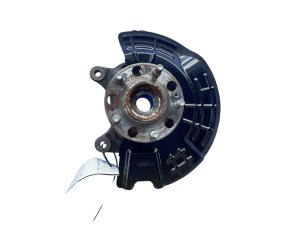
Material: Cast Aluminum. The wheel hub/bearing assembly is a separate, bolt-on component. Knuckles are specific to front/rear, left/right, and pre/post 2021 refresh models.
We Have This Part in Stock

The information in this article is provided for general reference and educational purposes only. Vehicle specifications, procedures, and part compatibility can vary by production date, trim level, and region. Always consult your vehicle's factory service manual and verify part numbers before purchasing or performing repairs. Safety-critical components such as airbags, seat belts, and braking systems should be installed by a qualified professional.
- Tesla X:
- Tesla S:
- 🎬 Helpful Videos
- 🛍️ Shop This Part
- Symptoms of a Failing Steering Knuckle Assembly
- Known Issues, Recalls, and Service Bulletins
- Crucial Compatibility Guide: Pre-Refresh vs. 2021+ Palladium/Plaid
- Pre-Refresh Models (approx. 2016 - early 2021)
- Refresh 'Palladium' & Plaid Models (approx. mid-2021 - 2025)
- Buying a Used Steering Knuckle: What to Inspect
- Replacement Overview and Torque Specs
- Cost Comparison
- Frequently Asked Questions (FAQ)
- 🎟️ Get 5% Off