

Tesla Model S & X Front Control Arm Guide (2012-2026): Clunks, Shudder, and Replacement
Diagnose and repair the common front suspension clunks, creaks, and acceleration shudder affecting the 2012-2026 Tesla Model S and 2016-2026 Tesla Model X.
- Front control arms on the Model S and X are a common wear item, causing clunks, creaks, and uneven tire wear.
- A major suspension redesign occurred in 2021. Parts for 'Refreshed' 2021+ models are NOT interchangeable with 2012-2020 vehicles.
- The infamous 'Tesla Shudder' on acceleration is caused by worn half-shafts, not directly by the control arms.
- A four-wheel alignment is MANDATORY after replacing any control arm to prevent poor handling and rapid tire wear.
Known Issues, Recalls, and Technical Service Bulletins (TSBs)
The front suspension on the 2012-2026 Tesla Model S and 2016-2026 Tesla Model X is a well-known area for premature wear. Several issues have been documented, leading to official service bulletins and investigations.
Front Upper Control Arm Creak (TSB SB-20-31-006)
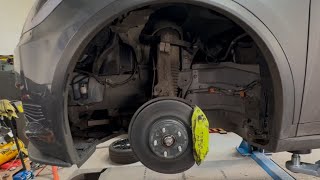
A persistent creaking or squeaking noise from the front suspension, especially at low speeds over bumps or when turning, is a very common complaint. This is often caused by water getting past the ball joint seal on the front upper control arms. The water washes out the grease, leading to corrosion and metal-on-metal contact. Tesla released Technical Service Bulletin SB-20-31-006, which outlines a procedure to reseal the area around the ball joints with urethane to prevent further water intrusion. 🎬 See this step-by-step front upper control arm replacement walkthrough While this TSB addresses the noise, it notes the condition is an NVH (Noise, Vibration, and Harshness) issue and does not cause premature failure of the joint itself.
Acceleration Shudder (Half-Shaft Wear)
A distinct vibration or shudder felt during hard acceleration is another widely reported problem, particularly in all-wheel-drive (AWD) models. This issue is not directly caused by the control arms, but is related to the front suspension geometry. The ride height of the Model S and especially the Model X puts the front half-shafts (axles) at a steep angle. This angle causes excessive wear on the half-shaft's internal components over time. The shudder is the feeling of the axle vibrating as it rotates over these worn, damaged spots. While Tesla's official fix is often to replace the half-shafts, the problem may return as quickly as 500 to 10,000 miles later because the root cause (the axle angle) isn't changed. Some aftermarket solutions use adjustable control arms or lowering links to slightly lower the vehicle's ride height, which reduces the half-shaft angle and can prevent the issue from recurring.
NHTSA Investigations & Recalls
The suspension of these vehicles has been the subject of multiple NHTSA investigations.
- Fore Link Investigation: An investigation was opened in 2020 for front fore link (a lower control arm) failures on 2015-2017 Model S and 2016-2017 Model X vehicles. While the NHTSA found over 400 instances of failure, it closed the investigation without a recall, stating that the vehicles remained controllable even after a failure.
- Loose Fastener Recalls: Tesla has issued recalls for fasteners that were not torqued correctly at the factory. NHTSA Campaign Number 21V835000 concerned loose front lateral link (lower control arm) bolts on some 2019-2021 Model 3 and 2020-2021 Model Y vehicles, which share a similar suspension design. A similar recall (20V-709) was issued for 2020 Model Y vehicles where the upper control arm bolt could be loose. While these specific recalls did not cover all Model S/X years, they highlight the critical importance of correct torque on all suspension components.
Symptoms of a Failing Control Arm
Control arm failure symptoms tend to start subtly and gradually worsen. Listening to your car is key to catching the problem early.
- Clunking or Popping Noises: This is the most common sign. You'll hear a distinct clunk, pop, or knock from a corner of the car when driving over bumps, potholes, or even just uneven pavement. This is caused by worn-out bushings or a failing ball joint allowing excessive movement.
- Creaking or Groaning: A sound like an old, creaky door, especially when turning the steering wheel at low speeds or going over a speed bump, points directly to a dry or corroded ball joint, most commonly on the upper control arms.
- Steering Wheel Vibration: A failing control arm can cause vibrations to be felt through the steering wheel. This is different from the acceleration shudder; it may be present at constant speeds and can indicate a loose ball joint or bushing.
- Wandering or Loose Steering: The vehicle may feel unstable at highway speeds, requiring constant small steering corrections to stay in a straight line. This happens when worn bushings allow the wheel's alignment to shift dynamically under load.
- Uneven Tire Wear: A critical sign of control arm failure is accelerated wear on the inner edge of the front tires. Worn bushings allow the top of the tire to tilt outward (negative camber), causing the inside edge of the tire to carry more load and wear out prematurely.
Warning: While some symptoms are just noise, a complete failure of a control arm or ball joint can cause the wheel to separate from the suspension, leading to a total loss of steering control. Do not ignore these symptoms.
Vehicle & Year-Specific Differences
It is absolutely critical to verify the correct parts for your vehicle, as Tesla made a significant change to the suspension with the 2021 "Refreshed" (sometimes called 'Palladium') models.
- Pre-Refresh (2012-2020 Model S, 2016-2020 Model X): These models use a specific set of control arms.
- Refresh (2021+ Model S & Model X): These vehicles use different suspension components. Parts are generally not interchangeable between the pre-refresh and refresh generations. For example, some part listings explicitly state they fit up to January 2021 models only.
Always verify compatibility by matching the OEM part number from your existing part to the replacement part. The provided vetted data lists numerous part numbers, indicating Tesla has updated these parts several times. Superseding part numbers are common, so a newer letter at the end (e.g., -F replacing -E) is usually a compatible update.
Buying a Used Suspension Control Arm
Given the high cost of new OEM parts, a used control arm from a low-mileage vehicle can be an excellent value. However, since this is a known wear item, careful inspection is key.
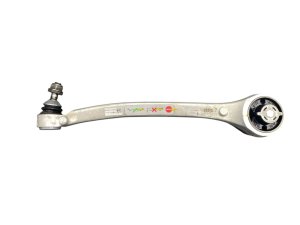
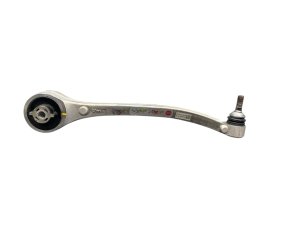
- Inspect the Bushings: The rubber bushings are the most common failure point. Look for any signs of cracking, tearing, or separation of the rubber from the metal sleeve. The rubber should be firm and intact.
- Check the Ball Joint: Try to move the ball joint stud by hand. There should be no noticeable play or looseness. The rubber boot covering the ball joint must be fully intact with no rips or tears, as this would allow dirt and water to enter and destroy the joint.
- Examine the Arm Itself: Check the metal arm for any signs of bending, heavy corrosion, or cracks, especially around the welds. Do not buy an arm that has been in a significant collision.
- Mileage is Key: These parts can fail anywhere from 40,000 to 80,000 miles, though some last longer. A used part from a vehicle with under 30,000 miles is ideal. A part from a car with 100,000 miles may not have much life left.
- Why Used OEM? A used original Tesla part is often a better choice than a cheap, new aftermarket part. The quality of the rubber in the bushings and the metallurgy of the ball joint are critical for longevity. Low-quality aftermarket arms are known to fail very quickly.
Cost Comparison
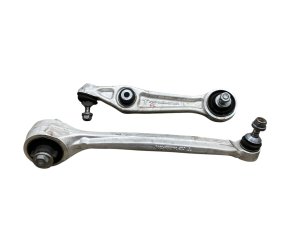
Prices can vary significantly based on the specific arm (upper, lower-forward, lower-aft) and sales channel.
| Part/Service | Estimated Cost |
|---|---|
| New OEM Control Arm (Single) | $150 - $400+ |
| New Aftermarket Control Arm (Single) | $100 - $250 |
| Used OEM Control Arm (Single) | $75 - $200 |
| Shop Labor (per side) | $220 - $450 |
| Total Replacement (Shop, per side) | $400 - $800+ |
| Total Replacement (Tesla Service Center) | $200 - $2,500 |
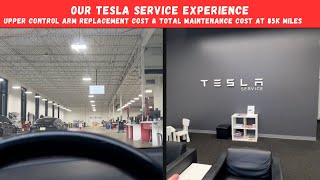
Note: Tesla Service Center pricing has a very wide range. For the common upper control arm creak, many owners report Tesla covering labor as a 'goodwill' gesture even out of warranty, resulting in a very low repair cost of only paying for parts (~$200). 🎬 Watch: Tesla owner shares real-world maintenance and control arm replacement costs However, for other control arm issues, quotes can be much higher.
Related Parts to Replace
- Replace in Pairs: It is highly recommended to replace control arms in left/right pairs. If one has failed due to mileage, the other is likely near the end of its service life.
- Hardware: Always use new nuts and bolts, especially nyloc (nylon-locking) nuts, as they are designed for single use.
- Wheel Alignment: A four-wheel alignment is mandatory after replacing any control arm. Failure to do so will result in poor handling and rapid, uneven tire wear.
Pro Tip: When installing new control arms, the bolts for the bushings must only be torqued to their final specification when the suspension is at its normal ride height. Tightening the bolts while the wheel is drooping (as on a lift) will twist and preload the rubber bushings, causing them to fail very quickly. For vehicles with air suspension, use 'Jack Mode' and then settle the car on its wheels or a drive-on lift before the final torque.
Installation Tips & Torque Specs
Replacing these arms is a feasible DIY for an experienced mechanic with the right tools. Always refer to the official Tesla service manual for the most accurate, up-to-date procedures.
| Fastener | Torque Spec (Pre-Refresh) | Notes |
|---|---|---|
| Upper Control Arm to Body (x2 bolts) | 68 Nm (50 lb-ft) | |
| Upper Control Arm to Knuckle | 60 Nm (44 lb-ft) | Replace nut. |
| Lower Fore Link to Knuckle | 180 Nm (133 lb-ft) | Replace nut. |
| Lower Aft Link to Knuckle | 195 Nm (144 lb-ft) | Replace nut. |
| Lower Fore Link to Subframe | 130 Nm (96 lb-ft) | Torque at ride height. |
| Lower Aft Link to Subframe | 130 Nm (96 lb-ft) | Torque at ride height. |
| Wheel Lug Nuts | 175 Nm (129 lb-ft) |
Note: These specs are for reference from pre-refresh models. Always verify the correct specs for your specific model year. Refresh (2021+) models may have different specifications.
Frequently Asked Questions (FAQ)
Do I need to replace both the left and right control arms at the same time?
It is strongly recommended. Control arms on both sides of the vehicle experience the same wear and tear. If the bushings or ball joint on one side have failed due to age and mileage, the other side is likely to fail soon. Replacing them in pairs ensures balanced handling and saves you from having to do the same job twice.
Is a wheel alignment required after replacing a control arm?
Yes, absolutely. A four-wheel alignment is mandatory. The control arms are a key part of what determines the wheel's alignment angles (camber, caster, and toe). Replacing an arm will change these angles, and driving without an alignment will cause poor handling, pulling to one side, and rapid destruction of your tires.
Does replacing the control arms fix the 'Tesla shudder'?
Usually, no. The shudder or vibration felt under acceleration is typically caused by worn front half-shafts (axles), not the control arms themselves. This wear is accelerated by the steep angle of the axles in AWD models. While worn control arm bushings can contribute to other vibrations, the specific acceleration shudder requires addressing the half-shafts.
Can I just replace the bushings or ball joints instead of the whole arm?
While some companies sell polyurethane bushings separately, it is generally not practical for a DIY repair. The original bushings and ball joints are pressed into the arm with thousands of pounds of force and require a hydraulic press and special fixtures to remove and install. For most people, replacing the entire control arm assembly is faster, easier, and ensures all components are new.
Helpful Videos
Technical Specifications
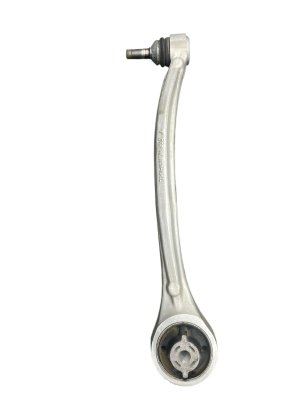
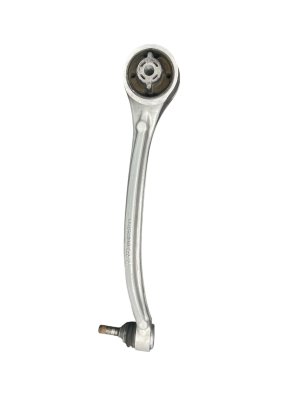
OEM Part Numbers: 1027322-00-F 1027322-00-G 1027327-00-B 1027327-00-C 1027327-00-D 1027327-00-E 1027327-00-F 1027351-00-C 1027351-00-D 1027351-00-E 1041570-00-B 1048951-00-A 1048951-00-C 1420321-00-B 1420341-00-B 6007997-00-D
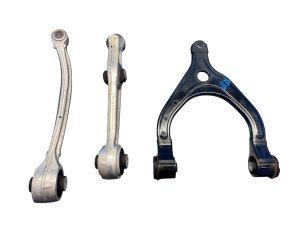
The front suspension is a multi-link design with one upper control arm and two lower control arms (fore and aft links) per side. The system utilizes an air spring and shock absorber. Final torque on bushing bolts must be applied at ride height.
We Have This Part in Stock

The information in this article is provided for general reference and educational purposes only. Vehicle specifications, procedures, and part compatibility can vary by production date, trim level, and region. Always consult your vehicle's factory service manual and verify part numbers before purchasing or performing repairs. Safety-critical components such as airbags, seat belts, and braking systems should be installed by a qualified professional.
- Tesla X:
- Tesla S:
- 🎬 Helpful Videos
- 🛍️ Shop This Part
- Known Issues, Recalls, and Technical Service Bulletins (TSBs)
- Front Upper Control Arm Creak (TSB SB-20-31-006)
- Acceleration Shudder (Half-Shaft Wear)
- NHTSA Investigations & Recalls
- Symptoms of a Failing Control Arm
- Vehicle & Year-Specific Differences
- Buying a Used Suspension Control Arm
- Cost Comparison
- Related Parts to Replace
- Installation Tips & Torque Specs
- Frequently Asked Questions (FAQ)
- 🎟️ Get 5% Off