

2016-2025 Explorer, Aviator & Police Interceptor Washer Reservoir: Leaks, Pumps & Part Differences
This guide clarifies the critical differences in washer fluid reservoirs between Ford Explorer and Lincoln Aviator generations and explains how to diagnose common failures.
- The reservoir is different for 2016-2019 (5th Gen) and 2020+ (6th Gen) models; you must buy for the correct generation.
- Verify if your vehicle has camera washers, as this requires a specific reservoir with extra hose ports.
- Cracks from age or impact are the most common failure, leading to visible leaks under the passenger front wheel.
- A used OEM reservoir is often a better choice than a new aftermarket part due to superior fitment and component quality.
Understanding Key Differences: Two Platforms, Two Reservoirs
While the Ford Explorer, Ford Police Interceptor Utility, and Lincoln Aviator share platforms, a major redesign in 2020 means the washer fluid reservoir is NOT the same across all 2016-2025 models. It's crucial to identify your vehicle's generation to get the correct part.
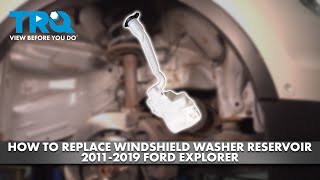
- 5th Generation (2016-2019): This includes the Ford Explorer and Ford Police Interceptor Utility. These models share one type of reservoir. 🎬 Watch: Step-by-step reservoir replacement for 2011-2019 models.
- 6th Generation (2020-2025): This includes the Ford Explorer, Ford Police Interceptor Utility, and Lincoln Aviator. These models share a different reservoir design. Further variations exist within this generation based on options like camera washers.
Warning: Always verify part numbers against your vehicle's VIN. The 2025 Ford Explorer received a facelift, and some parts, including the washer reservoir, may have changed mid-year. A part listed for a 2024 may not fit a late-production 2025 model.
Symptoms of a Failing Washer Fluid Reservoir
Diagnosing a problem with the washer system is usually straightforward. Here are the most common signs of trouble.
1. Visible Fluid Leak
This is the most common failure. You'll notice a puddle of blue, green, or orange fluid on the ground, typically under the front passenger-side wheel. The plastic can become brittle over time from heat cycles or suffer impact damage. Using plain water in the reservoir can also cause it to crack if the water freezes and expands.
2. Washers Don't Spray (or Spray Weakly)
If you activate the washers and nothing happens, or the spray is weak, the cause could be one of several things. First, check if the reservoir is empty. If it's full, listen for the pump motor; if you hear it humming, the pump is working, but you might have a clogged line, nozzle, or a leak. If you don't hear the pump at all, it could be a failed pump, a blown fuse, or a wiring issue.
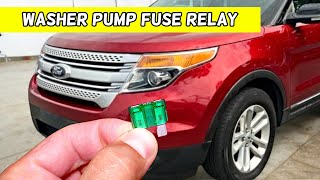
🎬 Check out this guide to find your washer pump fuse.3. "Low Washer Fluid" Warning Light Stays On
If the reservoir is full but the warning light on your dashboard won't turn off, the fluid level sensor has likely failed. On these vehicles, the sensor is integrated with or attached to the reservoir assembly, so the entire unit often needs to be replaced to fix the issue.
4. Only Front or Rear Washers Work
On many modern vehicles, a single, reversible pump supplies both the front and rear washers. If only one direction works, it could point to a problem within the pump itself or a blockage specific to one of the lines. On some Explorer ST models, owners have reported the filler neck seal leaking, which can cause fluid loss during driving.
Known Issues, Recalls, and Technical Service Bulletins (TSBs)
Recall 21C01 / NHTSA 21V-014: Contaminated Washer Fluid
A small number of 2020 Ford Explorer Police Interceptor and 2020 Lincoln Aviator vehicles were recalled because the washer fluid reservoir was filled with fluid contaminated with brake fluid at the factory. This could damage washer system components and reduce visibility. The fix involved dealers flushing the entire system and replacing the reservoir, pump, level sensor, and wiper blades. While this recall affected a very small batch of vehicles, it highlights the damage that can be caused by using incorrect fluids in the system.
Camera Washer Deletion (2022-2023)
Some 2022 and 2023 Explorer and Aviator models may have been built without a functional rear camera washer feature, even if the nozzle is present. This was due to a parts shortage. This means that even if your vehicle has a nozzle, it may not have the necessary hose connected to the reservoir. Vehicles with front and rear camera washers use a specific reservoir with additional outlets.
Buying a Used Washer Fluid Reservoir: What to Check
A used OEM reservoir can be a smart buy, offering factory fit and quality at a lower price than new. Here’s what to inspect before you buy.
- Check for Cracks: Meticulously inspect the entire plastic body, especially around the mounting points, seams, and the filler neck. Hairline cracks can be hard to see but will cause slow leaks.
- Inspect the Ports and Grommets: Ensure the rubber grommets where the pump(s) and level sensor push in are soft and free of cracks. Brittle, dry-rotted grommets are a common source of leaks.
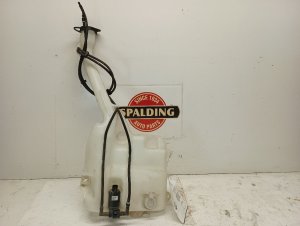
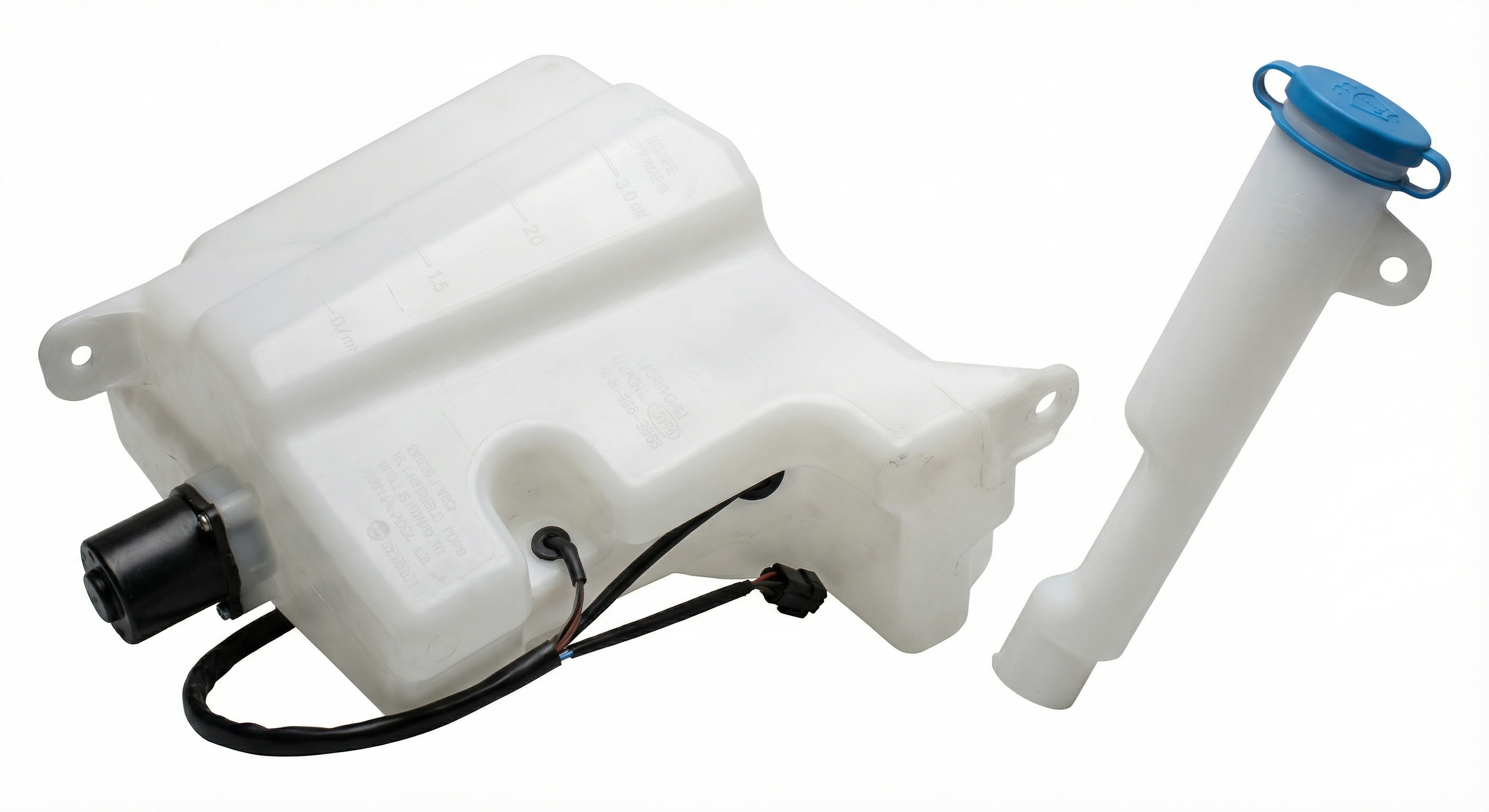
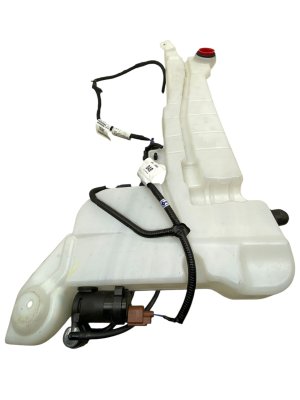
- Verify Included Components: Confirm if the reservoir comes with the pump(s) and the fluid level sensor. A complete assembly is ideal. If not, you will need to carefully transfer your old components, which risks damaging them.
- Match Part Numbers and Features: This is the most critical step. Compare the OEM part number on the used reservoir to your original. Pay close attention to whether your vehicle has front/rear camera washers, as these require a different reservoir with more outlets.
Pro Tip: For this part, a used OEM unit is often a better choice than a cheap, new aftermarket reservoir. Aftermarket tanks can be made from lower-grade plastic that becomes brittle quickly, and they often have poor fitment. The included pumps and sensors on aftermarket units are also a common point of premature failure.
Replacement Overview
- Difficulty: 2/5 (DIY Feasible)
- Estimated Time: 1-2 hours
- Common Tools: Jack and jack stands, socket set (8mm, 10mm, 11mm), trim removal tools, pliers, drain pan.
The washer reservoir is located behind the front passenger side wheel well liner. The general process involves jacking up the vehicle, removing the wheel, and removing the plastic fender liner to gain access. From there, you disconnect the electrical connectors for the pump and sensor, detach the fluid lines, and unbolt the reservoir from the chassis. 🎬 See this walkthrough for removing a 2020+ reservoir. Be prepared for any remaining fluid to drain out when you disconnect the lines.
Cost Comparison
Prices can vary based on the specific part number and included options (e.g., camera washers).
| Part Source | Estimated Price Range |
|---|---|
| New OEM | $90 - $200 |
| New Aftermarket | $50 - $110 |
| Used OEM | $60 - $120 |
| Shop Labor | $140 - $230 |
Frequently Asked Questions (FAQ)
Can I repair a cracked washer reservoir?
While plastic repair kits exist, they are rarely a permanent solution for a washer reservoir. The constant exposure to temperature changes and vibration, combined with the chemical nature of washer fluid, means most patches will eventually fail. Replacement is the only reliable repair.
Why is my washer fluid leaking from the top when I drive?
On some 6th generation (2020+) Explorer models, a poor seal where the long filler neck enters the main tank can cause fluid to slosh out and leak during driving, even if the tank itself isn't cracked. Reseating the filler neck or replacing the grommet can sometimes fix this issue.
Do I need a special reservoir for the camera washer?
Yes. Vehicles equipped with front and/or rear camera washers have additional spray jets that are fed by the washer system. These systems require a reservoir with extra outlets and potentially an additional pump. You must match this feature when buying a replacement.
My washers work, but the spray is weak. What's the problem?
If the pump is running and the tank is full, a weak spray is usually caused by a blockage. Start by cleaning the nozzles on the hood with a small pin. If that doesn't work, check the rubber hoses under the hood for kinks or cracks. Sometimes the T-connectors in the lines can degrade and break, causing a pressure leak.
Helpful Videos

Technical Specifications
OEM Part Numbers: FB5Z-17618-C FB5Z-17618-B LB5Z-17618-G lb5z17618a lb5z17618e lb5z17618f
Material: Polyethylene plastic. Typically includes integrated washer pump(s) and a fluid level sensor. Capacity varies slightly by model and options.
We Have This Part in Stock

The information in this article is provided for general reference and educational purposes only. Vehicle specifications, procedures, and part compatibility can vary by production date, trim level, and region. Always consult your vehicle's factory service manual and verify part numbers before purchasing or performing repairs. Safety-critical components such as airbags, seat belts, and braking systems should be installed by a qualified professional.
- Ford Explorer:
- Ford Police Interceptor Utility:
- Lincoln Aviator:
- 🎬 Helpful Videos
- 🛍️ Shop This Part
- Understanding Key Differences: Two Platforms, Two Reservoirs
- Symptoms of a Failing Washer Fluid Reservoir
- 1. Visible Fluid Leak
- 2. Washers Don't Spray (or Spray Weakly)
- 3. "Low Washer Fluid" Warning Light Stays On
- 4. Only Front or Rear Washers Work
- Known Issues, Recalls, and Technical Service Bulletins (TSBs)
- Recall 21C01 / NHTSA 21V-014: Contaminated Washer Fluid
- Camera Washer Deletion (2022-2023)
- Buying a Used Washer Fluid Reservoir: What to Check
- Replacement Overview
- Cost Comparison
- Frequently Asked Questions (FAQ)
- 🎟️ Get 5% Off